
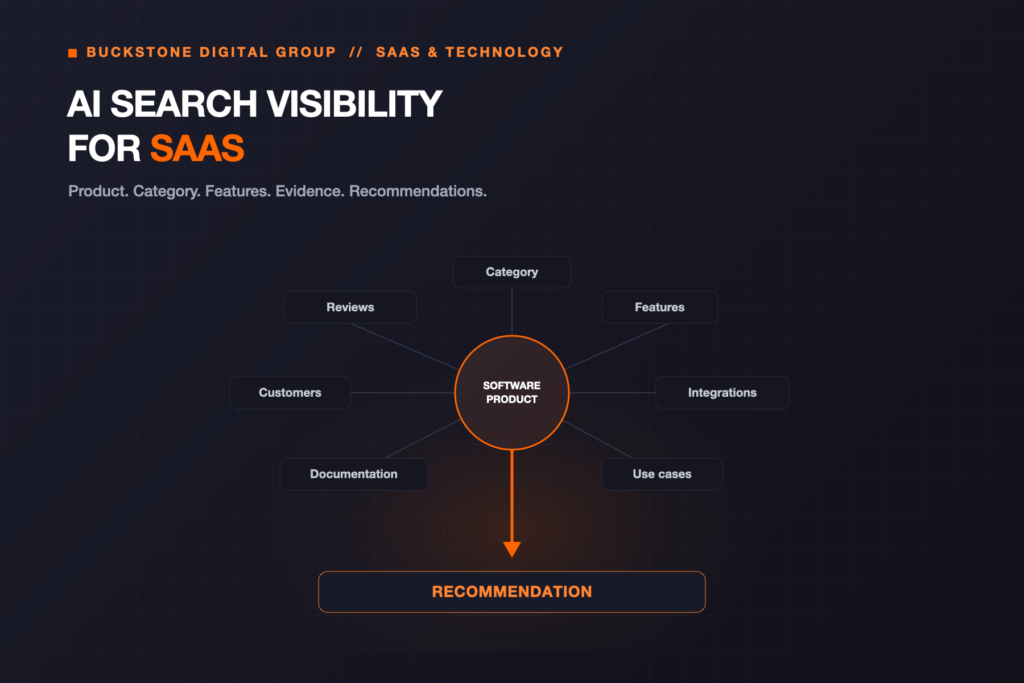
A marketing director at a 50-person firm needs new software. They search “best CRM for a professional-services company,” then “HubSpot alternatives with better reporting,” then “Product A vs Product B.” They ask ChatGPT which platform fits their needs, read a handful of G2 reviews, open two comparison pages, check whether it integrates with the tools they already run, scan pricing, read a case study, skim the docs — and only then book a demo. For a software company, SaaS discovery rarely happens through one keyword, one page, or one platform anymore. Before a product earns the demo, it increasingly has to earn inclusion in the consideration set.
That is a harder problem for software than for almost any other category, because the product is intangible. A shopper can hold a physical product; a search engine cannot run your software. Both depend entirely on the information ecosystem around it — your site, your docs, review platforms, marketplaces, comparison content, and what customers and partners say.
SaaS companies become more visible in AI search when their product category, capabilities, use cases, audiences, integrations, proof, and competitive position are easy to understand and consistently reinforced across the web. AI Search Visibility for SaaS is not simply about getting ChatGPT to mention the brand — it is about making the software understandable enough to be retrieved when a buyer describes the problem it solves.
- SaaS SEO remains foundational; AEO expands visibility beyond traditional rankings.
- Software needs especially strong entity and category clarity — what it does, who it serves, where it fits.
- Feature, use-case, integration, category, and comparison pages serve different search intents and shouldn’t be collapsed into one.
- Documentation can be a real discovery and trust asset for technical buyers.
- Customer evidence matters; review platforms and directories provide external corroboration.
- Comparison and “alternatives” searches are high-value mid/bottom-funnel opportunities.
- Generic thought-leadership is commoditized; product and customer expertise should be explicit.
- Technical SEO matters heavily on JavaScript-heavy SaaS sites.
- Branded visibility proves people already know you; non-branded visibility wins new buyers.
- Measure AI visibility through prompts, mentions, citations, competitive share of voice, and downstream trials, demos, pipeline, and revenue.
- SEO, AEO, paid media, product marketing, CRO, and analytics should operate together.
What is SaaS SEO?
SaaS SEO is the process of improving organic visibility for a software company’s product, category, features, use cases, integrations, comparisons, documentation, expertise, and commercial pages across search engines. It’s far more than blogging — it’s making every part of the buying journey retrievable.
That means product and category pages, feature pages, use-case pages, industry pages, integration pages, comparison and alternatives pages, documentation, educational content, technical SEO, entity structure, internal linking, conversion, and measurement. It works best when the site architecture mirrors the questions buyers ask during product discovery and evaluation — not the publishing calendar. For the done-for-you version, that’s our SEO for technology companies work.
How AI search changes SaaS discovery
Conversational search compresses category research, feature evaluation, company fit, and comparison into a single request — which changes what “ranking” even means for software.
| Traditional query | AI-style question |
|---|---|
| CRM software | What CRM is best for a 40-person professional-services firm that needs HubSpot integration and simple reporting? |
| project management software | Which project management platform is easiest for a remote creative agency with 20 employees? |
| cybersecurity platform | Which cybersecurity vendors specialize in mid-market healthcare companies? |
To answer those, a system has to know your category, your audience, your integrations, and how you compare — the exact things most SaaS sites communicate poorly.
Why SaaS is especially difficult for AI systems to understand
Unlike a physical product, software can’t be visually inspected. A SaaS product is pieced together from the homepage, product and feature pages, docs, pricing, integrations, app marketplaces, G2 and Capterra, partner pages, case studies, reviews, press, and comparison content — and those sources often disagree. Vague positioning, category ambiguity, feature jargon, rebrands, product-suite complexity, acquisitions, multiple product names, and different audience segments all add noise.
When a software company says it “empowers teams to work smarter,” it may sound polished to humans while communicating almost nothing about what the product actually does, who it’s for, or which category it belongs to.
The SaaS AI Search Visibility framework
Answer Engine Optimization for SaaS improves how a software company, its product, capabilities, audiences, and evidence are understood, retrieved, cited, compared, and recommended across AI-driven answer experiences. It sits on top of AI Search Visibility — the discipline of making a business understandable, credible, retrievable, and recommendable across traditional search engines and AI-driven answer platforms. SaaS companies shouldn’t choose between SEO and AEO; AEO expands the visibility model built on strong SEO, technical accessibility, product clarity, and evidence.
- 1Access
Can search and AI systems retrieve the product information?
- 2Understanding
Can they determine what the software is, who it serves, and what it does?
- 3Evidence
Does the site support product claims with customers, docs, examples, research, and proof?
- 4Corroboration
Do reviews, customers, partners, marketplaces, and industry sources reinforce the product story?
- 5Measurement
Are rankings, product discovery, AI recommendations, demos, trials, pipeline, and revenue improving?
1. Access
A JavaScript-heavy technology website can look perfect in a browser while still making important information unnecessarily difficult to retrieve. Evaluate crawlability, indexability, rendering and client-side content, robots directives, sitemaps, canonicals, international architecture, documentation and app subdomains, help centers, AI/search crawler access, login walls, and free tools. Start with is your website blocking AI crawlers? and technical SEO for AI search.
2. Understanding
Search systems should be able to answer three questions quickly: What is this software? Who is it for? What problem does it solve? That maps to clear entities — Organization, SoftwareApplication where appropriate, Person, WebPage, Article, BreadcrumbList — with stable IDs, consistent terminology, and internal linking that connects product, features, use cases, and industries. More in how AI systems understand your business and entity SEO.
3. Evidence
Customer case studies and logos where legitimate, quantified outcomes where verified, product demonstrations, documentation, feature and integration detail, security docs and certifications, original research, reviews, and implementation examples are what turn a claim into something a buyer — and an AI system — can verify.
4. Corroboration
Your website describes the product; customers, integration partners, marketplaces, reviewers, developer communities, and industry sources reinforce how the wider market understands it — the mechanism covered in how third-party sources influence AI recommendations.
5. Measurement
SaaS SEO reporting should connect visibility to product demand and pipeline, not stop at traffic — non-branded and commercial rankings, feature/integration/comparison-page visibility, organic signups, demos, trials, AI mentions and recommendations, competitive share of voice, and pipeline. See how to measure AI Search Visibility.
Category positioning: can search systems tell what kind of software this is?
Category clarity is the foundation of SaaS discovery — if systems can’t tell whether you’re a CRM, an ERP, a project-management tool, an HRIS, a cybersecurity platform, or marketing automation, they can’t match you to the buyer describing that need. Many brands try to create a new category, which can be strategically valuable — but it’s a search risk if buyers still use established terminology.
A company can introduce a new category without becoming invisible for the language buyers already use. Balance your brand terminology, the market’s terminology, and the terminology buyers actually search.
Product, feature, use-case, and industry pages
These four page types answer different questions, and collapsing them costs visibility. A product page explains the software as a whole; a feature page explains a specific capability (automated reporting, a workflow builder, SSO) in terms of the problem it solves, not the product navigation; a use-case page explains an outcome (“weekly client reporting for digital agencies”) because buyers frequently search for the outcome before they know which feature enables it; and an industry page speaks to a vertical’s workflows, terminology, integrations, and compliance.
| Page type | Answers the question |
|---|---|
| Product | What is this software? |
| Feature | What can this specific capability do for me? |
| Use case | What outcome can I accomplish with it? |
| Industry | Does it fit how my sector actually works? |
The failure mode is vertical pages built by copy-and-swap: replacing “manufacturers” with “law firms” in the same template does not create vertical expertise. Each page should carry specific workflows, challenges, terminology, integrations, and real customer evidence.
Do integration pages help SaaS SEO?
Yes — integration pages are one of SaaS SEO’s most valuable assets, because they answer a decisive buying question: will this fit into the stack we already run? Queries like “[product] + Salesforce,” “+ HubSpot,” “+ Slack,” or “+ QuickBooks” carry high intent.
A strong integration page explains what the integration does, the data exchanged, the use cases it enables, setup and limitations, screenshots, links to documentation, related workflows, and real customer examples. And each listing in an integration marketplace doubles as third-party corroboration of a real product relationship.
Documentation and developer content
Documentation is not only a support asset — for technical buyers it can be part of product discovery and validation. Help centers, developer and API docs, SDK guides, implementation tutorials, and changelogs all shape how the product is understood. The common problems are structural: docs on isolated subdomains, blanket noindex rules, JavaScript rendering issues, weak internal links back to the marketing site, and outdated content. The goal is accessibility and connection — not indexing every internal support artifact indiscriminately.
Should SaaS companies create comparison and “alternatives” pages?
Yes — “X vs Y” and “alternatives to X” are high-value mid/bottom-funnel queries from buyers who already understand the category and are actively evaluating options. The right approach is honest, current comparison content that acknowledges genuine competitor strengths, compares relevant dimensions, and identifies who each product fits.
The goal of comparison content is to help the right buyer choose — not to pretend every buyer should choose you. One-sided attack pages, invented competitor weaknesses, and fake reviews undermine both trust and AI recommendability. Honest comparison is what makes a product safely recommendable.
A strong SaaS website is not a collection of pages. It is a connected representation of the product and the market it serves — the company contains the product; the product connects to features, use cases, industries, integrations, customers, and experts; and internal linking makes those relationships explicit.
G2, Capterra, reviews, and customer case studies
Third-party review platforms and directories help form the public information environment around a software product — category context, feature language, competitor relationships, and customer sentiment — regardless of whether any individual AI system uses a specific source for a specific answer. Keep profiles accurate, categories correct, screenshots current, and reviews honestly earned; never manipulate ratings.
Customer case studies are your strongest first-party evidence: they connect product claims to a real implementation — customer type, problem, product usage, relevant features, and result — and should link naturally to product, use-case, industry, and feature pages. For example, our work with Pair Networks grew non-branded visibility 48% through title-tag optimization and organic traffic 50% — concrete, measured outcomes rather than adjectives.
Product-led and programmatic SEO
Product-led SEO turns genuine product value into search experiences — templates, tools, calculators, directories, integration catalogs, public datasets, and community resources. It works when the product or underlying data creates a genuinely useful page; automation alone is not a strategy. That distinction matters most in programmatic SEO: a large, legitimate dataset (an integration catalog, a real directory) can justify many pages, but the ability to generate 50,000 URLs does not mean search engines need 50,000 URLs. Thin, duplicative, no-demand pages create index bloat and crawl waste, a pattern covered in why generic content fails in AI search.
Technical SEO for SaaS websites
Technology companies often have sophisticated products sitting behind unnecessarily complicated search architecture. The usual suspects: JavaScript frameworks and client-side rendering that hide content, headless CMS pitfalls, documentation on a separate subdomain, app-vs-marketing-site confusion, localization and canonical issues, duplicate feature pages, login pages, faceted resource libraries, migration and redirect-chain risks, and orphaned experimental landing pages. Retrieval reliability is the foundation everything else sits on — the domain of website development and technical SEO.
Branded vs. non-branded visibility
Branded visibility proves people already know the company; non-branded visibility determines whether new buyers can discover it — and most SaaS companies are strong on the former and weak on the latter. Many rank well for their brand name, login, support, and product names, yet are nearly invisible for the category, use-case, problem, integration, alternatives, and comparison searches where new buyers actually start.
This is exactly the gap our Pair Networks work targeted: non-branded visibility grew 48% by aligning pages with the language buyers use rather than the brand’s internal terminology. A software company can own its brand name and still be almost invisible to buyers who don’t yet know the brand exists.
Why competing SaaS products appear instead of yours
When a competitor keeps surfacing in results and recommendations and you don’t, it’s rarely a verdict on the software. It’s usually a verdict on which product is easier for systems and buyers to understand and place.
- Their category is clearer and uses buyer language
- Their feature and use-case pages address specific problems
- Their integrations are easy to discover
- Their entity relationships are clearer
- Their site is technically easier to retrieve
- Their branded/non-branded balance is stronger
- Their comparison content captures evaluation demand
- Their customer evidence and documentation are stronger
- Their review footprint is more complete
- Their partner ecosystem reinforces them
- Their topical authority is deeper
- They monitor AI recommendation visibility
The competing product may not be better software. It may simply be easier for search systems and buyers to understand where it fits.
How ChatGPT and Google AI may recommend SaaS products
AI assistants increasingly suggest and compare software when buyers describe a need — “best CRM for manufacturers,” “software like HubSpot but cheaper,” “recommended cybersecurity software for small businesses” — but being mentioned isn’t enough if the system misunderstands what the software actually does. There is no universal ranking formula to game; monitor whether your product appears, whether its category, features, and audience are described accurately, which competitors show up, and which sources are cited.
On the Google side, the same fundamentals that support Search support AI Overviews and AI Mode: crawlable, well-structured product/use-case content and accurate information — not an AI-only markup hack. Optimize the information architecture, not imaginary AI ranking tricks. The same is true for Perplexity and ChatGPT recommendations.
Does structured data help SaaS companies?
Clean structured data helps clarify what your information means — but it doesn’t substitute for weak product positioning. Relevant types include Organization, SoftwareApplication where appropriate, Product and Offer where valid, Person, Article, BreadcrumbList, FAQPage, and Review/AggregateRating only where legitimately supported.
One useful nuance: unlike some retired rich-result types, SoftwareApplication remains a supported rich-result type — so accurate app markup can make a product page eligible for enhanced display. But eligibility is not a recommendation switch, and markup must match visible content and avoid duplicate entities. There is no “AI schema.” More in can structured data help AI Search Visibility?
What should a SaaS SEO + AEO audit include?
A serious audit works the whole system — product, site, and ecosystem:
- Crawlability, indexability, rendering, JS, canonicals, sitemaps, docs/subdomains, international, crawler access
- Category, product, features, use cases, industries, integrations, comparisons, alternatives, resources, docs
- Category clarity, audience, problem, capabilities, differentiation, buyer terminology
- Company, products, leadership, experts, customers, integrations, partners as clear entities
- Case studies, reviews, logos, demos, research, docs, certifications, integrations
- G2, Capterra, marketplaces, partners, customer sites, publications, communities; structured-data validity + duplicate audit
- AI prompt families, product mentions, citations, recommendations, competitors, accuracy, source analysis
- Demos, trials, signups, MQLs, SQLs, opportunities, pipeline, revenue
How SaaS companies should measure AI Search Visibility
AI rank tracking for SaaS is really product-positioning measurement at scale — track prompt families, then watch presence, category and audience association, feature accuracy, competitor share of voice, cited sources, and downstream trials, demos, and pipeline.
- 1Category
“Best CRM for [audience]” · “best software for [category]”
- 2Problem
“Software that helps with [problem]”
- 3Use case
“Best platform for [specific workflow]”
- 4Integration
“Software that integrates with X and Y”
- 5Comparison
“Product A vs Product B” · “alternatives to Product X”
- 6Brand validation
“Is Product X good?” · “what is Product X best for?”
The mechanics — and why AI visibility can’t collapse to one number — are in AI rank tracking vs. Google rank tracking.
What should a SaaS SEO agency actually do?
A SaaS SEO/AEO agency should understand the product well enough to explain where organic demand intersects with the buying journey — and sending a traffic report is not the same as building qualified product demand. That means evaluating technical architecture, product positioning, search demand, category visibility, feature and use-case architecture, integrations, comparison opportunities, content quality, entity structure, structured data, customer evidence, third-party corroboration, AI visibility, paid-search intelligence, conversion, and pipeline.
- What category does search currently associate us with, and which non-branded queries should discover us?
- Are our feature pages aligned with search intent, and distinct from use-case pages?
- Which integration, comparison, and alternatives pages should exist?
- Is our documentation helping or fragmenting visibility?
- Can Google retrieve all important JavaScript-rendered content?
- Which competitors appear in ChatGPT recommendations, and which sources reinforce them?
- How will AI recommendation visibility be measured?
- How will organic visibility connect to trials, demos, and pipeline?
- Can you implement technical and website changes directly?
- How do you prevent generic AI-generated content from diluting authority — and what happens after the audit?
If the SaaS SEO strategy begins and ends with “publish more blogs,” it is probably missing most of the buying journey. (For the full-scope version, see our SEO for technology companies services.)
Is SEO worth it for SaaS — and how long does it take?
Is SEO worth it for SaaS?
It can be, when meaningful non-branded search demand exists, buyers research before purchasing, the category has search demand, integrations create discoverability, comparison searches exist, and customer-acquisition value supports the investment. Success depends on market, category maturity, competition, ACV, sales cycle, PLG-vs-sales-led motion, existing authority, and differentiation — so evaluate SaaS SEO against qualified demand and pipeline, not traffic alone.
How long does SaaS SEO take?
There’s no universal timeline. Technical and on-page improvements can show up quickly; competitive non-branded visibility develops over time, depending on domain history, technical health, existing authority, category competition, product maturity, content gaps, and corroboration footprint. Be skeptical of fixed-date guarantees.
SEO or paid search for SaaS?
Rarely either/or, and the right answer depends on your revenue model. Paid search and paid social rent immediate attention and geographic/audience control; SEO and AEO build a discovery asset that compounds — category discovery, education, integrations, comparisons, and AI visibility. Measure both against your actual conversion (trial, freemium activation, demo, or sales-qualified opportunity), not form fills alone, since PLG and sales-led motions convert differently. Paid search and organic should share intelligence, not run in silos.
How BuckStone approaches SaaS SEO and AI Search Visibility
BuckStone does not treat SaaS SEO as a blog-production program. We look at the entire information system surrounding the software — what the product is, who it serves, how buyers search for it, which external sources reinforce it, and what happens after the visitor arrives — connecting technical SEO, AEO, entity SEO, product architecture, content strategy, structured data, website development, Google Ads, analytics, CRO, and AI visibility measurement.
The objective is not simply more organic traffic. It is greater visibility at the moments when buyers are discovering, comparing, validating, and selecting software — connected all the way through to trials, demos, and pipeline.
The final answer: how should SaaS companies prepare for AI-driven search?
Fix technical retrieval; clarify the product category; strengthen product pages; build meaningful feature and specific use-case pages; develop useful industry and integration pages; capture comparison and alternatives demand; make documentation accessible; represent entities clearly; add valid structured data; publish real customer evidence; strengthen third-party corroboration; monitor ChatGPT and AI recommendations; and measure trials, demos, pipeline, and revenue.
The goal is not to make AI recommend the software to everyone. It is to make the product easy to understand and credible enough to enter the consideration set when it genuinely fits the buyer’s problem.
The technology companies most prepared for AI-driven discovery will be the ones that make complex software easiest to understand, compare, verify, and act on.
Frequently asked questions
What is SaaS SEO?
SaaS SEO is improving organic visibility for a software company’s product, category, features, use cases, integrations, comparisons, documentation, expertise, and commercial pages across search engines — so the whole buying journey is retrievable, not just the blog.
What is AI Search Visibility for SaaS companies?
It’s making a software company and its product understandable, credible, retrievable, and recommendable across traditional search and AI answer platforms — so the product is retrieved when a buyer describes the problem it solves, not just when they search the brand.
What is AEO for SaaS?
Answer Engine Optimization for SaaS improves how a software company, its product, capabilities, audiences, and evidence are understood, retrieved, cited, compared, and recommended across AI-driven answer experiences like ChatGPT, Google AI Overviews and AI Mode, and Perplexity.
How is SaaS SEO different from traditional SEO?
SaaS SEO has to represent an intangible product through category, feature, use-case, integration, comparison, and documentation pages — and connect visibility to trials, demos, and pipeline rather than traffic. Product clarity and entity structure matter more than volume of posts.
How can SaaS companies appear in ChatGPT?
By making the product easy to understand and verify: clear category and positioning, strong feature/use-case/integration pages, honest comparison content, accurate reviews and directory profiles, and consistent information across the web. No method guarantees a specific recommendation.
Can ChatGPT recommend software products?
AI assistants frequently suggest and compare software when buyers describe a need. Coverage varies by prompt and changes over time, so monitoring accuracy — whether the category, features, and audience are described correctly — matters as much as presence.
How can SaaS companies appear in Google AI Overviews?
The same fundamentals that support Search support AI Overviews: crawlable, well-structured product, use-case, and comparison content, accurate information, and clear entities. There’s no special AI-only markup that guarantees inclusion.
How can SaaS companies appear in Google AI Mode?
AI Mode draws on Google’s index, so the priority is retrievable, well-organized content that answers category, feature, integration, and comparison questions — plus strong technical SEO on JavaScript-heavy sites. Optimize the information architecture, not imaginary AI hacks.
How can software companies improve Perplexity visibility?
Be clearly understandable and well-corroborated: accurate product pages, strong comparison and integration content, and consistent third-party sources Perplexity can cite. Presence and citation accuracy both matter.
Do feature pages help SaaS SEO?
Yes, when they explain customer value — the problem, how the capability works, who needs it, related use cases and integrations, and evidence — rather than simply repeating the product navigation.
Do use-case pages help SaaS SEO?
Yes. Buyers often search for the outcome before they know which feature enables it, so use-case pages (“weekly client reporting for agencies”) capture demand that feature pages miss.
Do integration pages help SaaS SEO?
Strongly. Integration queries (“[product] + Salesforce”) carry high intent because they answer whether the software fits the buyer’s existing stack, and marketplace listings double as third-party corroboration.
Should SaaS companies create industry pages?
Yes, when they carry real vertical substance — specific workflows, terminology, integrations, compliance, and customer evidence. Copy-and-swap vertical pages that only change the industry name don’t create expertise or rankings.
Should SaaS companies create comparison pages?
Yes — “X vs Y” queries are high-value evaluation-stage searches. Make them honest and current, acknowledge genuine competitor strengths, and identify who each product fits, which also supports AI recommendability.
Should SaaS companies create alternatives pages?
They can be valuable, since “alternatives to X” signals an active evaluation. Avoid thin pages, fake reviews, misleading comparisons, and one-sided attack content — help the right buyer choose.
Does documentation help SaaS SEO?
For technical buyers, documentation is part of discovery and validation. Keep it retrievable and linked to the marketing site, avoid blanket noindex and rendering issues, and don’t index every internal support artifact indiscriminately.
Does structured data help SaaS companies?
It clarifies what your information means but doesn’t fix weak positioning. SoftwareApplication, Organization, Product, and Article markup (matching visible content) help systems parse the product; it isn’t a recommendation switch.
What schema is useful for software companies?
Organization, SoftwareApplication where appropriate, Product/Offer where valid, Person, Article, BreadcrumbList, and FAQPage — plus Review/AggregateRating only where legitimately supported. SoftwareApplication remains a supported rich-result type. There is no “AI schema.”
Do G2 and Capterra reviews affect AI visibility?
They help form the public information environment around a product — category context, feature language, and sentiment — regardless of whether a given AI system uses a specific source for a specific answer. Keep profiles accurate and earn reviews honestly.
Do case studies help SaaS SEO?
Yes. Case studies connect product claims to real implementations and provide first-party evidence, and they should link to the product, feature, use-case, and industry pages they support.
What is product-led SEO?
Turning genuine product value — tools, templates, calculators, directories, integration catalogs, public data — into useful search experiences. It works when the product or data creates real value; automation alone is not a strategy.
Is programmatic SEO good for SaaS companies?
It can be, when a large, legitimate dataset backs the pages (a real integration catalog or directory). It fails when it mass-produces thin, duplicative, no-demand pages — generating 50,000 URLs doesn’t mean search engines need them.
How should SaaS companies measure AI Search Visibility?
Track prompt families (category, problem, use case, integration, comparison, brand validation) and watch product presence, category and audience association, feature accuracy, competitor share of voice, cited sources, and AI referral traffic — connected to trials, demos, and pipeline.
What should a SaaS AEO audit include?
Technical access, search/product architecture, entity clarity, product positioning, evidence, third-party corroboration, structured data, AI visibility, and conversion — with measurement tied to demos, trials, pipeline, and revenue.
What should a SaaS SEO agency actually do?
Understand the product, then connect technical SEO, positioning, category and feature architecture, integrations, comparison content, entity structure, structured data, evidence, corroboration, AI visibility, paid-search intelligence, and conversion — and report on qualified demand and pipeline, not just traffic.
Is SEO worth it for SaaS?
It can be very valuable when non-branded search demand exists, buyers research before buying, and acquisition value supports the investment. Success depends on market, category maturity, competition, ACV, and differentiation — judge it by qualified demand and pipeline.
How long does SaaS SEO take?
No universal timeline. On-page and technical wins can appear quickly; competitive non-branded visibility builds over time, depending on domain history, authority, category competition, product maturity, and content gaps. Be wary of fixed-date promises.
Should SaaS companies invest in SEO or Google Ads?
Usually both. Paid search captures immediate intent and provides fast data; SEO and AEO build compounding discovery across category, comparison, integration, and AI surfaces. Measure both against your real conversion model, not form fills alone.
Can an AEO agency guarantee ChatGPT recommendations?
No. No agency can guarantee that an AI assistant recommends a specific product for a specific prompt. The work is to improve clarity, evidence, and corroboration and to measure the results honestly.
What SaaS and technology marketing services does BuckStone provide?
BuckStone connects technical SEO, AEO and AI Search Visibility, entity SEO, product and content architecture, structured data, website development, Google Ads, analytics, CRO, and AI visibility measurement — organized around qualified software demand and pipeline.
Explore the rest of the series — manufacturers, home builders, law firms, restaurants, ecommerce brands, and contractors — all built on what AI Search Visibility is.
Sources & methodology
This article separates documented platform behavior (how Google Search, AI Overviews and AI Mode, ChatGPT/OpenAI search, and Perplexity are publicly described to work — capabilities that change over time and should be re-verified), established SEO and structured-data principles, BuckStone methodology (our five-part framework and audit approach), and professional judgment. Platform details referenced here — including Google’s SoftwareApplication structured-data support, Google Search Central guidance, and Schema.org types — reflect public documentation at the time of writing and may change; verify current 2026 documentation before implementation. The Pair Networks results referenced are from published BuckStone case studies. No software products, features, integrations, customers, reviews, ratings, statistics, or results were invented; nothing here guarantees a specific ranking or AI recommendation, and no review manipulation is endorsed. Additional references: OpenAI and Perplexity crawler/search guidance and Google Analytics documentation.