
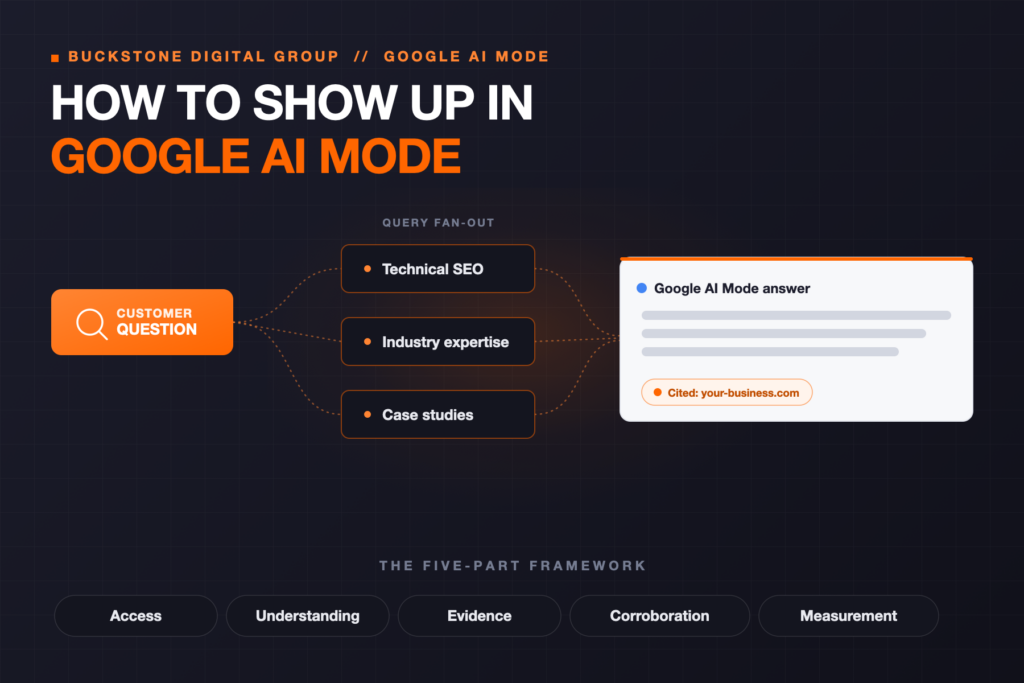
Google Search is changing from a place where people enter short keywords into a system where they can ask detailed questions, compare options, explore unfamiliar subjects, and continue a conversation.
A prospective customer might once have searched:
- manufacturing SEO company
- best commercial collection agency
- custom home builders near Chicago
- biodegradable industrial lubricant
- restaurant marketing agency
In Google AI Mode, that same person can ask:
- Which SEO agencies have experience working with industrial manufacturers?
- Compare commercial collection agencies that specialize in construction debt.
- Which custom home builders near Chicago are best suited for a modern luxury project?
- What should I evaluate when choosing a biodegradable industrial lubricant supplier?
- Recommend a digital marketing agency that understands both restaurant SEO and paid advertising.
Google may respond with a generated answer that organizes information, explains relevant considerations, links to supporting sources, and allows the user to ask follow-up questions.
That creates a new challenge for businesses.
It is no longer enough to rank for one short keyword.
Your website must provide enough useful, accessible, and credible information for Google to identify it as relevant across the broader set of questions surrounding the customer’s need.
So how does a business show up in Google AI Mode?
There is no separate AI Mode submission form, secret schema type, or guaranteed optimization switch.
Google’s official guidance is clear: visibility in AI Mode remains rooted in the same crawling, indexing, ranking, and quality systems The same is true of its sibling feature — see how to appear in Google AI Overviews. that power Google Search.
However, AI Mode changes how complex searches are explored and how information may be selected, combined, and presented.
Businesses therefore need to strengthen both their traditional SEO foundation and the larger information environment surrounding their brand. This guide is the Google-specific companion to our broader pillar on what AI Search Visibility means.
What is Google AI Mode?
Google AI Mode is a conversational search experience within Google Search.
It allows users to ask longer, more complicated questions and receive a generated response supported by information and links from the web.
Users can also ask follow-up questions without starting the research process over.
Instead of forcing someone to break a complicated need into several separate keyword searches, AI Mode can help organize the research process within one continuing interaction.
For businesses, that means Google may evaluate relevance across a much broader question than a traditional keyword alone suggests.
A user may not ask:
Traditional keywordindustrial SEO agency
They may ask:
“We are a mid-sized industrial manufacturer with declining non-branded traffic and a technically outdated website. Which type of agency should we hire, and what should we evaluate before choosing one?”
Google now has to address several parts of the question:
- The company is a manufacturer.
- It needs non-branded organic growth.
- The website may have technical problems.
- The user needs an agency.
- The user wants selection criteria.
- The user may want provider recommendations.
- The answer should connect technical SEO, content, industry experience, and business fit.
A company that has built meaningful coverage across those subjects may have more ways to become relevant than a company with one generic SEO services page.
How does Google AI Mode find information?
Google says its generative AI search experiences are grounded in information retrieved from its existing Search index.
That means the same basic Search process still matters:
- Google must be able to crawl the page.
- Google must process and index the page.
- The page must be eligible to appear in Search with a snippet.
- Google’s systems must consider the information relevant and useful.
- The page may then be selected as a supporting source within a generative response.
Meeting the technical requirements does not guarantee that a page will be crawled, indexed, ranked, cited, or shown.
It establishes eligibility.
Google uses retrieval to ground generated answers
Google describes its generative search systems as using retrieval-augmented generation.
In practical terms, Google retrieves relevant, current pages from its Search index and uses information from those pages to help produce a more accurate and useful generated response.
The response can then include links to supporting web pages.
This means your website does not need to be rewritten into a special format for an AI model.
It needs to be:
- Accessible
- Indexed
- Relevant
- Useful
- Clear
- Credible
- Competitive within Google Search
AI Mode may use query fan-out
One of the most important concepts for understanding AI Mode is query fan-out.
Google may take one complicated question and generate several related searches to explore different components of the subject.
Query fan-out
One question becomes many related searches
The user asks
Which environmentally responsible hydraulic fluid is appropriate for marine equipment operating in sensitive waterways?
Behind the answer, Google may explore related subtopics
The user sees one question.
Behind the response, Google may be evaluating information across several related searches and data sources.
This does not mean a company should create one page for every imaginable fan-out query.
Google explicitly advises businesses to focus on useful, satisfying content rather than manufacturing pages around every possible query variation.
The better strategy is to build complete, logical coverage of the subjects customers genuinely need to understand.
Is there a way to submit your business to Google AI Mode?
There is no separate organic submission form for AI Mode.
Google discovers most public web pages through its normal crawling systems. Confirm nothing is stopping that crawl in is your website blocking AI crawlers.
Businesses should use established Google tools and practices, including:
- Google Search Console
- XML sitemaps
- Crawlable internal links
- Correct indexation directives
- Google Business Profile
- Merchant Center where applicable
- Product feeds where applicable
- Accurate structured data
- Accessible public content
Submitting a sitemap or requesting indexing can help Google discover or revisit a page.
It does not guarantee AI Mode inclusion.
Likewise, creating a Google Business Profile does not guarantee that a local business will be recommended in a generated answer.
These systems make accurate information available to Google. Google still determines when and how that information is shown.
Does a business need special schema for Google AI Mode?
No.
Google states that there is no special schema.org type required for AI Mode or AI Overviews. If you surface in AI Mode but not the Overview, here is why your business isn’t showing up in Google AI Overviews.
Businesses should continue using structured data where it accurately represents visible content and supports existing Search features. See can structured data help your business appear in AI search for the full picture.
Depending on the site, that might include:
- Organization
- LocalBusiness
- Person
- Product
- Offer
- Service
- Article
- BreadcrumbList
- FAQPage where appropriate and supported
- Review markup where eligible
- Event
- JobPosting
- VideoObject
Structured data can help clarify:
- The organization behind the website
- Official company details
- Products and offers
- Authors and leadership
- Locations
- Page types
- Relationships between entities
- Breadcrumb structure
It cannot force Google to cite or recommend the business.
Schema should clarify reality—not attempt to manufacture relevance, reputation, or authority.
Do you need an llms.txt file for Google AI Mode?
No.
Google explicitly says it does not use llms.txt files as a special visibility or ranking mechanism for Google Search, including its generative AI features.
Creating one will neither improve nor reduce a site’s Google Search rankings merely because the file exists.
Other services may choose to use llms.txt, so a company may still maintain one for a separate purpose.
But it should not be sold as a Google AI Mode optimization requirement.
A technically weak website with generic content will not become competitive because someone added an AI text file.
Nine ways to improve your visibility in Google AI Mode
There is no shortcut, but there is a durable, Google-supported approach. These nine priorities strengthen both traditional Search performance and the broader information environment AI Mode draws on.
1. Make sure important pages are indexed and eligible for Search
Google AI Mode relies on content from Google’s Search index.
Start by confirming that the pages you want Google to use are:
- Publicly accessible
- Crawlable by Googlebot
- Not blocked by robots.txt
- Not marked
noindex - Returning a successful HTTP status
- Using correct canonical tags
- Internally linked
- Included in a logical site architecture
- Rendering important content properly
- Eligible to display a Search snippet
Use Google Search Console to inspect important URLs and identify:
- Indexing problems
- Crawling errors
- Canonical conflicts
- Duplicate pages
- Redirect issues
- Server failures
- Rendering problems
- Sitemap inconsistencies
A page cannot become a useful AI Mode source if Google cannot reliably access or index it.
Important distinction
Eligibility is not the same as selection or visibility
Three different things have to be true, in order, before your page appears in a generated answer:
- Indexed & eligible — Google can crawl the page and it is allowed to appear in Search.
- Considered relevant — Google’s systems judge it useful and competitive for the question being answered.
- Selected & shown — it is chosen as a supporting source within the generated response.
An indexed page is eligible to compete. It is not guaranteed to appear. Most “we’re indexed but invisible” problems live in the second and third stages—relevance, usefulness, and competitiveness—not the first.
Do not confuse indexing with selection
An indexed page is eligible to compete.
It is not guaranteed to appear.
The page must still be relevant, useful, credible, and competitive for the question Google is trying to answer.
2. Build complete coverage around real customer decisions
AI Mode allows people to ask broader and more detailed questions.
A generic service page may not provide enough information to address the full decision.
Suppose a company wants to appear when people search for an SEO agency for manufacturers.
Its website should do more than repeat:
Not enoughWe provide manufacturing SEO services.
Useful coverage might explain:
- Common organic search challenges manufacturers face
- Technical problems found on industrial websites
- Distributor versus end-customer search intent
- Product and application-page architecture
- Technical documentation
- Local and national market considerations
- How long sales cycles affect conversion tracking
- The relationship between SEO and paid search
- Case studies
- Measurement methods
- Relevant industry experience
- How to evaluate an agency
This does not require placing everything on one enormous page.
It requires a connected content system where each page has a clear purpose and supports the broader subject.
Think in topics and decisions, not just keyword variations
Do not create 20 near-duplicate pages targeting minor wording changes.
Instead, identify:
- What the customer is trying to accomplish
- Which questions arise during the buying process
- What evidence they need
- What risks they are evaluating
- Which comparisons they make
- What technical details matter
- Which pages best answer each need
This creates coverage that can support traditional searches and more complex AI Mode questions.
3. Publish non-commodity information
Google’s current guidance emphasizes creating unique, useful, non-commodity content.
AI Mode does not need another shallow summary of information already repeated across thousands of websites.
Stronger content may provide:
- Original research
- First-party data
- Detailed case studies
- Expert analysis
- Technical documentation
- Real examples
- Tested methodologies
- Cost guidance
- Industry benchmarks
- Product comparisons
- Decision frameworks
- Original imagery
- Demonstration videos
- Calculators
- Troubleshooting instructions
- Clear, supportable opinions
Demonstrate experience instead of declaring expertise
Avoid relying on claims such as:
- We are industry leaders.
- We provide world-class solutions.
- Our experts deliver unmatched results.
- We are the best choice.
Show:
- How you diagnose the problem
- What you evaluate
- What you have observed
- What the process includes
- Which tradeoffs matter
- What changed after implementation
- What clients should expect
- Where common advice fails
Specificity creates stronger evidence than promotional language.
4. Make your business and expertise easy to understand
Google must be able to identify what your company is and how it relates to the user’s question.
Clearly communicate:
- Official business name
- Business category
- Services
- Products
- Industries served
- Locations and service areas
- Leadership
- Authors
- Areas of expertise
- Differentiators
- Customer types
- Relevant credentials
- Official profiles
Support that information with:
- A clear homepage
- Complete service pages
- A substantial About page
- Leadership profiles
- Author archives
- Location pages where warranted
- Contact information
- Organization schema
- Person schema
- LocalBusiness schema where appropriate
- Consistent external profiles
- Contextual internal links
Vague brand language creates unnecessary ambiguity. See how AI systems understand your business.for the entity signals that reduce it.
A homepage that says “Transforming tomorrow through innovative solutions” may sound polished, but it does not clearly establish what the company sells or why it is relevant.
5. Strengthen third-party reputation and corroboration
Google can evaluate information beyond a company’s own website.
Relevant third-party sources may include:
- Customer reviews
- Industry publications
- Professional associations
- Local media
- Partner websites
- Client websites
- Expert interviews
- Conferences
- Trade organizations
- Product databases
- Relevant directories
- Forums and communities
- Video platforms
- Independent comparisons
These sources can reinforce:
- What the company does
- Where it operates
- Which industries it serves
- What customers think
- Which products it offers
- Who leads it
- Why it may be credible
Do not manufacture mentions
Google specifically warns against seeking inauthentic mentions as an AI visibility tactic.
Purchasing irrelevant placements, generating fake discussions, or distributing the same promotional description across hundreds of weak websites is not a substitute for authority.
Focus on sources that are:
- Relevant
- Accurate
- Maintained
- Independent
- Useful to customers
- Connected to the company’s actual work
6. Improve internal linking and site architecture
A strong page cannot contribute much if it is isolated from the rest of the site.
Internal links help people and search systems understand:
- Which pages are most important
- How services relate
- Which articles support a service
- How industries connect to capabilities
- Which case studies demonstrate results
- Who wrote the content
- Which pages provide deeper detail
For an AI Search Visibility content cluster, a logical structure might include:
- AI Search Visibility service page
- What Is AI Search Visibility?
- How to Get Your Business Recommended by ChatGPT
- How to Show Up in Google AI Mode
- Why Your Business Is Not Appearing in AI Search
- What Is Entity SEO?
- How to Measure AI Search Visibility
- AI crawler accessibility guide
- Relevant case studies
Each article should link where the connection genuinely helps the reader.
Do not mechanically insert the same exact-match service link into every paragraph.
7. Use Google’s business and product systems where applicable
Google says local business and product information can appear within generative search experiences where appropriate.
Businesses should maintain the Google systems relevant to their model.
Google Business Profile
Local and service-area businesses should maintain accurate:
- Name
- Address
- Phone number
- Categories
- Service areas
- Business hours
- Website
- Services
- Products
- Photos
- Reviews
- Updates
The profile should match the information on the website and other major sources.
Google Merchant Center
Ecommerce and product businesses should maintain accurate product feeds, including:
- Product names
- Descriptions
- Prices
- Availability
- Images
- Brand
- Identifiers
- Shipping
- Returns
- Landing pages
Product structured data
Product markup can help Google understand product details and support eligibility for relevant Search experiences.
These systems do not guarantee AI Mode visibility.
They provide Google with clearer, more current business and product information.
8. Support text with useful images and video
Google’s guidance specifically notes that relevant images and video may create additional ways for content to appear in generative search.
Use visual content when it improves understanding.
Examples include:
- Product photos
- Process diagrams
- Before-and-after examples
- Demonstration videos
- Charts
- Original graphics
- Facility images
- Project galleries
- Screenshots
- Technical illustrations
- Maps
- Comparison tables
Avoid adding generic stock photos merely to decorate a page.
Optimize important visual assets with:
- Descriptive filenames
- Appropriate alt text
- Useful surrounding copy
- Correct dimensions
- Strong image quality
- Mobile performance
- Image sitemaps where warranted
- Video pages and markup where appropriate
The visual asset should support the user’s task—not simply fill space.
9. Measure AI Mode visibility and business impact
Google Search Console now provides dedicated reporting for generative AI performance, including visibility within AI Mode, AI Overviews, and certain generative experiences in Discover.
Use that reporting to evaluate:
- Impressions
- Clicks
- Landing pages
- Topics
- Geographic performance
- Device performance
- Branded versus non-branded discovery where available
- Changes over time
Do not stop at impressions.
Connect Google visibility with:
- Engaged sessions
- Conversion events
- Form submissions
- Calls
- Ecommerce transactions
- Assisted conversions
- Lead quality
- Revenue
- Sales feedback
Establish a baseline before making changes
Record:
- Current AI Mode and AI Overview visibility
- Traditional organic performance
- High-value landing pages
- Conversion rates
- Non-branded discovery
- Competitor visibility
- Technical barriers
- Existing content coverage
Without a baseline, it becomes difficult to determine which changes produced meaningful improvement.
Is your website prepared for Google AI Mode?
See which factors are holding back your Google AI Mode visibility
BuckStone can evaluate the technical, content, entity, authority, local, and measurement factors affecting your visibility across Google’s traditional and AI-driven search experiences.
How query fan-out changes content strategy
Query fan-out does not mean you should attempt to reverse-engineer and publish a page for every hidden search Google might perform.
That approach would likely produce redundant, low-value content.
Instead, query fan-out reinforces the need for complete subject coverage.
For each important customer need, identify:
The main decision
What is the user ultimately trying to decide or accomplish?
Supporting questions
What must the user understand before making that decision?
Required evidence
What facts, examples, documentation, comparisons, or experience support the answer?
Relevant entities
Which companies, people, products, services, locations, standards, and industries are involved?
Appropriate page types
Which information belongs on:
- Service pages
- Product pages
- Industry pages
- Guides
- Case studies
- FAQs
- Comparison pages
- Author pages
- Location pages
Internal relationships
How should those pages link to one another?
A well-designed content architecture allows Google to retrieve the appropriate page or passage for different components of a complicated question.
What does not help you show up in Google AI Mode?
Creating an llms.txt file solely for Google
Google says it ignores llms.txt as a special ranking or visibility signal.
Adding unsupported AI schema
There is no official “AI Mode schema” or “GEO schema” that guarantees inclusion.
Breaking every paragraph into tiny chunks
Google says there is no requirement to divide content into unusually small pieces for its AI systems. Content length and structure should serve the reader and subject.
Rewriting every page for bots
Google says websites do not need to write in a special AI-only style or capture every long-tail wording variation. Write clearly for the intended audience.
Publishing hundreds of fan-out pages
Creating large numbers of pages around hypothetical query variations can become scaled content abuse if the pages add little value.
Buying artificial mentions
Inauthentic mentions and low-quality placements do not create legitimate authority.
Repeating “Google AI Mode” throughout the page
Keyword repetition does not prove that the company provides useful information about the underlying subject.
Guaranteeing AI Mode inclusion
Google controls its search systems and does not guarantee that any eligible page will be crawled, indexed, cited, or shown. An agency can improve the conditions supporting visibility. It cannot promise a particular generated response.
Why your business may not appear in Google AI Mode
Common reasons include the following—and if you are not sure which one applies, our companion guide diagnoses why a business may not be appearing in AI search results:
Your pages are not indexed
Google cannot select content that is unavailable from its Search index.
Your content is eligible but not competitive
Technical eligibility does not mean the page is the most relevant or useful source.
Your coverage is too shallow
A short service description may not address the broader questions involved in a complex search.
Your website is unclear
Google may struggle to identify the company’s category, services, industries, locations, or expertise.
Your information is generic
The page may offer nothing distinctive enough to support the response.
Your external reputation is weak
There may be little independent information connecting the company to the relevant subject.
Your business information is inconsistent
Conflicting company details can create uncertainty.
Competitors provide stronger evidence
They may have better documentation, original content, case studies, reviews, media coverage, product data, or subject coverage.
The question does not match your actual business
A company should not expect to appear for every loosely related search. The strongest visibility opportunities come from questions where the business is genuinely relevant.
Can local businesses appear in Google AI Mode?
Yes, local business information may be used when the user’s question has local intent.
A customer could ask:
- Who are the best electricians near Butler, Pennsylvania?
- Recommend a restaurant near Park Ridge for a private event.
- Which custom home builders serve Chicago’s northern suburbs?
- What law firms near me handle construction disputes?
Local visibility may draw from several sources, including:
- The company website
- Google Business Profile
- Reviews
- Business categories
- Location and service-area information
- Local pages
- Third-party directories
- Local media
- Relevant structured data
- Google’s broader local search systems
Businesses should ensure that their local information is complete, accurate, consistent, and supported by useful website content. Strong local SEO fundamentals remain the backbone of location-based discovery.
Can ecommerce products appear in Google AI Mode?
Google can incorporate product listings and product information where relevant.
Ecommerce businesses should maintain:
- Crawlable product pages
- Accurate Merchant Center feeds
- Product structured data
- Current prices
- Availability
- High-quality images
- Shipping information
- Return policies
- Product identifiers
- Useful descriptions
- Customer reviews where appropriate
- Comparison and educational content
A thin product page containing only a title, image, and short manufacturer description provides limited evidence for complex product questions.
Useful product pages should help the customer understand fit, specifications, use cases, limitations, and differences.
How long does it take to appear in Google AI Mode?
There is no universal timeline.
The time required depends on:
- Current indexation
- Site authority
- Content quality
- Competitive intensity
- Technical problems
- Crawl frequency
- Subject coverage
- Reputation
- External corroboration
- Product or business data
- The user’s question
- Changes to Google’s systems
A technical indexing problem may be corrected relatively quickly.
Building meaningful subject authority and external corroboration may require sustained work over several months.
Businesses should reject guaranteed timelines for a result controlled by Google.
How BuckStone helps businesses improve Google AI Mode visibility
BuckStone treats Google AI Mode as part of a broader search and discovery system—not an isolated optimization trick.
Our work can include:
Technical access and indexation
We identify crawling, rendering, canonical, internal linking, and indexation problems that prevent important pages from competing.
Content architecture
We organize service pages, industry pages, product information, supporting articles, case studies, and internal links around the decisions customers make.
Non-commodity content
We develop useful resources grounded in real expertise, examples, data, methodologies, and customer needs.
Entity clarity
We improve how the company, services, locations, products, leaders, authors, and areas of expertise are represented.
Structured information
We implement accurate structured data, business information, product data, and page relationships where appropriate.
External authority
We identify opportunities to improve reviews, industry mentions, partnerships, associations, directories, client corroboration, and digital reputation.
Measurement
We connect Search Console’s generative AI reporting with traditional SEO data, analytics, conversion tracking, and business outcomes. See the full approach in how to measure AI search visibility.
Implementation
BuckStone does not stop after producing an audit. We can fix technical issues, restructure websites, create content, implement schema, improve local profiles, optimize product data, strengthen internal links, and monitor performance.
The goal is not to chase one temporary Google feature.
It is to build a stronger digital presence capable of competing wherever Google surfaces information. Much of this is the same technical SEO foundation that supports traditional rankings—applied with AI-driven discovery in mind.
What should your company do first?
Begin with an honest baseline assessment.
Determine:
- Whether important pages are indexed
- Whether Google can render the content
- Whether services and products are clearly explained
- Whether the site covers real customer decisions
- Whether the company’s entity information is consistent
- Whether useful evidence exists
- Whether credible third parties support the business
- Whether relevant Google business and product systems are complete
- Whether generative AI performance is being measured
- Whether visibility produces conversions
The first priority will differ by business.
Some companies need technical remediation.
Others need a stronger content architecture, clearer entity signals, better product information, external authority, or measurement. See how entity SEO clarifies those signals.
The correct strategy begins with identifying the actual barrier—not installing the newest AI SEO plugin.
Final answer: How do you show up in Google AI Mode?
To improve your chances of appearing in Google AI Mode:
- Make sure Google can crawl and index your important pages.
- Build useful content around real customer questions and decisions.
- Publish original, expert-led information rather than commodity summaries.
- Clearly define your business, services, products, industries, locations, and expertise.
- Strengthen credible third-party reputation and corroboration.
- Improve internal linking and content architecture.
- Maintain Google Business Profile, Merchant Center, and product data where relevant.
- Use helpful original images and video.
- Measure generative AI visibility through Search Console, analytics, and conversions.
There is no special AI Mode submission form or guaranteed schema shortcut.
Google AI Mode is an evolution of Google Search.
The companies best prepared to compete will be those that make their websites technically accessible, genuinely useful, clearly organized, and supported by strong evidence across the web.
Your next step
Make your business easier for Google—and your customers—to understand.
BuckStone combines technical SEO, content strategy, structured data, entity optimization, digital authority, and performance measurement to improve visibility across Google Search, AI Mode, AI Overviews, and the wider AI search ecosystem.
Frequently Asked Questions
Can I submit my website directly to Google AI Mode?
No separate AI Mode submission form exists. Google discovers content through its normal crawling and indexing systems. Search Console, XML sitemaps, internal links, Google Business Profile, and Merchant Center can help Google discover and understand relevant information, but they do not guarantee inclusion.
Does my website need to rank first to appear in Google AI Mode?
Google does not state that a page must rank first in traditional results to be used within AI Mode. However, AI Mode is grounded in Google’s Search index and core ranking and quality systems, so strong organic search fundamentals remain important.
Does Google AI Mode use query fan-out?
Yes. Google says AI Mode and AI Overviews may use query fan-out, issuing several related searches across subtopics and data sources to address a complicated question.
Do I need special schema for Google AI Mode?
No. Google states that no special structured data type is required for generative AI search. Continue using accurate, supported structured data as part of the broader SEO strategy.
Do I need an llms.txt file for Google AI Mode?
No. Google says llms.txt does not help or hurt visibility in Google Search and is not required for AI Mode or AI Overviews.
Does traditional SEO still matter for Google AI Mode?
Yes. Google’s generative search systems use content from its Search index and rely on core ranking and quality systems. Crawlability, indexation, useful content, site architecture, authority, and relevance remain foundational.
Can local businesses appear in Google AI Mode?
Yes, local business information can be relevant to AI Mode responses with local intent. Businesses should maintain an accurate Google Business Profile, consistent location information, useful local content, reviews, and appropriate structured data.
Can products appear in Google AI Mode?
Yes. Google may display product information and listings when relevant. Ecommerce businesses should maintain accurate product pages, Merchant Center feeds, product structured data, pricing, availability, images, shipping, and return information.
Can BuckStone guarantee that my company will appear?
No agency can guarantee inclusion in a Google-generated answer. BuckStone can identify and improve the technical, content, entity, authority, product, local, and measurement factors that support visibility.
How can I measure Google AI Mode visibility?
Google Search Console provides generative AI performance reporting. Businesses should also evaluate landing pages, clicks, conversions, branded and non-branded discovery, and broader analytics data.
Sources and Methodology
This guide relies on Google’s official Search Central documentation for every factual claim about how Google AI Mode accesses, ranks, and surfaces web content. Where Google does not disclose the exact weighting of its systems, the article says so rather than presenting speculation as confirmed fact, and it distinguishes documented Google guidance from BuckStone’s strategic interpretation.
- Google Search Central — AI Features and Your Website. developers.google.com/search/docs/appearance/ai-features
- Google Search Central — Optimizing for Generative AI Features. developers.google.com/search/docs/fundamentals/ai-optimization-guide
- Google Search Central — Succeeding in AI Search. developers.google.com/search/blog/2025/05/succeeding-in-ai-search
- Google Search Central — Generative AI Performance Reports. developers.google.com/search/blog/2026/06/gen-ai-performance-reports
- Google Search Central — Guidance on Generative AI Content. developers.google.com/search/docs/fundamentals/using-gen-ai-content
- Google Search Central — How Google Search Works. developers.google.com/search/docs/fundamentals/how-search-works
- Google Search Central — Structured Data Introduction. developers.google.com/search/docs/appearance/structured-data/intro-structured-data
- Google Search Central — Preferred Sources. developers.google.com/search/docs/appearance/preferred-sources
Methodology. BuckStone’s AI Search Visibility framework—access, understanding, evidence, corroboration, and measurement—is applied in client engagements and refined through technical audits, controlled prompt and query testing, and analysis of Search Console and referral data. Statements attributed to Google reflect its publicly available Search Central guidance as of July 2026 and may change as Google updates its products and policies. BuckStone does not have access to Google’s private ranking algorithms; where exact system weighting is undisclosed, this article identifies the practical, observable factors a business can control rather than implying a guaranteed ranking formula.