
Business owners are beginning to ask a question that barely existed a few years ago:
How do I get ChatGPT to recommend my company?
It is a reasonable question.
Potential customers are no longer relying exclusively on traditional Google searches to research companies, compare providers, understand unfamiliar services, and decide whom to contact. They are also asking conversational AI platforms for recommendations.
They might ask:
- Who are the best commercial collection agencies?
- Recommend an SEO company for a manufacturing business.
- What are the top home builders near Chicago?
- Which industrial lubricant company should I consider?
- Who can help my company appear in Google AI Mode?
- What local restaurant would be good for a private event?
When ChatGPT answers those questions, it may name specific companies, describe why they are relevant, cite supporting websites, or help the user narrow down several options.
That creates an obvious business opportunity.
It also creates a great deal of bad advice.
There is no hidden form where every business can submit itself for recommendation. There is no single “ChatGPT ranking” that works like a traditional list of ten blue links. Adding a few keywords, installing schema markup, or publishing dozens of generic blog posts will not automatically make ChatGPT recommend your company.
Improving your visibility requires something more fundamental:
Your business must be accessible, understandable, relevant, credible, and supported by enough consistent evidence for an AI system to confidently include it in an answer.
This guide explains what that means, what OpenAI officially confirms, what remains uncertain, and what businesses can do to improve their chances of being discovered and recommended.
What does it mean to be “recommended by ChatGPT”?
Before optimizing for ChatGPT, it is important to define the outcome you actually want.
Being visible in ChatGPT can take several different forms.
Your business may be mentioned
ChatGPT may name your company as part of a broader explanation without formally recommending it.
For example:
ExampleSeveral agencies specialize in industrial SEO, including Company A, Company B, and BuckStone Digital Group.
That creates brand visibility, but it is not necessarily an endorsement.
Your website may be cited as a source
When ChatGPT uses web search, its answers can include inline citations and links to the sources used in the response. Users can open those citations to review the underlying material.
Your website might therefore receive visibility because one of its articles, service pages, studies, or resources helped support an answer—even when your company is not directly recommended as the provider.
Your company may appear as one option
ChatGPT might provide a shortlist of relevant businesses and explain the apparent strengths of each.
This is closer to traditional commercial search visibility, but the order and composition of the list may change depending on the wording of the prompt.
Your company may be recommended for a specific situation
This is the most valuable outcome.
Rather than simply mentioning your company, ChatGPT might connect it to a particular need:
ExampleBuckStone Digital Group may be a strong fit for an established company that needs traditional SEO, technical implementation, and AI Search Visibility integrated into one strategy.
This requires more than general brand awareness. The system must be able to connect the business to the user’s specific requirements.
ChatGPT may send traffic to your website
OpenAI says publishers can track visits from ChatGPT because referral URLs include the utm_source=chatgpt.com parameter. That traffic can be measured in analytics platforms such as Google Analytics — and connected through to leads, conversions, and ROI.
Important distinction
Crawled, cited, mentioned, and recommended are not the same outcome
These outcomes are not interchangeable. A company can be:
- Crawled but never cited
- Cited but never recommended
- Mentioned without receiving a link
- Recommended for one service but not another
- Visible for branded questions but absent from non-branded discovery prompts
- Recommended in one location but not another
That is why “What is my ChatGPT ranking?” is usually the wrong question. The better question is: across the questions our customers actually ask, how often is our business understood, surfaced, cited, and recommended?
How does ChatGPT find information about businesses?
ChatGPT does not answer every question in exactly the same way.
Some responses draw on information learned during model training. Other responses use live web search to retrieve more current information. OpenAI explains that when search or deep research is used, ChatGPT can access and cite current web sources.
ChatGPT may also consider context such as the wording of the user’s request, prior conversation context, and location when it is relevant. OpenAI’s ChatGPT Search documentation specifically notes that location can affect search results.
For a business, this means visibility can be influenced by several information environments:
- Your website
- Search-accessible web pages
- Articles and publications that mention your company
- Business directories
- Review platforms
- Association websites
- Local business sources
- News coverage
- Industry resources
- Product or service information
- Publicly available company profiles
- Information already associated with your brand or business entity
The exact contribution of each source is not publicly disclosed as a simple ranking formula.
OpenAI does state that ChatGPT Search ranking uses multiple factors intended to help users find reliable and relevant information, and that there is no way to guarantee a top position.
That is an important distinction.
There are actions businesses can take to improve their visibility. But anyone claiming to know a guaranteed ChatGPT ranking formula is presenting more certainty than the available evidence supports.
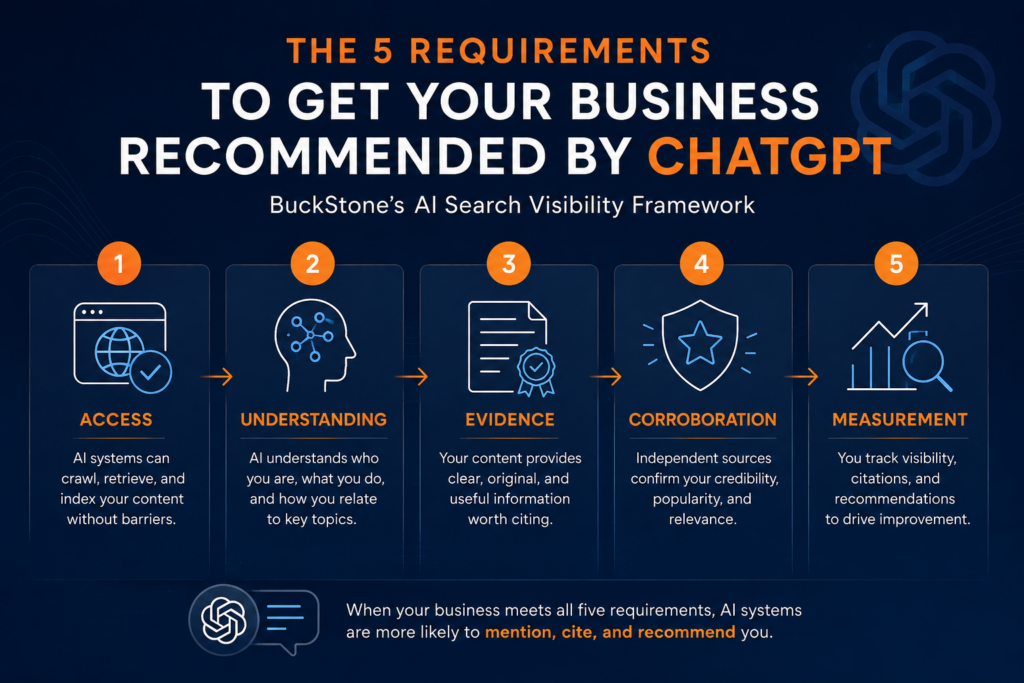
ChatGPT visibility begins with five requirements
At BuckStone, we organize AI Search Visibility around five connected requirements.
BuckStone’s AI Search Visibility Framework
Five requirements that work together
Can ChatGPT’s search systems reach your website and retrieve its content?
Can an AI system clearly determine who your company is, what it does, where it operates, and whom it serves?
Does your website contain useful, specific, original information that supports your expertise and claims?
Do credible third-party sources support what your business says about itself?
Are you systematically testing whether your company appears across relevant platforms, prompts, markets, and stages of the customer journey?
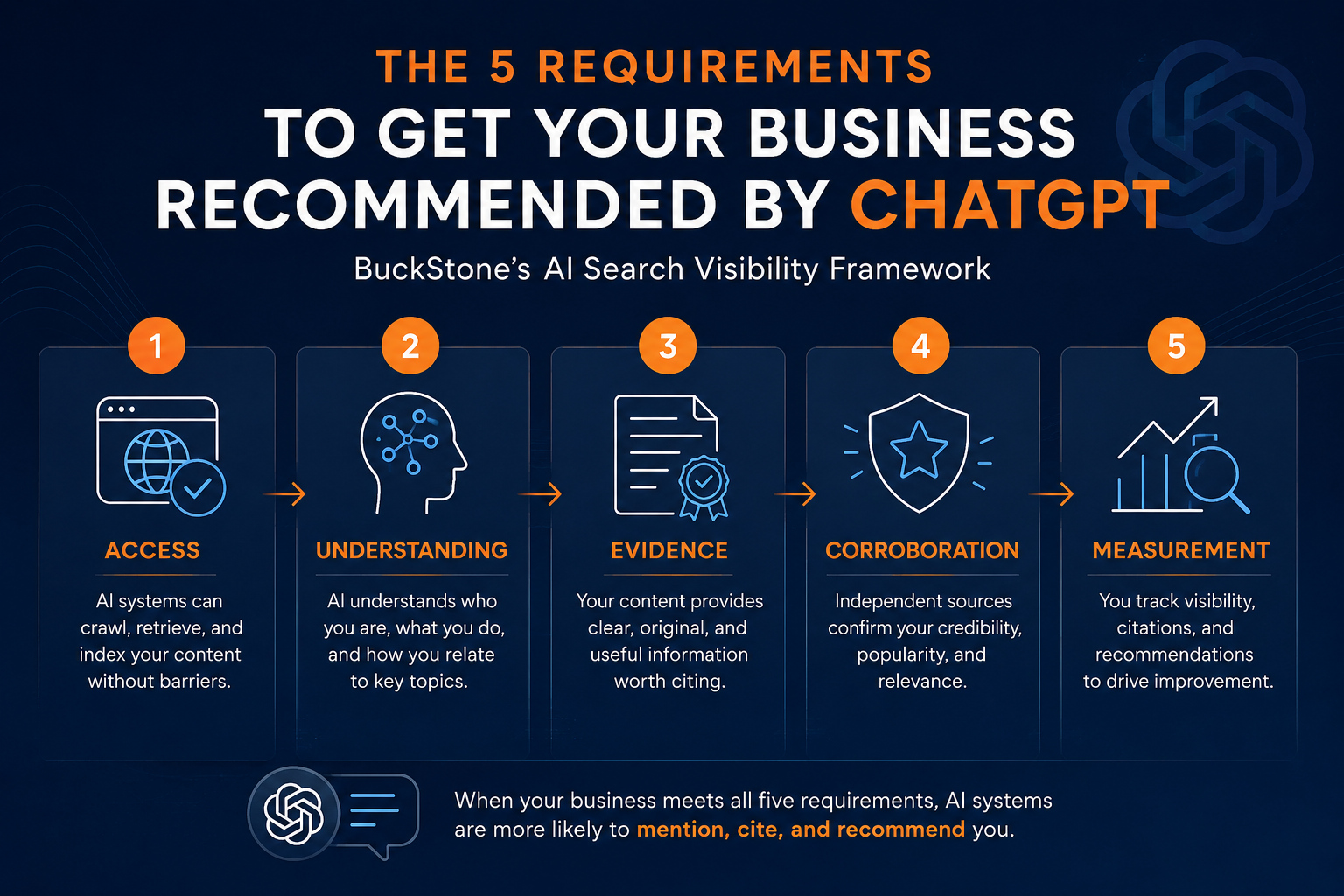
A weakness in any one of these areas can limit visibility.
A company may have excellent content that cannot be crawled. It may have a technically accessible website with vague messaging. It may describe itself clearly but have little independent evidence supporting its claims.
Successful AI visibility is not one tactic. It is the combined result of making a business easier to access, interpret, verify, and select.
Eight ways to improve your company’s visibility in ChatGPT
1. Make sure OpenAI can access your website
OpenAI operates several web crawlers with different purposes. If your site is turning them away, start with whether your website is blocking AI crawlers.
The crawler most directly relevant to ChatGPT Search visibility is OAI-SearchBot. OpenAI says this bot is used to surface websites within ChatGPT’s search features.
Sites that opt out of OAI-SearchBot will not be shown within ChatGPT Search answers, although they may still appear as navigational links in some circumstances. OpenAI recommends allowing the crawler in robots.txt and permitting traffic from its published IP ranges.
A basic robots.txt directive may look like this:
User-agent: OAI-SearchBot
Allow: /
That alone does not prove your site is fully accessible.
You should also check for:
- Sitewide
noindexdirectives - Incorrect canonical tags
- Firewall rules
- CDN restrictions
- Bot-management services
- Security plugins
- Rate limits
- Server errors
- Broken internal links
- Pages available only after form submissions
- Important content rendered improperly
- Accidental staging-site restrictions
- Conflicting robots directives
- Blocking of OpenAI’s published IP ranges
Some websites technically allow OAI-SearchBot in robots.txt while blocking it at the firewall or CDN level.
Allowing access does not guarantee a recommendation. It simply removes one potential barrier to being discovered and used in ChatGPT Search.
Crawling is not the same as recommendation
These stages should be treated separately:
- OpenAI can access the page.
- The page can be retrieved or indexed.
- The page is considered relevant to a question.
- The page is used as a source.
- The company is mentioned.
- The company is positively evaluated.
- The company is recommended.
A robots.txt update may help with the first stage. It does not automatically accomplish the other six.
2. Clearly explain what your business does
Many company websites are surprisingly difficult to understand. Our guide to how AI systems understand your business.covers what actually makes a company legible.
Their homepage headlines say things such as:
- Building tomorrow’s possibilities
- Innovation without limits
- Transforming businesses through bold thinking
- Solutions designed around you
- Where strategy meets success
These statements may sound polished, but they provide very little usable information.
A human visitor might eventually explore the navigation and determine what the company offers. An AI system also needs enough explicit information to confidently connect the company to a specific question.
Your website should clearly establish:
- Your official business name
- Your primary business category
- Your services or products
- Your target customers
- The industries you serve
- Your geographic market
- Your areas of specialization
- Your differentiators
- The problems you solve
- The evidence supporting your expertise
A stronger homepage introduction might say:
ExampleBuckStone Digital Group is a digital marketing agency providing technical SEO, content strategy, Google Ads, Local SEO, website development, ecommerce marketing, and AI Search Visibility services to established businesses.
That sentence is not flashy.
It is useful.
It gives people and machines a clearer understanding of the company’s identity and relevance.
Avoid making important information implicit
Do not assume an AI system will infer that:
- Your company serves manufacturers because two manufacturers appear in a logo carousel.
- You offer nationwide service because you have clients in several states.
- You specialize in technical SEO because one employee mentions it in a biography.
- You serve commercial clients because the word “commercial” appears once in a case study.
- You operate in a particular city because your address exists only in the footer.
Important business facts should be stated explicitly on the most relevant pages.
3. Build meaningful coverage of your actual services
A company will struggle to become associated with a service it barely explains.
Suppose your agency wants to be recommended for AI Search Visibility, but its website includes only one paragraph that says:
ExampleWe help brands succeed in the age of AI.
There is not enough substance there to demonstrate what the service includes, how the work is performed, whom it helps, or why the company is qualified to provide it.
A stronger content ecosystem might include:
- A complete AI Search Visibility service page
- An explanation of how ChatGPT Search works
- A guide to Google AI Mode visibility
- An article about entity SEO
- A technical AI crawler guide
- A structured data guide
- A measurement methodology
- An AI visibility audit explanation
- Relevant case studies
- Original observations or testing
- Industry-specific applications
- Clear relationships to traditional SEO
This does not mean publishing hundreds of shallow articles.
The goal is not to mention every variation of a keyword.
The goal is to demonstrate genuine subject-matter coverage.
Build around real customer questions
The best supporting content should answer questions such as:
- Why is my competitor appearing instead of me?
- Can ChatGPT access my website?
- Does schema markup help?
- Do reviews matter?
- How does ChatGPT know where my company operates?
- Can I measure ChatGPT referrals?
- How is AI visibility different from SEO?
- What should my company publish?
- Can an agency guarantee recommendations?
- How do third-party mentions affect visibility?
These questions reflect real business uncertainty. They are more useful than producing generic articles built around minor keyword variations.
4. Strengthen your business entity
An entity is a distinct person, company, place, product, organization, or concept that can be identified and understood across multiple sources.
For your business, entity clarity means that the wider web consistently supports a coherent answer to questions such as:
- What is this company?
- Is this the same organization referenced on another website?
- Where is it located?
- Who leads it?
- What services does it provide?
- Which industries does it serve?
- Is it associated with a particular specialty?
- Which profiles officially belong to it?
Several site elements can improve that clarity.
Build a complete About page
Your About page should explain:
- The company’s legal or commonly used name
- What the company does
- When it was founded
- Where it operates
- Who founded or leads it
- What type of clients it serves
- Its core expertise
- Relevant credentials or history
- Links to official profiles
Avoid turning the entire page into a brand manifesto that never explains the actual organization.
Create credible leadership and author profiles
Important articles should be associated with identifiable people who have relevant experience.
An author page can include:
- Full name
- Position
- Professional background
- Area of expertise
- Articles written
- Relevant credentials
- Speaking appearances
- Professional profiles
- A consistent headshot
- A clear relationship to the company
Do not invent credentials or inflate expertise. The goal is clarity and accountability.
Keep company information consistent
Review your:
- Company name
- Address
- Phone number
- Service area
- Leadership names
- Founding date
- Business categories
- Social profiles
- Directory listings
- Organization descriptions
- Google Business Profile
- Contact information
Minor wording differences are normal.
Material contradictions are not.
If one source says your company serves only western Pennsylvania, another says it is a Florida agency, and your website claims nationwide service without explaining the relationship, the overall entity becomes harder to interpret.
Use Organization and LocalBusiness structured data accurately
Structured data can help machines identify explicit information about a company and the relationships between pages and entities. Learn how to make those entities consistent in our guide to entity SEO for AI search.
Useful properties may include:
nameurllogodescriptionfoundingDateaddresstelephoneareaServedsameAsfounderemployeeknowsAbout
The markup must accurately reflect visible, supportable information on the website. Schema should clarify reality—not manufacture it.
Structured data may support machine understanding, but it does not force ChatGPT to recommend a company.
5. Earn credible third-party corroboration
Every company can claim to be excellent.
Independent sources help determine whether those claims are supported beyond the company’s own website.
Third-party corroboration can come from:
- Industry publications
- Professional associations
- Local media
- Client websites
- Conference websites
- Podcast appearances
- Expert interviews
- Relevant directories
- Review platforms
- Award organizations
- Community organizations
- Original research citations
- Partner profiles
- Vendor directories
- University or institutional sources
This is broader than conventional link building.
A backlink may be valuable, but the real strategic objective is to create verifiable relationships between your company and the subjects for which you want to be known.
Relevance matters more than random volume
A manufacturing marketing agency does not become more credible by appearing in 300 low-quality directories.
It may become more credible when:
- A recognized manufacturing publication quotes its research.
- A manufacturing association lists it as a partner.
- A client credits it within a documented case study.
- Its executives speak at a relevant industry event.
- Its data is referenced in a serious industry analysis.
- Several independent sources consistently associate it with manufacturing SEO.
These sources create a stronger, more coherent evidence network.
Brand mentions may still be useful without a traditional link
A relevant publication might mention your company without linking to it.
That mention can still contribute to the wider body of public information connecting your brand to a subject, person, market, or service.
Businesses should therefore stop evaluating every publicity opportunity solely by whether it produces a followed backlink.
The better questions are:
- Is the source credible?
- Is the context relevant?
- Is the business described accurately?
- Does the mention reinforce a meaningful area of expertise?
- Can users and machines clearly identify which company is being referenced?
6. Publish information worth citing
Most company blogs are not designed to become sources.
They are designed to satisfy an editorial calendar.
That produces articles such as:
- Five reasons digital marketing is important
- Seven benefits of working with an expert
- Ten trends to watch this year
- Why every business needs SEO
- Our ultimate guide to online success
The information is usually interchangeable with content published by thousands of other companies.
AI search creates even more pressure to produce something distinctive.
A useful source may include:
- Original research
- First-party data
- Detailed case studies
- Industry benchmarks
- Tested methodologies
- Cost data
- Decision frameworks
- Comparison criteria
- Expert analysis
- Technical documentation
- Clear definitions
- Useful calculators
- Practical diagnostic instructions
- Frequently updated reference material
- Specific examples drawn from real work
Show the evidence behind your conclusions
Instead of saying:
Instead ofSchema markup improves AI visibility.
Explain:
- What schema does
- Which entities it describes
- What information it clarifies
- What platforms officially confirm
- What remains unproven
- What your implementation process includes
- What schema cannot accomplish
- How you would validate the markup
Instead of saying:
Instead ofTopical authority is important.
Show:
- Which subjects a company must cover
- How those subjects connect
- Which pages answer which customer questions
- How internal links reinforce those relationships
- Where original evidence is needed
- How commercial and educational pages work together
Specificity creates usefulness.
Usefulness creates citation potential.
Original insight does not always require a massive study
Businesses often assume “original research” means surveying 10,000 people.
It can also include:
- Patterns found across technical audits
- Anonymized performance benchmarks
- Before-and-after case studies
- Analysis of public datasets
- A documented testing methodology
- Changes observed across search platforms
- A breakdown of recurring customer questions
- A decision-making framework refined through client work
- Screenshots and examples from real implementations
The information must be accurate, responsibly presented, and sufficiently detailed for others to evaluate it.
7. Keep your business facts current
AI-generated answers can expose stale information that businesses have ignored for years.
Common inconsistencies include:
- Old addresses
- Former leadership
- Discontinued services
- Incorrect business hours
- Duplicate company profiles
- Outdated service areas
- Old logos
- Incorrect pricing
- Closed locations
- Old phone numbers
- Conflicting company descriptions
- Abandoned social profiles
- Legacy domain names
- Former brand names with no explanation
Audit the information appearing on:
- Your website
- Google Business Profile
- Bing Places
- Major industry directories
- Review platforms
- Association profiles
- Social networks
- Partner websites
- Press releases
- Local listings
- Data aggregators
- Old websites or subdomains
You may not be able to correct every source.
Start with the sources that are most visible, authoritative, and directly connected to your business.
8. Measure ChatGPT visibility with controlled prompt testing
Businesses often test AI visibility like this:
- Open ChatGPT.
- Ask, “Who is the best SEO company?”
- Look for their company name.
- Conclude that they either do or do not rank in ChatGPT.
That is not a meaningful measurement system.
ChatGPT answers can vary based on:
- The exact wording of the prompt
- Whether search is used
- The user’s location
- Previous conversation context
- The requested criteria
- The level of specificity
- The date of the test
- The sources available
- The model or product experience
- Whether the question is local, national, informational, or commercial
A better approach begins with a controlled prompt set.
- Recommend an agency that provides technical SEO.
- Which companies specialize in AI Search Visibility?
- Who can help a manufacturer improve organic visibility?
- What agencies combine SEO and Google Ads?
- Which firms provide entity SEO consulting?
- Recommend an SEO agency for a home builder.
- Which digital marketing companies work with manufacturers?
- What SEO firms understand commercial construction?
- Who provides ecommerce SEO and marketplace advertising?
- Recommend an SEO company near Pittsburgh.
- Which digital marketing agencies serve Pennsylvania manufacturers?
- What are the best SEO firms in the United States for industrial companies?
- My traffic is growing, but leads are not. Who can help?
- My company does not appear in Google AI Mode. Which agency should I contact?
- Our site has thousands of technical errors. Who specializes in fixing them?
- Why is ChatGPT recommending our competitors?
- What type of company helps with ChatGPT visibility?
- Should I hire an SEO agency or a specialized AI SEO agency?
- Recommend firms that provide AI Search Visibility services.
- Compare Company A and BuckStone Digital Group for AI Search Visibility.
Record more than whether the brand appeared
Your tracking system should document:
- Whether the company was mentioned
- Its position in a list, when applicable
- The wording used to describe it
- Whether the description was accurate
- Which services were associated with it
- Whether the website was cited
- Which external sources were cited
- Which competitors appeared
- Whether search was used
- Whether the recommendation changed by geography
- Whether the answer included positive or negative qualifiers
- Whether the response created a plausible path to the website
This turns an anecdotal search into a repeatable visibility study.
Put the framework to work
See where your business stands across all five requirements
Access, understanding, evidence, corroboration, and measurement rarely fail all at once—usually one or two are holding you back. An audit pinpoints which.
Why does ChatGPT recommend competitors instead of your business?
When competitors appear and your company does not, there is rarely one universal explanation. For a full diagnostic across access, understanding, evidence, corroboration, and measurement, see our guide on why your business may not be appearing in AI search results.
Possible reasons include:
Your competitor is described more clearly
Its site may directly state the service, industry, audience, and location relevant to the prompt.
Your competitor has stronger third-party validation
It may appear across publications, associations, directories, review sources, and client websites that reinforce its relevance.
Your competitor has deeper content coverage
It may have useful pages addressing the exact service or problem the user described.
Your website may be inaccessible
OpenAI’s search crawler may be blocked by robots.txt, a CDN, a firewall, or another technical restriction.
Your business information may be inconsistent
Conflicting locations, descriptions, profiles, or service claims may reduce clarity.
Your company may have authority in a different subject
You might be well established for traditional SEO but have very little public information connecting the brand to AI Search Visibility.
The prompt may favor a different type of company
A user asking for a “local SEO freelancer” is not necessarily looking for a full-service agency, even if that agency provides Local SEO.
The answer may rely on sources where your company is absent
The model may find a relevant list, article, directory, or set of results that includes competitors but not your company.
This is why improving ChatGPT visibility requires both owned-site optimization and broader authority development.
What does not guarantee that ChatGPT will recommend your business?
Adding an llms.txt file
An llms.txt file has received substantial attention within the SEO industry.
It may have uses as a voluntary method of presenting information to certain AI systems or tools, but it is not an official universal submission mechanism that guarantees visibility in ChatGPT.
Do not treat it as a substitute for crawlability, strong content, entity clarity, or public authority.
Adding schema markup
Schema can clarify information about your organization, services, authors, articles, and relationships.
It cannot manufacture trust, reputation, relevance, or evidence that does not exist in the visible content.
Publishing hundreds of AI-generated articles
Content volume is not the same as topical authority.
Publishing hundreds of generic pages may create:
- Redundancy
- Contradictions
- Thin coverage
- Poor internal linking
- Crawl waste
- Brand dilution
- Factual errors
- A weaker user experience
AI assistance can support research, outlining, editing, and production. The finished material still needs original value, expert review, factual support, and a clear strategic purpose.
Repeating “ChatGPT” throughout your website
Keyword repetition does not prove expertise.
A company becomes relevant to AI Search Visibility by demonstrating that it understands and performs the underlying work—not by mentioning the platform in every heading.
Creating fake author biographies or credentials
Artificial expertise signals can create legal, reputational, and trust problems.
Use real people, real experience, real credentials, and supportable claims.
Buying low-quality directory placements
Random directory volume does not create meaningful authority.
Prioritize sources that are relevant, reputable, maintained, and capable of reinforcing accurate business information.
Prompting ChatGPT with your brand repeatedly
Repeatedly asking ChatGPT about your own company is not a credible optimization strategy.
It does not replace making better information available across the web.
Hiring an agency that guarantees recommendations
OpenAI explicitly says there is no way to guarantee a top ranking in ChatGPT Search.
An agency can improve technical access, content quality, entity clarity, corroboration, and measurement. Our guide to measuring AI search visibility shows how to track each of those.
It cannot ethically promise that a third-party AI platform will recommend a particular business for every relevant prompt.
Can you pay to be recommended by ChatGPT?
Businesses should distinguish between an organic recommendation and an advertisement.
OpenAI now sells advertising inside ChatGPT through a self-serve Ads Manager. Ads are separately labeled sponsored items and are not the same thing as being organically selected within an assistant’s answer.
Paying for advertising does not mean the assistant will organically endorse the advertiser.
For ecommerce businesses, OpenAI has also introduced product discovery capabilities and product-feed opportunities that can help products appear within shopping experiences. That is different from submitting an ordinary service business for guaranteed recommendation.
For most service businesses, there is no universal paid submission that guarantees inclusion in organic ChatGPT recommendations.
How long does it take to improve ChatGPT visibility?
There is no responsible universal timeline.
The answer depends on:
- Whether OpenAI can currently access the site
- The age and authority of the business
- Existing brand recognition
- Competitive intensity
- Content depth
- Technical problems
- Third-party mentions
- Review visibility
- Entity consistency
- The frequency with which relevant pages are discovered
- The type of prompts being targeted
- Whether the answer uses current web search
- Changes within ChatGPT’s systems
- Changes across external sources
A crawler-access problem might be corrected quickly.
Building meaningful authority around a new service category may require months of coordinated work.
Earning credible third-party corroboration can take even longer.
Businesses should be skeptical of anyone promising guaranteed ChatGPT recommendations within 30, 60, or 90 days.
How BuckStone approaches ChatGPT visibility
BuckStone treats ChatGPT visibility as one part of a broader AI Search Visibility strategy.
We do not attempt to manipulate one isolated prompt.
We work to improve the overall information environment surrounding the business.
Access
We evaluate whether AI search crawlers can reach important content.
That includes reviewing:
- Robots.txt
- Meta robots directives
- HTTP headers
- CDN rules
- Firewall restrictions
- Server responses
- Canonicals
- Internal links
- JavaScript rendering
- Indexation
- Security configurations
Understanding
We assess whether the business is clearly defined.
That includes:
- Organization information
- Service descriptions
- Industry relevance
- Geographic markets
- Leadership entities
- Author identities
- Website architecture
- Structured data
- Internal relationships between pages
- Consistency across major profiles
Evidence
We determine whether the company has published enough useful information to support its expertise.
That may include:
- Service pages
- Industry pages
- Case studies
- Original data
- Detailed educational content
- Methodology pages
- Comparison resources
- FAQs
- Technical documentation
- Expert commentary
Corroboration
We examine whether credible third-party sources reinforce the business’s claims.
That includes:
- Relevant media coverage
- Association listings
- Client mentions
- Industry publications
- Reviews
- Professional profiles
- Partner pages
- Interviews
- Citations
- Authoritative directories
Measurement
We establish a prompt-testing and analytics framework.
That can include:
- Prompt-set development
- Competitor comparisons
- Citation tracking
- Referral traffic
- Landing-page analysis
- Conversion tracking
- Brand-description accuracy
- Platform comparisons
- Geographic variation
- Trend reporting
The objective is not to create the illusion of a simple ChatGPT ranking.
It is to build a stronger, more measurable probability that the business will be discovered and considered when relevant questions are asked.
How to tell whether your company needs an AI Visibility Audit
An audit may be valuable when:
- Competitors appear in ChatGPT recommendations and your company does not.
- ChatGPT describes your company inaccurately.
- Your website receives little or no identifiable AI referral traffic.
- Your business recently changed names, services, locations, or leadership.
- You are launching a new service category.
- Your site has inconsistent organization information.
- You do not know whether AI crawlers are blocked.
- Your content strategy is built entirely around traditional keywords.
- You have strong real-world expertise but weak online authority.
- Your company has no systematic way to measure AI visibility.
- Your leadership team is asking about ChatGPT, Perplexity, Google AI Mode, or AI Overviews and no one has a credible answer.
A useful audit should not produce a generic score and a list of AI buzzwords.
It should identify specific weaknesses across access, understanding, evidence, corroboration, and measurement.
Final answer: How do you get ChatGPT to recommend your business?
There is no single button, schema property, directory, or content trick that forces ChatGPT to recommend a company.
You improve your chances by making your business:
- Technically accessible
- Clearly defined
- Relevant to the questions customers ask
- Supported by substantive content
- Consistent across the web
- Validated by credible third parties
- Easy to evaluate
- Worth citing
- Measurable across a controlled set of prompts
The businesses that perform best in AI search will not necessarily be those that publish the most content or chase every new acronym.
They will be the businesses that provide the clearest and strongest body of evidence about who they are, what they do, whom they help, and why they deserve to be considered.
That is the foundation of AI Search Visibility.
Your next step
Need to know why your business is—or is not—appearing in ChatGPT?
BuckStone Digital Group evaluates the technical, content, entity, authority, and measurement factors that influence visibility across ChatGPT, Google AI Mode, AI Overviews, Perplexity, and other AI-driven search experiences. Or explore how traditional SEO, entity optimization, structured data, and content strategy work together inside AI Search Visibility services.
Frequently Asked Questions
Can I submit my business directly to ChatGPT?
There is no universal submission form for ordinary businesses that guarantees inclusion in ChatGPT Search or recommendations. OpenAI recommends allowing OAI-SearchBot to access your website so eligible public content can be discovered for search experiences.
Does ChatGPT crawl my website?
OpenAI operates OAI-SearchBot for ChatGPT’s search features. Whether it can access your site depends on your robots.txt directives, server configuration, CDN, firewall, and other technical controls.
Should I allow OAI-SearchBot in robots.txt?
Businesses that want their public website content to be eligible for ChatGPT Search should generally allow OAI-SearchBot, provided that doing so aligns with their legal, privacy, publishing, and content-use policies. OpenAI says sites that opt out will not appear within ChatGPT Search answers, although they may still appear as navigational links.
Does schema markup help with ChatGPT visibility?
Schema markup can make important information and entity relationships more explicit. However, OpenAI has not published guidance stating that adding a particular schema type guarantees a ChatGPT recommendation. Schema should be used as one part of a broader strategy involving clear visible content, crawlability, entity consistency, authority, and corroboration.
Do backlinks affect ChatGPT recommendations?
OpenAI does not publish a simple backlink-based ranking formula for business recommendations. Relevant links and mentions can still be valuable because they improve discovery, create third-party corroboration, send referral traffic, and connect a company with credible industry sources. Quality and context matter more than acquiring large quantities of unrelated links.
Do online reviews influence ChatGPT recommendations?
Reviews contribute publicly available evidence about a company’s reputation, customer experience, location, and services. Their impact may vary depending on the prompt, platform, source, and whether current search is used. Reviews should be treated as part of the company’s wider authority and reputation footprint—not as a guaranteed ranking factor.
Why is ChatGPT recommending my competitors instead of me?
Competitors may have clearer service information, stronger third-party mentions, deeper content, better-known brands, more relevant reviews, stronger local signals, or more accessible websites. The cause should be investigated across technical access, entity understanding, content evidence, corroboration, and prompt-level testing.
Can anyone guarantee that ChatGPT will recommend my business?
No. OpenAI states that ChatGPT Search uses multiple factors intended to surface reliable and relevant information and that no one can guarantee a top ranking.
Sources and Methodology
This guide relies on OpenAI’s own public documentation and product announcements for every factual claim about how ChatGPT accesses, ranks, and surfaces web content. Where the evidence is uncertain, the article says so rather than presenting speculation as confirmed fact.
- OpenAI — Overview of OpenAI Crawlers (
OAI-SearchBot,GPTBot, andChatGPT-User), including robots.txt guidance and published IP ranges. platform.openai.com/docs/bots - OpenAI — ChatGPT Search documentation and help articles, covering how search retrieves and cites current web sources, the role of location, the
utm_source=chatgpt.comreferral parameter, and the statement that no top ranking can be guaranteed. help.openai.com - OpenAI — announcements regarding advertising and shopping/product-discovery experiences in ChatGPT, which are labeled and distinct from organic answers. openai.com/news
Methodology. BuckStone’s AI Search Visibility framework—access, understanding, evidence, corroboration, and measurement—is applied in client engagements and refined through technical audits, controlled prompt testing across services, industries, geographies, problems, and buying stages, and analysis of referral data. Statements attributed to OpenAI reflect its publicly available guidance as of July 2026 and may change as OpenAI updates its products and policies.