
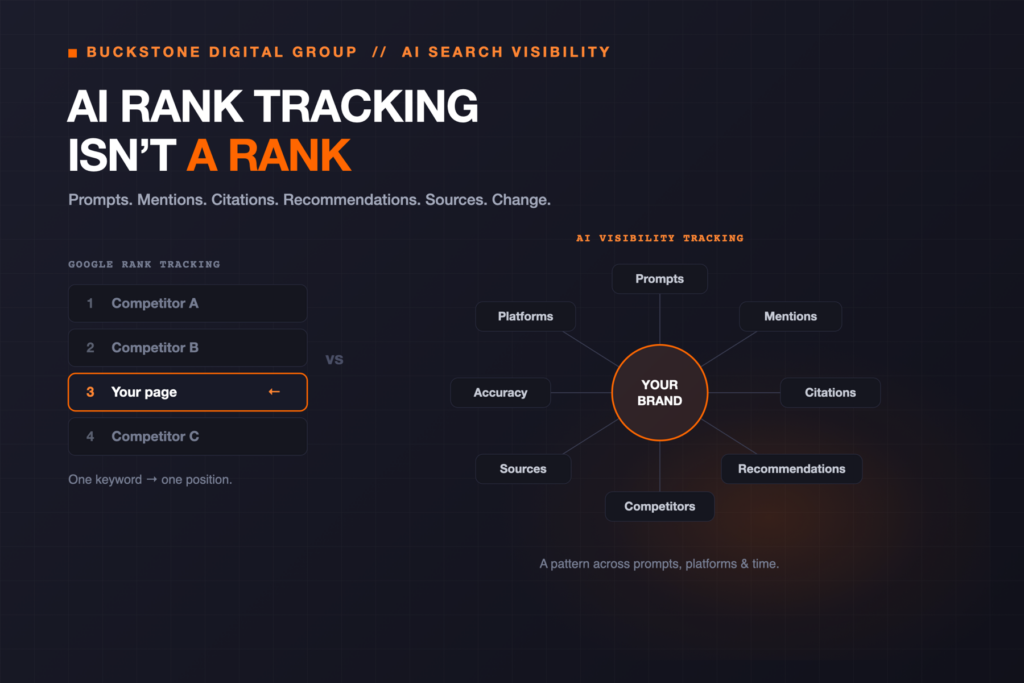
“Where do we rank in ChatGPT?” It sounds like a natural extension of the question every business has asked about Google for twenty years. But an AI answer often has no numbered list, no fixed set of businesses, no stable wording, and no traditional “position” to occupy. You can absolutely measure how you show up across AI search — but you usually can’t reduce it to one ranking number. The challenge isn’t that AI visibility is immeasurable; it’s that it needs a broader measurement model than a keyword and a position.
This is the final article in our thought-leadership series, and it connects everything before it — recommendability, third-party corroboration, and the rest — back to the practical question executives keep asking: is any of this working, and how would we know?
- Traditional rank tracking measures a defined keyword and position. AI answers often have neither a fixed order nor a fixed cast of businesses.
- Small prompt changes can produce different answers, and platforms behave differently — there is no single universal AI ranking for a business.
- Citation, mention, comparison, and recommendation are different outcomes. Treating them all as “rankings” loses the context that matters.
- One screenshot proves almost nothing. It shows an answer occurred; it doesn’t show consistency, share of voice, trend, or business impact.
- Prompt sets should mirror the buyer journey, not the agency’s favorite keywords, and competitor share of voice is usually more useful than one “AI rank.”
- Presence isn’t enough — accuracy, context, and sentiment matter too. An inaccurate recommendation isn’t automatically a win.
- First-party data (Search Console, GA4) belongs alongside prompt monitoring, and every share-of-voice number needs its methodology attached.
- Measurement only matters if it connects to outcomes — leads, calls, revenue, or pipeline — and no honest agency guarantees an AI ranking.
How traditional Google rank tracking works
Traditional rank tracking measures where a webpage appears for a defined search query, often across a specific search engine, location, device, and time. A tracker defines the keyword, engine, location, device, language, and date, then records the ranking URL, position, SERP features, movement, and competitors. It’s not perfectly simple — Google results already vary by location, device, personalization, intent, SERP features, and time — but it provides a relatively structured model: one keyword, one position, tracked over time.
AI visibility keeps the spirit of that discipline but breaks the tidy structure. To see why, it helps to define the terms plainly.
Traditional rank tracking measures where a webpage appears for a defined search query, often across a specific search engine, location, device, and time.
AI rank tracking is an informal term for monitoring how a brand, business, product, person, or webpage appears across AI-generated search and answer experiences. Because AI answers don’t always present a stable ordered list, “AI visibility tracking” is often the more accurate term.
AI visibility describes whether and how a business appears through mentions, citations, comparisons, recommendations, summaries, or source links across relevant AI-driven search experiences.
Why AI answers don’t behave like a ranked list
The single biggest difference is structural. A Google result is a position in a list; an AI answer is a piece of writing. That changes measurement in several ways:
- Answers may be narrative. A business can be woven into a paragraph rather than placed at “position three.”
- Lists may be unordered. When options do appear as a list, the order often isn’t a strict ranking.
- Options are compared by use case. One business may be suggested for enterprise buyers and another for local ones — in the same answer.
- Wording changes the outcome. “Best SEO agency” can produce a different answer than “best SEO agency for manufacturers” or “SEO agency with AEO expertise.”
- Different sources support the same business. You might be backed by your own site in one answer and a review site, partner page, or directory in another.
So traditional rank tracking follows a result; AI measurement has to follow the answer, the entity, and the sources supporting it. If your business isn’t entering answers at all, the cause is usually upstream — start with why a business doesn’t appear in AI results and whether crawlers can even reach you.
One intent, many prompts
In traditional search, a keyword is often the complete unit of measurement. In AI search, the prompt family matters — a group of related questions that share the same underlying intent but produce different answers. A single buyer looking for an SEO partner might ask any of these:
These prompts share commercial intent but generate different answers — and that variation isn’t noise to eliminate. Prompt wording can vary by industry, location, budget, company size, service, use case, urgency, product requirements, and customer type, and a business may be recommendable in one context but not another. Prompt variation often reveals where you’re actually relevant. That’s a direct extension of what we covered in what makes a business recommendable.
Platform differences matter
These environments are related, but they shouldn’t be collapsed into one universal score. Each is measured differently, and you should verify each platform’s current reporting capabilities rather than assume parity.
Traditional Google Search
Track rankings, URLs, SERP features, impressions, and clicks — the mature, well-documented baseline.
Google AI Overviews & AI Mode
Monitor presence, cited URLs, and brand mentions where observable, plus Google’s generative-AI performance data in Search Console where currently supported, and downstream traffic and conversions. Google’s first-party data is the most authoritative source of truth for its own surfaces — see appearing in AI Overviews and showing up in AI Mode.
ChatGPT
Monitor mentions, recommendations, citations and source links, accuracy, competitors, referral traffic, and prompt-level variability. Referral visits can often be identified in analytics, but not every interaction produces a click — more in getting recommended by ChatGPT.
Perplexity
Monitor mentions, citations, source URLs, competitor visibility, referral traffic, and answer variation. Perplexity surfaces numbered citations, which makes source analysis especially concrete — see getting cited by Perplexity.
Citation, mention, comparison, recommendation — not the same thing
Collapsing every appearance into “a ranking” throws away the most useful information. A brand can be cited but not recommended, recommended without its own site being cited, or mentioned inaccurately. These outcomes deserve separate tracking:
| Outcome | What it means |
|---|---|
| Citation | A source URL is referenced or linked in the answer |
| Mention | The brand or business is named |
| Description | The system explains what the business does |
| Comparison | The business is evaluated against alternatives |
| Recommendation | The business is presented as a suitable option |
| First mention | The brand appears earliest in the response |
| Exclusive recommendation | The answer names only that business |
| Referral visit | The user clicks through to the website |
| Conversion | The interaction contributes to a lead or sale |
Presence isn’t enough: context matters
Being in the answer is only the first question. A complete read also asks: Was the mention positive? Was the business described accurately? Was the right service associated with it? Was it recommended for the right audience? Was outdated information used? Was the citation relevant? Was a competitor positioned more favorably? An inaccurate recommendation is not automatically a win, and visibility without context can produce a misleading report. This is where accuracy review connects to how AI systems understand your business — and to the third-party sources that support each answer.
Why one screenshot proves almost nothing
A screenshot shows one prompt, one platform, one moment, one phrasing, one answer. It does not establish consistency, share of voice, a trend, competitive position, geographic coverage, or business impact. Answers also change over time for many reasons — platform updates, index changes, newly discovered sources, updated web content, prompt wording, location, session context, source availability, and model behavior. None of that means there’s a hidden formula to reverse-engineer; it means you should track patterns over time rather than overreacting to a single answer.
Durable visibility shows up as a consistent pattern across a defined prompt set, multiple platforms, and repeated checks — ideally tied to referral and conversion data.
What an AI visibility program should measure
A serious program measures more than one thing. These twelve dimensions turn scattered observations into a system — and pair naturally with our broader guide to measuring AI search visibility.
- Prompt coverage — how many strategically important prompts are monitored
- Brand presence — was the business named
- Citation coverage — was your site or a relevant source cited
- Recommendation coverage — was the business recommended as an option
- Prominence — where and how prominently it appeared
- Accuracy — was the business described correctly
- Context — which service, industry, location, or use case triggered visibility
- Competitor share of voice — which competitors appeared, and how often
- Source analysis — which URLs and domains supported the answer
- Stability — did visibility persist across repeated checks
- Referral traffic — did AI platforms send visits
- Conversions — did those visits contribute to leads, calls, sales, or pipeline
Prompt sets should be built around buyer intent, not the agency’s favorite keywords — a mix of discovery (“who provides X?”), recommendation (“who’s the best X for Y?”), comparison (“compare A and B”), validation (“is Company X reputable?”), branded (“what does Company X do?”), and problem-solving (“who can help with X?”) prompts that mirror the customer journey. As for how many: there’s no universal number. Scope depends on your services, products, locations, industries, audience segments, competitive landscape, budget, and reporting cadence. A smaller, strategically designed set beats hundreds of random questions with no connection to revenue — start with a defined core set and expand based on what it reveals. Frequency is a similar trade-off: fast enough to catch meaningful change, not so frequent that normal answer variation gets mistaken for strategy failure.
AI share of voice — with methodology attached
AI share of voice is the proportion of tracked prompts or answer opportunities in which a brand appears compared with selected competitors. It’s useful — but only when its methodology is disclosed: define the prompt set, define the competitors, record qualifying mentions or recommendations, and calculate the proportion of observed answer opportunities.
It does not mean 36% of all AI users, 36% of all possible prompts, or 36% market share. Every AI share-of-voice number should travel with the methodology that produced it.
The same honesty applies to prominence. Rather than inventing numeric positions for narrative answers, a clearer scale is qualitative: not present → cited only → mentioned → included among options → recommended → primary recommendation. The goal is consistent classification, not a proprietary score that hides how the result was calculated. And because the evidence behind an answer now matters as much as the answer itself, source analysis — which URL was cited, first-party or third-party, relevant or not — is part of rank tracking today, exactly as we argued in how third-party sources influence AI recommendations.
Manual testing vs. automated tools
Both have a place; neither is complete on its own.
- Rich context and qualitative interpretation
- Accuracy review and source inspection
- But: time-intensive, hard to scale
- Inconsistent without a defined protocol
- Repeatability, scale, historical tracking
- Competitor comparison and reporting
- But: limited platform coverage and sampling
- Methodology differences; possible answer variation
Tools are measurement instruments, not complete truth machines — no third-party platform sees every AI answer. Before trusting a vendor’s numbers, ask: Which platforms do you track, and how are prompts executed? Are tests localized, and personalized or session-neutral? How often are prompts run? How are mentions, recommendations, and citations classified, and how is prominence scored? Can we inspect the raw answers? How are competitors defined and share of voice calculated? How are historical answer changes preserved? Do you connect to Search Console, GA4, or CRM data? What are the platform limitations, and how do you avoid misleading precision? If a vendor can’t explain the methodology behind its score, the score shouldn’t drive strategy.
Common AI rank-tracking mistakes
- Tracking only branded prompts (overstates visibility)
- Testing one prompt wording (misses prompt-family variation)
- Treating every mention as positive (some are inaccurate or negative)
- Treating citations as recommendations (different outcomes)
- Testing one platform only (visibility differs by environment)
- Using screenshots as the entire report (no trend, no methodology)
- Ignoring competitors (presence means less without context)
- Ignoring source URLs (the evidence ecosystem matters)
- Ignoring conversion data (visibility without impact is incomplete)
- Overreacting to one change (patterns beat isolated answers)
- Reporting a proprietary score with no definitions (false precision erodes trust)
What an AEO report should include
A useful report explains what changed, why it likely changed, and what the business should do next. In practice that means an executive summary (what changed, why it matters, what’s next); prompt-set performance (presence, citations, recommendations, accuracy, share of voice); a platform breakdown (Google AI experiences, ChatGPT, Perplexity, others); competitor analysis (who gained, who lost, new visibility, source advantages); source analysis (first-party vs. third-party citations, new supporting sources, missing evidence); traffic and conversion (AI referrals, landing pages, leads, sales, assisted outcomes); and a prioritized set of actions across technical, content, entity, corroboration, and measurement. First-party data anchors the Google surfaces: Search Console can show what happened within supported Google experiences, but it can’t replace cross-platform prompt monitoring for ChatGPT, Perplexity, or other systems. And referral traffic measures clicks — it doesn’t measure every influence an answer may have had, since visibility can drive later branded search or direct visits that attribution won’t fully credit.
BuckStone’s AI visibility measurement framework
BuckStone doesn’t treat one AI visibility score as the answer. We build a measurement system from multiple observable signals, in layers:
- Traditional search baseline — rankings, impressions, clicks, organic traffic, leads.
- Generative search performance — supported Google generative-AI reporting and AI-feature data where available.
- Prompt visibility — mentions, citations, recommendations, comparisons, accuracy across a defined prompt set.
- Competitive visibility — share of voice, who appears instead, prompt gaps, source gaps.
- Source ecosystem — which pages are cited, which third-party sources support competitors, which evidence is missing.
- Business impact — referral traffic, leads, revenue, pipeline, assisted conversions.
The purpose of measurement isn’t a prettier dashboard — it’s deciding what to improve next. That closes the loop back to the framework that runs through this whole series, where measurement is the feedback signal for every other layer:
- 1Access
Can platforms retrieve the information? See technical SEO for AI search.
- 2Understanding
Are they describing the business correctly? This is entity SEO territory.
- 3Evidence
Which first-party pages support your visibility?
- 4Corroboration
Which third-party sources reinforce it?
- 5Measurement
Are mentions, citations, recommendations, traffic, and outcomes improving?
Can an agency guarantee an AI ranking? No — and no honest one will. Agencies don’t control platform outputs, model updates, index changes, user prompts, personalization, or competitor activity. What a credible partner can improve is technical access, entity clarity, content, evidence, corroboration, monitoring, and implementation. A good agency guarantees the rigor of the process, not a position it doesn’t control. If you’re weighing one, our guide to choosing an AEO agency covers what to look for.
So — can AI rankings be tracked?
Yes, but not exactly like traditional Google rankings. You can track AI visibility through a structured set of prompts, platforms, mentions, citations, recommendations, competitors, sources, traffic, and conversions. The result isn’t one universal rank — it’s a pattern of visibility. Traditional rank tracking tells you where a page appeared; AI visibility measurement tells you whether the business entered the answer, how it was represented, what supported it, who appeared instead, and whether any of it affected the customer journey. AI rank tracking is more complicated because the customer journey is more complicated. This is the same shift we described in is SEO dead? and AI SEO vs. traditional SEO — visibility expanded, so measurement had to expand with it.
Frequently asked questions
What is AI rank tracking?
AI rank tracking is an informal term for monitoring how a brand, business, product, person, or webpage appears across AI-generated search and answer experiences. Because AI answers don’t always present a stable ordered list, “AI visibility tracking” is often the more accurate term.
Does ChatGPT have rankings?
Not in the traditional sense. There is no single public ranking index that assigns your business a fixed position. A business may be mentioned, cited, compared, or recommended in an answer — and that can change with prompt wording and over time.
Can you track rankings in ChatGPT?
You can track visibility — whether and how your business appears across a defined set of prompts — but not a single stable ranking number. Useful tracking records mentions, recommendations, citations, accuracy, competitors, and any referral traffic.
How do you track ChatGPT visibility?
Run a consistent prompt set over time, record whether the business is mentioned, recommended, or cited, check accuracy, note which competitors appear, capture source links, and correlate with referral traffic in analytics. One test isn’t enough — look for patterns.
How do you track Google AI Overviews?
Monitor presence and cited URLs where observable, use Google’s generative-AI performance data in Search Console where currently supported, and watch downstream traffic and conversions. Google’s first-party data is the most authoritative source for its own surfaces.
How do you track Google AI Mode?
Similarly: track brand presence and source citations where observable, use supported Search Console generative-AI reporting, and follow referral and conversion behavior. Verify current reporting capabilities rather than assuming they match AI Overviews or ChatGPT.
How do you track Perplexity visibility?
Perplexity shows numbered citations, so record whether your business is mentioned or cited, which source URLs support it, which competitors appear, and any referral traffic — watching for answer variation across repeated checks.
What is AI visibility tracking?
It’s the practice of measuring whether and how a business appears through mentions, citations, comparisons, recommendations, summaries, or source links across relevant AI search experiences — a broader model than a single keyword position.
How is AI rank tracking different from Google rank tracking?
Google rank tracking usually asks where a page ranks for a defined keyword. AI visibility tracking must evaluate whether a brand appears, how it appears, which source supports it, how often the answer changes, and whether that visibility influences business outcomes.
Why do AI answers change?
Possible reasons include platform updates, index changes, newly discovered sources, updated web content, prompt wording, location, session context, source availability, and model behavior. Because of this, track patterns over time rather than reacting to a single answer.
Why does my business appear for one prompt but not another?
Prompts that share intent can still differ by industry, location, budget, company size, service, or use case, and a business may be relevant in one context but not another. Prompt variation often reveals exactly where you are — and aren’t — a strong fit.
What is a prompt set?
A prompt set is a defined collection of commercially important questions used to monitor AI visibility consistently over time. It should mirror the customer journey rather than an agency’s favorite keywords.
What is a prompt family?
A prompt family is a group of related questions that share the same underlying intent but can produce different answers — for example, several ways of asking for an SEO partner. Measuring the family, not just one phrasing, gives a truer picture.
What is AI share of voice?
AI share of voice is the proportion of tracked prompts or answer opportunities in which a brand appears compared with selected competitors. Every share-of-voice number should be reported with its methodology — the prompt set, competitors, and how appearances were counted.
How do you measure AI citations?
Record, across your prompt set, whether an answer cites a source, which URL and domain it cites, whether it’s your site or a third-party source, and whether the cited page is relevant and accurate — then track how that changes over time.
How do you measure AI recommendations?
Note whether the business is presented as a suitable option, whether it’s one of several or the primary recommendation, for which context or audience, and whether the description is accurate. Recommendations are distinct from mere mentions or citations.
Is a citation the same as a recommendation?
No. A citation references a source URL; a recommendation presents the business as a suitable option. A brand can be cited without being recommended, or recommended without its own site being cited. Tracking them separately preserves the context.
Is a mention the same as a ranking?
No. A mention means the business was named; it carries no fixed position and may be positive, neutral, or inaccurate. Treating every mention as a ranking overstates what actually happened in the answer.
How often should AI visibility be tracked?
There’s no universal cadence. Frequent checks suit volatile categories, launches, or reputation issues but can create noise; scheduled monthly checks suit trends and reporting. Track often enough to catch meaningful change, not so often that normal variation looks like failure.
How many prompts should a business track?
It depends on your services, products, locations, industries, audiences, competition, and budget. A smaller, strategically designed prompt set tied to revenue is more useful than hundreds of random questions. Start with a defined core set and expand based on what it reveals.
How accurate are AI rank-tracking tools?
They vary. No third-party tool sees every AI answer, and results depend on sampling, localization, personalization, and methodology. Tools are useful measurement instruments, but they should be paired with manual review and first-party data, not treated as complete truth.
Can AI traffic be tracked in GA4?
Often, partially. Visits from AI platforms can appear as referrals or through documented parameters, and you can review landing pages, engaged sessions, and conversions. But not every AI interaction produces a click, so some influence goes unattributed.
Can AI visibility be connected to leads?
Sometimes, partially. You can connect AI referral sessions to form submissions, calls, transactions, CRM source data, and assisted conversions, and watch branded-search changes. Perfect attribution isn’t possible, so the language around it should stay careful.
What should an AEO report include?
An executive summary, prompt-set performance (presence, citations, recommendations, accuracy, share of voice), a platform breakdown, competitor analysis, source analysis, traffic and conversion data, and prioritized actions. It should explain what changed, why it likely changed, and what to do next.
Can an AEO agency guarantee AI rankings?
No. Agencies don’t control platform outputs, model updates, index changes, user prompts, personalization, or competitors. A credible agency guarantees the rigor of the process — access, understanding, evidence, corroboration, and measurement — not a position it can’t control.
How does BuckStone measure AI Search Visibility?
We combine a traditional search baseline, supported generative-search reporting, prompt-level visibility (mentions, citations, recommendations, accuracy), competitive share of voice, source-ecosystem analysis, and business impact (referrals, leads, revenue) — with transparent methodology rather than a single opaque score.
Sources & methodology
This article separates several kinds of statement. Official first-party reporting refers to data from Google Search Console (including its generative-AI performance reporting) and analytics such as GA4 — the authoritative sources for Google surfaces and for site referral behavior; exact metrics, dimensions, and supported experiences change over time and should be verified against current documentation before relying on them. Third-party rank-tracking data and manual prompt testing are sampling methods that vary by tool, localization, personalization, and methodology, and no third-party tool observes every AI answer. BuckStone methodology refers to our layered measurement framework and five-part model (Access, Understanding, Evidence, Corroboration, Measurement) — our structured way of organizing the work, not an official metric endorsed by any platform. Where we describe platform behavior we’ve used careful, non-absolute language (“where supported,” “where observable,” “can vary”), and we make no claim that any platform publishes a universal AI ranking or that any method can guarantee a specific ranking, citation, or recommendation. No tool, metric, or platform capability is asserted here without noting that it should be verified against current documentation, and no tracking data, client results, or tool screenshots have been fabricated.