
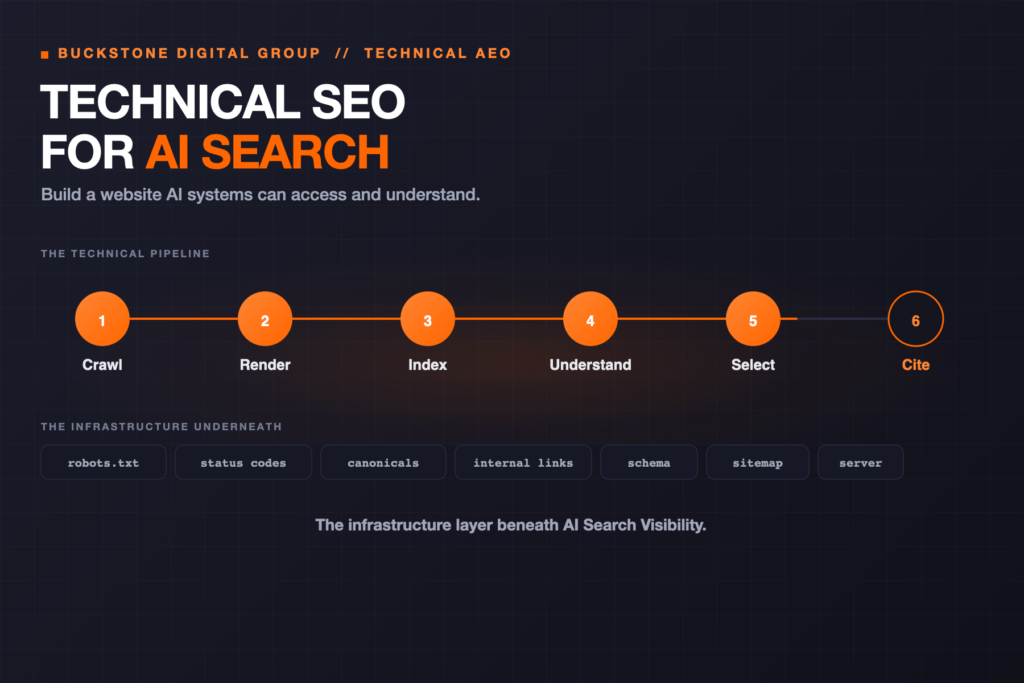
A company invests heavily in AI-focused content, entity SEO, schema markup, and AEO—but its most important pages are blocked, duplicated (a frequent problem for manufacturers),, poorly linked, rendered inconsistently, or technically difficult to retrieve.
No amount of topical authority fixes a page that search systems cannot reliably access or understand. The failure is rarely dramatic; it is a stack of quiet technical problems. Important service pages are noindexed. Canonicals point to the wrong URL. A CDN returns bot challenges. A security plugin blocks unfamiliar crawlers. Core content depends entirely on client-side JavaScript. Product pages return inconsistent status codes. XML sitemaps contain redirects. Internal links leave important pages orphaned. Schema creates duplicate company entities. A redesign leaves staging URLs in metadata. The site is fast for users but unstable for crawlers.
Technical SEO for AI search means removing the barriers that prevent search and answer systems from accessing, interpreting, connecting, and retrieving the website’s most valuable information.
This is the final Phase 2 article in our AI Search Visibility series, and it pulls the technical threads together. Answer Engine Optimization—AEO—is the practice of improving how a business and its information are understood, retrieved, cited, compared, and recommended across answer-based search experiences. Technical SEO is what makes any of that possible.
Key takeaways
Technical SEO for AI search, in one panel
- AI search depends on technical SEO foundations.
- Crawlability and indexability are different things.
- Crawler access can fail at robots.txt, firewall, CDN, server, authentication, or rendering layers.
- A
200 OKresponse does not prove meaningful content is available in the HTML. - Important pages should be internally linked and structurally easy to discover.
- Canonicals help consolidate duplicate or similar URLs but must be implemented consistently.
- XML sitemaps are discovery tools, not indexing guarantees.
- Structured data can clarify entities and relationships but does not replace content.
- JavaScript-heavy websites require careful rendering QA.
- Duplicate entity nodes, staging URLs, and conflicting metadata weaken technical clarity.
- Page speed and Core Web Vitals matter for UX and SEO but are not direct AI citation guarantees.
- Technical SEO should support content, evidence, entity clarity, and authority.
- AEO agencies should be able to diagnose technical issues, not merely produce content.
- BuckStone evaluates the full stack: website, server, CDN, rendering, architecture, schema, and measurement.
Is technical SEO different for AI search?
Mostly, no. The fundamentals are the same ones that have always mattered: crawlability, indexability, rendering, URL consistency, internal linking, page structure, structured data, server reliability, sitemaps, mobile usability, and search eligibility. What changes is the visibility context. Traditional SEO measures rankings, impressions, clicks, and CTR—which is exactly why SEO isn’t dead but has changed. AI Search Visibility also measures citations, mentions, comparisons, recommendations, source inclusion, and accuracy.
The technical foundation is familiar. The visibility outcomes are expanding.
Technical SEO vs. AEO
The two disciplines overlap heavily; it is more accurate to say AEO sits on top of technical SEO than beside it.
| Technical SEO provides | AEO builds on it with |
|---|---|
| Crawlability | Retrieval for a specific question |
| Indexability | Answer eligibility |
| Site architecture | Entity and topic relationships |
| Internal linking | Source and context relationships |
| Structured data | Machine clarity |
| Rankings & impressions | Citations, mentions, recommendations |
| Search performance | Search + answer visibility |
Technical SEO creates access and structure. AEO builds on that foundation with understanding, evidence, corroboration, and measurement.
Which is why the honest positioning is simple: AEO is not a replacement for technical SEO. It depends on it. And technical SEO alone does not create recommendations—it creates the conditions under which useful content, clear entities, evidence, and authority can compete.
1. Crawlability
Crawlability is whether the relevant systems can retrieve your pages at all. It can break at robots.txt, in page accessibility and links, in crawler permissions, in security tools, at the CDN, at the server, or behind authentication. Important public pages must be reachable by the systems you care about—the full stack is covered in is your website blocking AI crawlers.
The usual culprits: a stray Disallow: /, a blocked /blog/ or product directory, stale staging rules, bot challenges and CAPTCHAs, IP blocking, aggressive rate limiting, login walls, geographic restrictions, broken internal links, orphan pages, and unstable server responses.
2. Indexability
Crawlable is not the same as indexable. A page can be perfectly reachable and still be excluded by a noindex, an X-Robots-Tag header, a canonical pointing elsewhere, a redirect target, a soft 404, or duplicate-URL confusion—or simply never make it into a sitemap or get an internal link.
For Google’s generative AI features, pages generally need to be indexed and eligible for Google Search; the same fundamentals that govern appearing in Google AI Overviews apply here. For other AI platforms, think in terms of retrievability rather than assuming an identical indexing system.
3. Robots.txt and crawler-specific controls
robots.txt groups rules by user-agent, with global wildcards and crawler-specific rules. The important distinction is between search/retrieval crawlers and training crawlers—controlling one does not necessarily control the other, so a training opt-out is a separate decision from search visibility. Use only documented crawler names, and never open everything indiscriminately.
| Crawler | Documented role |
|---|---|
| Googlebot | Crawls for Google Search, which feeds AI Overviews and AI Mode (no separate public AI crawler) |
| OAI-SearchBot | Surfaces sites in ChatGPT’s search results |
| GPTBot | Crawls content that may be used to train OpenAI models |
| ChatGPT-User | User-triggered fetch for a specific request |
| PerplexityBot | Surfaces & links sites in Perplexity results |
| Perplexity-User | User-triggered fetch; generally ignores robots.txt |
Because some user-triggered fetchers do not respect robots.txt, and because Google uses no separate public AI-Overviews crawler, robots.txt is one control among several—the firewall and CDN layers matter just as much. The platform-specific playbooks that sit on top of this foundation are covered in how to get recommended by ChatGPT, how to show up in Google AI Mode, and how to get cited by Perplexity.
4. HTTP status codes and redirects
A crawler only ever gets what your server returns, so the status code is the first thing to verify on important URLs.
| Code | Meaning | Why it matters |
|---|---|---|
| 200 | OK | Success—but does not prove the content rendered |
| 301 | Permanent redirect | Consolidates signals to the new URL |
| 302 | Temporary redirect | Signals the move is not permanent |
| 403 | Forbidden | Often a firewall or bot block on a legitimate crawler |
| 404 | Not found | Page is gone; watch for soft 404s returning 200 |
| 410 | Gone | A deliberate, permanent removal |
| 429 | Too many requests | Rate limiting throttling crawlers |
| 500 | Server error | Makes the page unreliable to fetch |
| 502 | Bad gateway | Upstream/proxy failure |
| 503 | Service unavailable | Maintenance or overload; fine briefly, harmful if persistent |
Beyond the codes themselves, watch for redirect chains and loops, soft 404s, broken canonical targets, intermittent errors, stale URLs, and rate limiting that only appears under crawler load.
5. JavaScript rendering
A page can respond fine at the URL level and still hand back weak or empty primary HTML. The risks: client-side-only content, delayed API responses, hydration failures, blocked scripts or CSS, content injected after interaction, infinite scroll, lazy-loaded body text, and cookie- or authentication-dependent rendering. Do not assume every AI crawler renders JavaScript identically—Google can, but reliability varies across systems.
The safe approach: server-render or statically render primary content where practical, inspect the raw HTML response (not just the browser DOM), compare rendered output, test important pages, monitor JavaScript errors, and keep essential links and text in accessible HTML. This is frequently a development decision as much as an SEO one.
Technical audit
Your AI visibility problem may be technical before it is editorial.
BuckStone can audit crawlability, indexability, rendering, server responses, canonicals, structured data, internal linking, and crawler access across your highest-value pages.
6. Site architecture
Logical architecture makes the relationships between the homepage, services, industries, products, location pages, articles, case studies, authors, and About information legible to both people and machines. It also affects crawl depth and discoverability: pages buried many clicks deep, or reachable only through search, are harder to find. Treat “important pages within a few clicks of the homepage” as a useful heuristic, not an absolute rule.
Good architecture makes the website easier for users and machines to navigate as a coherent information system.
7. Internal linking
Internal links do the quiet work of discovery, crawl paths, topic and entity relationships, page importance, navigation, and context. The relationships that matter most are the obvious ones: article to service, service to case study, case study to industry, industry to service, article to author, author to organization, product to supporting guide, and location to service.
The common mistakes are just as consistent: orphan pages, generic “click here” anchors, footer-only links, repetitive automated links, linking every page to everything, broken internal links, and overusing exact-match anchors. Use natural, descriptive anchors that describe the destination.
8. Canonicals and duplicate content
A canonical tag tells search engines which URL you consider the primary version of similar or duplicate content—across parameters, HTTP/HTTPS, www/non-www, pagination, filtered URLs, product variants, staging URLs, printer pages, and syndication. Crucially, canonicals are a signal, not an absolute command; search engines may choose a different canonical, and platforms may treat them differently.
Ambiguity is the real enemy. When canonicals, internal links, sitemaps, and redirects point in different directions for the same content, you send conflicting signals. And duplicate content is not automatically a penalty—the goal is consolidation and clarity, not fear.
9. XML sitemaps
A sitemap supports discovery; it does not force indexing. A good one contains canonical, indexable, live, high-value URLs—and nothing else. The frequent problems are sitemaps stuffed with redirects, 404s, noindex URLs, staging URLs, duplicates, obsolete products, expired pages, and low-value parameter URLs. For larger sites, segmenting sitemaps by type (products, articles, pages) makes health issues easier to spot.
10. Structured data and entity relationships
Structured data can make relationships explicit—Organization, Person, Article, Product, LocalBusiness, BreadcrumbList, publisher, author, brand, location. The technical discipline is consistency: reuse a stable @id for the organization and each real person, avoid duplicate entity nodes from stacked plugins, remove staging references, and keep markup aligned with visible content. We cover the limits in can structured data help your business appear in AI search, and the wider identity picture in entity SEO.
Structured data should clarify the website’s information architecture, not create a second hidden version of the business.
11. Metadata, mobile, and Core Web Vitals
Metadata & page signals. Titles, meta descriptions, H1 and heading hierarchy, canonicals, robots directives, Open Graph, language and hreflang where relevant, and accurate publication and modification dates should be consistent and truthful. Metadata does not directly control AI citations—it clarifies.
Mobile. Google uses mobile-first indexing, so the mobile rendering is effectively the version that counts. Watch for content hidden on mobile, broken navigation, poor tap targets, modal obstruction, layout shifts, and mobile-only errors.
Core Web Vitals. The current set measures real-world experience: LCP (loading, target under 2.5 seconds), INP (responsiveness, target under 200 ms—INP replaced FID in 2024), and CLS (visual stability, target under 0.1). Performance matters for user experience, search quality, engagement, crawl efficiency in some environments, and conversion—but do not claim that faster Core Web Vitals directly determine AI citation inclusion. They don’t.
12. Server, CDN, firewall, and logs
Technical access can fail entirely outside the CMS. Your CDN, WAF, bot protection, caching, rate limiting, DNS, SSL, hosting, geoblocking, uptime, and response times all sit between a crawler and your content. This is why testing a page in your logged-in browser can miss crawler-specific failures completely—the request that succeeds for you may be challenged for an unfamiliar user-agent.
The reliable checks are the boring ones: review CDN and WAF logs, server logs, and crawler logs; inspect response headers; and repeat test requests. Log files are the ground truth for which crawlers actually reached the site, which URLs they requested, and what status they received—bearing in mind that crawler user-agents can be spoofed, so use official validation guidance (such as reverse-DNS or published IP ranges) where available.
Logs tell you what requested the website and how the server responded. They do not reveal every downstream ranking or citation decision.
Two structural issues deserve their own mention. Orphan pages—strong pages with no internal links, or linked only from the sitemap—stay weakly discoverable no matter how good they are; integrate them contextually into the relevant clusters. And pagination, filters, faceted navigation, and parameters can create crawl traps and duplicate categories on ecommerce and large sites; there is no single universal fix, but a coherent canonical, internal-linking, and indexation strategy is essential—often part of ecommerce and marketplace growth.
A technical SEO checklist for AI search
Access
- robots.txt & crawler permissions
- Firewall & CDN behavior
- Authentication walls
- Server stability
Indexability
noindex/X-Robots-Tag- Canonicals & redirects
- Search eligibility
- Sitemap inclusion
Rendering
- Primary HTML present
- JavaScript & blocked assets
- Hydration & content loading
- Mobile rendering
Architecture
- Crawl depth
- Internal links & orphan pages
- Breadcrumbs
- Service & topic relationships
Structured data
- Stable Organization & Person IDs
- Author/publisher relationships
- No duplicate nodes or staging URLs
- Visible-content alignment
Performance & monitoring
- Core Web Vitals & mobile usability
- Server response, uptime, caching
- Search Console, analytics, logs
- Crawler tests & AI visibility measurement
How to perform a technical AEO audit
The audit process
Ten steps, high-value pages first
Identify high-value pages
Homepage, service, product, industry, location pages, case studies, key articles, author pages.
Test crawler access
robots.txt, CDN, firewall, and server responses for the crawlers you care about.
Confirm indexability & canonicals
Check noindex, X-Robots-Tag, canonical targets, and redirect behavior.
Inspect raw & rendered HTML
Confirm primary content, links, and facts exist without JavaScript.
Crawl the architecture
Find broken links, orphan pages, crawl depth, redirects, duplicate titles and canonicals, thin pages.
Audit structured data
Node types, IDs, author and publisher relationships, duplicates, staging references.
Review sitemaps
Confirm only canonical, indexable, live, high-value URLs are included.
Review logs where available
Which crawlers arrive, which URLs, what status codes, and what is being missed.
Evaluate mobile & performance
Mobile rendering, Core Web Vitals, server response, and usability issues.
Connect findings to AI visibility
Which important pages are technically absent, inaccessible, or weakly connected—and which map to missing citations.
Diagnose and fix
A crawl report is only useful if someone can fix what it finds.
BuckStone combines technical SEO, development, structured data, entity optimization, content strategy, and AI visibility measurement—and can implement the fixes directly.
Does technical SEO guarantee AI visibility?
No. Technical work moves you through the first stage of a longer progression: Access → Understanding → Evidence → Corroboration → Measurement. A technically perfect page can still fail if it lacks relevance, useful information, original evidence, expertise, competitive strength, external credibility, or customer fit.
Technical SEO removes barriers. It does not create authority by itself.
If your business is missing across platforms, work through why your business is not appearing in AI search results, and confirm improvements with measurement rather than assumption.
What should a technical AEO agency do?
What a capable agency does
- Audits crawlability and indexability
- Reviews robots.txt and tests relevant crawlers
- Reviews CDN and firewall behavior and server responses
- Crawls the full site and reviews internal linking
- Audits canonicals and XML sitemaps
- Tests rendering and audits structured data
- Consolidates entity IDs and author/publisher relationships
- Analyzes logs where available
- Reviews mobile and performance issues
- Audits migration and staging leftovers
- Connects technical findings to content and AI visibility data
- Implements fixes and re-tests afterward
What it should not merely do
- Run an automated crawler and export 500 warnings
- Add schema and call it done
- Create
llms.txtor install plugins - Promise ChatGPT rankings
- Ignore the server and CDN layers
- Ignore business outcomes
Technical depth
- Strong technical SEO experience
- WordPress & development capability
- CDN and firewall knowledge
- Search Console & log analysis
Strategy & structure
- Structured-data implementation
- Entity SEO understanding
- Internal-linking strategy
- AI crawler awareness
Measurement & delivery
- AI visibility measurement, GA4, and conversion tracking
- Clear prioritization and the ability to implement fixes
- No guaranteed AI rankings — nobody controls independent source selection
How BuckStone approaches technical SEO for AI search
We run five connected workstreams. A technical discovery audit of robots.txt, crawlability, indexability, canonicals, redirects, sitemaps, response codes, and internal links. A crawler and security review covering Googlebot access, relevant AI search crawlers, firewall behavior, CDN rules, rate limiting, and server logs where available. A rendering audit comparing raw and rendered HTML, JavaScript dependencies, blocked assets, and primary-content accessibility. Site architecture work improving service, topic, industry, and author relationships, case-study integration, crawl depth, and orphan pages. And structured data and entity consolidation for Organization, Person, Article, Product, and LocalBusiness with stable IDs.
Two more make it durable: migration and deployment QA to catch staging rules, old canonicals, broken redirects, lost metadata, schema regressions, sitemap errors, and broken links; and measurement connecting technical work to search performance, Search Console’s generative AI reporting, AI citations, brand mentions, competitor visibility, referral traffic, and leads. It all maps onto our five-part framework—Access, Understanding, Evidence, Corroboration, Measurement—as the infrastructure layer beneath the whole AI Search Visibility system, and it is the backbone of our SEO and AI Search Visibility work.
BuckStone does not treat technical AEO as a separate collection of AI tricks. We make the website technically strong enough to support both traditional search and answer-engine visibility.
Final answer: technical SEO for AI search
Technical SEO for AI search should ensure that important pages are crawlable; public content is indexable or retrievable where relevant; server responses are stable; canonicals and redirects are coherent; primary content renders reliably; site architecture makes important pages easy to discover; internal links connect topics and entities clearly; XML sitemaps contain valid canonical URLs; structured data accurately represents the business; authors and publishers are connected correctly; CDNs, firewalls, and security tools do not block intended crawler access; mobile and performance problems do not undermine usability; technical changes are monitored over time; and technical improvements are tied to AI visibility and business outcomes.
Technical SEO creates the infrastructure for AI Search Visibility. Content, evidence, authority, and relevance determine what that infrastructure ultimately produces.
Work with BuckStone
Build the technical foundation for traditional and AI-powered search.
BuckStone can identify and fix the technical barriers limiting crawlability, indexation, understanding, source visibility, and conversion performance.
Frequently asked questions
What is technical SEO for AI search?
It is the disciplined application of crawlability, indexability, rendering, architecture, internal linking, canonicals, structured data, server reliability, and monitoring so that search and answer systems can access, interpret, connect, and retrieve a website’s most valuable information.
Is technical SEO different for AEO?
The fundamentals are the same. What changes is the visibility context: alongside rankings and clicks, AEO also cares about citations, mentions, comparisons, and recommendations. AEO builds on technical SEO rather than replacing it.
What is AEO technical SEO?
It is technical SEO applied with answer-engine outcomes in mind—making a site accessible, retrievable, interpretable, structurally coherent, and technically trustworthy so its content and entities can compete for inclusion in generated answers.
What technical SEO is required for ChatGPT visibility?
Publicly accessible, retrievable pages that OAI-SearchBot can reach—so review robots.txt, firewall, CDN, and server behavior, ensure primary content is in accessible HTML, and keep important pages internally linked. Access is necessary but does not guarantee citation.
What technical SEO is required for Google AI Overviews?
The same foundations as Google Search: crawlable and indexable pages, stable server responses, coherent canonicals, reliable rendering, and eligibility under Search Essentials. AI Overviews use the Search index, so there is no separate technical requirement.
Does Google use a separate crawler for AI Overviews?
No. AI is built into Search, so Googlebot access and standard indexing are the controls. There is no separate public AI Overviews crawler to allow, and no special submission process.
How do I know whether AI crawlers can access my website?
Test important pages, not just the homepage: read every robots.txt group, request each URL and record its status code, view the raw HTML, review CDN and firewall logs for blocked or challenged crawlers, and check server logs for which crawlers actually arrive.
Can robots.txt block AI Search Visibility?
Yes. A broad Disallow or a rule blocking a search crawler can make pages ineligible to be surfaced. Note that some user-triggered fetchers ignore robots.txt, so it is one control among several rather than the whole story.
Can a firewall block AI crawlers?
Yes, and it is a common hidden cause. A CDN or web application firewall can block a crawler by IP, user-agent, rate, or heuristics before the request reaches your site—so a passing robots.txt test does not prove the crawler is getting through.
Can JavaScript prevent AI systems from reading a website?
It can. If core content, links, or facts appear only after client-side JavaScript runs, a system may receive a nearly empty page while still getting a 200 response. Server-render or statically render the content that matters, and confirm it exists in the raw HTML.
Does schema markup help with AEO?
It can clarify entities and relationships and support ordinary Search features, but it does not guarantee AI citations and does not replace visible content. Treat it as clarity work that must match the page, not a submission mechanism.
Is structured data required for AI search?
No. Google states structured data is not required for its generative AI features and there is no special AI schema. Accurate structured data that matches visible content is reasonable to maintain, but it is not a requirement for appearing.
Do internal links matter for AI search?
Yes. Internal links drive discovery and crawl paths and express topic and entity relationships. Orphan pages—strong pages with no internal links—stay weakly discoverable no matter how good the content is.
Do canonical tags affect AI Search Visibility?
Canonicals help consolidate duplicate or similar URLs so signals point to one primary version. They are a signal rather than an absolute command, and conflicting canonicals, links, sitemaps, and redirects create ambiguity that can weaken visibility.
Are XML sitemaps important for AEO?
They support discovery of your canonical, indexable, high-value URLs, but they do not force indexing. A sitemap full of redirects, 404s, or noindex URLs is a common technical problem worth cleaning up.
Does page speed affect AI search visibility?
Performance matters for user experience, search quality, engagement, and crawl efficiency in some environments, but faster load times do not directly guarantee AI citations. Fix speed for users and search quality, not as an AI citation lever.
Do Core Web Vitals affect AI citations?
Not directly. LCP, INP, and CLS measure loading, responsiveness, and visual stability for real users and feed into search quality, but no documentation ties them to AI citation selection. They are a UX and SEO signal, not an AI switch.
Can duplicate content hurt AI search visibility?
Duplicate content is not automatically a penalty, but it can split or confuse signals when canonicals and links are inconsistent. The goal is consolidation and clarity so the intended primary URL is the one that competes.
What is an orphan page?
A page with no internal links pointing to it—or one reachable only from the XML sitemap. Even excellent orphan pages are hard to discover; the fix is integrating them contextually into the relevant topic or service cluster.
What is a technical AEO audit?
A structured review of crawler access, indexability, rendering, architecture, internal linking, canonicals, sitemaps, structured data, logs, mobile, and performance on high-value pages—then connecting those technical findings to AI visibility outcomes and a prioritized fix list.
What should an AI SEO technical audit include?
Crawler and firewall/CDN access testing, indexability and canonical review, raw-vs-rendered HTML inspection, a full-site crawl for orphans and duplicates, structured-data and entity consolidation, sitemap and log review, mobile and Core Web Vitals checks, and a measurement plan.
Should I hire a technical SEO agency or an AEO agency?
Realistically you need one team that does both. AEO depends on technical SEO foundations, so an agency that cannot diagnose crawl, index, rendering, and server issues—and implement fixes—cannot deliver durable AI visibility.
How much does a technical AI SEO audit cost?
There is no universal price. Cost depends on website size, CMS, ecommerce complexity, number of templates, CDN and firewall setup, rendering architecture, existing technical debt, structured-data complexity, log access, number of locations, and how much implementation is required.
Can technical SEO guarantee AI citations?
No. Technical SEO removes barriers and creates eligibility, but citation still depends on relevance, useful content, evidence, authority, and competition—and no agency controls a platform’s independent source-selection decisions.
Does llms.txt improve technical AEO?
There is no documentation making llms.txt a requirement, and Google states Search does not use such files. Prioritize crawlability, indexability, rendering, architecture, structured data, and evidence instead.
What does BuckStone include in an AI Search Visibility audit?
Technical discovery (access, indexability, canonicals, sitemaps, response codes, links), crawler and security review, a rendering audit, site-architecture and entity work, structured-data consolidation, migration QA, mobile and performance review, and measurement connecting the work to search, AI, and business outcomes.
Sources & methodology
Platform and technical claims here were checked against current official documentation. We distinguish official platform documentation and established technical-SEO standards from BuckStone’s AEO methodology and practical recommendations. Where platforms do not disclose complete retrieval or source-selection systems—which they do not—we say so rather than inferring a formula. Core Web Vitals are current as of publication (LCP, INP, CLS; INP replaced FID in 2024), Google’s generative AI features use the Search index with no separate public AI crawler, and Google states Search does not use llms.txt. No AI citation, ranking, or traffic outcome is guaranteed, and no live robots.txt, CDN, firewall, global-schema, or plugin changes were made in producing this article.
- Google Search Central — How Google Search Works
- Google Search Central — Search Essentials
- Google Search Central — robots.txt Introduction
- Google Search Central — Robots Meta Tag Specifications
- Google Search Central — HTTP Status Codes & Network Errors
- Google Search Central — JavaScript SEO Basics
- Google Search Central — Canonicalization & Consolidating Duplicate URLs
- Google Search Central — Sitemaps Overview
- Google Search Central — Links Best Practices
- Google Search Central — Mobile-First Indexing
- Google Search Central — Core Web Vitals (LCP, INP, CLS)
- Google Search Central — Introduction to Structured Data
- Google Search Central — AI Features and Your Website
- Google Search Central — Optimizing for Generative AI Features
- OpenAI — Publishers and Developers FAQ
- Perplexity — Perplexity Crawlers