
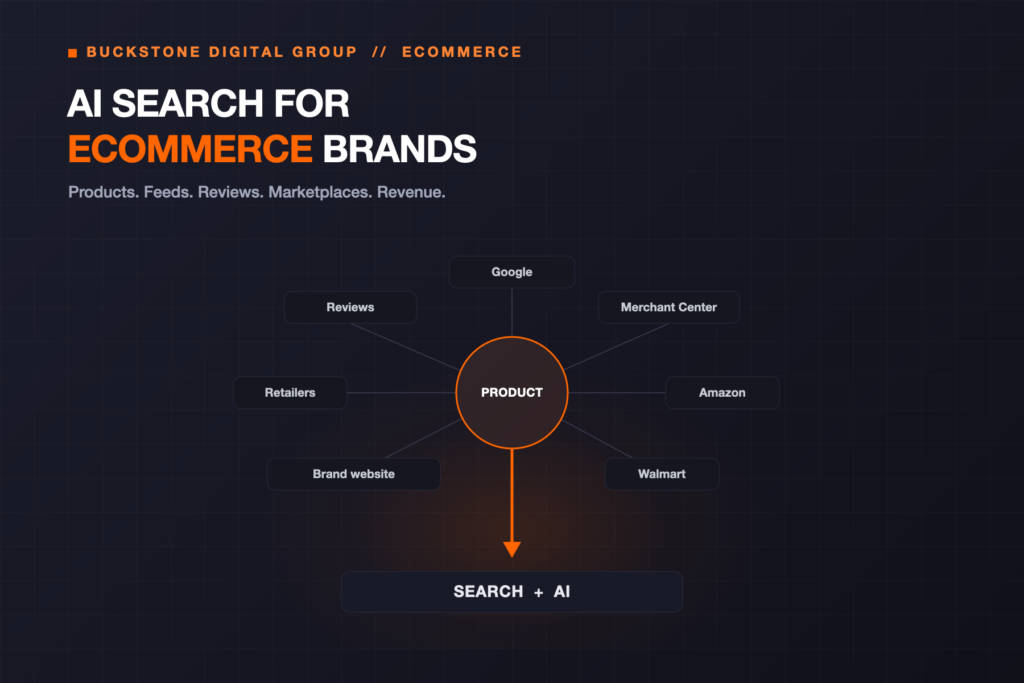
A shopper opens ChatGPT and asks which product to buy for a specific problem. They check Google, glance at Shopping results, skim an AI Overview, search the item on Amazon, compare a few reviews, land on the brand’s own website, search the exact product name, compare prices across two retailers, and finally buy from whichever channel makes the most sense. Not one of those steps is a single keyword ranking for a single product page. For an ecommerce brand, visibility is no longer one ranking for one product page — it is the ability to maintain accurate, persuasive product information across an increasingly fragmented buying journey.
This is the challenge of AI search for ecommerce brands: most brands lose that journey in small, invisible ways — thin product pages, the manufacturer’s description copied to every retailer, conflicting product names, missing identifiers, weak variant architecture, an incomplete Merchant Center feed, outdated prices, out-of-stock confusion, reviews disconnected from the product, resellers outranking the brand, and no way to see which competing products AI keeps recommending. This article is about closing those gaps — making each product easy for both shoppers and AI systems to identify, compare, verify, and buy.
Ecommerce AI visibility depends on whether search systems can accurately understand the product, distinguish it from alternatives, verify its attributes, determine whether it is available and relevant, and find enough credible information to surface it during a buying decision. Product visibility is no longer controlled by one product page — and the strongest ecommerce search strategy keeps that ecosystem accurate, structured, differentiated, and measurable.
- Product identity must be consistent across channels — the channel may change, but the product should not.
- Product detail pages remain foundational; category and collection pages capture broader buyer intent.
- Product feeds are part of the visibility system, not just an advertising input.
- Structured data should match visible product information — and identifiers (SKU, GTIN, MPN) reduce ambiguity.
- Variants require deliberate architecture, not one universal solution.
- Reviews provide product-level evidence, real-world language about fit, performance, and limits.
- Availability and pricing should stay current across the site, feed, structured data, and marketplaces.
- Retailers and marketplaces can strengthen or complicate brand visibility; duplicate descriptions weaken differentiation.
- AI recommendations are contextual to the shopper’s need — there is no universally “best” product.
- Measure across search, AI, marketplaces, traffic, conversion, and revenue — not rankings alone.
- SEO, AEO, Merchant Center, paid media, marketplaces, and CRO should not operate as separate silos.
How AI-driven product discovery changes ecommerce
Answer-driven systems now support product discovery, recommendations, comparison, alternatives, feature filtering, use-case matching, research, review summarization, brand evaluation, and even retailer selection. Shoppers ask things like “what is the best non-toxic lubricant for marine equipment?”, “which running shoe is best for wide feet?”, “compare these three products,” or “is there a cheaper alternative to this one?” across ChatGPT, Google AI Overviews, Google AI Mode, and Perplexity.
Product discovery increasingly begins with the problem, preference, or constraint — not necessarily the product name. That means your product has to be understandable by its attributes and use cases, not just its SKU. See what AI Search Visibility is and how businesses get recommended by ChatGPT.
Product recommendability is contextual
A product may be recommended based on use case, feature, compatibility, price, size, material, quality, reviews, availability, shipping, brand, sustainability, customer type, or experience level. The same product can be the right answer for one shopper and the wrong answer for the next.
There is no universally “best product.” There is a best fit for a particular shopper and use case — which is the whole premise of what makes a business (or product) recommendable.
The ecommerce AI Search Visibility framework
AI Search Visibility is the discipline of making a business understandable, credible, retrievable, and recommendable across traditional search engines and AI-driven answer platforms. For ecommerce, that expands: ecommerce AI Search Visibility also requires making individual products, product families, attributes, availability, and brand relationships easy to understand. Answer Engine Optimization (AEO) is the practice of improving how a brand and its products are understood, retrieved, cited, compared, and recommended across answer-driven search experiences. And ecommerce SEO is the process of improving organic visibility for product pages, categories, collections, brands, buying guides, and other commercial pages across search engines. Ecommerce SEO and AEO should operate as one coordinated strategy, not two disconnected projects.
- 1Access
Can systems retrieve the catalog and product information?
- 2Understanding
Can they distinguish products, variants, brands, features, and use cases?
- 3Evidence
Do PDPs, reviews, specifications, media, and buying resources support product claims?
- 4Corroboration
Do marketplaces, retailers, reviewers, distributors, and customers reinforce the product information?
- 5Measurement
Are product visibility, recommendations, conversions, and revenue improving?
1. Access: can systems retrieve the product information?
Access covers crawlability, indexability, rendering, robots directives, XML and product sitemaps, JavaScript, canonicals, pagination, infinite scroll, faceted navigation and filters, internal search pages, product feeds, AI/search crawler access, image accessibility, out-of-stock pages, and marketplace links. A product cannot compete for discovery if critical specifications, pricing, availability, or variant information cannot be reliably retrieved. Start with is your website blocking AI crawlers? and technical SEO for AI search — the foundation that website development supports.
2. Understanding: can systems identify exactly what the product is?
Systems should be able to understand brand, product, product family, SKU, MPN, GTIN, variant, size, color, material, category, features, use cases, compatibility, manufacturer, seller, price, and availability — expressed through Product, Offer, Brand, Organization, BreadcrumbList, and ProductGroup (where current documentation supports variants), with stable IDs, sensible internal linking, and consistent Merchant Center identifiers.
Product ambiguity creates recommendation friction. The easier it is to distinguish Product A from Product B, the easier it becomes to evaluate which one fits the shopper’s request. More on this in how AI systems understand your business and entity SEO.
3. Evidence: does the page prove the product is worth considering?
“Premium quality” is a claim. Specifications, materials, dimensions, compatibility, testing, certifications, real reviews, product photos and video, demonstrations, instructions, use cases, FAQs, warranty, returns, and shipping details are the evidence that makes the claim believable and comparable.
4. Corroboration: does the wider ecosystem reinforce the information?
A brand website describes the product. Amazon, Walmart, retailers, distributors, review publications, marketplace reviews, comparison sites, industry publications, product databases, and customers help create the wider information environment surrounding it — the mechanism explained in how third-party sources influence AI recommendations.
5. Measurement: is visibility creating demand and revenue?
Track product and category rankings, search impressions, Shopping visibility, AI mentions and product recommendations, citation and prompt coverage, competitor share of voice, AI referral traffic, product-page engagement, add-to-cart and conversion rate, revenue, marketplace sales, and new-customer acquisition. Ecommerce visibility should ultimately connect to product discovery, conversion, and revenue — not just rankings. See how to measure AI Search Visibility.
Product detail pages: the ecommerce foundation
A strong product detail page (PDP) should carry the exact product name, brand and product family, images and video, price and availability, a variant selector, a real description with benefits and features, specifications, materials, dimensions, compatibility, use cases, shipping, returns, warranty, reviews, FAQs, related products, and a clear call to action.
A product page should answer enough of the buying question that the shopper does not need to reconstruct basic product facts from Amazon, Reddit, or a retailer. (Depth, not bloat — every field should earn its place.)
- Exact product name, brand, and product family
- Price, availability, and a clear variant selector
- Consistent identifiers (SKU, GTIN, MPN)
- Shipping, returns, and warranty information
- A clear, prominent add-to-cart CTA
- Specifications, materials, dimensions, compatibility
- Original images, alternate views, and video where useful
- Use cases and honest benefit/limitation context
- Real product reviews and product-specific FAQs
- Related and comparison links to aid self-selection
Product descriptions: stop giving retailers your entire SEO strategy
Many brands distribute identical descriptions to Amazon, Walmart, retailers, distributors, and affiliates. That may be operationally necessary — but the brand’s own PDP should hold the strongest, most complete version of the product story: brand expertise, use cases, comparison context, demonstrations, original images, FAQs, technical detail, and customer evidence.
If every seller has the exact same product description, the brand has surrendered one of its easiest opportunities to differentiate its own page. (This isn’t about a “duplicate-content penalty” — it’s about being the clearest, richest source.) Related: why generic content fails in AI search.
Product identifiers: SKU, MPN, GTIN, UPC, model numbers
Identifiers help systems determine whether two listings describe the same product. Keep them consistent across your website, Merchant Center, Amazon, Walmart, retailers, and structured data. No single identifier guarantees AI inclusion — but inconsistent identifiers guarantee ambiguity.
| Identifier | What it does |
|---|---|
SKU | Your internal stock-keeping unit; unique within your catalog |
GTIN / UPC / EAN | Globally unique product identifier used across retailers and marketplaces |
MPN | Manufacturer part number; identifies the product independent of seller |
| Model number | The manufacturer’s model designation shoppers often search by |
Product variants
Color, size, flavor, material, pack quantity, configuration — variants are where architecture decisions matter most. The options include one canonical PDP with selectable variants, separate indexable variant URLs where justified, and ProductGroup/variant structured data (with variesBy, hasVariant, and a stable productGroupID) where current documentation supports it, alongside careful canonicalization, unique inventory, variant-specific images, and variant-specific identifiers.
The right architecture depends on whether the variant has distinct search demand, meaningful content, and a reason to exist independently. Don’t mint a URL for every combination — and don’t bury a high-demand variant inside a dropdown.
A quick way to decide:
\n| When the variant… | Better architecture |
|---|---|
| Has its own search demand (a color, size, or model people search for) | Give it an indexable URL with unique content and its own Product markup |
| Differs only cosmetically, with no distinct demand | One canonical PDP with a variant selector, grouped via ProductGroup |
| Shares specs, price, and story across many options | ProductGroup with variesBy/hasVariant — don’t mint a URL per combination |
| Is effectively a different product (different use or specification) | Treat it as its own product, with its own page and identifiers |
Category and collection pages
Category and collection pages capture broader product intent. Strong ones offer a clear category definition, useful filters, a relevant product selection, buyer guidance, key attributes, comparison support, relevant FAQs, and internal links — without burying the products under a giant SEO essay.
Product pages answer “Is this the product?” Category pages often answer “Which type of product should I choose?” Both are commercial pages worth optimizing.
Faceted navigation and filters
Filters for size, color, price, material, feature, brand, and availability are great for shoppers — and dangerous for crawl budget. Millions of crawlable combinations create duplicate content, parameter-URL sprawl, crawl waste, index bloat, and canonical confusion. Decide which facets deserve indexation, which stay user-only filters, and which combinations have real search demand.
Ecommerce architecture should expand intentionally, not every time a shopper clicks a filter.
Out-of-stock and discontinued products
“Out of stock” is product information — a disappearing URL often creates a worse customer and search experience. For temporarily unavailable items, keep the page live, show accurate status, offer restock notifications, suggest alternatives, and preserve SEO value. For permanently discontinued products, the right move depends on backlinks, search demand, whether a replacement exists, and historical usefulness — options include keeping an archived page, linking to a replacement, or redirecting when genuinely appropriate. There is no blanket rule.
Pricing and availability accuracy
Price and availability may diverge across your website, Amazon, Walmart, retail partners, sale pricing, the Merchant Center feed, and structured data — and every promotion, coupon, member price, or backorder is a chance for them to drift apart.
Product information stops being useful when the shopper cannot trust whether the item is actually available at the stated price.
Product structured data
Product structured data helps systems parse a page accurately. Relevant types and properties include Product, Offer, Brand, AggregateRating (where valid), Review (where legitimate), SKU/GTIN/MPN, availability, price and currency, shipping/returns properties where supported, and ProductGroup for variants where current documentation supports it. Google supports two related experiences here — product snippets and merchant listings — and both can support variants. The rules matter: schema must match visible content; never fabricate reviews; don’t mark marketplace reviews as first-party without valid implementation; don’t display stale price or availability; avoid duplicate Product nodes injected by themes, apps, or plugins.
Product schema should describe the product page accurately. It is not an AI recommendation switch — and, as with the retirement of certain rich-result types, valid markup earns eligibility and clarity, not a guaranteed placement. See can structured data help AI Search Visibility?
Google Merchant Center and product feeds
Merchant Center is not merely an advertising feed. It is an important structured representation of the ecommerce catalog within Google’s ecosystem — product title, description, link, image, price, availability, brand, GTIN, MPN, condition, product type, Google product category, shipping, and promotions. Google’s free product listings are on by default in newer Merchant Center accounts, and Google describes its AI shopping experiences (AI Mode and AI Overviews) as assembling product information, prices, and availability from the same Shopping Graph that Merchant Center helps populate.
The feed, PDP, structured data, checkout, and inventory should agree. When the product feed, product page, and structured data disagree on price, availability, or identity, you hand ambiguity to the exact systems you want to recommend you. (Merchant Center capabilities evolve — verify current Google documentation before exact configuration claims.)
Amazon, Walmart, resellers, and the brand website
Marketplaces are separate search ecosystems with their own listings, titles, bullets, images, reviews, inventory, advertising, and search behavior — and a product can perform very differently on Amazon, on Walmart, on Google, and on your own site. Coordinate content consistency, availability, marketplace SEO, and PPC across them (using Brand Registry and authorized-reseller relationships where relevant), even when the purchase happens off your site.
Marketplace visibility should be coordinated with the brand strategy even when the purchase occurs outside the brand website. That coordination is the core of ecommerce & marketplace growth.
Brand vs. reseller visibility
A reseller sometimes outranks the brand for the brand’s own product — usually because of better descriptions, stronger marketplace authority, more reviews, cleaner structured data, more complete inventory, stronger backlinks, or better crawlability. Resellers aren’t enemies: they expand distribution, create corroboration, generate reviews, and increase availability.
The objective is not to suppress legitimate resellers. It is to make the brand the clearest source of truth for its products — the same principle that helped Packer’s Pine beat bigger brands in AI search.
ChatGPT and Google AI for ecommerce
Shoppers ask AI for the best product for a use case, for A-vs-B comparisons, for affordable alternatives, for a product with a specific feature, for where to buy, and whether something is worth it. Monitoring should capture whether the product appears, the brand association, whether the attributes are correct, the recommendation context, which competitors show up, which sources are cited, and which retailers get mentioned. A product mention is only useful if the recommendation accurately reflects what the product actually is — there is no universal ChatGPT ranking formula to game.
Ecommerce brands should treat Google Search, Shopping, Merchant Center, structured data, and AI search as connected surfaces that require consistent product information — not as separate optimization projects. No single optimization guarantees AI inclusion.
Content, comparison, and conversion
Beyond product pages, useful ecommerce content includes buying and comparison guides, product-selection tools, use-case and care content, troubleshooting, FAQs, video demonstrations, original research, and compatibility guides. The best of it shortens the distance between a question and a confident purchase. Honest comparison content helps buyers self-select; fake comparisons that always crown the brand are just ads in disguise.
| Generic | Useful & specific |
|---|---|
| Benefits of Protein Powder | Whey Concentrate vs. Isolate: Which Fits Your Protein, Calorie, and Budget Goals? |
| How to Choose Running Shoes | Neutral vs. Stability Running Shoes: How to Choose Based on Your Gait and Training |
| Why Eco-Friendly Products Matter | How to Compare Biodegradability Claims Before Choosing an Industrial Lubricant |
| Our Product Is High Quality | What Our Product Is Made From, How It’s Tested, and Which Applications It Was Designed For |
And none of it matters if the store doesn’t convert. AI and search traffic still meet product-page speed, mobile UX, CTA clarity, checkout friction, shipping costs, returns, trust signals, and payment options. More visibility cannot compensate for a store that makes buying unnecessarily difficult. On the demand side, Google Ads and Shopping capture high-intent product searches, defend the brand, and launch products; paid social drives discovery, creative testing, retargeting, and catalog advertising; marketplace PPC supports Amazon and Walmart visibility; and ChatGPT Ads now supports product-feed campaigns built from a retail catalog. Paid media creates demand and immediate visibility; SEO and AEO strengthen the product information buyers use to evaluate the purchase.
Why competing products appear instead of yours
When a competing product keeps showing up in recommendations and yours doesn’t, it’s rarely about the product being objectively better. It’s usually about which one is easier to identify, compare, verify, and buy.
- Their product identity is clearer
- Their PDPs contain better information
- Their identifiers are consistent
- Their category pages capture the intent better
- Their structured data is more accurate
- Their product imagery is stronger
- Their website is easier to crawl
- Their reviews are stronger and more recent
- Their marketplace listings are more complete
- Their pricing and availability are more reliable
- Their Merchant Center feed is cleaner
- Their comparison content is more useful
- Retailers reinforce their visibility
- They monitor AI recommendations — and their store converts
The competing product may not be objectively better. It may simply be easier for shoppers and search systems to identify, compare, verify, and purchase.
What should an ecommerce AEO audit include?
A practical ecommerce AEO audit works the five layers through the whole commerce stack:
- Crawlability, indexability, rendering, canonicals, facets, filters, pagination, product sitemaps, crawler access
- Categories, collections, product families, products, variants, internal linking, on-site search
- Brand, product names, SKU/GTIN/MPN, variant identifiers
- PDP depth, specs, images, video, FAQs, reviews, availability, shipping, returns
- Product/Offer/ProductGroup/reviews/ratings; duplicate nodes; price and availability accuracy
- Merchant Center titles, descriptions, identifiers, images, price, availability
- Amazon, Walmart, resellers, listing accuracy, brand ownership, reviews
- Rankings, Shopping visibility, AI prompts, mentions, citations, recommendations, share of voice, traffic, conversion, revenue, marketplace sales
How ecommerce brands should measure AI Search Visibility
Because product intent is contextual, measurement should follow prompt families, then watch brand and product presence, citation and recommendation coverage, accuracy, competitor share of voice, which retailers and brand-site pages get cited, AI referral traffic, conversion, and revenue.
- 1Product discovery
“Best [product] for [use case]” · “What should I buy for X?”
- 2Feature discovery
“Best [product] with [feature]” · “product suitable for [constraint]”
- 3Comparison
“Product A vs Product B” · “alternatives to Product X”
- 4Price / value
“Best [product] under $X” · “is Product X worth the price?”
- 5Brand validation
“Is [brand] good?” · “is [product] worth buying?”
- 6Purchase discovery
“Where can I buy Product X?” · “is Product X available on Amazon?”
Watching a product’s share of these prompts over time — and why it moves — is exactly what AI rank tracking vs. Google rank tracking covers.
How BuckStone approaches ecommerce AI visibility
BuckStone does not treat ecommerce as “do SEO on the Shopify site.” We evaluate the entire commerce ecosystem: technical SEO and site architecture, PDPs and categories, product schema, product feeds and Merchant Center, Google Ads and Shopping, paid social, Amazon and Walmart, marketplace PPC, reseller relationships, reviews, AI recommendation visibility, analytics, and conversion — connected to revenue.
Ecommerce brands do not need separate teams optimizing the website, Merchant Center, Amazon, Walmart, paid media, and AI visibility without talking to one another. BuckStone treats product discovery as one connected system — from search query or AI prompt to product data, marketplace visibility, click, conversion, and revenue. The channel may change. The product identity should not.
Questions ecommerce brands should ask their SEO or AEO agency
An ecommerce search strategy should have answers more specific than “we’ll optimize your product descriptions.” Use this to pressure-test any agency:
- Can search engines crawl our catalog efficiently?
- Are filters creating index bloat?
- Are product variants structured correctly?
- Are SKU, MPN, GTIN, and brand identifiers consistent?
- Is Product schema accurate, and price/availability synchronized?
- Is Merchant Center aligned with the website?
- Are discontinued and out-of-stock products handled correctly?
- Why do retailers outrank our own PDPs?
- How are Amazon and Walmart included in the strategy?
- Which competing products appear in AI recommendations, and which sources support them?
- Are our reviews strengthening the right product attributes?
- How are AI product recommendations measured, and are AI visits converting?
- How are paid search and Shopping informing SEO?
- Can you implement Shopify/WordPress/feed/schema changes directly — and what happens after the audit?
The final answer: how should ecommerce brands prepare for AI search?
Ecommerce brands should fix catalog crawlability, clarify product identity, strengthen PDPs, improve category architecture, use identifiers consistently, manage variants intentionally, keep pricing and availability accurate, improve Product schema, clean Merchant Center feeds, coordinate marketplace listings, build authentic review evidence, strengthen comparison and buying content, track AI product recommendations, and connect visibility to conversion and revenue.
The goal is not to make AI recommend every product to every shopper. The goal is to make each product understandable and credible enough to be considered when it genuinely fits the shopper’s need.
The ecommerce brands most prepared for AI-driven discovery will be the ones that keep product information accurate, differentiated, and connected everywhere customers shop and search.
Frequently asked questions
What is AI Search Visibility for ecommerce brands?
It’s making a brand and its products understandable, credible, retrievable, and recommendable across traditional search and AI answer platforms — including individual products, product families, attributes, availability, and brand relationships — so products get discovered and recommended across the whole buying journey.
What is AEO for ecommerce?
Answer Engine Optimization for ecommerce is improving how a brand and its products are understood, retrieved, cited, compared, and recommended across answer-driven experiences like ChatGPT, Google AI Overviews and AI Mode, and Perplexity.
How can products appear in ChatGPT recommendations?
Make each product easy to identify and verify: strong PDPs, consistent identifiers and naming, accurate structured data, a clean Merchant Center feed, authentic reviews, and coherent marketplace listings. No method guarantees a specific recommendation, but clarity and corroboration make a product a more likely, more accurate answer.
Does ChatGPT recommend ecommerce products?
AI assistants frequently suggest, compare, and help shoppers evaluate products, often drawing on web sources, reviews, and shopping data. Coverage and behavior change over time and vary by prompt, so accuracy monitoring matters as much as presence.
How can products appear in Google AI search?
The same fundamentals that support Search and Shopping support AI features: crawlable, well-structured product pages; accurate product data and structured data; and a clean Merchant Center feed. Google describes its AI shopping answers as drawing on the Shopping Graph, so consistent product information across surfaces is key. Nothing guarantees inclusion.
Does Product schema help AI Search Visibility?
Accurate Product, Offer, and (where supported) ProductGroup markup helps systems parse your products and can make them eligible for enhanced listings. It won’t repair thin content or a broken feed, and it isn’t a recommendation switch — use it for clarity, not as a shortcut.
Does Merchant Center help ecommerce visibility?
Yes. Merchant Center is a structured representation of your catalog inside Google’s ecosystem, powers free product listings, and feeds the Shopping Graph that Google’s AI shopping experiences draw on. A clean, accurate feed is increasingly foundational, not just an ads input.
Do product feeds matter for AI search?
They matter as one part of the system. A feed that agrees with your product pages and structured data on identity, price, and availability reduces ambiguity for the systems assembling shopping answers. A feed that disagrees creates it.
Do SKUs and GTINs matter for SEO?
They help systems determine whether two listings describe the same product, which reduces ambiguity across your site, feed, marketplaces, and structured data. No single identifier guarantees inclusion, but inconsistent identifiers reliably cause confusion.
Should every product variant have its own page?
Not necessarily. Give a variant its own indexable URL when it has distinct search demand, meaningful content, and a reason to exist independently. Otherwise a canonical PDP with selectable variants — supported by ProductGroup markup where appropriate — is often cleaner.
How should out-of-stock products be handled?
For temporary stockouts, keep the page live with accurate status, offer restock alerts, and suggest alternatives — “out of stock” is useful product information. Avoid deleting URLs, which usually creates a worse customer and search experience.
What should happen to discontinued products?
It depends on backlinks, search demand, whether a replacement exists, and historical usefulness. Options include keeping an archived page, linking to a replacement, or redirecting when genuinely appropriate. Avoid blanket redirects of every discontinued URL.
Why do retailers outrank brand websites?
Often because their listings have better descriptions, more reviews, stronger authority, cleaner structured data, more complete inventory, or better crawlability. The fix isn’t to fight resellers — it’s to make the brand PDP the clearest, richest source of truth for the product.
How should brands handle duplicate product descriptions?
Distributing the same copy to retailers may be necessary, but your own PDP should hold the strongest, most complete version — brand expertise, use cases, comparisons, original media, FAQs, and technical detail. This isn’t about a penalty; it’s about differentiation where you control the page.
Do Amazon and Walmart listings help product visibility?
They create separate search ecosystems and can corroborate a product, generate reviews, and expand availability — but they need the same accuracy as your own site. Coordinate content, availability, and identifiers across them so they reinforce, rather than contradict, your brand.
Do reviews affect AI product recommendations?
Reviews are real-world evidence about fit, performance, and limitations, and contribute to how a product is understood. Volume alone isn’t a strategy, and manipulation — fake reviews, deceptive rating imports, hiding legitimate negatives — violates platform policies.
Do category pages matter for AI search?
Yes. Category and collection pages capture broader “which type should I choose?” intent. Strong ones offer clear definitions, useful filters, buyer guidance, and comparison support without burying products under a giant essay.
Does AI search change ecommerce content strategy?
It rewards content that shortens the distance between a question and a confident purchase — buying and comparison guides, selection tools, use-case content — over generic posts. Honest comparison content that helps shoppers self-select is especially valuable.
How should ecommerce brands track ChatGPT visibility?
Track prompt families (discovery, feature, comparison, price, brand validation, purchase) and watch product and brand presence, citation and recommendation coverage, attribute accuracy, competitor share of voice, cited sources, and AI referral traffic — then connect those to conversion and revenue.
What is AI product share of voice?
It’s the proportion of relevant AI answers (within a defined set of prompts) in which your product appears or is recommended, relative to competitors. It’s an observed presence measure for a test set, not a market-share figure.
What should an ecommerce AEO audit include?
Technical access, catalog architecture, product identity, product content, structured data, product feeds, marketplaces, external corroboration, and measurement tied to Shopping visibility, AI recommendations, conversion, and revenue.
Should ecommerce brands hire an AEO agency?
What matters is whether the partner understands ecommerce discovery as a system — catalog architecture, product data, feeds, marketplaces, reviews, and measurement — and can implement the technical, content, and feed work rather than just advising on it.
Can AEO guarantee product recommendations?
No. No agency can guarantee that a specific assistant recommends a specific product for a specific prompt. A credible partner improves the inputs — clarity, accuracy, evidence, corroboration, conversion — and measures results honestly.
How do SEO and marketplace optimization work together?
They should share product identity, data, and evidence. Consistent titles, identifiers, descriptions, and availability across your site, feed, and marketplaces reduce ambiguity everywhere — and marketplace reviews and authority can corroborate the brand’s own pages.
What ecommerce growth services does BuckStone provide?
BuckStone connects technical and ecommerce SEO, product schema, category and PDP optimization, Merchant Center and feeds, Google Ads and Shopping, paid social, Amazon and Walmart, marketplace PPC, reviews and reputation, AI visibility measurement, analytics, and conversion — implemented directly and organized around product discovery and revenue.
Explore the rest of the series — manufacturers, home builders, law firms, restaurants, contractors, and technology & SaaS — all built on what AI Search Visibility is.
Sources & methodology
This article separates documented platform behavior (how Google Search, Shopping, Merchant Center, AI Overviews and AI Mode, ChatGPT/OpenAI search, and Perplexity are publicly described to work — capabilities and reporting that change over time and should be re-verified), established ecommerce-SEO and structured-data principles, marketplace-specific behavior (Amazon, Walmart), BuckStone methodology (our five-part framework and audit approach), and professional judgment. Platform features referenced here — including Product and merchant-listing structured data, ProductGroup/variant markup, Merchant Center free listings, and Google’s description of AI shopping experiences drawing on the Shopping Graph — reflect public documentation at the time of writing and may change; verify current 2026 documentation before implementation. No products, SKUs, identifiers, prices, reviews, marketplace listings, Merchant Center behavior, or client results were invented; the Packer’s Pine reference links to a published BuckStone case study. Nothing here guarantees a specific AI product recommendation, and no review manipulation or deceptive marketplace tactic is endorsed. Primary references: Google Search Central — Product, merchant listing, and product variant structured-data documentation; Google Merchant Center Help; Schema.org Product; and OpenAI and Perplexity crawler/search guidance.