
Your company may have a technically sound website, useful content, and strong real-world expertise—and still be difficult for search and AI systems to understand.
The problem may not be that you are missing a keyword. The problem may be that the larger digital identity surrounding your business is unclear.
Perhaps:
- Several versions of the company name appear online.
- The website never clearly defines the business category.
- Services are mentioned but not fully explained.
- Leadership pages do not exist.
- Articles are attributed to a generic administrator.
- Structured data creates several disconnected versions of the same organization.
- An old address remains on directory profiles.
- LinkedIn describes the company differently from the website.
- Search systems can find content but cannot confidently connect it to the business’s services or experts.
- Third-party sources provide little evidence supporting the company’s claims.
These are entity problems.
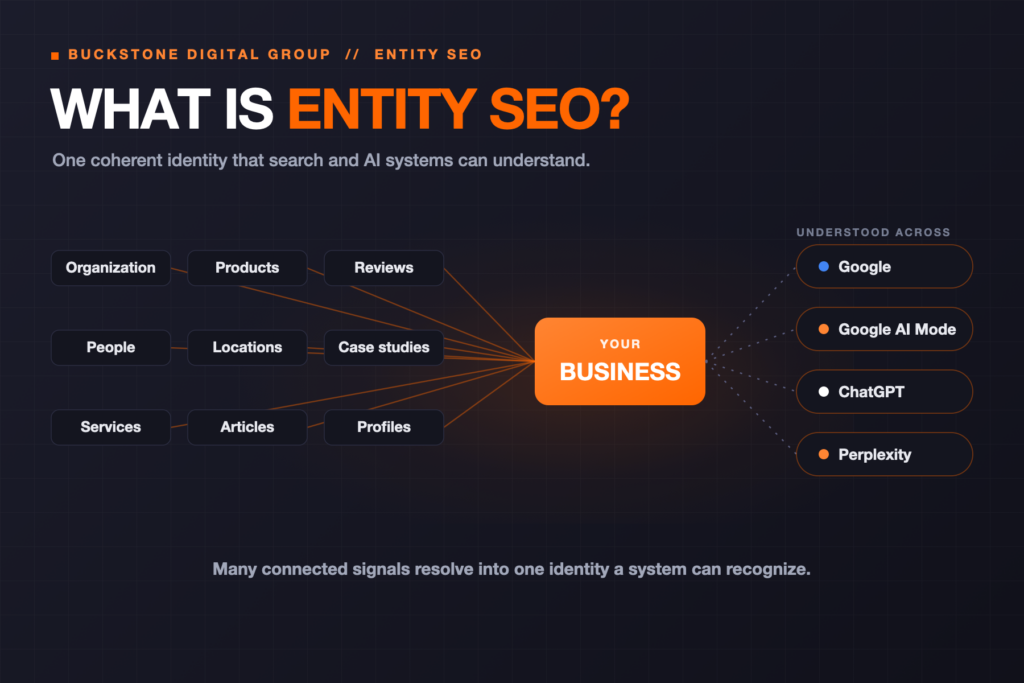
Entity SEO is the practice of making the identifiable people, organizations, services, products, places, and subjects surrounding a business clearer, more consistent, and better connected across its website and the wider web.
It is not a secret AI ranking trick. It is the work of reducing ambiguity. We show how that works in practice in how AI systems understand your business.
That matters because search and AI systems must do more than match words. They need to determine what a business is, which information belongs to it, what it provides, whom it serves, where it operates, who represents it, and whether other sources support those relationships. This is the entity layer that sits underneath both traditional SEO and AI Search Visibility.
Key takeaways
Entity SEO, in one panel
- An entity is an identifiable person, organization, place, product, service, or concept.
- Entity SEO is industry terminology for improving how those entities and their relationships are represented online.
- It is not a separate official Google ranking system or one universal AI optimization method.
- Keywords describe language; entities identify the specific things that language refers to.
- Clear entities help reduce ambiguity around company names, services, people, products, and locations.
- Structured data can make facts and relationships more explicit, but it must match visible content.
sameAscan reference official or authoritative identity pages, but it is not a shortcut for rankings or AI recommendations.- About pages, leadership profiles, author archives, service pages, internal links, reviews, directories, and third-party coverage all contribute to entity clarity.
- A business should generally maintain one coherent Organization entity and stable Person entities for its real authors and leaders.
- Duplicate or contradictory schema can make the site’s entity graph harder to interpret.
- Entity clarity supports traditional SEO and AI Search Visibility, but it does not guarantee a citation or recommendation.
- BuckStone approaches entity optimization as a website, content, structured-data, authority, and measurement problem—not merely a schema task.
What is an entity?
An entity is a distinct thing that can be identified. For a business website, common entities include the company, its founders and employees, its services, its products, its locations, its brands, its customers, its industries, its authors, its articles, its case studies, its events, its professional associations, and the subjects in which it has expertise.
A few concrete examples:
- “BuckStone Digital Group” is an organization entity.
- “Jeff Palicki” is a person entity.
- “AI Search Visibility” is a subject or service concept.
- “Pittsburgh” is a place entity.
A specific product, location, article, author, and company can all be separate entities with relationships between them. For example:
- Jeff Palicki works for BuckStone Digital Group.
- Jeff authors an article about AI Search Visibility.
- BuckStone offers AI Search Visibility services.
- The article supports the service page.
- The company works with manufacturers and financial-services firms.
- Case studies provide evidence connecting the company to those industries.
The goal is not to create a complicated diagram for its own sake. The goal is to make those relationships clear and consistent.
What is entity SEO?
Entity SEO is the practice of improving how identifiable things and their relationships are represented across a website and the wider web. That can involve:
- Clarifying the company’s identity
- Defining services and products
- Connecting authors with their work
- Connecting leaders with the organization
- Describing locations and service areas
- Maintaining consistent business information
- Using accurate structured data
- Creating logical internal links
- Building complete About and leadership pages
- Earning relevant third-party mentions
- Correcting outdated profiles
- Consolidating duplicate entities
- Strengthening content around meaningful topics
- Making expertise easier to verify
Entity SEO should not be reduced to adding a few JSON-LD properties. We cover exactly what markup can and cannot do in can structured data help your business appear in AI search. Structured data is one layer. Visible content, site architecture, authorship, external corroboration, and consistency matter just as much.
Is “entity SEO” an official Google term?
Entity SEO is widely used within the search industry, but businesses should not interpret it as a standalone Google product, a public ranking system, or a guaranteed optimization formula.
Google does provide structured-data guidance for organizations, people, products, articles, profile pages, and other identifiable things. Google also explains that Organization markup can help it understand administrative details and disambiguate an organization.
That is not the same as saying:
The overreachAdd Organization schema and your company will rank better.
The responsible interpretation is:
Clear, accurate information can help search systems understand what a page and organization represent. When those details are wrong or outdated, fixing the incorrect information at its source is what keeps the entity clear.
Entity optimization should support the larger SEO and user-experience strategy. It should not be sold as a hidden algorithm.
Keywords, topics, and entities are not the same thing
These concepts overlap, but they are different. A keyword is language, a topic is a subject area, and an entity is the specific thing being discussed.
Keyword
Language
A word or phrase used in content or a search. It describes what people search for and how subjects are expressed.
Examples
- SEO agency
- financial advisor
- biodegradable lubricant
- restaurant near me
- AI Search Visibility
Topic
Subject area
The broader area of information surrounding a question or need. For “financial advisor,” the topic could include:
Might include
- Retirement planning
- Fiduciary standards
- Wealth management
- Fees & credentials
- Locations & reviews
Entity
The specific thing
The particular organization, person, service, product, or place being referred to. “Apple” alone is ambiguous:
“Apple” could be
- A fruit
- A technology company
- A record label
- A person’s nickname
- A local business
The word alone is ambiguous. Context and connected information help identify which entity is intended. The same problem can affect businesses with common names, acronyms, similar competitors, former brands, multiple locations, parent and subsidiary relationships, leaders who share names with others, and products with generic names. Entity optimization reduces that ambiguity.
Why entity clarity matters for AI search
AI-driven search often responds to complex questions rather than matching one phrase to one page. A user might ask:
Example promptWhich SEO agencies work with industrial manufacturers and also understand AI Search Visibility?
To include a company confidently, the platform may need to determine which organization is being referenced, whether it is an SEO agency, whether it works with manufacturers, whether it provides AI Search Visibility, whether credible content supports those claims, which people are connected to that expertise, whether the company is active and current, and whether the business matches the user’s requirements.
If that information is vague, inconsistent, or unsupported, the company may be harder to surface. Entity clarity can support a system’s ability to connect:
- Company → service
- Company → industry
- Company → location
- Company → leader
- Author → article
- Article → topic
- Case study → service
- Case study → industry
- Product → manufacturer
- Location → local business
This does not guarantee inclusion. It improves the information environment from which platforms make decisions. If your business is missing from these answers entirely, that is often a deeper issue—we cover it in why your business is not appearing in AI search results.
Entity audit
Does AI understand what your company actually does?
BuckStone can evaluate how your business, services, people, locations, content, and structured data are represented across your website and the wider search ecosystem.
How entity optimization supports Google Search
Google’s search systems need to crawl, index, interpret, and evaluate pages. Clear entities can support that process by helping establish which organization operates the website, which name is preferred, which profiles belong to the organization, who authored a piece of content, which service or product a page describes, which location a business serves, how articles and commercial pages relate, and which information is consistent across pages.
Google’s Organization structured-data documentation says that adding Organization markup can help Google understand administrative details and disambiguate the organization. Google also recommends that structured data match the visible content. This is a clarity mechanism—not permission to add unsupported claims. The same discipline underpins technical SEO as a whole.
How entity clarity relates to ChatGPT and Perplexity
OpenAI and Perplexity do not publish a simple entity-optimization checklist for business recommendations. Their search experiences can retrieve public web information, cite sources, and produce answers based on available evidence.
A company can make that public evidence easier to interpret by maintaining clear company descriptions, complete service pages, accurate leadership profiles, identifiable authors, consistent official profiles, useful original content, relevant third-party mentions, accurate structured data, and strong relationships between informational and commercial pages.
Businesses should not claim that a particular schema property directly causes a ChatGPT or Perplexity recommendation. The practical objective is broader:
Make the business easier to identify, understand, verify, and connect to relevant questions.
For the platform-specific version of this work, see how to get your business recommended by ChatGPT.
The major entity types surrounding a business
Organization
The main company or legal/business entity operating the website. Useful information may include name, URL, logo, description, contact information, address where appropriate, founding information, official social and profile URLs, founders, employees or leadership, and parent or subsidiary relationships where relevant. The website should normally reuse one stable Organization identity rather than creating a disconnected new company node on every page.
Person
A real individual connected to the business—a founder, CEO, account manager, author, technical expert, medical reviewer, attorney, financial professional, or product specialist. A Person entity may include name, profile URL, role, biography, image, official professional profiles, relationship to the organization, and authored content. The visible profile should support the schema. Do not invent qualifications.
Service
A capability the company provides—technical SEO, AI Search Visibility, local SEO, website design, paid search, financial planning, electrical inspections, private dining. A service should not exist only inside schema. The website should contain visible, substantial information explaining what it is, who it is for, what problems it solves, what the process includes, how it relates to the company, and what evidence supports the offering.
Product
A specific item offered for sale. Product clarity may include name, brand, manufacturer, description, model or identifier, price, availability, images, specifications, reviews where eligible, and its relationship to product categories and use cases. Product information should remain consistent between visible pages, structured data, feeds, and external marketplaces.
Place and LocalBusiness
Businesses with local or location-based relevance should clearly represent address, service area, phone number, hours, categories, locations, geographic markets, Google Business Profile information, and relevant location pages. Avoid creating location entities for places where the company has no real presence or legitimate service relationship.
Article and other creative works
Articles, case studies, videos, research, guides, and reports are entities as well. Useful relationships include who authored the work, which organization published it, which topics it discusses, which service it supports, which case study or data it references, and when it was published and updated. Authorship and publishing relationships should be consistent across the visible page and schema.
What does a strong business entity system look like?
A coherent business entity system connects several parts that reinforce one another:
A clear homepage
The homepage states who the company is, what it provides, whom it serves, where it operates, and what differentiates it.
A complete About page
The About page defines the organization, leadership, history, areas of expertise, business model, relevant relationships, and links to official profiles.
Leadership and author pages
Real people have full names, accurate titles, professional biographies, profile images, authored content, relevant external profiles, and stable Person schema.
Complete service pages
Each major service has enough substance for people and machines to understand what the company actually provides.
Logical internal linking
Articles, services, industries, case studies, authors, and About information reinforce one another contextually.
Accurate structured data
The site reuses stable entity IDs and avoids disconnected duplicates.
Consistent external information
Major profiles, directories, review platforms, and association listings present the same core facts.
Third-party corroboration
Independent sources support the company’s experience, reputation, relationships, or expertise.
No single item creates the entity. The complete system does.
What is a stable entity ID?
Within JSON-LD structured data, an @id can provide a stable identifier for an entity inside the site’s schema graph. For example:
// One reusable identifier for the same company
"@id": "https://example.com/#organization"
That identifier can be reused wherever the same organization appears. An article can identify the organization as its publisher. A Person entity can reference the organization as the person’s employer. An About page can discuss the same organization.
The important point is consistency. Do not generate a separate, unrelated Organization entity on every page when those nodes all represent the same company. Likewise, each real author should have one stable Person entity rather than several disconnected versions.
Why duplicate entity nodes can become a problem
Duplicate nodes are not automatically catastrophic, but disconnected and contradictory versions create unnecessary ambiguity. Common problems include:
- Different Organization
@idvalues on different pages - One company node using the live domain and another using a staging domain
- Several Person nodes for the same author
- Different job titles on different pages
- Old profile URLs in
sameAs - Conflicting logos
- Different business names
- Articles attributed to the Organization when a Person wrote them
- An author archive and article byline using separate Person identities
- Manually added schema duplicating Yoast’s graph
- LocalBusiness and Organization nodes that are never connected
The goal is not to minimize the number of schema nodes at all costs. The goal is to ensure that each node represents a real distinct thing and that repeated references use a consistent identity.
What does sameAs mean?
The Schema.org sameAs property points to another URL that unambiguously identifies the same entity. For an organization, appropriate references might include an official LinkedIn company page, a verified social profile, a relevant authoritative organization profile, Wikidata or Wikipedia where legitimately applicable, an official parent-company profile, or certain recognized business or professional profiles.
For a person, appropriate references might include an official LinkedIn profile, ORCID for researchers, a professional-organization profile, a personal professional website, or a verified public profile.
Do not use sameAs as a dumping ground for every directory listing or mention. The destination should genuinely identify the same person or organization.
What sameAs is
- An identity-clarification property
- A pointer to a URL that unambiguously identifies the same entity
- A way to connect an official LinkedIn, Wikidata, or verified profile
What sameAs does not do
- Guarantee rankings, a knowledge panel, or AI citations
- Transfer authority automatically
- Turn an unrelated profile into proof
- Replace visible content or third-party credibility
How structured data supports entity clarity
Structured data makes certain information machine-readable. Depending on the site, useful types may include Organization, LocalBusiness, Person, ProfilePage, Article, BlogPosting, Product, Offer, BreadcrumbList, Service, Event, JobPosting, VideoObject, and Dataset.
Structured data can help define page type, author, publisher, organization, product, location, breadcrumb hierarchy, and relationships between entities. But schema must match the visible page. If a page says one thing and the JSON-LD says another, the markup does not create truth.
Schema is not an AI visibility shortcut
Several weak AI SEO pitches reduce entity optimization to a four-step promise:
The pitch to avoid1) Install a schema plugin. 2) Add dozens of properties. 3) “Own your entity.” 4) Rank in ChatGPT.
That is not a defensible strategy. Schema cannot independently create expertise, reputation, reviews, original evidence, industry experience, strong service coverage, customer trust, media recognition, or AI recommendations. It can clarify information that already exists.
BuckStone treats structured data as part of the entity system—not the entire system.
Nine ways to strengthen your business entity
1. Establish one clear company identity
Use a consistent business name, logo, website URL, description, contact information, business category, address or service area where applicable, leadership structure, and official profiles. Document preferred naming conventions internally—decide how abbreviations, legal names, trade names, and former names should be represented.
2. Build a substantive About page
A useful About page should clearly answer: What is the company? What does it do? Who leads it? Whom does it serve? Where does it operate? What expertise does it have? How is it different? Which official profiles belong to it? Do not use the entire page for vague mission language.
3. Create real leadership and author profiles
Each important author or leader should have a public profile page, accurate role, useful biography, profile image, relevant expertise, authored articles, professional-profile links, and a stable Person identity. The byline should link to the author page, and the article schema should reference the same Person entity. At BuckStone, authors such as Jeff Palicki and Dalton West each maintain a dedicated author archive that ties their bylines to a consistent identity.
4. Clearly define each major service and product
Do not rely on a homepage list alone. Create substantial pages that explain what the offering is, who needs it, what problems it solves, what is included, the relevant process, relevant expertise, evidence and case studies, related industries or use cases, and the next step.
5. Connect the website through purposeful internal links
Useful relationships may include article → service, service → case study, case study → industry, industry → service, article → author, author → About page, About page → leadership, product → supporting guide, and location → LocalBusiness information. Links should help the reader. Do not force every page into every cluster.
6. Consolidate structured-data identities
Audit Organization nodes, Person nodes, LocalBusiness nodes, publisher references, author references, staging URLs, duplicate IDs, conflicting properties, schema plugins, theme-generated markup, and custom JSON-LD. Choose one primary schema system where practical, and extend it carefully rather than creating parallel disconnected graphs.
7. Correct external inconsistencies
Review major sources such as Google Business Profile, LinkedIn, Bing Places, industry associations, review platforms, directories, partner websites, old domains, press releases, and social profiles. Prioritize correcting sources that are authoritative, visible, and relevant.
8. Earn meaningful third-party corroboration
Look for legitimate opportunities through client case studies, industry publications, professional associations, interviews, podcasts, conferences, research citations, partner pages, reviews, relevant directories, and local media. The objective is not link volume—it is independent evidence connecting the business to its real services, industries, people, and expertise.
9. Monitor entity accuracy over time
Entities change. Companies move, rebrand, add services, retire products, hire leaders, change ownership, expand locations, merge, and update official profiles. Maintain an entity-change checklist so visible content, schema, profiles, and directories remain aligned.
Beyond markup
A schema plugin cannot fix a fragmented digital identity.
BuckStone combines technical SEO, structured data, website architecture, content, authorship, external consistency, and AI visibility testing to create a clearer business entity.
Common entity SEO mistakes
Creating schema that is not supported by visible content
Do not claim services, locations, qualifications, reviews, leadership, or relationships that users cannot verify on the page.
Treating sameAs as a link-building tactic
Only use URLs that truly identify the same entity.
Creating duplicate Organization entities
Reuse the established company identity across the site.
Leaving staging domains in schema
Audit URLs after migrations and redesigns.
Using a logo as a Person image
A Person should use an actual image of the person where available.
Publishing articles under “Admin”
Use real authors where authorship matters.
Inventing expertise labels
Expertise should be grounded in the person’s role, biography, work, and content.
Confusing service-area relevance with physical locations
Do not imply that a company has offices where it does not.
Adding every possible Schema.org property
More properties do not automatically mean better markup. Use accurate, useful information.
Assuming a knowledge panel is the goal
A knowledge panel is not required for a business to generate leads or appear in AI search. The real objective is accurate and useful visibility.
Ignoring external contradictions
A perfect schema graph cannot erase widespread conflicting information across important external profiles.
Why businesses become difficult to understand
Common causes accumulate over years: vague homepage copy, thin service pages, a missing About page, no leadership profiles, generic author accounts, conflicting company descriptions, old addresses, multiple domains, inconsistent branding, duplicate structured data, broken author archives, disconnected case studies, no industry context, and no third-party corroboration.
One agency builds the website. Another publishes content. A developer adds schema. A directory copies an old description. An employee creates a new social profile. A staging domain remains in metadata. Eventually, the business has several digital identities instead of one coherent entity.
Does every business need this level of work? Every business that depends on online discovery benefits from clear, consistent identity information. The need becomes especially important when the business has a common or ambiguous name, several companies share similar names, the organization has multiple locations or brands, leadership expertise matters, authors publish expert content, the offering is complex, the company serves several industries, the business recently rebranded, old domains or profiles remain online, search platforms describe the business inaccurately, competitors are more consistently represented, or AI systems fail to connect the business to relevant services. The depth of work should match the complexity of the organization.
How to audit your business entity
Use this high-level checklist to find where your identity is unclear or inconsistent.
Organization identity
- Is the official business name consistent?
- Is the preferred website URL clear?
- Is the logo current?
- Is the business category explicit?
- Is the company description consistent?
- Are contact details accurate?
- Are former names explained where needed?
People and authorship
- Are leaders identified?
- Are titles accurate?
- Do authors have profile pages?
- Do article bylines link correctly?
- Are Person entities stable?
- Do profiles include legitimate official references?
Services and products
- Does each major offering have a complete page?
- Are services connected to the organization?
- Are product names, brands, and details consistent?
- Are discontinued offerings removed or clarified?
Locations
- Are physical offices distinguished from service areas?
- Is LocalBusiness information accurate?
- Does Google Business Profile match the website?
- Are location pages legitimate and useful?
Structured data
- Is there one coherent Organization identity?
- Are duplicate Person entities avoided?
- Are author and publisher relationships correct?
- Are IDs stable and staging URLs removed?
- Does markup match visible content?
Internal relationships
- Do articles link to relevant services?
- Do services link to proof?
- Do case studies connect to industries?
- Do author pages connect to content?
- Does the About page connect leadership and organization?
External corroboration
- Do major profiles describe the company accurately?
- Are reviews tied to the correct business?
- Do credible sources connect the company to its expertise?
- Are outdated directories corrected?
How entity SEO fits BuckStone’s AI Search Visibility framework
Entity optimization touches all five parts of BuckStone’s AI Search Visibility framework. It is not a separate silo—it is one of the connective layers supporting the entire visibility system.
The framework
Where entity clarity does its work
Access
Search systems must retrieve the pages and structured information.
Understanding
Clear organization, person, service, product, and location entities reduce ambiguity.
Evidence
Content and case studies demonstrate what the entities know and do.
Corroboration
Independent sources support the relationships and claims.
Measurement
Audits and prompt testing reveal whether the company is being described and associated accurately.
How BuckStone improves entity clarity
BuckStone evaluates the complete digital identity surrounding a business.
Organization audit
We identify conflicting company names, outdated descriptions, incorrect URLs, duplicate schema nodes, staging references, inconsistent contact information, and missing official profiles.
Website architecture
We connect services, industries, locations, authors, leadership, articles, case studies, products, and About information—often as part of broader website design and development work.
Structured data
We establish stable IDs, reuse Organization and Person entities, correct author and publisher relationships, remove disconnected duplicates, validate visible-content alignment, and extend the existing schema graph carefully.
Author and leadership systems
We build public profiles, accurate biographies, author archives, article relationships, professional-profile references, Person schema, and visible expertise.
Content and service clarity
We improve homepage positioning, service descriptions, product information, industry relevance, topic coverage, internal linking, and evidence and case studies.
External consistency
We identify important profiles and sources that need correction or expansion.
AI visibility testing
We evaluate whether platforms identify the company correctly, associate it with the correct services, recognize its experts, describe its locations accurately, cite its content, and compare it with appropriate competitors.
BuckStone does more than add schema
An entity audit often reveals issues across the whole website. BuckStone can implement technical corrections, structured data, About pages, leadership profiles, author archives, service pages, industry pages, internal linking, content strategy, case-study integration, local SEO, directory cleanup, analytics and monitoring, and AI Search Visibility testing. The result is not simply “more markup.” It is a clearer and more defensible digital identity.
Final answer: What is entity SEO?
Entity SEO is the practice of making the identifiable people, organizations, services, products, places, and subjects surrounding a business easier to understand and connect. It involves clear visible information, consistent company facts, complete service and product pages, real author and leadership profiles, purposeful internal links, accurate structured data, stable entity identities, relevant official profiles, independent corroboration, and ongoing accuracy.
It does not replace keywords, technical SEO, content, links, reviews, or reputation. It helps connect them. As search becomes more conversational and AI-driven, businesses need more than pages containing the right phrases. They need a coherent identity that search systems can access, interpret, verify, and connect to the customer’s question.
Work with BuckStone
Make your business easier to understand, verify, and recommend.
BuckStone can identify and fix the technical, content, structured-data, authorship, and authority problems weakening your company’s digital identity.
Frequently asked questions
What is an entity in SEO?
An entity is a distinct person, organization, place, product, service, or concept that can be identified. Entity SEO focuses on making those things and their relationships clearer across a website and the wider web.
Is entity SEO an official Google ranking factor?
Google does not define “entity SEO” as one standalone public ranking factor. It does provide guidance for structured data and organization disambiguation. Entity optimization should be treated as clarity and consistency work rather than a guaranteed ranking formula.
What is the difference between a keyword and an entity?
A keyword is a word or phrase. An entity is the specific thing that the language refers to. The same word can refer to several entities, so context and connected information help resolve the intended meaning.
Does structured data help Google understand a business?
Google says Organization structured data can help it understand administrative details and disambiguate an organization. Structured data must accurately reflect visible content and does not guarantee rankings or AI inclusion.
Does schema markup improve ChatGPT visibility?
OpenAI does not publish guidance stating that a particular schema type guarantees ChatGPT visibility. Accurate schema can contribute to a clearer public information environment, but it should be combined with strong content, crawlability, entity consistency, and third-party evidence.
What does sameAs mean in schema?
sameAs references another URL that unambiguously identifies the same person or organization, such as an official LinkedIn profile or recognized professional profile. It is an identity reference, not a ranking shortcut.
Should every page have Organization schema?
The same organization may be referenced throughout the site, but those references should reuse the established Organization identity rather than creating disconnected duplicate companies. The exact implementation depends on the site’s schema system.
Why are author pages important?
Author pages connect real people to their work, roles, expertise, professional profiles, and organization. They can improve accountability, clarity, navigation, and structured authorship relationships.
Can entity SEO create a Google Knowledge Panel?
Clear and consistent information may support how an entity is understood, but no agency can guarantee that Google will create or display a Knowledge Panel.
How do I know whether my business has entity problems?
Common signs include inaccurate AI descriptions, conflicting company information, duplicate schema nodes, outdated profiles, missing leadership pages, generic authorship, unclear services, and inconsistent locations.
What is included in an entity SEO audit?
An entity audit can examine organization identity, people, services, products, locations, structured data, stable IDs, authorship, internal linking, external profiles, reviews, third-party mentions, and AI-generated descriptions.
How does entity SEO support AI Search Visibility?
It helps AI-driven platforms identify the business, connect it to the correct services and subjects, resolve its people and locations, and evaluate supporting evidence. It improves clarity but does not guarantee citations or recommendations.
Sources & methodology
This article distinguishes between official platform documentation, Schema.org vocabulary definitions, and BuckStone’s strategic interpretation. Google’s and Schema.org’s documentation describe how structured data and entities can clarify information; they do not promise rankings, citations, or knowledge panels. Where a platform does not publish exact ranking or source-selection methods—including how ChatGPT, Perplexity, or Google AI Mode choose which businesses to name—we say so rather than implying a formula. Recommendations for implementation reflect BuckStone’s experience, not a guaranteed outcome.
- Google Search Central — Organization Structured Data
- Google Search Central — Introduction to Structured Data
- Google Search Central — General Structured Data Guidelines
- Google Search Central — Article Structured Data
- Google Search Central — ProfilePage Structured Data
- Google Search Central — AI Features and Your Website
- Google Search Central — Optimizing for Generative AI Features
- Schema.org — Organization
- Schema.org — Person
- Schema.org — sameAs