
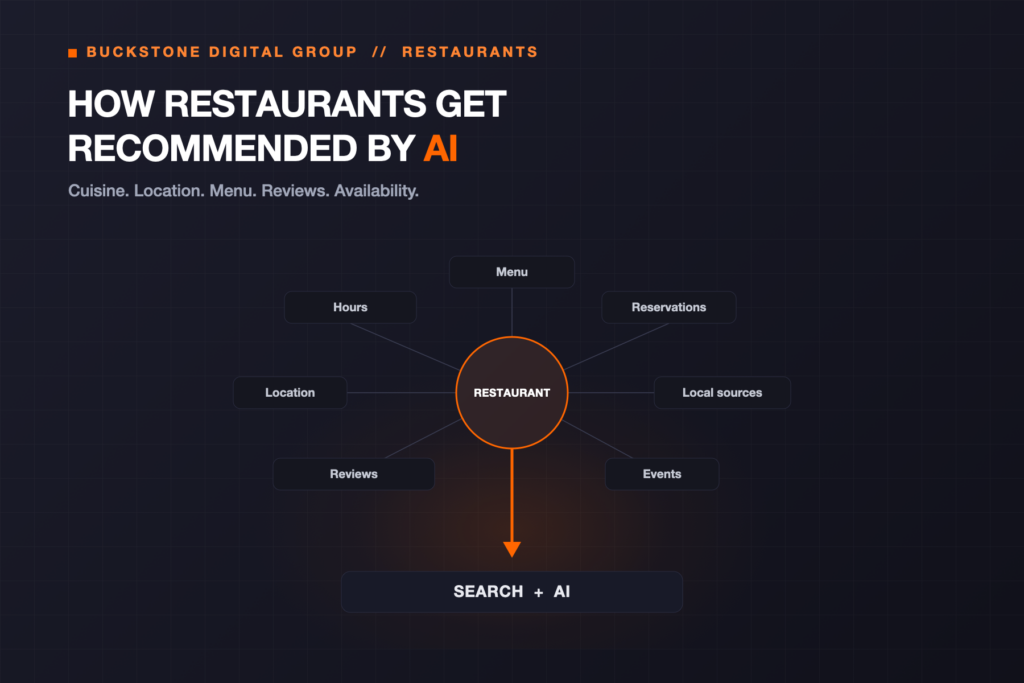
A hungry diner opens Google and searches for a cuisine or an occasion, glances at the map, then asks ChatGPT which places are worth considering nearby. They skim an AI Overview, open two menus, check whether the kitchen is still open, read a handful of recent reviews, look at the photos, see whether a table is available tonight, land on the restaurant’s own site, and finally call, reserve, or tap directions. Not one of those steps is a single keyword ranking. For a restaurant, visibility is the ability to stay accurate, relevant, and compelling across the entire decision window between “Where should we eat?” and the reservation, order, or visit.
That window is where restaurants quietly lose business they never see. Menus are trapped in PDFs or flat images. Hours are outdated on half the platforms a diner checks. The cuisine is described as “great food and great atmosphere” on the website but something different on a delivery app. Reservation links are broken, event pages advertise a concert that happened last spring, and nobody is tracking which competing restaurants keep getting recommended instead. This article is about closing that gap — making a restaurant easy for both diners and AI systems to understand, verify, and choose.
Here is the through-line we will keep returning to:
Restaurants become more recommendable when search and AI systems can clearly understand where they are, what they serve, when they are open, who they are suited for, what the dining experience is like, and whether current external sources reinforce that information.
- Restaurant recommendations are contextual, local, and often time sensitive. Diners ask for the right place for a cuisine, occasion, and moment — not “the best restaurant” in the abstract.
- Hours, location, menu, cuisine, and availability must stay accurate across your site, Google Business Profile, and third-party platforms.
- Menus should be readable as HTML, not available only as PDFs or images.
- Cuisine, atmosphere, and occasion should be described specifically, because systems can’t recommend a fit you never state.
- Reviews matter, but volume alone is not the strategy. Recency, specificity, and owner responses carry weight too.
- Google Business Profile is a primary decision surface for many restaurant searches, not a supporting asset.
- Events, live music, and seasonal offerings need current information; a stale calendar erodes trust faster than none.
- Dietary options should be represented clearly and honestly, never with unsafe or overstated claims.
- Reservation, ordering, direction, and calling paths must actually work.
- Structured data can clarify identity, menu, and hours — it cannot repair stale information or a weak reputation, and it no longer guarantees a rich result.
- Reviews, reservation and delivery platforms, tourism sites, and local media form the external ecosystem that corroborates your story.
- AI mentions must be checked for accuracy, not just presence.
- Measurement should connect visibility to reservations, calls, directions, orders, and revenue where possible.
Why AI recommendation visibility matters for restaurants
Diners increasingly use AI-driven search to discover restaurants, match a place to an occasion, filter by cuisine, find dietary options, identify what’s open now, compare locations, plan travel, research atmosphere, find events, decide what to order, and validate a restaurant’s reputation before committing. These are the same jobs diners have always done — they’re just doing more of them inside answer engines like ChatGPT, Google AI Overviews, Google AI Mode, and Perplexity.
This does not mean AI has replaced Google Maps, review platforms, or restaurant websites. It means the shortlist often forms earlier and somewhere else.
AI may shape the shortlist, while Maps, reviews, menus, and the restaurant website validate the final choice. The goal is to be understood well enough to make the shortlist — and accurate enough to survive the validation. See what AI Search Visibility is and how businesses get recommended by ChatGPT.
Restaurant recommendability is contextual
Diners rarely ask for a restaurant in the abstract. They ask for the right restaurant for a particular place, meal, occasion, preference, budget, and moment. A single restaurant may be the ideal answer for date night, a business dinner, a family meal, live music, outdoor dining, a quick lunch, a special occasion, a large group, brunch, late-night, a dietary restriction, a tourist visit, a local favorite, a specific cuisine, or a certain price point — and a poor answer for the ones next to it.
A restaurant is not universally “the best.” It is the best fit for a particular diner, location, occasion, preference, and moment.
Vague positioning weakens that fit. A system cannot confidently place you into an occasion you never describe. Compare:
| Generic | Specific & recommendable |
|---|---|
| Great food and great atmosphere. | Seasonal American cuisine, outdoor riverfront seating, and live music on Friday evenings. |
| Something for everyone. | Family-friendly booths, a dedicated kids’ menu, and a quieter back room for large groups. |
| Authentic Italian. | Handmade pasta, a Neapolitan wood-fired oven, and a gluten-free pasta option on request. |
The specific version is not just better marketing — it gives search and AI systems the concrete, verifiable details they need to match you to a real request. This is the heart of what makes a business recommendable. (Never invent details you can’t stand behind.)
The restaurant AI Search Visibility framework
AI Search Visibility is the discipline of making a business understandable, credible, retrievable, and recommendable across traditional search engines and AI-driven answer platforms. Answer Engine Optimization (AEO) is the practice of improving how a restaurant and its information are understood, retrieved, cited, compared, and recommended across answer-driven search experiences. And restaurant SEO is the process of improving visibility for a restaurant’s location, cuisine, menu, hours, dining experience, events, reputation, reservations, and commercial pages across search engines and local-search platforms. In practice, restaurant SEO, local SEO, and AEO should work as one coordinated strategy — not three disconnected efforts.
Underneath it all is one idea: restaurant AI visibility is not one ranking or one review score. It is the result of local relevance, menu clarity, reputation, accurate business information, contextual fit, technical accessibility, and third-party corroboration. BuckStone organizes that into five layers.
- 1Access
Can search and AI systems retrieve the menu, hours, location, event, and reservation information?
- 2Understanding
Can they identify the restaurant’s cuisine, atmosphere, occasions, amenities, and local relevance?
- 3Evidence
Does the restaurant provide current menus, photos, events, chef or ownership context, and other proof of the experience?
- 4Corroboration
Do reviews, reservation platforms, tourism sources, local publications, and delivery platforms reinforce the restaurant’s identity and reputation?
- 5Measurement
Are visibility, directions, calls, reservations, orders, visits, and revenue improving?
1. Access: can systems retrieve the restaurant’s information?
Access covers crawlability, indexability, mobile usability, rendering, robots directives, XML sitemaps, page speed, and AI/search crawler access — plus the restaurant-specific traps: menus locked in PDFs or images, reservation widgets and ordering integrations that load only as scripts, JavaScript-only event calendars, thin location pages, buried hours, and missing click-to-call links.
A visually impressive restaurant website can still be difficult to evaluate if its menu, hours, events, or reservation options are hidden inside images, PDFs, or scripts.
Start here: is your website blocking AI crawlers? and technical SEO for AI search. If the foundation is weak, everything above it wobbles — which is where website development and technical SEO come in.
2. Understanding: can systems identify the restaurant and the experience?
Systems should be able to understand the restaurant name and brand, its location, cuisine, menu, price positioning, meal periods, hours, dietary options, reservation and ordering options, atmosphere, outdoor seating, events, live entertainment, parking, accessibility, chef or ownership where relevant, multiple locations, and any parent restaurant group. On the structured side that maps to entities like Organization, Restaurant, LocalBusiness, Menu / MenuSection / MenuItem, Event, Person where relevant, and BreadcrumbList — each with a stable @id, sensible internal linking, and clear location relationships.
If the restaurant never clearly describes its cuisine, occasions, amenities, and menu relationships, search systems must infer what the restaurant itself should state directly.
Deeper reading: how AI systems understand your business and what entity SEO is.
3. Evidence: does the restaurant support its positioning?
“The perfect date-night restaurant” is a marketing claim. A current menu, real photos, chef information, ingredient sourcing where factual, legitimate awards, press coverage, an event schedule, reservation availability, customer reviews, dietary details, signature dishes, history, ownership, community involvement, and private-dining or catering information are the context that makes the claim believable.
“The perfect date-night restaurant” is a marketing claim. Menu, atmosphere, photos, hours, reservations, reviews, and independent coverage provide the context that makes the claim believable.
4. Corroboration: does the wider web reinforce the story?
Corroboration comes from Google reviews, Yelp, TripAdvisor, OpenTable, Resy, DoorDash, Uber Eats, Grubhub, tourism sites, local media, food publications, event calendars, community organizations, hotel-concierge resources, social profiles, Maps, and local directories.
The restaurant website explains the experience. Reviews, reservation platforms, tourism sources, local publications, and delivery platforms help reinforce how the restaurant is understood in the market.
More on why this matters: how third-party sources influence AI recommendations.
5. Measurement: is visibility leading to dining activity?
Track organic rankings, map visibility, Google Business Profile interactions, website visits, menu views, calls, direction requests, reservation clicks, online reservations, orders, event-page visits, AI mentions, AI citations, recommendations, accuracy, prompt coverage, competitor share of voice, AI referral traffic, and revenue where attributable.
Restaurant reporting should connect visibility to dining actions, not stop at impressions and website sessions. See how to measure AI Search Visibility.
Google Business Profile: the local visibility foundation
For many restaurant searches, Google Business Profile is not a supporting asset. It is one of the primary decision surfaces — the thing a diner sees before they ever reach your website. Getting it right means the correct business name, accurate primary and secondary categories, address, phone, hours (including holiday hours), a menu link, a reservation link, ordering links, the website link, current photos, attributes, reviews, questions and answers where applicable, and an accurate map pin.
- Correct name, address, phone, and an accurate map pin
- Precise primary category plus relevant secondary categories
- Regular hours, holiday hours, and special hours
- Menu, reservation, and ordering links that resolve correctly
- Current, real photos of food, space, and exterior
- Service options: dine-in, takeout, delivery
- Attributes: outdoor seating, live music, accessibility, parking
- Dietary offerings represented honestly (e.g., vegetarian, vegan, gluten-free options)
- No duplicate, closed, or relocated listings competing with the real one
- Monitoring for unauthorized edits and platform-controlled ordering links
Multi-location brands add complexity: seasonal and special hours, duplicate-profile cleanup, and consistent management across every location. Because these signals feed the map pack and “near me” results, local SEO is where much of this work lives. (Verify current Google Business Profile functionality before making exact claims — features change.)
Menu accessibility and menu SEO
A diner should not have to pinch and zoom a PDF to understand what the restaurant serves. A strong menu experience presents current items, sections, descriptions, prices where public, accurate dietary labels, availability, seasonal status, and meal period — as real, accessible text, with an order or reservation call-to-action nearby.
- Rendered in HTML, not only as a PDF, image, or scanned document
- Clear sections and item descriptions
- Prices where you publish them, kept current
- Accurate dietary labels and meal-period context
- An update cadence so seasonal changes don’t go stale
- Menus available only as PDFs, images, or third-party widgets
- A separate thin URL for every single dish
- Menu content that contradicts delivery-app or reservation-platform listings
- Prices and items that no longer match what the kitchen serves
PDFs can stay as a convenience — but the critical information should also live in HTML.
Does every menu item need its own page?
Usually not. Dedicated pages make sense for signature dishes, high-demand specialty products, catering packages, private dining, distinct experiences, or products you sell online. For everything else, the goal is to make the menu understandable, not create hundreds of low-value URLs. Thin, near-duplicate dish pages tend to dilute a site rather than strengthen it — a pattern we cover in why generic SEO content fails in AI search.
Cuisine, atmosphere, and occasion language
Restaurants should explicitly describe cuisine, style, atmosphere, price positioning, service model, meal periods, occasions, and amenities — using the distinctions diners actually search: fine dining, casual, family friendly, counter service, full service, outdoor seating, live music, date night, business dinner, private dining, sports viewing, brunch, late night. Used accurately, these are the hooks an answer engine attaches a recommendation to.
AI systems cannot confidently recommend a restaurant for an occasion the restaurant never describes. Claim the occasions you genuinely serve — and only those.
Dietary needs and allergen information
Dietary visibility is valuable and sensitive. Restaurants may represent vegetarian options, vegan options, gluten-free options, allergy-aware preparation, and halal or kosher claims where genuinely verified — but always with honest limits about cross-contact. Precise language protects diners and the restaurant: “gluten-free options,” “dishes prepared without a certain ingredient,” “ask staff about allergies,” and “kitchen cross-contact may occur.”
Dietary visibility should never come at the cost of inaccurate safety claims. Represent what the kitchen can truthfully deliver, and qualify anything you can’t guarantee.
Hours, holidays, and “open now” searches
Current hours are decisive, because so many restaurant searches carry an implicit “right now.” The problem is that hours live in many places — the website, Google Business Profile, Yelp, TripAdvisor, reservation platforms, delivery platforms, and social profiles — and they drift apart. Holiday hours, seasonal schedules, kitchen-close times, bar hours, brunch hours, event hours, and temporary closures all need to be consistent.
Restaurant recommendation visibility can collapse at the moment of decision if hours are inconsistent or outdated.
Events, live music, and seasonal experiences
Live music, holiday meals, tastings, trivia, special menus, brunch events, community events, private events, and seasonal patios are exactly the specifics that make a restaurant recommendable for an occasion — but only when the information is fresh. A strong event page includes the event name, date, time, location, description, pricing where applicable, a reservation or ticket action, recurrence, and current status, and can use Event markup where valid. Expired events must never keep appearing as upcoming.
Event visibility depends on freshness. An outdated calendar can damage trust faster than having no calendar at all.
Done well, event content compounds: our Pennyville Station case study shows how a local restaurant’s seasonal event pages generated nearly 10,000 Google impressions — visibility that a static, single-page site would never have earned.
Restaurant structured data
Used carefully, structured data helps systems parse a restaurant’s identity, menu, hours, and events. Relevant types include Restaurant, LocalBusiness, Organization, Menu, MenuSection, MenuItem, Event, Person where relevant, BreadcrumbList, FAQPage, ImageObject, and Offer where valid. The rules matter more than the tags: schema must match visible information; avoid duplicate Restaurant, LocalBusiness, and Organization entities; use stable IDs; never add fake reviews or ratings; and don’t mark up third-party reviews as first-party aggregate ratings without valid support.
One current reality check: structured data is not a shortcut to a rich result. Google has retired several rich-result types — most recently FAQ rich results, which stopped appearing in Search on May 7, 2026 — even though the underlying schema stays valid and machine-readable. So the reason to use clean markup today is clarity for search and AI parsing, not a guaranteed visual feature. That framing is covered in can structured data help AI Search Visibility?
Structured data can clarify the restaurant’s identity, menu, hours, and events. It cannot repair an inaccurate menu or a weak reputation.
Reviews and reputation
Reviews are not merely a score. They are a constantly updated public description of the dining experience — across Google, Yelp, TripAdvisor, and reservation- and delivery-platform reviews. Sentiment, recency, specificity, owner responses, recurring complaints, and how a restaurant handles service recovery all shape how it’s understood.
- Track recurring themes: food quality, service, wait times, atmosphere
- Watch value, cleanliness, reservation experience, and dietary accommodations
- Respond professionally, especially to recurring issues
- Use patterns to fix operations, not just optics
- Fake reviews or incentivized reviews that violate platform policies
- Review gating that filters out negative feedback
- Keyword scripting in solicited reviews
- Publicly disclosing a customer’s private information in a reply
Local publications, tourism sites, reservations, and delivery
Beyond reviews, independent coverage reinforces cuisine, signature dishes, atmosphere, chef identity, events, location relevance, local reputation, and tourism relevance. The quality of the source matters far more than the quantity.
One relevant local dining feature can provide more context than dozens of generic directory listings.
So favor meaningful coverage — local food media, tourism sites, community calendars — over mass press-release distribution, fake awards, opaque pay-to-play listings, and low-quality directories. None of it guarantees an AI recommendation; it strengthens the context around one.
Reservation platforms
OpenTable, Resy, Tock, direct reservations, and Reserve with Google are both conversion tools and external information sources describing the restaurant. Keep the name, address, hours, menu, availability, photos, reservation destination, cancellation information, and special events correct on each. Not every restaurant needs a third-party reservation platform — but wherever you appear, the details must match.
Delivery and ordering platforms
DoorDash, Uber Eats, Grubhub, Toast, and direct ordering can carry incorrect menus, price differences, outdated items, wrong hours, duplicate profiles, brand-name inconsistencies, and even unauthorized listings. Each of those quietly sets the wrong expectation.
Third-party ordering visibility helps only when the information is accurate enough to set the right customer expectation.
Multi-location restaurant architecture
For groups, the relationship between the restaurant brand and its individual locations has to be explicit — each location with its own page, menu, hours, phone number, reservation and ordering paths, reviews, Google Business Profile, events, and photos. The failure mode is thin location pages that differ only by city name.
Each restaurant location should be represented as a real place with its own operating details, not a duplicated SEO page.
Restaurant content strategy
Skip the generic monthly-blog quota. The most valuable restaurant content usually helps someone decide where, when, why, or how to dine: current menus, event pages, seasonal updates, chef stories, ingredient sourcing where meaningful, private-dining and catering information, signature-dish stories, local guides, visitor resources, community involvement, reservation guidance, dietary information, holiday offerings, and restaurant history.
| Generic | Useful & specific |
|---|---|
| Why You Should Eat Local | What Makes Our Friday-Night Live Music Experience Different From a Typical Dinner Service |
| Benefits of Outdoor Dining | What to Expect From Our Outdoor Patio During Spring, Summer, and Fall |
| Our Delicious Menu | How Our Seasonal Dinner Menu Changes — and Which Signature Dishes Remain |
| Plan Your Next Event With Us | Private Dining for 20–60 Guests: Menus, Room Setup, Reservations, and What’s Included |
Tourism and visitor visibility
Restaurants near hotels, airports, downtown districts, attractions, event venues, parks, campgrounds, or convention centers can benefit from content that clarifies distance, parking, reservations, dining times, group accommodations, and local relevance. The line to hold: visitor-focused content should solve a real planning problem, not merely repeat the name of a nearby attraction — and never become a doorway page for every landmark.
Paid media and restaurant visibility
Paid media buys attention now; SEO and AEO build the information diners use to validate the choice. Google Ads can support branded protection, high-intent local searches, catering, private dining, reservations, events, new locations, and delivery. Paid social supports visual discovery, events, specials, new menus, retargeting, tourism audiences, and local awareness. Meanwhile, SEO and AEO deliver durable discovery, local reputation, menu understanding, recommendation readiness, and validation.
Paid media can create immediate attention. SEO and AEO build the information diners use to validate the choice.
Why competing restaurants get recommended instead of you
When a competitor keeps showing up in recommendations and you don’t, it is rarely a mystery of taste. It is usually a difference in how understandable and verifiable each restaurant is. Common reasons:
- Their cuisine is described more clearly
- Their menu is accessible in HTML
- Their hours are more consistent across platforms
- Their atmosphere and occasions are explained better
- Their photos carry more context
- Their dietary options are clearer
- Their website is easier to crawl
- Their reviews are stronger or more recent
- Their Google Business Profile is more complete
- Their reservation and ordering paths are easier
- Their event information is current
- Their third-party listings are more consistent
- Their local publication coverage is stronger
- They monitor and improve AI recommendation visibility
The competing restaurant may not serve better food. It may simply be easier for diners and search systems to understand, validate, and choose.
What should a restaurant AEO audit include?
A practical restaurant AEO audit works through the same five layers, made concrete:
- Crawlability, indexability, rendering, mobile usability, page speed
- Menus, reservation widgets, ordering systems, event calendars, AI/search crawler access
- Restaurant identity, brand, locations, cuisine, hours, phone, price range, service model, amenities
- GBP categories, hours, menu/reservation/ordering links, photos, reviews, duplicates, accuracy
- HTML menu, current prices, dietary info, meal periods, signature dishes, private dining, catering, events, local relevance
- Restaurant, LocalBusiness, Menu, Event, Person, breadcrumbs; duplicate entities; review markup
- Reviews, reservation and delivery platforms, tourism sites, local media, directories, social profiles
- Rankings, map visibility, AI prompts, mentions, citations, recommendations, accuracy, calls, directions, reservations, orders, revenue
How restaurants should measure AI Search Visibility
Because restaurant intent is contextual, measurement should follow prompt families rather than a single keyword list. Track how you appear across the ways diners actually ask — then watch brand presence, citation and recommendation coverage, accuracy, occasion and cuisine associations, competitor share of voice, cited sources, AI referral traffic, and downstream calls, reservations, and orders.
- 1Cuisine discovery
“Best [cuisine] restaurant in [location]” · “Where should I eat [cuisine] tonight?”
- 2Occasion discovery
“Best restaurant for date night” · “Restaurant for a business dinner” · “Family-friendly restaurant near me”
- 3Amenity discovery
“Restaurant with outdoor seating” · “live music” · “parking” · “dog-friendly patio”
- 4Dietary discovery
“Gluten-free options” · “vegan restaurant near me” · “vegetarian-friendly dinner”
- 5Timing & availability
“Restaurant open now” · “brunch this Sunday” · “accepting reservations tonight”
- 6Validation
“Is [restaurant] good?” · “What should I order at [restaurant]?” · “Compare [restaurant] and [competitor]”
The mechanics of tracking these — and why AI visibility can’t be reduced to one number — are covered in AI rank tracking vs. Google rank tracking.
How BuckStone approaches restaurant AI visibility
BuckStone does not treat restaurant marketing as “post on social media and ask for more reviews.” We evaluate the full system: technical SEO, local SEO, Google Business Profile, menu accessibility, restaurant structured data, location pages, reviews and reputation, event visibility, reservation platforms, delivery platforms, local and tourism sources, website development, Google Ads, paid social, analytics, AI visibility measurement, and reservation and order tracking.
Restaurants do not need disconnected SEO, social, website, review, reservation, and advertising efforts. They need one system connecting discovery, validation, availability, and conversion.
Put simply: BuckStone connects SEO, AEO, local visibility, paid media, website strategy, reputation, and measurement around the actual diner decision journey — and we can implement the WordPress, menu, schema, and tracking changes directly rather than handing over a slide deck.
Questions restaurants should ask their SEO or AEO agency
A restaurant search strategy should have answers more specific than “post more often and get more reviews.” Use this to pressure-test any agency:
- Can search systems access our menu in HTML?
- Are our cuisine and dining experience described clearly?
- Are our hours consistent across major platforms?
- Is our Google Business Profile fully optimized and current?
- Are reservation and ordering links accurate?
- Are dietary claims precise and safe?
- Are events marked up — and removed when expired?
- Is our Restaurant schema valid, with no duplicate entities?
- Which restaurants appear in AI recommendations instead of us?
- Which reviews or third-party sources support them?
- How are ChatGPT, AI Overviews, and Maps visibility measured?
- Are calls, directions, reservations, and orders tracked?
- Can you implement WordPress, Elementor, menu, schema, and tracking changes directly?
- How do SEO, local search, paid media, and reputation work together?
- How will you handle multi-location restaurants?
- What happens after the audit?
The final answer: how can restaurants improve AI recommendation visibility?
Restaurants should fix technical access, maintain accurate hours, make menus accessible in HTML, clarify cuisine and occasion fit, strengthen the Google Business Profile, improve reservation and ordering pathways, manage reviews authentically, keep events current, represent dietary options accurately, use structured data carefully, strengthen local and third-party corroboration, monitor AI recommendations and their accuracy, and connect visibility to dining actions.
The goal is not to make the restaurant the universal recommendation. The goal is to make it the most credible and relevant option for the right diner, cuisine, occasion, place, and time.
The restaurants most prepared for AI-driven discovery will be the ones that make their menu, experience, reputation, and availability easiest to understand and verify.
Frequently asked questions
What is AI Search Visibility for restaurants?
It’s the discipline of making a restaurant — its location, cuisine, menu, hours, experience, and reputation — understandable, credible, retrievable, and recommendable across traditional search and AI answer platforms, so it stays discoverable across the whole dining decision, not just one ranking.
What is AEO for restaurants?
Answer Engine Optimization is the practice of improving how a restaurant and its information are understood, retrieved, cited, compared, and recommended across answer-driven search experiences like ChatGPT, Google AI Overviews and AI Mode, and Perplexity.
How can restaurants appear in ChatGPT recommendations?
Make the restaurant easy to understand and verify: an HTML menu, clear cuisine and occasion language, accurate hours, a complete Google Business Profile, working reservation and ordering paths, and consistent third-party listings and reviews. No method guarantees a specific recommendation, but clarity and corroboration make you a more likely, more accurate answer.
Does ChatGPT recommend restaurants?
AI assistants frequently suggest and compare restaurants, often drawing on web sources and reviews. Coverage and behavior change over time and vary by prompt and location, which is why accuracy monitoring matters as much as presence.
How can restaurants appear in Google AI Overviews?
The same fundamentals that support Search support AI Overviews: crawlable, well-structured pages; accurate local information; clear menus and descriptions; and strong reviews and corroboration. There is no separate markup that guarantees inclusion.
How can restaurants improve Google Maps visibility?
Optimize the Google Business Profile — correct categories, hours, menu and reservation links, photos, and attributes — maintain consistent listings elsewhere, and earn genuine, recent reviews. Local relevance and proximity to the searcher are major factors.
Does a restaurant menu help SEO?
Yes, when it’s readable. A current HTML menu with sections, descriptions, and dietary context gives search and AI systems concrete signals about cuisine, price, and fit that an image or PDF can’t provide.
Should menus be available in HTML?
Yes. Keep a PDF for convenience if you like, but the critical menu information should also exist as accessible HTML text so it can be read by systems and by diners on any device.
Are PDF menus bad for SEO?
PDF-only or image-only menus aren’t inherently “bad,” but they’re harder to parse and often outdated. Relying on them alone hides your most important information. Pair any PDF with a current HTML menu.
Does Restaurant schema help AI visibility?
Clean, accurate Restaurant, Menu, and Event markup helps systems parse your identity and details. It won’t repair stale information or a weak reputation, and it no longer guarantees a rich result — Google has retired several, including FAQ rich results as of May 2026. Use schema for clarity, not as a shortcut.
Do reviews affect AI restaurant recommendations?
Reviews are part of the public evidence about a restaurant, and their sentiment, recency, and specificity contribute to how it’s understood. Volume alone isn’t a strategy, and manipulation violates platform policies.
Do Yelp and TripAdvisor influence restaurant visibility?
They’re part of the external ecosystem that describes and corroborates a restaurant. Keeping information accurate and consistent across them supports how you’re understood, even though no single platform controls AI recommendations.
Do reservation platforms influence AI visibility?
OpenTable, Resy, Tock, and Reserve with Google are both conversion tools and information sources. Accurate details there reinforce your identity and availability; inconsistent details create confusion.
Do delivery platforms affect restaurant visibility?
Yes — DoorDash, Uber Eats, and Grubhub carry menus, prices, and hours that diners and systems may see. Incorrect or duplicate listings set the wrong expectation, so they need the same accuracy as your own site.
How important are accurate restaurant hours?
Critical. Many restaurant searches carry an implicit “right now.” Inconsistent or outdated hours — including holiday and seasonal hours — can lose a diner at the exact moment of decision.
How should restaurants promote live music and events?
Give meaningful events their own current pages with name, date, time, description, pricing where relevant, and a reservation or ticket action, using Event markup where valid. Remove or update expired events so nothing appears as upcoming when it isn’t.
Do dietary options help restaurant search visibility?
Represented accurately, dietary options help you match dietary searches. Use precise language (“gluten-free options,” “ask staff about allergies,” “cross-contact may occur”) and never overstate safety.
How can restaurants rank for “near me” searches?
Strengthen local relevance: an optimized Google Business Profile, consistent listings, genuine reviews, accurate hours and location details, and location-specific content. Proximity and relevance to the searcher are key factors.
Should every restaurant location have its own page?
Yes — each location should have a real page with its own address, hours, menu differences, contact, reservation and ordering paths, photos, and events. Avoid thin pages that differ only by city name.
How do restaurants measure ChatGPT visibility?
Track prompt families (cuisine, occasion, amenity, dietary, timing, validation) and watch brand presence, citation and recommendation coverage, accuracy, cited sources, and AI referral traffic — then connect those to calls, reservations, and orders.
What should a restaurant AEO audit include?
Technical access, business and location entities, Google Business Profile, menu and content, structured data, corroboration across reviews and platforms, and measurement tied to calls, directions, reservations, orders, and revenue.
Can an AEO agency guarantee restaurant recommendations?
No. No agency can guarantee that a specific assistant recommends you for a specific prompt. A credible partner improves the inputs — clarity, accuracy, reputation, corroboration — and measures the results honestly.
Should restaurants hire a specialized restaurant SEO agency?
What matters is whether the partner understands restaurant discovery — local intent, menus, occasions, hours, reviews, reservations, delivery, and multi-location structure — and can implement the technical, local, and content work as one system.
How does local SEO support restaurant AEO?
Local SEO supplies the accurate location, hours, category, and reputation signals that answer engines rely on. Restaurant SEO, local SEO, and AEO should run as one coordinated strategy rather than separate efforts.
What restaurant marketing services does BuckStone provide?
BuckStone connects technical and local SEO, Google Business Profile, menu accessibility, structured data, reviews and reputation, event visibility, website development, Google Ads and paid social, analytics, and AI visibility measurement — implemented directly and organized around the diner decision journey.
Explore the rest of the series — manufacturers, home builders, law firms, ecommerce brands, contractors, and technology & SaaS — all built on what AI Search Visibility is.
Sources & methodology
This article separates documented platform behavior (how Google Search, AI Overviews and AI Mode, ChatGPT/OpenAI search, Perplexity, and Google Business Profile are publicly described to work — capabilities and reporting that change over time and should be re-verified), established local-SEO and structured-data principles, BuckStone methodology (our five-part framework and audit approach), and professional marketing judgment. Platform features referenced here — including Google Business Profile menu, reservation, and ordering options, Reserve with Google, and the retirement of certain rich-result types such as FAQ rich results in May 2026 — reflect public documentation at the time of writing and may change. No restaurants, menu items, prices, hours, reviews, awards, events, dietary claims, or client results were invented; the Pennyville Station reference links to a published BuckStone case study. Nothing here guarantees a specific AI recommendation, and no review manipulation or unsafe dietary claim is endorsed. Primary references: Google Search Central structured-data and AI-features documentation, Google Business Profile Help, Schema.org (Restaurant, Menu, MenuItem, Event), OpenAI and Perplexity crawler/search guidance, and Google Analytics documentation.