
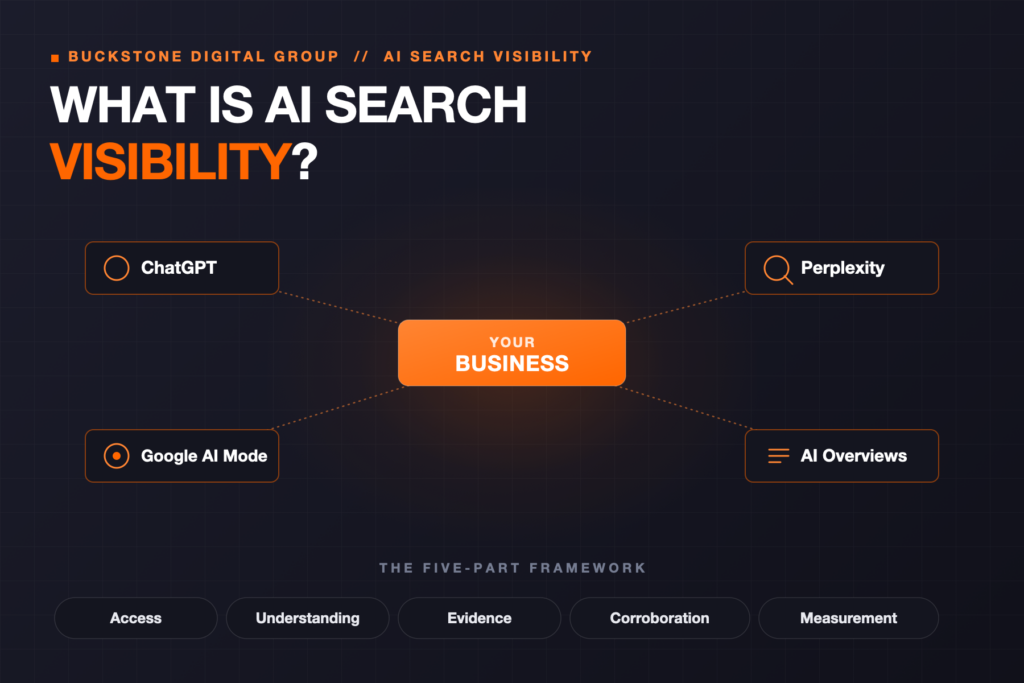
Search is no longer confined to a list of links on Google.
Customers now use ChatGPT to research service providers. They ask Google AI Mode to compare options, use AI Overviews to understand unfamiliar subjects, and turn to Perplexity for sourced answers and recommendations.
Instead of searching only with short phrases such as:
- commercial collection agency
- SEO company near me
- industrial lubricant manufacturer
- custom home builder Chicago
They can ask complete, highly specific questions:
- Which commercial collection agencies specialize in construction debt?
- Recommend an SEO agency that understands industrial manufacturing.
- What should I look for when choosing a biodegradable lubricant supplier?
- Which custom home builders near Chicago are known for modern architecture?
- Compare several companies and explain which one appears best suited to my situation.
The search platform may answer directly, summarize multiple sources, cite websites, compare companies, and suggest what the user should do next.
That creates a new visibility challenge for businesses.
It is no longer enough to ask:
Where does our website rank?
Companies must also ask:
Can AI-driven search systems find us, understand what we do, verify our expertise, and confidently include us in an answer? We break that question down in how AI systems understand your business.
That broader discipline is AI Search Visibility.
What is AI Search Visibility?
Definition
AI Search Visibility
AI Search Visibility is the practice of improving a business’s ability to appear meaningfully within AI-generated search and discovery experiences.
That can include whether the business is:
- Found by an AI search system
- Understood accurately
- Associated with the correct services, products, industries, and locations
- Used as a supporting source
- Cited through a link
- Mentioned by name
- Included in a comparison
- Presented as a relevant option
- Recommended for a particular need
- Described accurately when users ask about it
- Sent referral traffic from an AI platform
The objective is not merely to make a company’s name appear somewhere in a generated response.
The objective is to improve the probability that the company becomes part of the answer when its experience, services, products, location, or expertise genuinely match the user’s need.
A practical example
Imagine a manufacturer that produces biodegradable industrial lubricants.
Traditional SEO might focus on improving the company’s visibility for searches such as:
- biodegradable industrial lubricants
- environmentally acceptable lubricant supplier
- hydraulic oil for marine equipment
AI Search Visibility considers those searches, but it also examines more conversational discovery questions:
- Which companies manufacture environmentally acceptable lubricants in the United States?
- What lubricant suppliers serve marine and industrial customers?
- Compare biodegradable hydraulic fluid manufacturers.
- What should I consider when choosing an environmentally responsible industrial lubricant?
- Which supplier appears to have the strongest technical documentation and industry expertise?
The business must be more than technically indexable.
Search systems must be able to understand the company, connect it with the right topics, find reliable evidence, and determine whether it belongs in the answer.
Which platforms are included in AI Search Visibility?
AI Search Visibility is not limited to one platform.
It can involve:
ChatGPT Search
ChatGPT can use web search to answer current questions, cite sources, and help users research products, services, companies, and decisions.
OpenAI operates OAI-SearchBot to surface public web content within ChatGPT’s search experiences. Allowing that crawler can make content eligible for discovery, although access alone does not guarantee that a page will be cited or a company recommended. For a platform-specific walkthrough, see our companion guide on getting your business recommended by ChatGPT.
Google AI Mode
Google AI Mode lets users ask detailed, conversational questions and receive organized AI-generated responses with links that allow them to explore supporting information on the web.
It is part of Google Search and remains connected to Google’s crawling, indexing, ranking, and quality systems. For a practical, Google-specific playbook, see our guide on how to show up in Google AI Mode.
Google AI Overviews
AI Overviews can appear within Google Search results to summarize a subject using information from multiple sources. Our guide explains how to appear in Google AI Overviews.
A company may receive visibility through a cited article, service page, product page, local business result, or another source that helps support the generated response.
Perplexity
Perplexity is a search and answer platform that retrieves information from the web and prominently cites supporting sources. Our guide to getting cited by Perplexity.covers how to become one of those sources
Perplexity operates PerplexityBot for surfacing and linking websites within its search results. As with other crawlers, allowing access creates eligibility—not guaranteed inclusion.
Other AI-driven search and discovery systems
The broader category may also include:
- Gemini experiences
- Microsoft Copilot
- Bing’s generative search features
- Shopping assistants
- Vertical AI research tools
- Marketplace recommendation systems
- Search features embedded into software and business platforms
- Future conversational discovery products
The exact platforms will continue to change.
That is why businesses should build a durable information and authority foundation rather than optimize around one temporary interface.
Is AI Search Visibility the same as AI SEO, GEO, or AEO?
Several overlapping terms are used to describe this field.
AI SEO
AI SEO is commonly used to describe optimization for search experiences that use generative AI.
It can also be misunderstood as using AI to perform ordinary SEO work, so the term is not always precise.
Generative Engine Optimization
Generative Engine Optimization, or GEO, generally refers to increasing visibility within answers generated by AI systems.
The term is useful in some industry discussions, but it can imply that there is one unified “generative engine” with one optimization formula. There is not.
Answer Engine Optimization
Answer Engine Optimization, or AEO, generally refers to structuring information so it can be used in direct answers.
The concept predates the current generation of AI search and has historically included featured snippets, voice assistants, knowledge panels, and other answer-oriented formats.
Why BuckStone uses AI Search Visibility
We use AI Search Visibility because it describes the business outcome rather than pretending there is one universal optimization mechanism.
The question clients care about is not which acronym wins.
They want to know:
- Are we visible?
- Are we described accurately?
- Are competitors being recommended instead of us?
- Is our website being cited?
- Can these platforms access our content?
- What information are they using?
- What should we improve?
- Is this visibility generating meaningful business?
AI Search Visibility creates room to address those questions across platforms without oversimplifying how each system works.
Does AI Search Visibility replace traditional SEO?
No.
Traditional SEO remains the foundation of visibility across Google and much of the searchable web.
Google has explicitly stated that its generative search features are rooted in its core Search ranking and quality systems. Pages still need to meet Google’s technical requirements and be eligible for indexing and search presentation.
Foundational technical SEO work remains critical:
- Crawlability
- Indexation
- Site architecture
- Internal linking
- Page relevance
- Helpful original content
- Mobile usability
- Page performance
- Structured information
- Local signals
- Product data
- Authority
- Reputation
- Search intent alignment
OpenAI and Perplexity also use web crawlers to discover content for their respective search experiences. If those crawlers cannot reach you, see whether your website is blocking AI crawlers.
A website that is technically inaccessible, poorly organized, vague, outdated, or unsupported by credible information will not become competitive merely because someone labels the work “GEO.”
What changes with AI-driven search?
The work expands.
Traditional rank tracking often focuses on where a particular URL appears for a particular query.
AI Search Visibility also considers:
- Whether the brand appears at all
- How it is described
- Which services are associated with it
- Whether the website receives a citation
- Which external sources influence the answer
- Whether the company appears for conversational prompts
- Whether recommendations vary by location or context
- Whether the answer accurately reflects the company
- Whether the business is compared favorably with competitors
- Whether the interaction produces a website visit or lead
SEO is not dead.
The definition of meaningful search visibility is becoming broader.
Why rankings alone no longer tell the whole story
A company can rank well in traditional search and still be absent from an AI-generated answer.
It can also be cited in an AI response even when the cited page is not the first traditional result a user would have clicked.
AI-generated responses can draw from several sources, break a complex question into multiple components, synthesize information, and present the user with a direct answer.
The customer may never examine a conventional list of ten results.
That does not make rankings irrelevant.
It means rankings are now one part of a larger discovery environment.
Businesses should monitor at least four layers of visibility:
Traditional search visibility
Where pages appear in ordinary search results.
Generative search visibility
Whether the business or its content appears in AI Mode, AI Overviews, ChatGPT, Perplexity, or comparable experiences.
Citation visibility
Whether the company’s website is linked as a supporting source.
Recommendation visibility
Whether the company is presented as a suitable provider, product, source, or solution for a specific need.
These layers overlap, but they are not identical.
Being crawled, indexed, cited, mentioned, and recommended are different outcomes
One of the biggest mistakes in AI search discussions is collapsing every stage into the word “ranking.”
A website can move through several distinct stages.
From access to recommendation
Eight distinct stages — not one “ranking”
Crawled
A platform’s bot can access and retrieve the page.
Indexed or retrievable
The page becomes available within a search index, cache, or retrieval system.
Selected as relevant
The system determines that the information may help answer a particular question.
Used as supporting evidence
Information from the page contributes to the response.
Cited
The response includes a link or visible attribution to the source.
Mentioned
The company or brand is named within the answer.
Compared
The company is evaluated alongside alternatives.
Recommended
The company is presented as a potentially suitable choice for the user’s specific need.
Allowing a crawler may support the first stage.
It does not automatically produce the final stage.
This distinction matters because each failure requires a different solution.
A crawl-access problem is technical.
An entity-understanding problem may require clearer company and service information. Building that clarity is the focus of entity SEO.
A citation problem may require more useful and original source material.
A recommendation problem may involve relevance, reputation, corroboration, differentiation, or insufficient evidence.
How AI search systems decide what information to surface
No single formula applies across every AI search platform.
Each platform has its own:
- Crawlers
- Search indexes
- Retrieval systems
- Ranking and quality systems
- Models
- Source-selection methods
- Product features
- Personalization or contextual signals
- Citation interfaces
- Policies
The exact weighting of those systems is not publicly disclosed in a simple checklist.
However, businesses can improve the quality of the public information available to them.
AI-driven search systems generally need to resolve questions such as:
- What is this company?
- What does it provide?
- Where does it operate?
- Who does it serve?
- What subjects is it qualified to discuss?
- Is the information current?
- Is the source relevant to the question?
- Does the company provide evidence?
- Do independent sources support its claims?
- Is the business appropriate for this user’s specific situation?
That creates a practical optimization opportunity even without a published ranking formula.
BuckStone’s five-part AI Search Visibility framework
BuckStone evaluates AI Search Visibility through five connected requirements.
BuckStone’s AI Search Visibility Framework
Five requirements that work together
Can search and AI systems reach and retrieve your information?
Can a system determine who you are, what you do, where you operate, and whom you serve?
Have you published specific, original information worth retrieving and citing?
Does the wider web independently support what your business says about itself?
Can you tell whether your visibility is actually improving across platforms and prompts?
Together, they help explain why one business becomes visible while another remains absent or poorly represented.
1. Access: Can search and AI systems reach the information?
Visibility begins with technical access.
A company’s content cannot contribute to a search response if the relevant platform cannot retrieve it.
Access issues may involve:
- Robots.txt
- Meta robots directives
- X-Robots-Tag headers
- Firewalls
- CDN bot restrictions
- Security software
- Rate limiting
- JavaScript rendering
- Broken links
- Incorrect canonicals
- Redirect chains
- Server errors
- Staging restrictions
- Authentication barriers
- Poor indexation
- Pages orphaned from the site architecture
Different platforms may use different crawlers.
For example:
- Google uses its own crawling and indexing systems.
- OpenAI identifies
OAI-SearchBotas the crawler used for ChatGPT Search visibility. - Perplexity identifies
PerplexityBotas the crawler used to surface websites within Perplexity search.
Allowing one crawler does not automatically allow every other platform.
It is also possible for robots.txt to permit a crawler while a firewall or CDN blocks the same requests at the server level.
Access is necessary, but not sufficient
A fully crawlable website can still have poor AI visibility.
Technical access simply gives the content a chance to be considered.
It does not prove that the information is useful, relevant, credible, or recommendable.
2. Understanding: Can the system determine who you are and what you do?
Many businesses have websites that sound impressive but communicate very little.
Their headlines say:
- Transforming tomorrow
- Innovation that inspires
- Solutions built around you
- Your partner for growth
- Excellence without limits
These messages do not clearly establish:
- The company’s category
- Its services
- Its products
- Its customers
- Its industries
- Its locations
- Its differentiators
- Its expertise
AI Search Visibility requires entity clarity.
A company should make it easy to determine:
- Its official name
- What type of organization it is
- What it sells or provides
- Whom it serves
- Where it operates
- Which people lead it
- Which subjects it knows
- How its pages, services, authors, products, and locations relate to one another
- Which external profiles officially belong to it
Useful supporting elements can include:
- A clear homepage
- Complete service pages
- An accurate About page
- Leadership profiles
- Author pages
- Contact and location information
- Google Business Profiles
- Consistent directory profiles
- Organization and LocalBusiness structured data
- Person schema
- Product and service information
sameAsreferences to official profiles- Logical site architecture
- Contextual internal linking
Structured data can make relationships more explicit, but it should reflect visible facts rather than inventing authority.
3. Evidence: Have you published information worth using?
A company cannot build meaningful AI visibility through claims alone.
Saying “we are experts” is not evidence.
Useful evidence may include:
- Detailed service explanations
- Original research
- First-party data
- Case studies
- Technical documentation
- Industry benchmarks
- Process explanations
- Cost guidance
- Comparison criteria
- Expert analysis
- Tested methodologies
- Product specifications
- Customer use cases
- Clear definitions
- Diagnostic resources
- Frequently updated reference material
The strongest content gives a search system something specific to retrieve.
Generic content creates weak evidence
Thousands of companies publish interchangeable articles such as:
- Five reasons SEO is important
- Ten digital marketing trends
- Why every business needs a website
- Benefits of working with an expert
- The ultimate guide to growing online
These articles may be readable, but they contribute very little unique information.
AI tools can already summarize common knowledge.
Businesses create stronger citation and authority opportunities when they contribute:
- New observations
- Specific examples
- Real experience
- Original frameworks
- Useful data
- Better explanations
- Defensible opinions
- Detailed answers unavailable elsewhere
The objective is not to publish more words.
It is to publish more usable evidence.
4. Corroboration: Does the wider web support what you say?
A company’s website is only one source of information about it.
Independent corroboration may come from:
- Clients
- Review platforms
- Industry publications
- Professional associations
- News coverage
- Local media
- Partner websites
- Conferences
- Podcasts
- Expert interviews
- Vendor directories
- Product databases
- Award organizations
- Community organizations
- Universities
- Research citations
- Relevant business directories
These sources can reinforce relationships between a company and its:
- Industry
- Services
- Location
- Leadership
- Products
- Customers
- Expertise
- Reputation
This is broader than conventional backlink acquisition.
A relevant, accurate brand mention may contribute useful public information even when it does not include a followed link.
Corroboration must be authentic
Businesses should not respond by purchasing hundreds of irrelevant listings or manufacturing fake mentions.
Google has explicitly warned that inauthentic mentions are not a substitute for high-quality content and legitimate authority.
The objective is to create accurate, meaningful, independently supported information—not the appearance of popularity.
5. Measurement: Can you tell whether visibility is improving?
AI Search Visibility cannot be measured by running one prompt and checking whether the company appears.
Responses may vary based on:
- Prompt wording
- Search availability
- User location
- Conversation context
- Requested criteria
- Model or interface
- Date
- Platform
- Source freshness
- Commercial versus informational intent
Measurement requires a defined framework. Our guide to measuring AI search visibility breaks that framework into concrete metrics.
That may include:
- A controlled prompt library
- Brand mention tracking
- Citation tracking
- Competitor comparisons
- Description-accuracy reviews
- Referral analytics
- Landing-page performance
- Server-log analysis
- AI crawler activity
- Lead-source questions
- Conversion tracking
- Geographic testing
- Platform comparisons
- Google Search Console reporting
- Trend analysis over time
The goal is not to manufacture one simple “AI ranking.”
The goal is to identify where the company appears, why it appears, how it is described, which sources influence the result, and whether visibility creates business value.
How visible is your business across AI search?
See whether AI search can access, understand, and evaluate your business
BuckStone can evaluate whether ChatGPT, Google AI Mode, AI Overviews, Perplexity, and traditional search systems can properly access, understand, and evaluate your business—and which of the five requirements is holding you back.
How Google AI visibility is measured
Google now provides dedicated Search Console reporting for generative AI performance, including visibility within AI Overviews, AI Mode, and generative experiences in Discover.
That gives businesses more direct insight into Google’s generative search ecosystem than was previously available.
It does not eliminate the need to evaluate:
- Which landing pages receive visibility
- Which topics produce clicks
- Whether visits convert
- How branded and non-branded discovery differ
- What competitors appear for the same needs
- Whether content supports meaningful business outcomes
Google visibility should be connected to the same analytics and conversion framework used for the rest of organic search.
How ChatGPT and Perplexity visibility can be measured
These platforms require a combination of methods.
Useful signals can include:
- Referral sessions
- Referral URL parameters
- Landing pages
- Assisted conversions
- Controlled prompt tests
- Brand mentions
- Citations
- Competitor appearances
- Crawler activity
- Server logs
- Lead intake questions
- Sales conversations
OpenAI indicates that ChatGPT referral traffic can be tracked in analytics, including through its referral source parameter.
That traffic represents only one portion of visibility.
A user may see a company mentioned and later visit through a branded Google search, direct navigation, or another channel.
AI visibility measurement therefore needs to account for both direct and assisted discovery.
What AI Search Visibility is not
AI Search Visibility is not:
- Keyword stuffing pages with “ChatGPT”
- Publishing hundreds of generic AI-generated posts
- Installing one schema plugin
- Creating an
llms.txtfile and considering the work complete - Submitting a business to a secret AI directory
- Buying fake brand mentions
- Asking employees to repeatedly prompt the company name
- Rebranding ordinary SEO with a new acronym
- Guaranteeing that an AI platform will recommend a client
You do not need special Google AI markup
Google states that no special schema, AI-specific file, or llms.txt file is required to appear in AI Mode or AI Overviews.
Google’s generative experiences use content from the existing Search index and remain grounded in its broader ranking and quality systems.
That does not mean structured data is useless. Our guide to what structured data can and cannot do for AI search covers where it genuinely helps.
It means structured data should be used to clarify real entities and content—not sold as a secret AI inclusion switch.
An llms.txt file is not a universal ranking mechanism
Some tools and developers may choose to use llms.txt as a voluntary method of presenting information.
It is not a universal standard supported by every search platform, and it does not replace crawlability, indexation, content quality, entity clarity, or authority.
AI-generated content is not automatically bad
Using AI to assist with research, organization, analysis, or production is not inherently the problem.
The problem is publishing low-value, inaccurate, repetitive, or scaled content without meaningful human contribution.
Google’s guidance focuses on whether content is helpful, original, reliable, and compliant with its spam policies—not merely whether AI was involved in producing it.
Why your business may not appear in AI search
Common causes include the following—each one diagnosed in depth, with a checklist, in our guide on why your business is not appearing in AI search results:
Your website is inaccessible
A relevant crawler may be blocked by robots.txt, a firewall, a CDN, a security plugin, or another technical control.
Your company is described vaguely
The website may never clearly state what the company does, whom it serves, or where it operates.
Your service coverage is too shallow
A company may claim to provide a service but offer no substantial page, methodology, case study, or supporting content about it.
Your entity information is inconsistent
Company names, addresses, leaders, descriptions, locations, or official profiles may conflict across sources.
Your content is generic
The website may contribute no original evidence or uniquely useful information.
Third-party corroboration is weak
The company may have little visibility beyond its own website.
Competitors are easier to evaluate
Competitors may have clearer services, stronger reviews, better-known experts, more detailed content, or more independent coverage. That imbalance is often why ChatGPT recommends competitors instead of you.
The prompt is not actually a fit
A user asking for a local freelancer may not be looking for a nationwide agency.
Visibility should be evaluated in relation to genuine customer fit, not every imaginable prompt.
What should businesses do now?
Businesses do not need to abandon their existing SEO strategy and chase every AI-related trend.
They should strengthen the foundation that supports both traditional and generative search.
Audit crawler and index access
Determine whether Google, OpenAI, Perplexity, Bing, and other relevant systems can reach important public content.
Clarify the business entity
Make company, service, product, industry, location, leadership, and author information explicit and consistent.
Build complete service coverage
Create pages and supporting content that demonstrate real expertise rather than mentioning services in passing.
Publish better evidence
Develop case studies, data, methodologies, examples, documentation, and expert-led resources.
Strengthen external authority
Earn relevant reviews, mentions, partnerships, citations, coverage, and association profiles. For location-based discovery, that also means well-maintained local SEO signals and directory consistency.
Improve structured information
Use accurate schema, internal links, page relationships, and site architecture to clarify how entities and subjects connect.
Establish an AI visibility baseline
Define the prompts, platforms, competitors, citations, and analytics signals that should be monitored.
Connect visibility to revenue
Track whether AI-driven discovery produces qualified visits, leads, assisted conversions, and business opportunities.
Does every business need an AI Search Visibility strategy?
Not every company needs a large standalone AI initiative.
However, most businesses that rely on online discovery should understand whether AI search is changing their customer journey.
The need is especially strong when:
- Customers perform extensive research before contacting a provider.
- The company sells a complex product or service.
- Trust and expertise influence the buying decision.
- Competitors are already appearing in AI-generated answers.
- The company operates in several industries or locations.
- The website contains valuable technical or educational information.
- The organization has strong real-world expertise but weak digital authority.
- Leadership wants to understand how search behavior is evolving.
- The company depends heavily on organic discovery.
- The brand is frequently compared with alternatives.
The appropriate strategy depends on the business.
For some companies, the immediate priority is fixing technical access.
For others, it is entity clarity, content architecture, third-party authority, measurement, or a combination of all five.
What is an AI Search Visibility audit?
An AI Search Visibility audit evaluates how well a business can be accessed, understood, supported, and surfaced across AI-driven discovery experiences.
A meaningful audit should examine:
Technical access
- AI crawler permissions
- Search crawler access
- Robots directives
- CDN and firewall behavior
- Indexation
- Canonicals
- Rendering
- Site architecture
Entity understanding
- Organization information
- Services
- Products
- Locations
- Leadership
- Authors
- Structured data
- Official profiles
- Business consistency
Content evidence
- Service depth
- Topical coverage
- Originality
- Case studies
- Data
- Documentation
- Expertise
- Citation potential
External corroboration
- Reviews
- Brand mentions
- Links
- Publications
- Associations
- Partner sources
- Directories
- Reputation signals
Visibility and measurement
- Prompt testing
- Competitor appearances
- Citation tracking
- Referral traffic
- Description accuracy
- Google generative-search reporting
- Conversion paths
The result should not be a generic score.
It should identify the specific barriers preventing the business from being found, understood, cited, and recommended—and prioritize the work most likely to improve those outcomes.
How BuckStone improves AI Search Visibility
BuckStone Digital Group combines technical SEO, content strategy, entity optimization, structured data, digital authority, website improvement, and measurement into one coordinated system.
We do not approach AI visibility as a collection of isolated hacks.
We evaluate the complete information environment surrounding the business.
We identify access problems
We determine whether search and AI crawlers can reach, render, and retrieve important pages.
We improve entity clarity
We strengthen how the company, services, products, leaders, authors, industries, and locations are represented and connected.
We build evidence
We develop service pages, topical clusters, case studies, first-party insights, technical resources, and other information worth retrieving and citing.
We strengthen corroboration
We identify opportunities to improve reviews, directory accuracy, association visibility, media coverage, client mentions, and other independent support.
We establish measurement
We build prompt libraries, competitor baselines, citation monitoring, analytics reporting, and conversion tracking.
We execute the work
BuckStone does not stop with an audit. We can implement technical changes, improve website architecture, create content, add structured data, strengthen internal links, optimize local profiles, improve analytics, and coordinate the larger visibility strategy.
The objective is not to make one temporary prompt produce the company’s name.
It is to build a stronger, more defensible digital presence across the search experiences customers use today—and the ones they will use next.
Final answer: What is AI Search Visibility?
AI Search Visibility is the discipline of making a business easier for AI-driven search systems to:
- Access
- Understand
- Evaluate
- Cite
- Compare
- Recommend
It does not replace SEO.
It expands the definition of search visibility beyond rankings and links to include generated answers, citations, brand descriptions, comparisons, recommendations, and conversational discovery.
There is no universal optimization switch.
Businesses improve their position by building a technically accessible website, a clearly defined entity, useful evidence, credible external corroboration, and a meaningful measurement system.
That is the foundation BuckStone uses to help companies compete across ChatGPT, Google AI Mode, AI Overviews, Perplexity, and the broader future of search.
Your next step
Search is changing. Your business should not become harder to find.
BuckStone combines technical SEO, entity optimization, content strategy, structured data, authority development, and platform-specific measurement to help businesses compete across both traditional and AI-driven search.
This guide is the foundation. For industry-specific playbooks, explore AI Search Visibility for manufacturers, home builders, law firms, restaurants, ecommerce brands, contractors, and technology & SaaS.
Frequently Asked Questions
What is AI Search Visibility?
AI Search Visibility is the practice of improving how a business or website is found, understood, cited, compared, and recommended within AI-driven search experiences such as ChatGPT, Google AI Mode, AI Overviews, and Perplexity.
Is AI Search Visibility the same as SEO?
It overlaps heavily with SEO, but it evaluates additional outcomes such as generated mentions, citations, comparisons, recommendations, description accuracy, and conversational prompt visibility. Traditional SEO remains the technical and strategic foundation.
Is SEO dead because of AI?
No. Google’s generative search features remain connected to its core Search systems, while other AI search platforms also rely on accessible web content and retrieval. Businesses still need crawlability, relevance, useful content, authority, and a strong website.
What is the difference between AI SEO and GEO?
Both terms commonly describe optimization for AI-generated search experiences. AI SEO can also mean using AI within an SEO workflow, while GEO usually means Generative Engine Optimization. BuckStone uses AI Search Visibility because it describes the outcome across multiple platforms without implying one universal ranking system.
Can I guarantee that ChatGPT or Google AI Mode will recommend my business?
No. Third-party platforms control their own systems and do not provide a guaranteed organic submission or recommendation mechanism. Businesses can improve accessibility, clarity, relevance, evidence, and authority, but no ethical agency can promise a specific recommendation.
Does schema markup improve AI Search Visibility?
Structured data can clarify entities, attributes, and relationships. It should be part of a broader strategy, but it does not independently guarantee citation or recommendation.
Do I need an llms.txt file?
Google explicitly states that llms.txt is not required for AI Mode or AI Overviews. Other tools may choose to use it voluntarily, but it is not a universal AI visibility requirement or a substitute for strong technical SEO and useful content.
How do I measure AI Search Visibility?
Measurement can include controlled prompt testing, citations, brand mentions, competitor appearances, description accuracy, referral analytics, crawler activity, conversion tracking, and Google Search Console’s generative AI performance reporting.
How long does AI Search Visibility take to improve?
There is no universal timeline. Technical barriers may be corrected quickly, while content authority, entity clarity, external corroboration, and competitive visibility may require sustained work over several months.
What is included in an AI Search Visibility audit?
A proper audit evaluates technical access, entity clarity, content evidence, structured data, topical authority, third-party corroboration, platform visibility, competitor appearances, citations, analytics, and conversion measurement.
Sources and Methodology
This guide relies on official platform documentation for every factual claim about how AI-driven search systems access, rank, and surface web content. Where a platform does not disclose its exact ranking methods, the article says so rather than presenting speculation as confirmed fact, and it distinguishes documented platform behavior from BuckStone’s strategic interpretation.
- Google — AI Features and Your Website. developers.google.com/search/docs/appearance/ai-features
- Google — Guide to Optimizing for Generative AI Search. developers.google.com/search/docs/fundamentals/ai-optimization-guide
- Google — Succeeding in AI Search. developers.google.com/search/blog/2025/05/succeeding-in-ai-search
- Google — Search Generative AI Performance Reports. developers.google.com/search/blog/2026/06/gen-ai-performance-reports
- Google — Guidance on Generative AI Content. developers.google.com/search/docs/fundamentals/using-gen-ai-content
- OpenAI — Publishers and Developers FAQ. help.openai.com/en/articles/12627856-publishers-and-developers-faq
- OpenAI — Overview of OpenAI Crawlers (
OAI-SearchBot,GPTBot, andChatGPT-User), including robots.txt guidance. platform.openai.com/docs/bots - Perplexity — Official Crawler Documentation (
PerplexityBot). docs.perplexity.ai/docs/resources/perplexity-crawlers
Methodology. BuckStone’s five-part AI Search Visibility framework—access, understanding, evidence, corroboration, and measurement—is applied in client engagements and refined through technical audits, controlled prompt testing across services, industries, geographies, and buying stages, and analysis of referral data. Statements attributed to Google, OpenAI, and Perplexity reflect their publicly available guidance as of July 2026 and may change as those platforms update their products and policies. BuckStone does not have access to any platform’s private ranking algorithms; where exact weighting is undisclosed, this article identifies the practical, observable factors a business can control rather than implying a guaranteed ranking formula.