
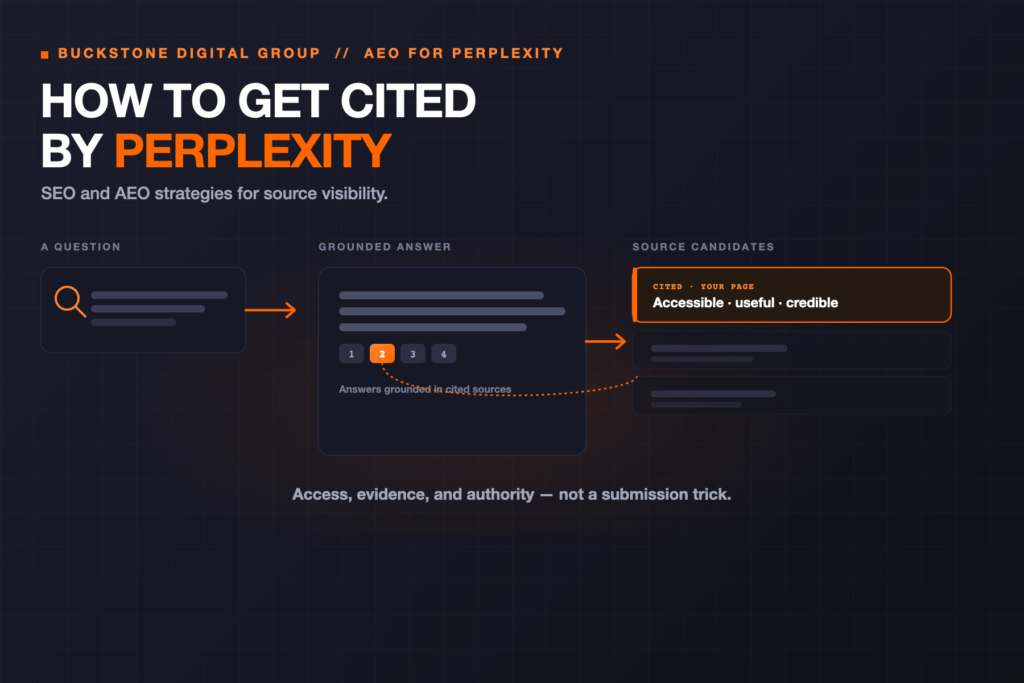
You ask Perplexity a question directly related to your company’s expertise. It cites several competitors, publications, or directories—but not your website.
The reaction is usually a rapid series of questions. Does Perplexity even know our site exists? Is our crawler access blocked? Does it just prefer larger brands? Do we need schema markup, or more articles? Can an agency simply submit our business to Perplexity?
There is no documented Perplexity submission form that guarantees citations. For your page to be cited, Perplexity generally has to be able to (1) access the information, (2) retrieve it for the question, (3) interpret what the page provides, (4) judge it useful and relevant, (5) use it to support the answer, and (6) present it as a cited source. Each stage is a filter.
To improve your chances of being cited by Perplexity, publish accessible, specific, evidence-rich content that directly supports the questions your customers ask—and build enough authority and consistency for that information to be credible.
This is the Perplexity-specific application of our wider framework. It sits at the intersection of technical SEO, content strategy, entity SEO, structured data, source credibility, digital PR, internal linking, analytics, and Answer Engine Optimization—and, importantly, Perplexity does not publish a guaranteed citation formula, so no agency can promise a particular page will be cited.
Key takeaways
Getting cited by Perplexity, in one panel
- Perplexity citations are links to sources used to support generated answers.
- PerplexityBot is intended to surface and link websites in search results.
- Perplexity-User may fetch pages in response to user requests—and generally ignores robots.txt.
- Allowing crawler access is necessary for many citation opportunities but does not guarantee inclusion.
- Perplexity does not publish a complete citation-selection formula.
- Useful source pages are specific, clear, publicly accessible, current, and supported by evidence.
- Original research, statistics, case studies, product details, and expert explanations can create citation-worthy information.
- Strong SEO supports Perplexity AEO through crawlability, page structure, internal linking, relevance, and authority.
- Structured data can clarify information but is not a documented Perplexity citation requirement.
- A brand mention, a website citation, and a business recommendation should be measured separately.
- One manual prompt is not enough to evaluate Perplexity visibility.
- Referral traffic measures clicks, not every unclicked citation.
- Competitive prompt tracking can reveal which sites and page types Perplexity favors for important topics.
- BuckStone combines technical access, content, entity clarity, corroboration, and measurement.
What is a Perplexity citation?
A Perplexity citation is a linked source presented alongside or within an AI-generated answer to support information in the response. Perplexity describes itself as an answer engine: it searches the web in real time and returns answers grounded in sources, with numbered inline citations linking to the originals.
A citation can point to an article, a research report, a product or service page, official documentation, a government source, a news story, a business website, a directory, a review platform, a forum discussion, or any other public webpage. What it does not automatically mean is endorsement, recommendation, agreement with everything on the page, permanent visibility, top placement, or qualified traffic.
A citation means the page was used as a source for that answer. It does not automatically mean the business was recommended.
Citation vs. mention vs. recommendation
These three outcomes look similar in an answer and are constantly conflated. They occur independently, and you should track each one separately.
Citation
You are a source
Perplexity links to your website or content as a source supporting the answer.
Example
- A BuckStone article is cited while BuckStone is not named as an agency.
Mention
You are named
Your company, product, leader, or service is named in the generated answer—with or without a link.
Example
- BuckStone is named in a comparison without its site being cited.
Recommendation
You are the answer
Perplexity presents your company as a suitable option for the user’s need—often drawing partly on third-party sources.
Example
- BuckStone is recommended based partly on reviews and directories.
How does Perplexity find and retrieve sources?
Perplexity documents the crawlers it uses to gather and retrieve public web information, and describes returning answers grounded in web sources with citations.
Perplexity documents the crawlers it uses to gather and retrieve public web information, but it does not publish a complete formula explaining why one page is selected over another for every answer.
So the honest model is: get the technical fundamentals right so your pages are eligible, then make them the kind of source a system has a genuine reason to cite. Neither half works alone.
PerplexityBot vs. Perplexity-User
Perplexity documents two user agents with different jobs. Treating them as interchangeable—or as training crawlers—leads to the wrong fixes.
| User agent | Documented purpose | Practical consideration |
|---|---|---|
| PerplexityBot | Surface and link websites in Perplexity’s search results (not used for foundation-model training) | Review robots.txt, firewall, CDN, and the published IP ranges; allow it for content you want discovered |
| Perplexity-User | Retrieve a page in response to a specific user request (not used for training) | Generally ignores robots.txt because it is user-initiated, so manage it at the firewall/IP level, not via robots.txt |
Two things follow. First, because Perplexity-User is user-triggered and generally ignores robots.txt, aggressive bot protection or a firewall rule—not your robots file—is the more likely place a legitimate user-driven fetch gets blocked. Second, Perplexity publishes official IP-range JSON endpoints and advises using the most current ones; a hardcoded list copied from a blog post goes stale. The controls work independently, and changes may take up to 24 hours to be reflected.
Should you allow PerplexityBot in robots.txt?
If Perplexity search visibility is a goal, a business should generally check whether PerplexityBot can reach the public content it wants discovered. But there is no universal policy—weigh your visibility goals against server load, security, content licensing, paywalls, and any legal or contractual constraints. Allowing access should be scoped to public content intended for discovery.
Scope it carefully
Never open these to any crawler
- Customer portals and authentication-protected resources
- Private documents and confidential files
- Paid member content and paywalls
- Administrative areas and regulated information
Allowing appropriate access is a technical-access decision, and it overlaps directly with the wider question of whether your website is blocking AI crawlers. We do not change live robots.txt, CDN, or firewall settings as part of writing this guide—those are implementation decisions made deliberately, with the business.
How to check whether Perplexity can access your website
Test the pages that earn business, not just the homepage. Work down the stack.
robots.txt
- PerplexityBot rules and any broad wildcard blocks
- Sitewide or directory-level blocks
- Staging leftovers and duplicate rule groups
- Remember Perplexity-User generally ignores robots.txt
CDN & firewall
- 403 / 429 responses and bot challenges
- CAPTCHA pages and geographic restrictions
- Rate limiting and managed bot protection
- Security-plugin logs; the published IP guidance
URLs & rendering
- Test service, product, article, and case-study pages
- Confirm the H1, body, author, and dates are in the raw HTML
- Check internal links and product/service details render
- Confirm meaningful content isn’t JS-only
Logs & re-testing
- Look for Perplexity user agents in server/CDN logs
- Check response codes, failed requests, and challenges
- Confirm successful retrieval of key URLs
- Re-test after changes; allow up to 24 hours to reflect
Access audit
Is Perplexity able to retrieve your best content?
BuckStone can audit PerplexityBot and Perplexity-User access across your robots.txt, firewall, CDN, server responses, rendering, and important pages.
Why crawler access alone is not enough
Access is the first filter, not the last. A page moves through several stages before it becomes a citation, and it can drop out at any of them.
The citation progression
Six stages from crawlable to cited
Accessible
The crawler can reach the page—robots, firewall, and server all permit it.
Retrievable
The content can be fetched and read for the question at hand.
Relevant
The page actually addresses the prompt, not a loosely related topic.
Useful
It answers specifically and completely, with substance rather than filler.
Credible
Evidence, authorship, and corroboration make it trustworthy as a source.
Cited
It is selected to support the answer—and out-competes the alternatives.
A perfectly accessible page still fails if it is too general, thin, outdated, duplicative, poorly organized, unsupported, commercial without useful information, unclear about its author, misaligned with the prompt, or simply weaker than a competing source.
Access creates eligibility for retrieval. It does not create a reason to cite the page.
What content is most likely to be useful as a source?
There is no guaranteed content formula. But strong source material tends to share these traits.
1. Direct answers to specific questions
Answer the question clearly rather than hiding the substance beneath a long introduction. Use concise summaries, descriptive headings, and complete explanations—without writing only for snippets or artificial answer blocks.
2. Original evidence
First-party research, survey data, product testing, case-study results, benchmarks, methodologies, industry datasets, original photography, expert observations, and documented customer outcomes. The evidence must be real and its methodology transparent.
3. Specific product and service information
Capabilities, specifications, public pricing, availability, locations, industries served, requirements, limitations, process, use cases, and comparisons. Concrete information is more useful than thin marketing language.
4. Expert explanations
A real author with a relevant role, a clear biography, demonstrated experience, sources, examples, and accurate update dates. An author page does not guarantee citations—it makes real expertise easier to identify and verify.
5. Current, maintained information
Outdated prices, products, staff, laws, platform features, or statistics weaken usefulness. Use real modified dates only when meaningful updates occurred—never change dates to simulate freshness.
6. Clear page structure
Descriptive headings, concise summaries, tables and lists where they help, definitions, examples, source references, a logical hierarchy, and accessible HTML—without forcing every answer into a card or FAQ.
7. Transparent sourcing
When making factual claims, link to primary sources, identify methodology, show publication dates, explain calculations, distinguish fact from interpretation, and correct outdated claims.
8. Strong topical and entity context
Make clear who published the page, who wrote it, what organization they represent, what topic it addresses, and how it relates to the rest of the site. This is where source quality meets entity SEO and how AI systems understand your business.
9. Public accessibility
Pages hidden behind login systems, broken scripts, aggressive bot challenges, or inaccessible rendering make poor source candidates—even when the content itself is excellent.
10. External credibility and corroboration
Independent evidence from industry publications, reviews, association profiles, partner pages, news coverage, customer case studies, and research citations. Quality and relevance beat volume—mass low-quality directory submissions are not a corroboration strategy.
Does structured data help with Perplexity citations?
Structured data can help clarify your organization, author, article, product, location, publisher, dates, and the relationships between them. But Perplexity does not publicly state that a particular Schema.org type guarantees citation selection, and it does not document structured data as a requirement.
Structured data can improve clarity, but it is not a documented Perplexity citation switch.
Use it where it accurately reflects visible content—the full picture is in can structured data help your business appear in AI search.
Does llms.txt help?
Perplexity, like many developer platforms, may publish an llms.txt documentation index for its own developers—but that does not mean every business needs an llms.txt file to be cited. There is no documentation making it a universal AEO requirement. Your priorities remain publicly accessible pages, correct crawler controls, useful content, internal linking, clear entities, strong evidence, and credible external support.
Are blog posts the only pages that get cited?
No. Blog articles, product and service pages, case studies, research, documentation, category and location pages, About pages, public reports, comparison pages, and FAQ resources can all be cited. The page type should match the question: a technical query may favor documentation or a guide; a product comparison may draw on detailed product pages and independent reviews; a business-recommendation prompt may lean on service pages, reviews, directories, and third-party sources; and a statistic may favor primary research.
How to optimize an existing page for Perplexity
When a page you already have should be earning citations and isn’t, work through this in order.
Page optimization
Eight steps to a more citable page
Identify the prompt category
Educational, diagnostic, comparison, recommendation, validation, transactional, or local.
Review currently cited sources
Record domains, page types, information, dates, evidence, authors, and structure — without copying them.
Identify the information gap
What does the current answer omit? Is it outdated, missing a primary source, or too general? What real evidence can you add?
Improve direct usefulness
Add a clear answer, definitions, specific examples, evidence, methodology, expert context, current data, sources, and limitations.
Strengthen entity & authorship
Connect the author, organization, relevant service, supporting case study, related research, and external profiles.
Improve internal discovery
Link from relevant service pages, topic hubs, related articles, case studies, and author pages.
Confirm technical access
Re-test retrieval, response codes, rendering, directives, and CDN/firewall behavior.
Monitor the prompt set
Track whether the page becomes cited, mentioned, used for more prompts, replaced, visited, or converted.
Beyond crawlability
Being crawlable does not make a page citation-worthy.
BuckStone combines technical SEO, content strategy, original evidence, entity optimization, internal linking, and source analysis to improve Perplexity visibility.
How optimization differs by business type
B2B companies
Prioritize technical explanations, industry use cases, case studies, comparison content, original data, expert authors, and clear product and service pages—then track demos and leads. This is core SEO and AEO territory.
Local businesses
Prioritize accurate location information, services, reviews, hours, local guides, and business profiles, with recommendation prompts, calls, and bookings as outcomes. Local recommendations often lean heavily on external profiles and reviews, not just the website.
Ecommerce and product companies
Prioritize product details, specifications, availability, pricing, use cases, comparison content, feeds, reviews, and original images or demonstrations, with revenue tracking—work that overlaps with ecommerce and marketplace growth.
Publishers and research organizations
Prioritize citation frequency, unique URLs cited, original research, source freshness, clear methodology, and expert authorship, with referral traffic and newsletter conversions as outcomes.
How to measure Perplexity visibility
Measurement here follows the same discipline as our guide to measuring AI search visibility: a stable, documented prompt set tested on a schedule, with citations, mentions, and recommendations tracked separately.
| Metric | What it tells you |
|---|---|
| Citation coverage | Share of monitored prompts where your domain is cited |
| Mention coverage | Share where your brand is named, linked or not |
| Recommendation coverage | Share where you are presented as a suitable option |
| Unique URLs cited | Whether one page carries you or many pages do |
| Share of voice | Your presence vs. a defined competitor set |
| Accuracy | Whether the description of you is correct |
| Referral traffic | Clicks that actually reach the site (not every citation) |
| Conversions | Leads, sales, or bookings tied to that traffic |
Every reported number needs its conditions recorded: the prompts, date, location, platform and mode, account state, testing conditions, and result evidence. To track Perplexity referral traffic, use GA4—session source, source/medium, referrals, landing pages, engaged sessions, key events, leads, and revenue—and maintain a reviewed AI-referral channel grouping rather than hardcoding an unverified universal rule.
Analytics can measure users who click through. It cannot measure every unclicked citation or mention.
And one manual Perplexity search is not a measurement. The same prompt can vary by wording, date, location, product or search mode, account context, follow-up questions, available sources, index updates, and generation variability. Manual testing is valuable for diagnosing a specific prompt, reviewing cited sources, and capturing examples—but it should not be the entire reporting methodology.
Common SEO and AEO mistakes
- Assuming crawler access guarantees citations
- Blocking PerplexityBot unintentionally, or ignoring Perplexity-User (which robots.txt won’t control)
- Disabling security globally to “let it in”
- Publishing generic AI-written summaries and expecting to become a source
- Copying currently cited sources instead of adding something new
- Inventing statistics or hiding the direct answer
- Ignoring authorship and update dates
- Publishing no original evidence
- Using schema as the entire strategy
- Treating every citation as a recommendation
- Testing only branded prompts, or measuring only referral traffic
- Changing the prompt set every month
- Reporting a visibility percentage without a denominator
- Ignoring competitors or incorrect descriptions
- Treating
llms.txtas a guaranteed solution, or promising Perplexity rankings
What a Perplexity SEO or AEO agency should do
Answer Engine Optimization—AEO—is the practice of improving how a business and its information are understood, retrieved, cited, compared, and recommended across answer-based experiences. Perplexity AEO still depends on SEO fundamentals: a platform cannot cite content it cannot access, retrieve, interpret, or consider relevant. Here is what separates a capable agency from a schema-plugin vendor.
What a capable agency does
- Audits PerplexityBot and Perplexity-User access
- Reviews robots.txt, CDN, firewall, and server logs
- Builds a commercially relevant prompt set
- Establishes a citation and competitor baseline
- Identifies currently cited sources and content gaps
- Improves content usefulness and creates real evidence
- Strengthens authorship and entity clarity
- Improves internal linking and fixes structured-data conflicts
- Builds external corroboration
- Tracks citations, mentions, recommendations, traffic, and conversions
- Turns findings into monthly actions
What it should not merely do
- Install a schema plugin or add FAQ blocks
- Generate hundreds of AI-written articles
- Add
llms.txtand call it done - Promise Perplexity rankings or citations
- Submit the company to low-quality directories
- Report screenshots without methodology
- Count every mention as a recommendation
When choosing an SEO and AEO agency, look for technical SEO and crawler/firewall expertise, content strategy, entity SEO, structured-data implementation, an original-research capability, a prompt-monitoring methodology, competitive reporting, GA4 and conversion measurement, development capability to ship fixes, transparent limitations—and no guaranteed citations. Any agency promising guaranteed Perplexity rankings is misrepresenting how the platform works.
How BuckStone improves Perplexity visibility
We work the same five layers we apply across AI Search Visibility. Access—PerplexityBot and Perplexity-User permissions, robots.txt, CDN and firewall behavior, server responses, rendering, and retrieval of important pages. Understanding—company identity, service and product clarity, authorship, structured data, page structure, internal relationships, and location information. Evidence—original research, case studies, product information, expert explanations, useful comparisons, and transparent methodology. Corroboration—external mentions, reviews, industry publications, partner pages, directories, and the sources that appear in competitor answers. Measurement—citations, mentions, recommendations, prompt coverage, competitor share of voice, accuracy, referral traffic, and leads.
BuckStone does not treat Perplexity optimization as a submission trick. We improve whether the company’s information is accessible, useful, credible, corroborated, and measurable.
Final answer: how to get cited by Perplexity
To improve your chances of being cited by Perplexity: allow appropriate public crawler access; confirm important pages are technically retrievable; answer specific customer questions clearly; publish original evidence and useful detail; keep information current and accurate; identify real authors and organizations; connect related pages through internal links; build credible external corroboration; monitor a stable prompt set; and measure citations, mentions, traffic, and business outcomes separately. If you are missing entirely today, start with why your business is not appearing in AI search results, and see how the same discipline plays out on other platforms in how to get recommended by ChatGPT and how to show up in Google AI Mode.
The goal is not to trick Perplexity into citing your website. The goal is to become one of the most useful and credible public sources for the questions your customers ask.
Work with BuckStone
Become a more useful source for the questions your customers ask.
BuckStone can build your Perplexity prompt set, technical baseline, content plan, competitive analysis, citation tracking, and implementation roadmap.
Frequently asked questions
What is a Perplexity citation?
A linked source presented alongside or within a Perplexity answer to support the information in that response. Perplexity is an answer engine that grounds answers in real-time web sources with numbered inline citations to the originals.
How do I get my website cited by Perplexity?
Make your public content accessible to Perplexity’s crawlers, answer specific questions clearly, add original evidence and concrete detail, keep it current, identify real authors, connect related pages, and build external corroboration. There is no guaranteed formula—these steps improve the likelihood, not the certainty.
How does Perplexity choose sources?
Perplexity documents the crawlers it uses to gather and retrieve public web information and describes grounding answers in cited sources, but it does not publish a complete formula explaining why one page is chosen over another for every answer.
What is PerplexityBot?
PerplexityBot is the crawler Perplexity documents as designed to surface and link websites in its search results. Perplexity states it is not used to crawl content for AI foundation-model training.
What is Perplexity-User?
Perplexity-User is a user-triggered fetcher that may visit a page to help answer a specific user question. It is not used for training, and Perplexity notes it generally ignores robots.txt because it is user-initiated.
What is the difference between PerplexityBot and Perplexity-User?
PerplexityBot surfaces and links sites in search results and respects robots.txt; Perplexity-User fetches a page in response to a specific user request and generally ignores robots.txt. They serve different purposes and can be managed independently—PerplexityBot via robots.txt, Perplexity-User more at the firewall/IP level.
Should I allow PerplexityBot in robots.txt?
If Perplexity search visibility is a goal, generally yes for the public content you want discovered—Perplexity recommends allowing PerplexityBot. Scope it to public pages and keep private, paid, and administrative areas blocked. Weigh server load, security, and licensing before deciding.
Does allowing PerplexityBot guarantee citations?
No. Allowing access makes a page eligible for retrieval, but citation still depends on relevance, usefulness, credibility, and competition. Perplexity does not guarantee that any accessible page will be cited.
Why is Perplexity not citing my website?
Common reasons include blocked or challenged crawler access, JavaScript-only content, pages that are thin or too general, no original evidence, unclear authorship, outdated information, or simply stronger competing sources for that question.
What content is most likely to be cited by Perplexity?
Accessible pages that answer a specific question clearly and back it with real evidence—original research, concrete product or service detail, expert explanation, transparent sourcing, current information, and clear authorship. No content type is guaranteed to be cited.
Does schema markup help with Perplexity citations?
Structured data can clarify your organization, author, product, and relationships, which reduces ambiguity. Perplexity does not document any schema type as a citation requirement or guarantee, so treat schema as clarity work, not a citation switch.
Does Perplexity use structured data?
Perplexity does not publish that a particular Schema.org type is required or that it determines citation selection. Accurate structured data that matches visible content is reasonable to maintain, but it is not a documented Perplexity requirement.
Does llms.txt improve Perplexity visibility?
There is no documentation making llms.txt a requirement for being cited by Perplexity. Accessible pages, correct crawler controls, useful content, clear entities, and credible evidence matter far more.
Can service pages be cited by Perplexity?
Yes, when they provide concrete, useful information—what the service is, who it is for, what is included, the process, evidence, and relevant detail—rather than thin marketing copy. The page type should match the question being asked.
Can product pages appear in Perplexity?
Yes. Detailed product pages with specifications, availability, pricing where public, use cases, and reviews can support product and comparison answers, especially alongside independent sources. Keep product data consistent across the page, feeds, and marketplaces.
Do original research and statistics improve citation opportunities?
They can, because original, well-sourced data gives an answer engine a specific reason to cite you. The research must be real and its methodology transparent—fabricated or unsupported statistics undermine credibility rather than build it.
How do I optimize existing content for Perplexity?
Identify the prompt category, review the sources currently cited, find the information gap, add a clear answer with real evidence and current detail, strengthen authorship and entity signals, improve internal links, confirm technical access, and monitor a defined prompt set for changes.
How do I track Perplexity citations?
Test a stable prompt set on a schedule and record citations, mentions, and recommendations separately, along with the conditions. Third-party monitoring tools can help at scale, but no tool observes every real user prompt, and your own analytics only captures clicked visits.
Can GA4 track traffic from Perplexity?
Yes, for users who click a citation through to your site—via session source, source/medium, referrals, and landing pages in GA4. Maintain a reviewed AI-referral channel grouping, and remember it captures clicks, not every citation.
Does referral traffic show every Perplexity citation?
No. Referral traffic only reflects users who clicked through. Many citations are read without a click, so referral data undercounts citation activity and should be paired with prompt monitoring.
How often should Perplexity visibility be measured?
Monthly prompt tracking is a practical baseline for reporting, with high-priority prompts checked more often and referral traffic monitored continuously. Keep the core prompt set stable so periods are comparable.
Can an AEO agency guarantee Perplexity citations?
No. No agency controls Perplexity’s independent citation decisions, and Perplexity does not publish a guaranteed selection formula. A good agency improves access, usefulness, credibility, and measurement—which raises the likelihood without promising the outcome.
What should a Perplexity visibility audit include?
PerplexityBot and Perplexity-User access review, robots.txt/CDN/firewall and log analysis, a commercially relevant prompt set, a citation and competitor baseline, cited-source and content-gap analysis, entity and authorship review, structured-data checks, and a measurement plan tied to business outcomes.
How much does Perplexity SEO or AEO cost?
There is no universal price. Cost depends on website size, technical issues, prompt volume, content and research needs, competitive intensity, entity complexity, external corroboration, reporting scope, and how much implementation is required.
Sources & methodology
Platform claims here were checked against current official Perplexity documentation. We distinguish Perplexity’s crawler documentation and public product descriptions from BuckStone’s SEO and AEO methodology and practical recommendations. Where Perplexity does not disclose its complete retrieval or citation-selection method—which it does not—we say so rather than inferring a formula. PerplexityBot is documented as surfacing and linking sites in search results (not training); Perplexity-User is documented as a user-triggered fetcher that generally ignores robots.txt. No guarantee of citation, mention, recommendation, ranking, or traffic is expressed or implied, and no live robots.txt, CDN, or firewall changes were made in producing this article.
- Perplexity — Perplexity Crawlers (PerplexityBot, Perplexity-User, robots.txt & IP guidance)
- Perplexity Help Center — What Is Perplexity?
- Perplexity Help Center — How Does Perplexity Work?
- Perplexity Help Center — What Is an Answer Engine?
- Google Search Central — robots.txt Introduction
- Google Search Central — JavaScript SEO Basics
- Google Search Central — Introduction to Structured Data