
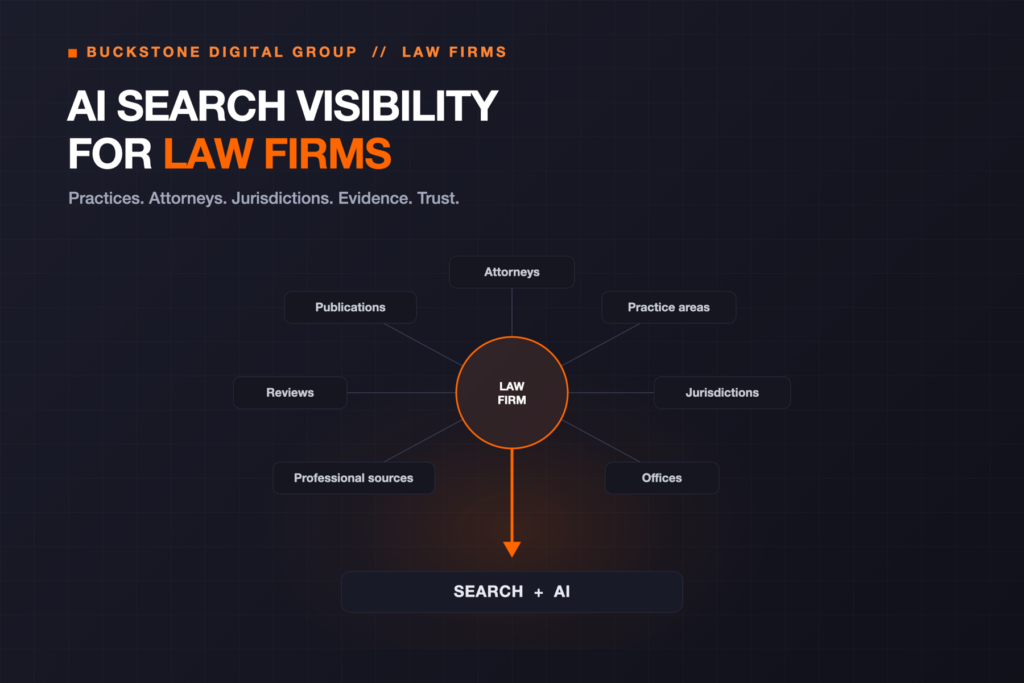
Someone with a payment dispute searches Google for the problem, reads an AI Overview, then asks ChatGPT what kind of attorney handles construction collections in Pennsylvania and which firms to consider near them. They compare two firms, read attorney bios and reviews, scan representative matters, confirm the firm is admitted in the right jurisdiction, and finally call or submit an intake form. Not one of those steps is a single keyword ranking. For a law firm, visibility is the ability to stay accurate, credible, and discoverable throughout a high-stakes decision — and in legal search, visibility without accuracy can create reputational and ethical risk.
This is the law-firm-specific application of our AI Search Visibility series — not a generic pile of practice-area blogs. It reflects how prospective clients actually research attorneys by legal problem, practice area, location, jurisdiction, experience, reputation, and fee structure, and what that demands of a firm’s website and professional footprint — within the accuracy and ethics standards that govern legal marketing.
It doesn’t provide legal advice or jurisdiction-specific ethics guidance. Legal-advertising and professional-conduct rules vary by state and change over time, so firms should have qualified counsel review marketing claims, case-result language, testimonials, comparative statements, and disclaimers under the rules applicable to their jurisdictions.
- Legal recommendation visibility is contextual and jurisdiction-dependent. A firm is relevant for a specific matter, client, location, and jurisdiction — not universally.
- Practice-area pages should explain specific matters, not just name a broad category.
- Attorney pages are core trust and entity assets, not internal staff bios — admissions, jurisdictions, and experience must be accurate.
- Legal content needs qualified attorney review, because incorrect information can cause real harm and carry ethical risk.
- Case results can be evidence — but require careful, ethical presentation and must never imply guaranteed outcomes.
- Reviews, directories, bar profiles, publications, and associations can reinforce the external footprint — managed within confidentiality and advertising rules.
- Structured data clarifies relationships but cannot manufacture qualifications, authority, or a recommendation.
- Multi-location firms need legitimate, consistent office architecture — never manufactured locations or duplicate profiles.
- Measure qualified intake, not raw traffic — and evaluate AI mentions for accuracy, not just presence.
Two definitions to anchor the strategy, because firms are often sold “SEO” and “AEO” as separate line items:
Law-firm SEO is the process of improving visibility for a firm’s practice areas, attorneys, offices, jurisdictions, legal resources, and commercial intake pages across search engines.
Answer Engine Optimization, or AEO, is the practice of improving how a law firm and its information are understood, retrieved, cited, compared, and recommended across answer-driven search experiences.
They should be coordinated, not disconnected. Beneath both sits the broader discipline: AI Search Visibility is the discipline of making a business understandable, credible, retrievable, and recommendable across traditional search engines and AI-driven answer platforms.
Why AI Search Visibility matters for law firms
AI-driven search may shape problem identification, attorney-type selection, practice-area discovery, firm shortlisting, local recommendations, attorney comparisons, and reputation research — often before a prospective client contacts anyone. None of that replaces a qualified attorney’s legal analysis; the ultimate advice must come from counsel. But AI-generated answers may decide which firms enter the consideration set at all, which is the dynamic behind getting recommended by ChatGPT and what makes a business recommendable.
Legal recommendation visibility is contextual
A firm may be relevant based on practice area and sub-practice, jurisdiction and court, location, client type, matter value, industry, urgency, fee model, and attorney admission. Consider how differently these read to a recommender: “construction collection attorney in Pennsylvania,” “employment lawyer representing executives,” “personal injury lawyer near Pittsburgh,” “business litigation firm for manufacturers,” “attorney handling mechanic’s liens across multiple states.” A law firm is not universally recommendable; it is potentially relevant for a particular legal issue, client, location, and jurisdiction. The more precisely — and accurately — your site states and supports that fit, the more decision-shaped questions you can appropriately be an answer to.
The law-firm AI Search Visibility framework
We organize the work in five layers, each adapted to legal search — with accuracy and ethics governing every one. They build on each other; evidence a system can’t reach or understand is wasted.
1. Access — can systems retrieve the legal information?
Crawlability, indexability, canonicals, robots directives, sitemaps, rendering, mobile usability, page speed, CDN/firewall behavior, and AI/search crawler access — plus legal-site traps: gated resources, PDF accessibility, JavaScript-based attorney or office directories, broken intake forms, and dynamically generated location pages. A sophisticated legal website can still be invisible if its practice-area, attorney, or office information is technically hard to retrieve. Start by confirming crawlers can reach you and reviewing technical SEO for AI search.
2. Understanding — can systems identify the firm, attorneys, practices, offices, and jurisdictions?
Systems should be able to resolve your firm identity (and former or alternate names), attorneys and roles, bar admissions, practice areas and sub-practices, industries served, offices, jurisdictions, publications, and professional relationships. That’s supported by Organization, Person, and — where valid — LegalService or LocalBusiness schema, breadcrumbs, stable @ids, consistent naming, and internal links that connect attorney↓practice, attorney↓office, and article↓author. When those relationships are unclear, systems infer facts the firm should define directly — the core of entity SEO and how AI systems understand your business.
3. Evidence — does the firm support its claims?
Detailed attorney biographies, bar admissions, education, relevant experience, representative matters, publications, speaking engagements, leadership roles, professional memberships, and case results with proper context and disclaimers. “Experienced legal counsel” is a claim; specific attorney experience, documented matters, admissions, and published work are evidence — and none of it should be invented or exaggerated.
4. Corroboration — does the wider web reinforce the firm’s information?
State bar directories, legitimate legal directories, professional associations, industry publications, news coverage, conference and university profiles, and reviews. Your website describes your attorneys and capabilities; independent professional and industry sources can reinforce whether those identities and relationships are accurately represented — the mechanism in how third-party sources influence AI recommendations.
5. Measurement — is visibility improving and producing qualified intake?
Rankings, impressions, local visibility, practice-area traffic, attorney-page engagement, AI mentions and citations, recommendation and prompt coverage, competitor share of voice, AI referral traffic, calls, consultation requests, qualified intake, and signed matters where attribution allows. Legal reporting should distinguish clearly between traffic, inquiries, qualified matters, and retained clients.
Practice areas vs. specific legal problems
Prospective clients usually search for the problem they have, not the internal practice-area label a firm uses. A strong practice-area page helps them understand whether the firm handles that type of matter and what the next step looks like — without giving individualized legal advice. It typically covers a clear description of the matter, who the firm represents, jurisdictions served, common scenarios, the relevant process at a high level, the attorney team, representative experience, FAQs, appropriate disclaimers, and a consultation CTA. The architecture usually runs three levels deep:
- Broad practice page — e.g., construction law
- Sub-practice pages — e.g., mechanic’s liens, construction collections, payment disputes, bond claims, defect disputes
- Industry pages — e.g., contractors, material suppliers, manufacturers, employers
Internal links should connect practice → sub-practice → attorney → industry → resource → contact, so a system can follow a specific problem to the attorneys who handle it.
Attorney biographies and content review
Attorney pages are not internal staff pages — they’re central trust, entity, and conversion assets. A strong one carries the attorney’s name, title, firm, office and contact details, practice areas, jurisdictions and bar admissions, education, relevant experience, representative matters, publications, speaking engagements, professional memberships, a clear disclaimer around results, and links to related practices and articles. Person schema and stable identity relationships help systems connect the attorney to their work — but schema never creates a credential; it only reflects verified, visible facts.
- A specific description of the matter, not a broad label
- Who the firm represents and jurisdictions served
- Common scenarios and the process at a high level
- The attorney team and representative experience
- FAQs and appropriate disclaimers
- A clear consultation CTA and internal links
- Name, title, firm, office, and contact details
- Practice areas, jurisdictions, and bar admissions
- Education and relevant experience
- Representative matters and publications
- Speaking, memberships, and a results disclaimer
- Person schema + links to related practices/articles
Legal content should clearly indicate its author, a reviewer where applicable, publication and updated dates, jurisdictional scope, and its general informational purpose. AI can accelerate legal-content production, but an attorney must supply or verify the legal judgment — and a generic disclaimer does not excuse inaccurate content.
Jurisdictional relevance and ethics
Legal information can depend on the state, federal jurisdiction, court, administrative agency, local rules, statutory changes, case law, and bar admission — so every page should be clear about its jurisdictional scope, and time-sensitive content needs a review schedule. This is also where legal marketing carries obligations most other industries don’t:
Avoid universal legal claims; qualify jurisdiction. Don’t promise outcomes, imply that past results guarantee future ones, or use “specialist/expert” designations where they’re regulated. Handle testimonials, comparative statements, and case-result disclaimers under the rules of the applicable jurisdiction — and keep client information confidential. When in doubt, route claims through qualified counsel before publishing.
Office and location pages
A legitimate office page carries a real office name, address, phone, hours, the attorneys based there, the practices available, directions and access details, consultation information, a map, and a clear relationship to the firm. It should represent a real legal presence — never a virtual office or mailbox presented as staffed, a fake local page, a false practitioner location, or a duplicate Google Business Profile. Create a city page only when the firm has genuine local relevance: an actual office or meaningful service presence, attorneys serving the jurisdiction, relevant matters, and a real conversion path. Repeating a city name doesn’t establish jurisdictional or professional relevance, and copy-and-swap city pages read as the thin content generic-content guidance warns against. Multi-location firms need accurate, consistent architecture — each office with clear attorney and practice associations, correct phone routing, careful canonicalization, and legitimate local presence.
Case results, reviews, and directories
Case results and representative matters can demonstrate experience, but they must never imply that similar outcomes are guaranteed, and they carry real constraints: confidentiality, client consent, required disclaimers, jurisdictional advertising rules, and the risk of missing context or false comparability. Where results can’t be publicly used, firms can rely on anonymized, properly approved representative-matter descriptions — never invented examples.
Reviews and reputation — Google reviews, legal-directory reviews, and client testimonials — speak to responsiveness, communication, and the intake experience, but a firm must balance reputation management with confidentiality: responses must not disclose client information, some jurisdictions regulate testimonials or comparative claims, and fake or incentivized reviews are unacceptable. Legal directories and professional profiles — state bar directories, professional organizations, legitimate directories, conference and university bios, publication author pages — should be judged on accuracy, independence, relevance, completeness, recency, and legitimacy. The goal isn’t maximum directory volume; it’s an accurate, credible professional footprint. And on structured data: Organization, Person, and — where valid — LegalService or LocalBusiness can clarify firm→attorney→practice→office relationships, but avoid duplicate firm entities, keep IDs stable, match visible content, and never mark up unsupported reviews or unverified credentials. As we put it in our structured-data guide: schema can clarify relationships; it cannot manufacture qualifications or experience.
Content: generic vs. useful
Skip the generic monthly blog quota. The best legal content answers a real client question while showing how the firm understands the underlying legal and commercial problem — the principle behind why generic content fails. The difference is stark (these are topic framings, not legal advice):
| Generic | Useful & specific |
|---|---|
| What Is Construction Law? | What Pennsylvania Contractors Should Know Before Filing a Mechanic’s Lien |
| Why You Need a Business Lawyer | When a Contract Dispute Becomes Expensive Enough to Involve Litigation Counsel |
| Steps After a Car Accident | What Evidence Should Be Preserved After a Pennsylvania Commercial-Vehicle Accident? |
| Employment Law FAQs | What Executives Should Review Before Signing a Severance Agreement |
Why competing law firms appear instead of you
When a competitor keeps showing up in Google and AI answers and you don’t, it’s rarely because they’re more capable. It’s usually because they’re easier for clients and search systems to understand, verify, and shortlist.
- Their practice-area pages are more specific and their jurisdictional relevance is clearer
- Their attorney biographies are more complete and connected to relevant practices
- Their local office information is more consistent and their reviews are stronger or more recent
- Their professional profiles reinforce their experience, and their content is more useful and current
- Their representative experience is documented more clearly (and ethically)
- Their site is easier to crawl and their structured data is cleaner
- Their external professional footprint is stronger — and they convert more of the visibility they already earn
What a law-firm AEO audit should include
A real audit looks at the whole system — and, uniquely for legal, an ethics and compliance layer.
| Layer | What we examine |
|---|---|
| Technical access | Crawlability, indexability, rendering, mobile, sitemaps, robots, AI/search crawler access, forms, calls, PDFs, accessibility |
| Firm & attorney entities | Organization, LegalService, Person, offices, attorneys, roles, admissions, jurisdictions, professional profiles |
| Site architecture | Practices, sub-practices, industries, attorneys, offices, resources, case results, internal links |
| Content & accuracy | Practice depth, jurisdictional scope, attorney review, update dates, sources, disclaimers, duplicate/generic content |
| Evidence | Attorney experience, representative matters, publications, speaking, associations, permitted case results, reviews |
| Corroboration | Bar profiles, directories, associations, publications, local sources, reviews, professional profiles |
| Measurement | Rankings, local visibility, AI prompts, mentions, citations, recommendations, accuracy, competitors, calls, qualified intake, retained matters |
| Ethics & compliance | Advertising claims, testimonials, comparative language, case-result disclaimers, specialization claims, confidentiality, location accuracy, jurisdictional rules |
How law firms should measure AI Search Visibility and intake
Track prompt families that mirror how clients actually ask — remembering AI visibility is a pattern, not a single rank, per AI rank tracking vs. Google rank tracking:
- Practice discovery — “who handles [legal issue]?,” “what type of lawyer do I need for [problem]?”
- Local recommendations — “best [practice] lawyer in [location],” “attorneys near me for [matter]”
- Industry-specific needs — “law firm for construction collections,” “business attorney for manufacturers”
- Attorney validation — “is [attorney] experienced in [area]?,” “what does [firm] handle?”
- Firm comparisons — “compare [firm] and [competitor],” “which firm is better suited for [matter]?”
For each, record firm and attorney mentions, practice associations, citations, recommendations, and — critically — accuracy (including jurisdictional accuracy), plus competitor share of voice, cited sources, and AI referral traffic. Then connect it to calls, consultation requests, and qualified intake, tying back to how to measure AI search visibility. Visibility has limited value without effective intake: track calls and answer rates, form completions, matter type, geography, conflict status, qualification, and retained matters — because the objective isn’t the most leads, it’s more qualified opportunities for matters the firm actually wants and can handle. Google Ads can generate immediate demand for high-intent legal searches, but weak intake or landing pages waste even a strong campaign. ChatGPT Ads, by contrast, is not currently open to legal services at all — OpenAI’s ad policy disallows the category — which makes organic AI visibility the only route into ChatGPT for law firms right now. Platform surfaces differ, too: see Google AI Overviews, AI Mode, and Perplexity.
How BuckStone approaches law-firm AI visibility
We don’t sell firms “publish generic legal blogs and buy expensive clicks.” We evaluate the full system — technical SEO, practice-area architecture, attorney entities, office and jurisdiction structure, structured data, legal content strategy with attorney-review workflows, reputation, professional corroboration, local SEO, Google Ads, website development, call and form tracking, intake quality, and AI visibility measurement — and build one plan around the real gaps. (We’re a marketing partner, not a source of legal or ethics advice; your counsel owns those calls.)
The principle: law firms don’t need disconnected SEO, PPC, website, and intake initiatives — they need one system connecting discovery, credibility, consultation, qualification, and retention. The same five layers, in legal terms:
- 1Access
Can systems retrieve your practice, attorney, office, and resource information?
- 2Understanding
Can they connect you to the right attorneys, matters, industries, offices, and jurisdictions?
- 3Evidence
Does the firm support its experience and claims accurately?
- 4Corroboration
Do directories, associations, publications, and reviews reinforce your identity and experience?
- 5Measurement
Are visibility, accurate recommendations, qualified inquiries, and retained-matter opportunities improving?
If you’re interviewing an SEO or AEO partner, ask questions more specific than “we’ll publish more blogs and build more links” (our guide to choosing an AEO agency covers what to look for): Can systems clearly understand our practices and sub-practices, and are attorney pages connected to relevant practices and offices? Are bar admissions and jurisdictions accurate, and are we creating thin or duplicate city pages? Are office and Google Business Profile locations legitimate? Who reviews legal content before publication, and how are legal updates kept current? Are case-result claims properly contextualized, and is our structured data creating duplicate firm entities? Which firms appear in AI recommendations instead of us, which sources reinforce them, and how are AI mentions checked for legal and factual accuracy? How are calls and qualified matters tracked, and can you implement the WordPress, Elementor, schema, and analytics changes directly?
How law firms improve AI Search Visibility
Fix technical access, clarify practice and sub-practice architecture, and strengthen attorney pages. Define jurisdictions accurately, build only legitimate location pages, and publish attorney-reviewed legal content. Support claims with verified evidence, strengthen professional corroboration, manage reviews ethically, and use structured data carefully. Then monitor AI accuracy and recommendations, and connect visibility to qualified intake. The goal is not to make an AI system recommend the firm for every legal problem — it’s to make the firm a credible, accurate, and relevant option for the matters, clients, and jurisdictions it genuinely serves. The firms most prepared for AI-driven discovery will be the ones that make their legal capabilities easiest to understand, verify, and act on — without sacrificing accuracy or professional responsibility.
Frequently asked questions
What is AI Search Visibility for law firms?
It’s the discipline of making a firm’s practice areas, attorneys, offices, jurisdictions, and experience understandable, credible, retrievable, and recommendable across traditional search and AI answer platforms — accurately — so the firm stays discoverable across a high-stakes decision, not just one ranking.
What is AEO for law firms?
Answer Engine Optimization is the practice of improving how a firm and its information are understood, retrieved, cited, compared, and recommended across answer-driven experiences like ChatGPT, Google AI Overviews, AI Mode, and Perplexity. For firms it centers on practice clarity, attorney entities, jurisdictional accuracy, evidence, and corroboration.
How can law firms appear in ChatGPT recommendations?
Make content reachable, clearly define which matters you handle and where you’re admitted, connect attorneys to relevant practices, support experience with accurate evidence, and keep professional profiles consistent. No method guarantees a recommendation, but these conditions make you a credible, accurate option to name for the matters you actually serve.
Does ChatGPT recommend attorneys?
It can surface, compare, or name firms when there’s enough clear, credible, corroborated information to treat them as a relevant option for a described matter and jurisdiction. It won’t reliably recommend a firm whose practices, admissions, and reputation aren’t clearly represented — and any answer should be verified with a qualified attorney.
How can lawyers appear in Google AI Overviews?
AI Overviews draw on Google’s index, so strong technical SEO, specific practice-area content, accurate attorney and office entities, clean structured data, and credible reviews all help. Monitor presence and cited URLs where observable, and treat Google’s own Search Console data as the source of truth for its surfaces.
How can law firms improve Perplexity visibility?
Perplexity surfaces numbered citations, so ensure your practice, attorney, and location pages are crawlable and citable, keep jurisdictional and experience details accurate and in HTML, and build corroborating professional sources. Then track which URLs it cites for your firm and practice prompts.
Is legal SEO different from traditional SEO?
It shares the fundamentals but adds legal complexity: jurisdiction-dependent accuracy, practice and sub-practice architecture, attorney entities and bar admissions, high-stakes intake, and advertising and ethics rules that vary by state. The strongest approach runs legal SEO and AEO as one coordinated, attorney-reviewed strategy.
Do practice-area pages help AI visibility?
Yes — a specific practice-area page captures how clients actually search (by problem) and connects the matter to the attorneys who handle it. When it explains specific matters and jurisdictions rather than naming a broad category, it’s one of a firm’s strongest assets.
Should every attorney have a biography page?
Generally yes. Attorney pages are core trust and entity assets — complete, accurate bios with practice areas, jurisdictions, admissions, experience, and representative matters help both clients and search systems understand who does what, and connect each attorney to their practices and content.
Should law firms create pages for every city?
Only where there’s genuine local relevance — a real office or meaningful service presence, attorneys serving the jurisdiction, relevant matters, and a real conversion path. Repeating a city name across near-duplicate pages doesn’t establish jurisdictional or professional relevance and can hurt more than help.
How do law firms establish jurisdictional relevance?
By clearly stating where attorneys are admitted, which courts and jurisdictions the firm serves, and the jurisdictional scope of each page — and keeping that information accurate and current. A legally accurate statement in one state may be incomplete or wrong in another, so pages should qualify jurisdiction rather than make universal claims.
Do attorney credentials help AI Search Visibility?
Accurate, verifiable credentials — admissions, education, experience, publications — strengthen evidence and help systems and clients evaluate a firm. They must be genuine and visible; never invent or exaggerate credentials, and avoid regulated designations like “specialist” or “expert” where they aren’t permitted.
Does Person schema help attorneys?
It helps by making an attorney’s identity and relationships (to practices, offices, and authored content) clearer to machines — but only as a translation of verified, visible facts. Person schema can’t create a credential or authority; it should never contradict the page.
Does LegalService schema help law firms?
Where genuinely valid, LegalService or LocalBusiness schema can clarify the firm’s identity, offices, and service relationships. Use it carefully: avoid duplicate firm entities, keep IDs stable, match the visible content, and don’t add unsupported reviews or ratings.
Do reviews affect law-firm AI recommendations?
Reviews can reinforce reputation and provide an outside perspective, contributing to a stronger footprint. No platform publishes a rule that reviews cause recommendations, responses must never disclose client information, some jurisdictions regulate testimonials, and fake or incentivized reviews are unacceptable.
Do legal directories matter?
Accurate profiles in state bar directories and legitimate legal directories can corroborate a firm’s identity and experience. Judge them on accuracy, independence, relevance, and legitimacy rather than volume — the goal is a credible professional footprint, not being listed everywhere.
Do case results help legal SEO?
They can serve as evidence of experience, but they carry constraints: confidentiality, client consent, required disclaimers, and jurisdictional advertising rules. They must never imply guaranteed outcomes, and where results can’t be publicly used, anonymized approved representative-matter descriptions are the safer path.
How should firms present past results?
With context and required disclaimers, never implying similar outcomes are guaranteed, and always within the applicable jurisdiction’s advertising rules and client-confidentiality obligations. When public use isn’t appropriate, use anonymized, approved representative-matter descriptions instead of specific outcomes.
Can AI write legal content?
AI can accelerate drafting and structure, but it can’t supply the legal judgment. Legal accuracy depends on jurisdiction and current law, so an attorney must supply or verify the substance — a generic disclaimer does not excuse inaccurate content that could mislead a reader.
Should an attorney review AI-generated legal content?
Yes. Because incorrect legal information can cause harm and carry ethical risk, any AI-assisted legal content should be reviewed and verified by a qualified attorney before publication, with clear authorship, review, dates, and jurisdictional scope.
How do firms monitor inaccurate AI answers?
By tracking a defined set of practice, local, and validation prompts and evaluating each mention for accuracy — including jurisdictional accuracy — not just presence. When an AI answer misstates a firm’s practices, admissions, or reputation, the response is to strengthen and clarify the accurate first-party and corroborating information systems can rely on.
How do law firms measure AI visibility?
Track firm and attorney mentions, practice associations, citations, recommendations, and accuracy across a defined prompt set; add competitor share of voice, cited sources, and AI referral traffic; and connect it all to calls, consultation requests, and qualified intake. It’s a pattern across the journey, measured to retained matters, not one ranking.
What should a law-firm AEO audit include?
Technical access, firm and attorney entities, site architecture, content accuracy and attorney review, evidence, corroboration, measurement, and — distinctly for legal — an ethics and compliance review of advertising claims, testimonials, comparative language, case-result disclaimers, specialization claims, confidentiality, and jurisdictional rules.
Can an AEO agency guarantee attorney recommendations?
No. No agency controls platform outputs, model updates, or user prompts. A credible partner improves the conditions — accurate access, understanding, evidence, corroboration, and measurement — and guarantees the rigor of the process, not a specific recommendation or outcome.
What legal marketing services does BuckStone provide?
BuckStone coordinates legal SEO, AEO and AI Search Visibility, technical SEO, structured data, practice-area and attorney architecture, website development, local SEO, Google Ads, and call/intake tracking — connected as one system and measured against qualified intake and retained matters rather than traffic alone. BuckStone is a marketing partner and does not provide legal or ethics advice.
Explore the rest of the series — manufacturers, home builders, restaurants, ecommerce brands, contractors, and technology & SaaS — all built on what AI Search Visibility is.
Sources & methodology
Legal-information disclaimer. This article is marketing guidance, not legal or ethics advice, and it does not analyze any jurisdiction’s rules. Law-firm advertising and professional-conduct requirements vary by state and change over time; firms should have qualified counsel review marketing claims, case-result language, testimonials, comparative statements, disclaimers, and location representations under the rules applicable to their jurisdictions. This article separates documented platform behavior (how Google Search, AI Overviews and AI Mode, ChatGPT/OpenAI search, Perplexity, and Google Business Profile are publicly described to work — capabilities and reporting that change over time and should be verified against current official documentation), legal-advertising and ethics considerations (which are jurisdiction-specific and referenced here only in general, non-binding terms), traditional/technical/local SEO principles, and BuckStone methodology (our five-part framework: Access, Understanding, Evidence, Corroboration, Measurement — a way of organizing the work, not an official metric endorsed by any platform). Legal examples — practice/sub-practice structures, prompt phrasings, and topic framings — are illustrative and generic; no specific attorneys, bar admissions, offices, case results, settlements, verdicts, reviews, awards, certifications, or client outcomes have been invented or attributed to a real firm. We use hedged language (“may,” “can help,” “subject to applicable rules,” “requires attorney verification”) deliberately, and make no claim that any platform guarantees a specific ranking, citation, or recommendation.