
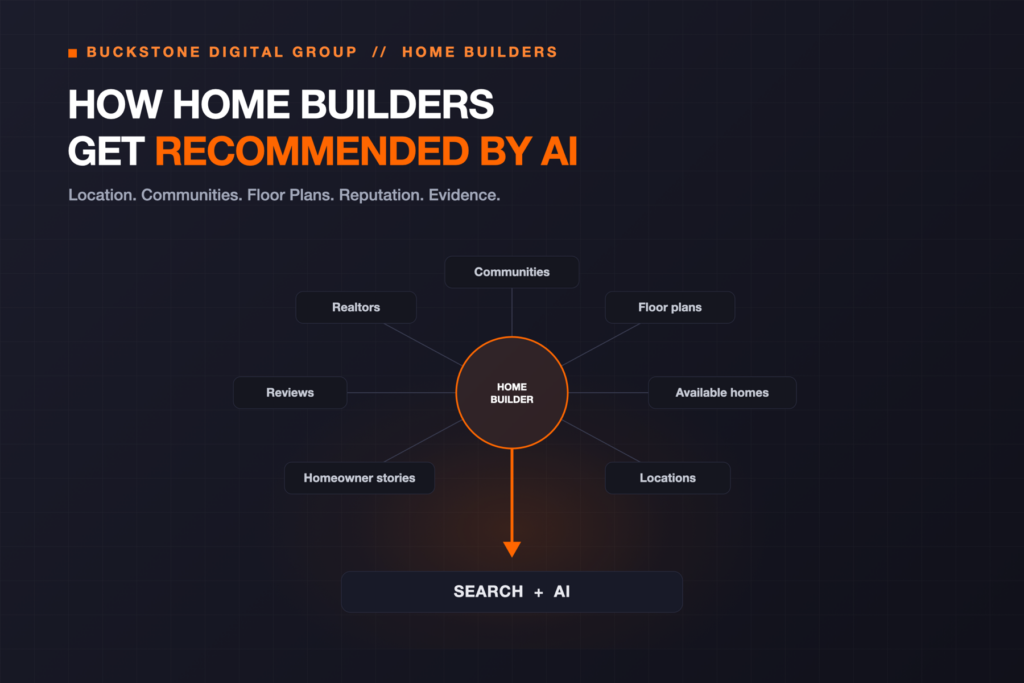
A family relocating for work starts on Google — “new home builders near [town]” — then asks ChatGPT which builders have single-story homes available now in a specific school-attendance area, skims a Google AI Overview, compares two communities and three floor plans, checks Maps and reviews, searches a builder by name, opens a move-in-ready listing, screenshots the pricing, asks their realtor, and books a model-home visit two weekends later. Not one of those steps is a single Google ranking. For a home builder, visibility is the ability to stay credible and discoverable across a long, high-consideration buying journey.
This is the home-builder-specific application of our AI Search Visibility series — not a generic checklist. It’s about how buyers actually research builders, communities, floor plans, locations, reputation, and available homes, and what that demands of a builder’s website and its footprint across Google, Maps, review platforms, real-estate portals, and AI answer engines.
- Recommendation visibility is local and contextual. A builder isn’t universally recommendable — it’s recommendable for a specific location, budget, home type, and buyer.
- Define clearly where you build. Vague service areas are one of the most common reasons builders get left out of local answers.
- Community pages, floor plans, and available homes serve different search intents and need to be connected, not siloed.
- Not every move-in-ready home deserves a permanent indexable page — and inventory accuracy is a trust issue, not just an SEO one.
- Reviews and reputation matter, but they aren’t the whole strategy. Homeowner stories and completed-project evidence turn “quality craftsmanship” into proof.
- Photos aren’t enough — critical community, floor-plan, and home details belong in accessible text, not only images and PDFs.
- Realtors, portals, associations, and reviews shape your external footprint — and conflicting inventory data across them erodes trust.
- Location content must stay fair-housing compliant: practical context, accurate sourcing, and no unsupported neighborhood or school characterizations.
- Measure to sales, not sessions. Tie visibility to calls, model-home visits, consultations, and CRM-qualified leads across a months-long cycle.
Two definitions to anchor the strategy, because builders are often sold “SEO” and “AEO” as separate things:
Home-builder SEO is the process of improving visibility for a builder’s company, communities, locations, floor plans, available homes, design capabilities, reputation, and buyer resources across search engines.
Answer Engine Optimization, or AEO, is the practice of improving how a home builder and its information are understood, retrieved, cited, compared, and recommended across answer-driven search experiences.
The two should run as one coordinated strategy. Beneath both sits the broader discipline: AI Search Visibility is the discipline of making a business understandable, credible, retrievable, and recommendable across traditional search engines and AI-driven answer platforms.
Why ChatGPT recommendations matter for home builders
Buyers increasingly use AI assistants to discover builders, compare custom versus production options, identify who builds in a location, research communities, weigh reputations, ask about price ranges, find move-in-ready homes, and prepare questions before ever contacting a sales office. This doesn’t replace realtors, Google, or the builder’s own website — but it shapes the shortlist early.
AI recommendations may influence which builders enter the buyer’s consideration set before the builder ever knows the search occurred. If you’re not a clear, credible option for the specific need, you’re simply not named — the dynamic we cover in getting recommended by ChatGPT and what makes a business recommendable.
Recommendation visibility is highly local and contextual
A builder may be the right answer for one city, one county, one community, one price range, one architectural style, or one buyer type — and irrelevant to the next. Think about how differently these read to a recommender: “best luxury builder in [city],” “custom home builder near [town],” “builder with move-in-ready homes in [community],” “home builder with larger lots near [area],” “builder offering multigenerational floor plans.” A builder is not universally recommendable; it is recommendable for a specific buyer, location, budget, home type, and need. The more precisely your site states and supports that fit, the more of those decision-shaped questions you can be the answer to.
The home-builder AI Search Visibility framework
We organize the work in five layers, each adapted to how buyers actually shop for a home. They build on each other — evidence a system can’t reach or understand is wasted.
1. Access — can systems retrieve the information?
Crawlability, indexability, canonicals, robots directives, sitemaps, rendering, mobile performance, CDN/firewall behavior, and AI/search crawler access — plus the builder-specific traps: JavaScript-rendered inventory, gated floor plans, PDF brochures, and IDX or inventory integrations that hide the details. A beautiful builder website can still be hard to understand if critical community, inventory, or floor-plan information is trapped in scripts, images, PDFs, or a disconnected system. Start by confirming crawlers can reach you and reviewing the fundamentals in technical SEO for AI search.
2. Understanding — can systems identify the builder, locations, communities, and homes?
Systems should be able to resolve your company identity and leadership, office and sales locations, service areas, communities and developments, floor plans, available homes, home styles, price positioning, lot types, build process, warranty, and realtor relationships. That’s supported by Organization, LocalBusiness, and Person schema, breadcrumbs, stable @ids, consistent naming, clean internal linking, and clear community/location hierarchies. If the site doesn’t explicitly connect the builder to a community, a floor plan, a location, and an available home, systems are forced to infer relationships you should define directly — the core of entity SEO and how AI systems understand your business.
3. Evidence — does the builder prove quality and reputation?
Completed-home galleries, homeowner stories, warranty details, design and construction process, community and floor-plan specifics, build timelines, testimonials, reviews, team expertise, and legitimate awards. “Quality craftsmanship” is a claim; completed projects, homeowner feedback, process detail, and specific design outcomes are evidence.
4. Corroboration — does the wider web reinforce the story?
Google reviews, realtor websites, homeowner reviews, local publications, HOA and development sites, chambers, building associations, real-estate portals, and map listings. Your website explains what you offer; reviews, realtors, homeowners, associations, and local sources reinforce whether the market sees you the same way — the mechanism in how third-party sources influence AI recommendations.
5. Measurement — is visibility improving across the journey?
Rankings, local visibility, community and floor-plan impressions, available-home engagement, AI mentions and citations, recommendation and prompt coverage, competitor share of voice, AI referral traffic, calls, form submissions, community inquiries, model-home visits, consultations, CRM-qualified leads, and sales opportunities. Reporting should show whether the right buyers are finding the right communities and homes — not simply whether traffic rose.
Builder, community, floor plan, and available home
The heart of home-builder architecture is four connected page types that answer four different questions — and internal linking must tie them together. Your builder page establishes who you are, where you operate, and whether you’re custom, semi-custom, production, or luxury — easy to classify without forcing anyone to assemble the story from scattered pages. From there:
Buyers rarely search only by plan name — they search by lifestyle need. Making the relationships explicit (this plan, in these communities, currently available as these homes) is what lets search and AI systems connect a buyer’s need to your inventory.
Community and floor-plan pages
These are among a builder’s most important assets, and each should function as a decision resource rather than a photo gallery with a contact button.
- Community name, city/region, and map location
- Builder relationship, status, and available homes
- Floor plans, lot information, and amenities
- Accurate, neutral local context (schools, commute) with sourcing
- Photos, FAQs, and a visit/contact CTA
- Current availability and internal links to plans & homes
- Plan name, beds/baths, square footage, stories, garage
- Key features and design/exterior options
- Lifestyle fit: first-floor primary, home office, multigen layout
- Lot compatibility and community availability
- Virtual tour, downloadable plan, price guidance where appropriate
- Related available homes, related communities, consultation CTA
Available homes and the inventory lifecycle
A strong available-home page carries the address or lot identifier, community, builder, status, price where public, floor plan, beds/baths, square footage, completion stage, photos, features, location, a contact CTA, and related inventory. But the harder discipline is the lifecycle — and handling it well is a trust issue, not just an SEO one.
Update status clearly, never leave stale “available” messaging on a sold home, and preserve valuable sold-home pages when they support galleries, proof, or community history — using redirects only when the page no longer has value. And no, every inventory record does not automatically deserve permanent search visibility: create a dedicated, indexable page when a home has distinct buyer value, meaningful search interest, complete information, and a real conversion path; manage the rest with inventory feeds, faceted navigation, canonicals, and sensible expiration rather than a sprawl of thin, duplicate pages.
Location pages and fair-housing-safe context
City, county, neighborhood, and service-area pages earn their place only when they carry real, location-specific substance — your communities and projects there, build and lot conditions, local design context, permitting knowledge where accurate, and buyer questions. A location page should prove local relevance, not merely repeat the city name; copy-and-swap city pages are thin pages that generic content guidance warns against.
Fair-housing note — this matters. Buyers care about practical context like school district, commute, amenities, taxes, HOA, and lot sizes, and you can help them understand it using accurate, neutral, well-sourced language with appropriate disclaimers. You must not steer, characterize neighborhoods by the composition of protected classes, use coded phrases, or make unsupported “best school” or “safe neighborhood” claims. Location content should help buyers understand practical context without crossing into discriminatory or unsupported characterization — a legal and ethical requirement, not a stylistic preference.
Reviews, homeowner stories, and galleries
Reviews across Google, community platforms, and homeowner testimonials speak to construction quality, timeliness, responsiveness, communication, and post-sale service — and authenticity, recency, specificity, and how you respond to complaints all matter. Never use fake or incentivized reviews; a detailed, genuine homeowner review reinforces what kind of experience you actually provide, which connects to local visibility as much as to AI recommendation.
Homeowner stories — buyer goal, location, home type, design challenge, your process, customizations, and outcome — turn “we build custom homes” into proof of what customization actually looked like, and they support builder, community, floor-plan, and location pages at once (with homeowner approval before sharing private details). And because builder sites lean heavily on imagery, support galleries with descriptive alt text, captions, and page context that name the community, floor plan, style, and room type — search and AI systems shouldn’t have to infer an entire project from an image file, and alt text should describe, not keyword-stuff.
On structured data: Organization, LocalBusiness, Person, Breadcrumb, Article, FAQPage, ImageObject, and — only where genuinely valid — Place or real-estate types can clarify the builder, community, location, and home relationships. But don’t mark every home as Product, don’t add Review or AggregateRating without legitimate visible reviews and policy compliance, don’t create duplicate Organization/LocalBusiness entities, and keep schema matching the visible page. Our guide on structured data covers the discipline.
Custom vs. production vs. luxury builders
The right search architecture depends on your operating model — the emphasis shifts:
| Builder type | What the site should emphasize |
|---|---|
| Custom | Design process, architecture, lot evaluation, service area, materials, customization, portfolio, client stories, consultation |
| Production / community | Communities, floor plans, available homes, pricing, amenities, inventory, model homes, sales offices |
| Luxury | Portfolio quality, design expertise, architects, materials, estate locations, process, privacy, reputation |
A dedicated community or development microsite occasionally makes sense — a distinct brand, a focused audience, deep local content — but only with a strategic reason beyond owning another domain, because microsites can divide authority, duplicate content, and split analytics. If you build one, cross-reference the main builder site and keep ownership clear. The same consistency discipline applies to portals and third-party sources — Zillow, Realtor.com, Redfin, MLS-fed pages, builder portals, and map platforms: keep address, price, status, square footage, floor plan, photos, builder name, and community name consistent, because conflicting inventory information damages both buyer trust and machine clarity. Realtors sit in this ecosystem too, acting as both a conversion channel and part of the external footprint around your brand.
Why competing builders get recommended instead of you
When a competitor keeps showing up in Google and AI answers and you don’t, it’s rarely because they build a better home. It’s usually because they’re easier to understand, validate, and shortlist online.
- Their service area is clearer, and their community pages are more complete
- Their available inventory is current and their floor-plan pages explain buyer fit
- Their reviews are stronger or more recent, and their builder identity is consistent
- Their leadership, expertise, and homeowner stories are easier to verify
- Their galleries carry context and their external listings are accurate
- Their site is easier to crawl and their local presence is stronger
- Their content answers more specific buyer questions — and they measure and act on AI-visibility gaps
What a home-builder AEO audit should include
A real audit looks at the whole system, not just keywords or a Google Business Profile.
| Layer | What we examine |
|---|---|
| Technical access | Crawlability, indexability, rendering, mobile, sitemaps, robots, JavaScript inventory, PDFs, AI/search crawler access |
| Company & local entities | Organization, LocalBusiness, leadership, sales contacts, offices, model homes, communities, service areas |
| Site architecture | Communities, locations, floor plans, available homes, galleries, process, warranty, reviews, internal links |
| Content & evidence | Homeowner stories, completed projects, community & floor-plan detail, available-home accuracy, process, team |
| Structured data | Organization, LocalBusiness, Person, Place, breadcrumbs, review markup validity, duplicate entities |
| Corroboration | Reviews, realtors, portals, associations, local media, community sources, partners, awards |
| Measurement | Rankings, local visibility, prompts, mentions, citations, recommendations, AI referrals, calls, forms, visits, qualified leads, sales opportunities |
How home builders should measure AI Search Visibility
Track prompt families that mirror how buyers actually ask — remembering that AI visibility is a pattern, not a single rank, as we cover in AI rank tracking vs. Google rank tracking:
- Builder discovery — “best home builders in [market],” “custom home builders near me,” “luxury builders in [city]”
- Community discovery — “new-home communities near [location],” “communities with larger lots”
- Floor-plan discovery — “builders with first-floor primary suites,” “one-story floor plans near [city],” “multigenerational home builders”
- Available-home discovery — “move-in-ready homes in [market],” “new homes available now in [community]”
- Validation — “is [builder] reputable?,” “what do reviews say about [builder]?,” “compare [builder] and [competitor]”
For each, record brand and community presence, citations, recommendations, accuracy, competitor share of voice, cited sources, and AI referral traffic — then connect it to calls, visits, and CRM-qualified leads, tying back to how to measure AI search visibility. Because the cycle runs months, don’t judge it only on same-session form fills; use nurture, available-home alerts, model-home invitations, and CRM source tracking to see the full picture. And remember the platform surfaces differ: guidance for each lives in Google AI Overviews, AI Mode, and Perplexity.
How BuckStone approaches home-builder AI visibility
We don’t sell builders “run ads and publish neighborhood blogs.” We evaluate the full system — technical and local SEO, community architecture, floor-plan and available-home pages, structured data, entity clarity, reviews and reputation, homeowner evidence, third-party portals, Google Ads and paid social, CRM and nurture, AI visibility measurement, website development, and conversion tracking — and build one plan around the real gaps.
The principle: home builders don’t need disconnected campaigns — they need one digital system connecting discovery, validation, inventory, reputation, lead capture, and follow-up. The same five layers, in builder terms:
- 1Access
Can systems retrieve your builder, community, floor-plan, and inventory information?
- 2Understanding
Can they connect you to your locations, communities, home types, price positioning, and buyer fit?
- 3Evidence
Does the site prove quality, process, reputation, and completed work?
- 4Corroboration
Do reviews, realtors, associations, portals, and homeowners reinforce your story?
- 5Measurement
Are visibility, recommendations, inquiries, visits, and sales opportunities improving?
If you’re interviewing an SEO or AEO partner, ask questions more specific than “we’ll publish more blogs and target more cities”: Can systems clearly understand where we build? Are our community pages complete enough to support decisions, and are floor plans connected to communities and available homes? Is our inventory current and indexable, and should sold homes stay live? Are reviews, offices, model homes, and communities represented correctly, and is our structured data valid? Which builders appear in AI recommendations instead of us, and which third-party sources support them? How are calls, visits, and CRM-qualified leads tracked — and can you implement the Elementor, CMS, schema, and tracking changes directly?
How home builders appear in ChatGPT recommendations
Clarify your company and location entities, build strong community pages, connect floor plans and available homes, and keep inventory current. Strengthen local SEO, publish homeowner evidence, improve review and reputation visibility, add context to galleries, and use structured data carefully. Keep realtor and third-party information consistent, monitor recommendation prompts, and connect visibility to qualified leads and sales opportunities. The goal is not to convince ChatGPT that every buyer should choose you — it’s to make you a credible, relevant option for the right buyer, location, home type, and budget. The builders most prepared for AI-driven discovery will be the ones that make their communities, homes, reputation, and buyer fit easiest to understand and verify.
Frequently asked questions
How can home builders appear in ChatGPT recommendations?
Make your content reachable, clearly define where you build and what buyers can purchase, connect communities to floor plans and available homes, back your reputation with reviews and homeowner evidence, and keep information consistent across realtors and portals. No method guarantees a specific recommendation, but these conditions make you a credible, easy-to-name option for the right buyer and location.
What is AI Search Visibility for home builders?
It’s the discipline of making a builder’s company, communities, locations, floor plans, homes, and reputation understandable, credible, retrievable, and recommendable across traditional search and AI answer platforms — so you stay discoverable across the whole buying journey, not just one ranking.
What is AEO for home builders?
Answer Engine Optimization is the practice of improving how a builder and its information are understood, retrieved, cited, compared, and recommended across answer-driven experiences like ChatGPT, Google AI Overviews, AI Mode, and Perplexity. For builders it centers on local relevance, clear community and inventory data, evidence, and corroboration.
Is home-builder SEO different from traditional SEO?
It shares the fundamentals but adds home-buying complexity: highly local intent, community and floor-plan architecture, live inventory, reviews and reputation, realtor and portal ecosystems, long high-consideration cycles, and fair-housing-sensitive location content. The strongest approach runs home-builder SEO and AEO as one coordinated strategy.
Does ChatGPT recommend custom home builders?
It can surface, compare, or name builders — custom or production — when there’s enough clear, credible, corroborated information to treat them as a relevant option for a described need. It won’t reliably recommend a builder whose service area, capabilities, and reputation aren’t clearly represented online.
How can builders appear in Google AI Overviews?
AI Overviews draw on Google’s index, so strong technical SEO, complete community and floor-plan content in HTML, accurate local entities, clean structured data, and credible reviews all help. Monitor presence and cited URLs where observable, and treat Google’s own Search Console data as the source of truth for its surfaces.
How can builders improve Perplexity visibility?
Perplexity surfaces numbered citations, so ensure your community, floor-plan, and available-home pages are crawlable and citable, keep local and inventory details accurate and in HTML, and build corroborating sources like reviews and legitimate listings. Then track which URLs it cites for your builder and community prompts.
Do home-builder reviews affect AI recommendations?
Reviews can reinforce reputation and provide outside perspective on quality, timeliness, and service, contributing to a stronger footprint. No platform publishes a rule that reviews cause recommendations, and fake or incentivized reviews are never advisable — the goal is authentic, specific feedback.
Do community pages help SEO?
Yes — a complete community page captures highly local, high-intent searches and connects buyers to available homes and floor plans. When it functions as a real decision resource (location, amenities, availability, FAQs) rather than a photo gallery, it’s one of a builder’s strongest assets.
Should every community have its own page?
Generally yes, where each community is genuinely distinct — different location, amenities, floor plans, and availability create different search intent. Each page should carry real, specific substance and current availability, not a templated repeat of the community name.
Should every floor plan have its own page?
Create a dedicated page when a plan has distinct search demand, features, or buyer fit. Describe it by lifestyle need (first-floor primary, home office, multigenerational) and connect it to the communities where it’s offered and the homes currently available, rather than publishing near-duplicate variants.
Should every available home have its own page?
Not automatically. Create an indexable page when a home has distinct buyer value, meaningful search interest, complete information, and a real conversion path. Manage the rest with inventory feeds, faceted navigation, canonicals, and expiration so you don’t generate thin, duplicate pages.
What should happen to sold-home pages?
Update the status clearly and never leave stale “available” messaging. Preserve a sold-home page when it still adds value — supporting a gallery, proof, or community history — and use a redirect only when the page no longer has a useful purpose. Inventory accuracy is a trust issue.
Does schema help home builders?
Used correctly, yes — it clarifies your identity, locations, communities, and page relationships for machines. It only helps as a translation of what’s visible on the page, and it should never contradict the content or force real-estate concepts into invalid markup types.
What schema should home builders use?
Typically Organization, LocalBusiness, Person, BreadcrumbList, Article, FAQPage, and ImageObject — plus Place or specific real-estate types only where genuinely valid. Avoid marking every home as Product, avoid Review/AggregateRating without legitimate visible reviews and policy compliance, and avoid duplicate Organization or LocalBusiness entities.
Do galleries help AI Search Visibility?
They can, but only when supported by descriptive alt text, captions, and page context that name the community, floor plan, style, and room type. Search and AI systems shouldn’t have to infer an entire project from an image file — the surrounding text does much of the work.
Do homeowner stories help?
Yes — a specific story (buyer goal, location, home type, design challenge, process, outcome) turns broad claims into proof and supports builder, community, floor-plan, and location pages at once. Always get homeowner approval before sharing private details.
How important is local SEO for builders?
Very — home-builder demand is intensely local, so accurate business information, Google Business Profile, reviews, and location relevance are foundational. Local visibility and AI recommendation reinforce each other: the same clear, consistent, well-reviewed presence helps both.
Should every model home have a Google Business Profile?
Not by default. Google Business Profile strategy should reflect real, staffed locations and current platform guidelines — not a desire to create more map listings. A staffed sales center or model home may qualify; duplicate or unstaffed listings can cause problems.
Do realtor websites influence builder visibility?
They can. Realtors are both a conversion channel and part of the external information ecosystem — their listings, community pages, and partner content contribute to how the market and search systems describe you. The aim is accurate, consistent representation, not manipulating their content.
How should builders handle Zillow and other portals?
Keep your information consistent with your own site — address, price, status, square footage, floor plan, photos, builder name, and community name. Conflicting inventory data across portals damages both buyer trust and machine clarity, so treat portal accuracy as part of your visibility strategy.
How do home builders measure AI visibility?
Track a defined set of builder-, community-, floor-plan-, available-home-, and validation-prompts; record mentions, citations, recommendations, accuracy, competitor share of voice, and cited sources; and connect AI referral traffic to calls, model-home visits, and CRM-qualified leads over a months-long cycle. It’s a pattern across the journey, not one ranking.
What should a home-builder AEO audit include?
Technical access, company and local entities, site architecture (communities, floor plans, inventory), content and evidence, structured-data validity, corroboration (reviews, realtors, portals, associations), and measurement — examined together, to find where buyers and search systems lose the story between what you build and how it’s represented online.
Should builders hire a specialized home-builder SEO agency?
What matters most is whether the partner understands communities, floor plans, live inventory, realtor and portal ecosystems, long buying cycles, and fair-housing-sensitive location content — and can implement technical, schema, and tracking changes directly. Ask specific questions about architecture, inventory, entities, competitors, and measurement before committing.
What makes a home builder recommendable in AI search?
Being clearly understood as a credible, relevant option for a specific buyer, location, home type, and budget — with reachable content, complete community and inventory information, real evidence, consistent data across the web, and reputation that outside sources corroborate.
What home-builder marketing services does BuckStone provide?
BuckStone coordinates home-builder SEO, AEO and AI Search Visibility, local SEO, community and inventory architecture, structured data, website development, Google Ads and paid social, and analytics/CRM tracking — connected as one system and measured against calls, visits, qualified leads, and sales opportunities rather than traffic alone.
Explore the rest of the series — manufacturers, law firms, restaurants, ecommerce brands, contractors, and technology & SaaS — all built on what AI Search Visibility is.
Sources & methodology
This article separates documented platform behavior (how Google Search, AI Overviews and AI Mode, ChatGPT/OpenAI search, Perplexity, and Google Business Profile are publicly described to work — capabilities and reporting that change over time and should be verified against current official documentation), traditional, technical, and local SEO principles (crawlability, structured data, information architecture, business-listing consistency), and BuckStone methodology (our five-part framework: Access, Understanding, Evidence, Corroboration, Measurement — a way of organizing the work, not an official metric endorsed by any platform). Home-builder examples — buyer scenarios, community/floor-plan structures, and prompt phrasings — are illustrative and generic; no specific communities, floor plans, available homes, prices, school or neighborhood characterizations, reviews, awards, or client results have been invented or attributed to a real company. Fair-housing compliance: location and neighborhood language here is deliberately practical and neutral — it does not steer, characterize areas by the composition of protected classes, use coded phrasing, or make unsupported safety or “best school” claims, and builders should apply the same standard to their own content. We use hedged language (“can help,” “where observable,” “where supported”) deliberately, and make no claim that any platform guarantees a specific ranking, citation, or recommendation.