
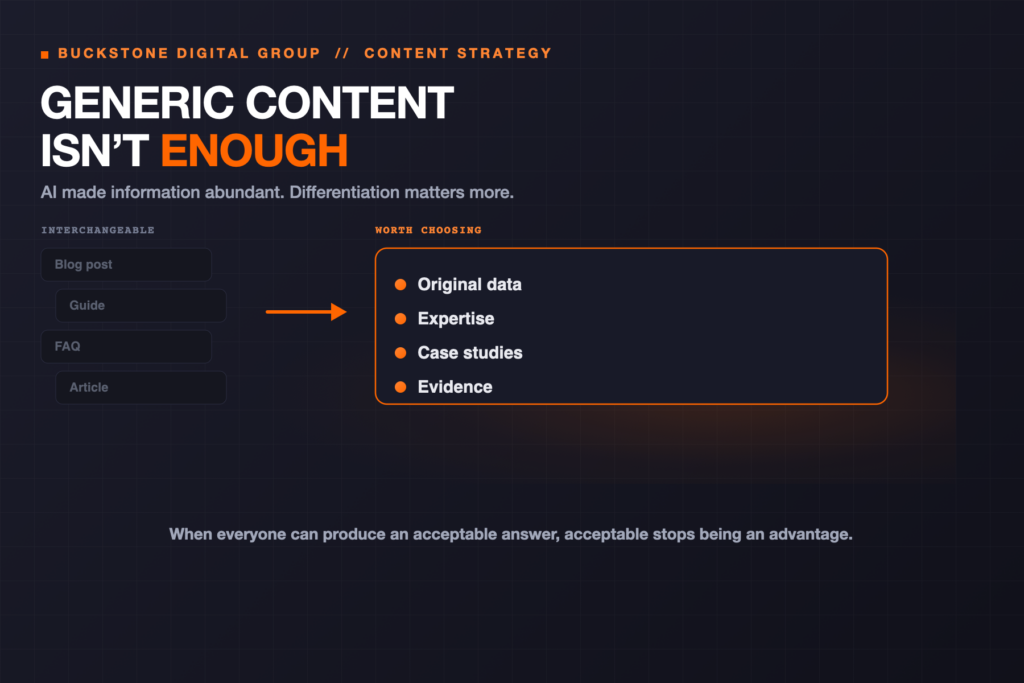
You can now generate a competent blog post, FAQ, product description, or service page in minutes. That’s genuinely useful. It’s also why “competent” stopped being a competitive advantage. When everyone can produce an acceptable answer, acceptable is table stakes.
AI did not kill content marketing. It killed the value of being merely informative. The problem was never AI-generated content—it’s content that contributes nothing new.
This is the third piece in our thought-leadership run, after is SEO dead? and AI SEO vs. traditional SEO. Both argued that search is expanding, not ending. This one narrows to a single, uncomfortable consequence: generic content is losing value because generic information is no longer scarce.
Key takeaways
Why generic content is losing ground
- AI-generated content is not inherently bad.
- Generic content is becoming trivially easy to produce.
- Informational accuracy alone no longer differentiates a page.
- Content should contribute evidence, expertise, specificity, or original insight.
- Original research and first-party data create defensible value.
- Case studies turn claims into evidence.
- Expert commentary distinguishes a brand from interchangeable summaries.
- Product and service specificity is hard to fake.
- Strong opinions should be grounded in real expertise.
- Structured data cannot rescue weak content.
- Content should strengthen how systems understand the business.
- Third-party corroboration reinforces first-party claims.
- Maximum publishing volume is not the goal.
- The goal is differentiated information worth retrieving, citing, and trusting.
What is generic SEO content?
Generic content is the interchangeable stuff: “10 Benefits of SEO,” “What Is Technical SEO?,” “Top Digital Marketing Trends,” “Why Your Business Needs a Website.” None of those topics is bad. The problem appears in the treatment—when a page says the same thing as hundreds of others, adds no original experience, no new data, no specific examples, no expert interpretation, no evidence, and no distinctive point of view.
A generic topic can still produce excellent content. A generic treatment of that topic usually cannot.
Why generic content used to work better
Generic informational content used to succeed more often—not because search engines rewarded thin work, but because the competitive bar was lower. Fewer businesses had strong sites, fewer pages targeted each topic, and content was slower and more expensive to produce. The supply of optimized content was simply smaller, so “covers the topic well” went further than it does now.
What AI changed
Four shifts, in plain terms. AI lowered the cost of competent content to near zero—anyone can produce structured, readable articles fast. Your topic strategy is now easy to copy; a visible content calendar is no longer a moat. Basic informational coverage became replicable—definitions, tips, and summaries synthesize in seconds. And volume lost meaning: publishing more pages doesn’t automatically create more authority.
AI increased the supply of content. It did not increase the supply of genuine experience.
Why generic information is less valuable in AI search
AI-driven answers synthesize across many sources. If a hundred pages all say essentially the same thing, any single one becomes easy to substitute. The strategic implication is straightforward.
Interchangeable content creates interchangeable sources.
A business is stronger when its content offers something distinctive enough to matter—a proprietary dataset, an original methodology, a documented customer outcome, an expert interpretation, a specific product spec, a real implementation detail. Those are the things that make a page worth retrieving rather than one of many equivalents. (If your pages aren’t being retrieved or cited at all, that’s often an access or clarity problem before it’s a content one—see why your business isn’t appearing in AI search results.)
Content audit
Is your content giving search engines and AI systems a reason to choose you?
BuckStone can evaluate your content strategy, entity structure, competitive gaps, evidence, internal linking, and AI visibility to identify where your content creates authority—and where it’s simply adding volume.
Content now has to answer: why this source?
Every page should be able to answer one question: why should a search engine, an AI system, a journalist, a customer, or another website use this page instead of 500 alternatives? Good answers sound like: we have original data, we ran the research, we built the product, we did the work, we tested the methodology, we have documented results, we know this industry deeply, we can explain something others can’t.
If the only answer is “because our article also explains the topic,” the content probably doesn’t have a moat.
What valuable content looks like now
Eight ingredients, most of which a competitor can’t reproduce by summarizing the same sources you did.
1. Original experience
What actually happened during an implementation—what failed, what changed, the operational detail you only get by doing the work.
2. First-party data
Search performance, customer behavior, survey results, conversion data, internal research. (Never expose confidential client information—aggregate and anonymize.)
3. Case studies
Starting point, strategy, execution, outcome, and context.
Case studies transform “we know how to do this” into evidence that the work has actually been done.
4. Expert analysis
Not just what happened, but why it matters—the interpretation a model can’t infer from everyone else’s summaries.
5. Proprietary methodology
A named framework—ours runs Access, Understanding, Evidence, Corroboration, Measurement—turns expertise into something recognizable and reusable.
6. Specific product or service knowledge
Details competitors can’t write accurately without genuine knowledge of the work.
7. Strong, defensible opinions
Grounded in experience and data—for example, that publishing more content is not automatically better.
8. Useful comparisons
Comparisons that genuinely help a buyer decide, not filler.
Why case studies beat generic claims. “We improve organic visibility” is a claim; “here was the starting point, the work, and the measurable change” is evidence—and evidence serves buyers, search engines, AI systems, entity credibility, internal linking, and your service and industry pages at once. See our case studies for how we structure it.
Why first-party data is defensible. A competitor can summarize your article. They can’t automatically recreate your customer dataset, your test results, or your operational experience.
The more useful information originates with your business, the harder your content is to commoditize.
Why expert authorship matters. Anonymous generic content and expert-supported content are read differently—author pages, credentials, role, experience, consistency, and a clearly defined Person entity all help. But schema clarifies who the author is; it can’t manufacture expertise the author doesn’t have. And content should reinforce what the business is known for—which industries it serves, which problems it solves, which topics it has real authority on.
A strong content strategy doesn’t merely accumulate articles. It strengthens the system’s understanding of the business.
Structured data cannot rescue generic content
Structured data is genuinely useful—but it interprets information; it doesn’t make the information worth choosing. FAQ schema doesn’t make weak answers authoritative, Article schema doesn’t make commodity content original, Person schema doesn’t create expertise, and Organization schema doesn’t create brand authority. The full picture is in can structured data help your business appear in AI search?
Structured data helps systems interpret information. It does not make the information worth choosing.
Why mass-producing AI content is strategically dangerous
The risk isn’t that AI wrote the page. It’s the pile-up of pages nobody needed: topic cannibalization, repetition, thin differentiation, editorial inconsistency, weak internal linking, shaky fact-checking, brand dilution, outdated pages accumulating, crawl budget spent on low-value URLs, and reporting noise that hides what actually works.
The danger is not that AI wrote the page. The danger is publishing pages nobody needed.
Should businesses use AI to create SEO content?
Yes—intelligently. AI is excellent for research support, topic modeling, outlines, gap analysis, draft assistance, editing, summarization, data organization, internal-link discovery, and content-refresh analysis. What it requires from you is expert direction, fact-checking, original inputs, brand knowledge, editorial judgment, and evidence.
AI can dramatically improve content production. It cannot manufacture genuine expertise, first-party evidence, or customer outcomes that don’t exist. AI should accelerate expertise, not substitute for it.
A better content-production model
The order matters: value first, AI second.
The process
Eight steps, evidence before automation
Start with a real question
A genuine customer or market question, not a keyword in isolation.
Decide if you have something to contribute
Experience, data, an example, a case study, an expert opinion, product knowledge?
Research what already exists
Identify what’s missing or weak in the current results.
Gather original inputs
Interview experts, pull data, review client outcomes, analyze real projects.
Use AI to accelerate production
To draft and structure faster—not to invent evidence.
Add citations, context, corroboration
Support important claims with credible sources.
Connect it to the business entity
Link to services, authors, industries, case studies, and related resources.
Measure real value
Rankings, citations, traffic, leads—did it create visibility and business value?
Fewer pages or more? Neither extreme is the strategy. Publish as much as you can justify with real search demand, customer usefulness, and differentiated value—no arbitrary monthly quota.
How to audit your existing content for genericity
Run each page through these questions. A cluster of “no” answers means the page needs a new reason to exist—not just a refresh.
Relevance
- Answers a real customer question?
- Supports a service, product, entity, or buyer journey?
- Better than what already ranks?
- Still accurate?
Differentiation
- Anything competitors can’t easily reproduce?
- Firsthand experience?
- Evidence or original data?
- An identifiable expert contributor?
Connection & value
- Specific to our business or industry, not any company?
- Internally linked into the broader site architecture?
- Creates traffic, citations, leads, or other measurable value?
Value over volume
More content is not the goal. More valuable content is.
BuckStone builds search strategies around customer demand, technical SEO, entity clarity, original evidence, authority, AI visibility, and conversion—not arbitrary publishing quotas.
What generic content should become
The same topics can be rewritten to carry evidence and a point of view. A few illustrative shifts:
| Generic | Differentiated |
|---|---|
| 10 Benefits of SEO | What we learned growing organic visibility across 20 B2B service pages |
| What Is Entity SEO? | What happens when Google can’t tell which business, author, or service a page represents |
| How to Improve Ecommerce Sales | Five conversion problems we found repeatedly across ecommerce sites—and how we fixed them |
| Why Structured Data Matters | How we diagnose duplicate Organization and Person schema on WordPress sites |
Same subjects; different reason to exist. The differentiated versions are built on real technical work and outcomes a competitor can’t summarize into being.
How BuckStone approaches content strategy
We don’t define content as “publish X blogs per month.” Strategy starts with search opportunity, buyer questions, business expertise, existing authority, competitive gaps, entity relationships, commercial relevance, and—critically—whether real evidence is available. Only then does the format follow: a service page, industry page, case study, guide, research piece, FAQ, comparison, blog article, or landing page.
The content format follows the strategic need. The strategy doesn’t begin with a monthly blog quota. We’d rather publish one piece with a defensible reason to exist than five that could have been written for any company in the industry.
That approach connects to real website and development work—because the best evidence often comes from what we actually build and fix—and it maps to the same five layers we apply to all SEO and AI visibility work.
The framework, applied to content
Content should strengthen the visibility system
Access
Can search and AI systems retrieve it? See crawler access.
Understanding
Is it clear who created it, what it covers, and how it connects to the business?
Evidence
Does it contribute substantive proof or expertise—not just coverage?
Corroboration
Are important claims supported by credible external sources?
Measurement
Does it earn rankings, citations, traffic, and leads?
What gets more valuable as AI grows? As priorities, the durable formats are the ones hardest to commoditize: original research, case studies, expert analysis, product documentation, detailed service information, industry-specific insight, comparisons, first-party datasets, unique methodologies, real implementation guides, customer evidence, and genuine thought leadership—the kind of material worth surfacing whether the query lands in Google AI Overviews, AI Mode, ChatGPT, or Perplexity.
Final answer: does generic content still work?
Generic content isn’t useless because AI exists. It’s less defensible because AI made generic information abundant. The response isn’t to stop producing content—it’s to raise the standard. The question is no longer “did we publish something useful?” It’s “did we contribute something worth choosing?” And differentiated content solves only part of the problem—the larger one is what makes the business itself credible enough to recommend, which is where this series goes next.
AI made publishing easier. That makes originality, expertise, evidence, and credibility more valuable—not less.
Beyond commodity content
Publish content competitors can’t replace with a prompt.
BuckStone helps established businesses build differentiated content and search visibility across Google, AI Overviews, AI Mode, ChatGPT, Perplexity, and traditional search.
Frequently asked questions
Is AI-generated content bad for SEO?
No—not inherently. What underperforms is generic content that adds nothing new, whoever or whatever wrote it. AI used to accelerate genuinely valuable, evidence-backed content is a strength.
Can AI-written content rank in Google?
Yes. Google’s guidance focuses on helpful, reliable, people-first content regardless of how it’s produced—it does not penalize content simply for being AI-assisted. The bar is usefulness and originality, not authorship method.
Why does generic SEO content fail?
Because generic information is no longer scarce. When a hundred pages say the same thing, any one of them is easy to substitute—so interchangeable content creates interchangeable, replaceable sources.
What is generic SEO content?
Content that covers a topic the same way as everyone else—no original experience, data, examples, expert interpretation, evidence, or distinctive viewpoint. The topic can be fine; the generic treatment is the problem.
Does AI search make blogging less valuable?
It makes generic blogging less valuable and differentiated content more valuable. Blogging that carries real evidence, expertise, or original data still earns visibility.
Is blogging still worth it?
Yes, when each piece has a defensible reason to exist. Publishing for volume alone isn’t worth it; publishing differentiated, useful content connected to your business is.
What content performs best in AI search?
Content that’s hard to commoditize: original research, case studies, first-party data, expert analysis, detailed product and service information, and useful comparisons.
What makes content worth citing?
Something distinctive that other sources can’t supply—original data, firsthand experience, a documented outcome, expert interpretation, or specificity that requires real knowledge of the work.
Does original research help SEO?
It creates defensible value because competitors can summarize your article but can’t recreate your dataset or findings. That originality is exactly what makes a page harder to substitute.
Does first-party data help AI search visibility?
It helps by making your content genuinely original and useful. No agency can guarantee AI citations, but content built on data only you have is harder to commoditize and more likely to be worth referencing.
Do case studies help SEO?
They turn claims into evidence and support buyers, entity credibility, internal linking, and your service and industry pages. They don’t guarantee AI citations, but they make the business demonstrably credible.
Does expert authorship matter?
Yes. Identifiable experts with real credentials and experience differentiate content from anonymous summaries. Schema can clarify who the author is, but it can’t manufacture expertise the author lacks.
Does structured data improve weak content?
No. Structured data helps systems interpret information; it doesn’t make weak information worth choosing. FAQ, Article, and Person schema don’t create authority, originality, or expertise.
Should businesses use AI to write content?
Yes, intelligently—for research, outlines, drafting, editing, and analysis—paired with expert direction, original inputs, fact-checking, and evidence. AI should accelerate expertise, not substitute for it.
How should businesses use AI for content creation?
Bring the value first: a real question, your experience or data, and research into what’s missing. Use AI to draft and structure faster, then add citations, corroboration, and connections to your business.
Is publishing more content better for SEO?
Not by itself. More pages don’t create more authority; low-value pages can cause cannibalization, crawl waste, and reporting noise. Publish what you can justify with demand and differentiated value.
Should businesses publish fewer, better articles?
Often, yes—but the real answer is neither minimalism nor volume. Publish as much as you can back with real search demand, customer usefulness, and something distinctive to contribute.
What is commodity content?
Content that’s interchangeable with hundreds of alternatives—accurate but undifferentiated, with nothing a competitor couldn’t reproduce by summarizing the same sources.
How do you make AI-generated content unique?
By feeding it original inputs it can’t invent: your data, experience, case studies, expert opinions, and product knowledge—then editing for accuracy and connecting it to your business entity.
What makes content hard for competitors to copy?
Information that originates with your business: proprietary datasets, documented outcomes, real implementation detail, and named methodologies. Anyone can restate a definition; few can recreate your evidence.
How do you audit generic content?
Ask whether each page answers a real question, contains anything competitors can’t reproduce, includes experience or evidence, is specific to your business, is internally linked, is still accurate, and creates measurable value.
Should old generic articles be deleted?
Not automatically. Some should be improved with real evidence, some consolidated, some kept if they still earn value, and some retired. The test is whether the page has a reason to exist—not merely whether it’s old.
What’s the difference between helpful content and differentiated content?
Helpful content answers the question competently; differentiated content adds something others can’t—evidence, originality, expertise. As competent content becomes abundant, differentiation is what makes a source worth choosing.
How does content support AEO?
Differentiated, well-connected content gives answer engines something specific and credible to retrieve, cite, and attribute to your business—rather than one more interchangeable page to synthesize past.
How does content support AI Search Visibility?
It strengthens how systems understand and describe your business across Google and AI platforms, and—paired with entity clarity and corroboration—makes you more likely to be surfaced, cited, and recommended.
Sources & methodology
This is strategic thought leadership; it separates documented platform behavior from BuckStone’s methodology, strategic inference, and professional opinion. Where we reference platform behavior—that Google’s helpful-content guidance is about people-first usefulness and reliability rather than penalizing AI-assisted content per se; that Google states structured data isn’t required for AI features; that AI Overviews and AI Mode draw on Google Search systems and cite sources—these were checked against current official Google Search Central documentation. We do not claim that AI systems automatically favor original research, that AI-written content is penalized simply for being AI-made, that case studies guarantee AI citations, that structured data directly causes AI recommendations, or that platforms share one universal content-ranking system. No fabricated data, statistics, or client case studies appear in this article; the before/after examples are illustrative and generic.