
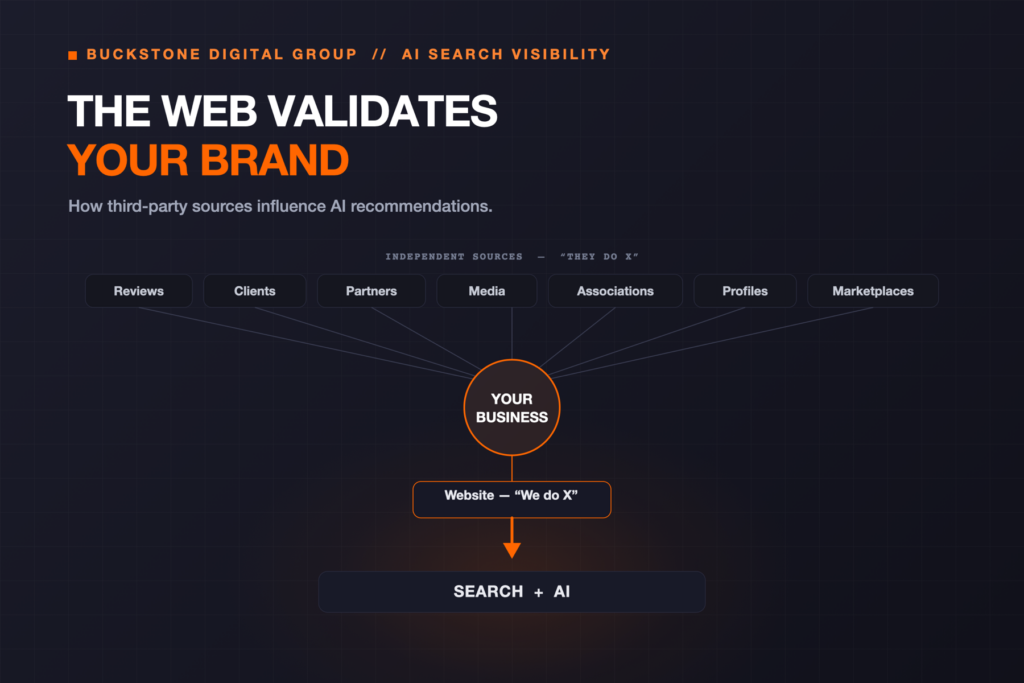
A business website says, “We are a leading industrial lubricant manufacturer serving demanding applications.” That is useful information — but it is the business talking about itself. Now imagine the wider web also carries distributor listings, an industry-association profile, customer references, product documentation, reviews, and trade coverage that all reinforce who the company is, what it sells, which industries it serves, and why customers trust it. That is a far richer picture. Your website tells systems what you say about your business; third-party sources help show whether the wider web tells the same story.
This article goes deep on one idea at the heart of BuckStone’s AEO methodology: a business saying something about itself is a claim, and independent sources saying the same thing create corroboration. It builds directly on what makes a business recommendable, where corroboration was one of ten readiness factors. Here it becomes the main subject.
- First-party claims and third-party corroboration are different things. One is what you say; the other is whether anyone independent says it too.
- Don’t rely only on your own website to establish credibility — a business exists inside a wider information ecosystem.
- Third-party sources can reinforce identity, expertise, reputation, products, services, and relationships.
- Reviews are one type of corroboration, not the whole strategy. Backlinks matter too, but corroboration is broader than link building.
- Relevant sources beat indiscriminate volume. Being represented accurately in places that make sense matters more than being mentioned everywhere.
- Consistency reduces ambiguity; contradictory external information weakens clarity. Ten sources repeating the wrong fact don’t make it right.
- Client, partner, association, and industry sources can be especially valuable, particularly in B2B.
- PR should create real visibility and evidence, not manufactured mentions. Corroboration is earned, not bought.
- No external mention can guarantee an AI recommendation — the goal is a stronger, more consistent footprint, measured against real outcomes.
Evidence vs. corroboration
These two words anchor the whole article, so it’s worth being precise about them.
First-party evidence is information published or owned by the business itself, such as case studies, research, product data, team expertise, and customer outcomes.
Third-party corroboration is independent information from external sources that reinforces important facts, relationships, expertise, reputation, or claims associated with the business.
Evidence answers, “Can we support this claim?” Corroboration answers, “Does anyone else support it too?” Your original content and research build the first; the wider web builds the second. The contrast is easiest to see side by side.
- Case studies and customer results
- Product specifications and data
- Certifications and credentials
- Original research
- Expert bios and methodology
- Customer and partner pages
- Reviews and marketplace listings
- Industry associations and directories
- Trade publications and news coverage
- Interviews, podcasts, professional profiles
The strongest position is when both align: what you publish about yourself and what independent sources say about you tell a consistent story. That’s the connection between AI search visibility and the reputation surrounding your brand.
Why third-party corroboration matters
AI Search Visibility is shaped not only by what a business publishes about itself, but also by how consistently that business is represented across independent sources. When multiple credible sources reinforce what a business is, what it does, who it serves, and why it’s credible, that business becomes easier to identify, validate, and evaluate. Corroboration strengthens five things in particular:
- Identity — external sources can reinforce your name, location, leadership, products, services, industries, and partners, which supports the way systems come to understand your business.
- Relevance — an industry association or client page can reinforce that you actually operate in a specific field, not just claim to.
- Reputation — reviews and customer commentary add an outside perspective your own site can’t provide.
- Expertise — publications, interviews, podcasts, talks, and cited research reinforce expert positioning.
- Relationships — partner and client pages validate that real business relationships exist.
Search systems don’t need every source to say the exact same sentence. They benefit from a coherent information ecosystem — many independent signals pointing the same direction.
Not all third-party sources are equal
It would be a mistake to treat every mention as equally useful. A recognized manufacturing association profile describing a manufacturer’s capabilities carries very different weight than a generic directory listing one of ten thousand businesses with no editorial value. Rather than a universal hierarchy, judge each source across these dimensions:
- Relevance to your field and audience
- Independence from your own control
- Authority and recognition of the source
- Specificity of what it says about you
- Accuracy and recency of the information
- Relationship to the business (real vs. incidental)
- Editorial quality, visibility, and authenticity
The goal is not to be mentioned everywhere. It is to be represented accurately in places that make sense.
The main types of third-party sources
Corroboration comes from many places. Here are the ones that tend to carry real informational value — and how to think about each.
Reviews
Reviews add customer experience, confirm the service or product, and often the location, with recency and sentiment attached. A specific review carries more context than a generic one: “Great company!” says little, while “They helped us redesign the ecommerce site and improve our Google Ads tracking” reinforces concrete facts about what you do. The goal is authentic customer feedback, not keyword-engineered testimonials — never manipulate review language or use incentivized or fake reviews.
Client and customer sources
External customer sources can validate a real relationship, industry experience, the services performed, product usage, and outcomes — for example a customer’s partner page, a vendor listing, a jointly published case study, or a testimonial on an identifiable customer site. These are among the most credible signals because they’re genuinely independent. (Only ever use client relationships publicly with the client’s approval.)
Partner and vendor pages
Real partnerships can reinforce business relationships, technology expertise, certifications, distribution, and service capability — authorized-dealer pages, technology-partner listings, vendor directories, agency-partner programs. Not every partner badge is meaningful, but legitimate ones add context a competitor can’t easily fake.
Industry associations and professional organizations
These can clarify your industry category, membership, professional specialization, location, leadership, and legitimate credentials. Association membership clarifies context; it should not be treated as proof of performance by itself.
Trade publications and media
Interviews, expert commentary, company profiles, research citations, and genuine trade coverage can reinforce expertise and business facts. Quality is everything here: a meaningful industry mention is different from distributing the same press release across hundreds of low-value domains.
Podcasts, webinars, and speaking appearances
These can reinforce expert identity, topics, role, industry, and company affiliation — especially when the appearance is documented on the web with show notes, a transcript, a speaker bio, a business link, and clear topic context. Audio itself isn’t automatically parsed by every system; the accessible web documentation around the appearance is what does the work.
Professional profiles
LinkedIn, industry directories, author pages, and conference bios all describe the people behind a business. Consistency in names, roles, companies, expertise, and locations is what makes them useful — the same discipline behind entity SEO. Conflicting profiles create ambiguity instead of clarity.
Backlinks vs. brand mentions
Two external signals often get conflated. They’re related but not identical.
A backlink is a link from another website to the business’s site. A backlink is one type of external signal — corroboration is a broader concept.
A brand mention is an external reference to a company or brand, whether or not it includes a clickable link.
- Another site links to your site
- Supports discovery and traditional SEO authority
- Provides a navigational connection
- An external source references your business
- May or may not include a link
- Can reinforce identity, expertise, relationship, or reputation
Corroboration can exist with or without a hyperlink. That said, unlinked mentions don’t function exactly like links inside ranking systems — links remain important, and mentions can carry a different kind of informational value. The practical answer to “links or mentions?” is usually “both, earned honestly.”
Sources to handle with care
Business directories
Legitimate directories can help with business identity, location, category, and contact information — particularly for local businesses, where accuracy and consistency support local visibility. But listing a business in hundreds of random directories is not an AEO strategy. Favor accuracy, relevance, quality, your local ecosystem, and industry-specific directories over mass-citation tactics.
Marketplace and product sources
For ecommerce brands and manufacturers, Amazon, Walmart, distributor sites, retailer listings, and product databases can reinforce product identity, specifications, brand, availability, and reviews. Consistent product information across these sources — names, SKUs, specs, brand relationships, availability — is what keeps the picture coherent, which is central to ecommerce and marketplace growth.
Wikipedia and Wikidata
Buyers often ask about these. They can provide highly structured entity information when a business legitimately meets their independent notability and editorial requirements — but AEO is not a reason to manufacture encyclopedic notability. Never create a promotional Wikipedia page simply for SEO, and never manipulate Wikipedia or Wikidata. If notability is genuine, structured entity data can help; if it isn’t, forcing it does more harm than good.
Why consistency matters — and what to do when it’s wrong
Corroboration only helps when the story being corroborated is accurate. Common contradictions quietly undermine clarity: an old business name, a former address, past executives listed as current, conflicting service descriptions, outdated phone numbers, incorrect product data, different founding dates, or duplicate brand profiles. Ten sources repeating the wrong information do not make it right — they make the ambiguity worse.
When external information is wrong, work a practical process rather than panicking:
- Identify the source.
- Determine whether it actually matters.
- Correct owned or claimable profiles first.
- Contact publishers where appropriate.
- Strengthen accurate first-party information so the correct version is well-supported.
- Monitor whether the incorrect information persists.
You can’t force a third party to change editorial content, but you can make the accurate version of your business the easiest and best-supported one to find. If systems can’t reach your corrected information in the first place, revisit whether your site is blocking AI crawlers.
How to audit your external footprint
You can map your corroboration today with a straightforward process.
- Search your brand. Review how your business name, leadership, products, services, locations, and reviews are represented.
- Search your experts. Check names, titles, profiles, articles, interviews, and associations for consistency.
- Search category relationships. Try queries like [brand] manufacturer, [brand] reviews, or [brand] [industry] to see how the web connects you to a field.
- Map important sources into categories: customers, partners, associations, reviews, media, professional profiles, directories, marketplaces.
- Identify contradictions and gaps — where information conflicts, and where a credible source ought to exist but doesn’t.
- Compare against competitors (more on this below).
- Prioritize legitimate opportunities based on relevance and impact, not volume.
Building corroboration without becoming spammy
Corroboration should be earned from real relationships and real evidence. The line between building authority and spamming is not subtle.
- Earn customer case studies and authentic reviews
- Maintain accurate profiles and marketplace data
- Join legitimate, relevant associations
- Contribute expertise to trade media and events
- Publish original research worth citing
- Develop real partner relationships; make expert info easy to verify
- Buying thousands of directory listings
- Fake reviews and manufactured testimonials
- Paid links disguised as editorial; link farms
- Fake awards and fake author profiles
- Spammy press-release syndication
- Wikipedia manipulation; irrelevant guest-post campaigns
Does digital PR help AI Search Visibility? It can — but only when the result is meaningful. Good campaigns create relevant mentions, links, expert recognition, research citations, brand discovery, and accurate external descriptions. Digital PR shouldn’t be reduced to “get links for AEO”; strong campaigns create information worth discussing.
Original research does double duty. It creates first-party evidence and gives third parties something useful to cite. The strongest content doesn’t merely earn traffic — it gives the wider web a reason to reference the business. That’s the bridge between content strategy and off-site authority, and it’s also how third-party sources support entity clarity: when many legitimate sources consistently connect a person to a company and a company to its services, the public information footprint becomes more coherent (BuckStone → SEO, AEO, AI Search Visibility, Google Ads, website development is our own illustrative example — not a claim about any specific knowledge graph).
Corroboration by business type
The principles are universal, but the highest-value sources differ by model.
Local
Google Business Profile, reviews, local directories, local press, chambers of commerce, and community organizations all matter, with NAP (name, address, phone) consistency, correct category, location, and reputation doing much of the work.
B2B
Client evidence, partnerships, industry publications, professional profiles, trade associations, case studies, speaking appearances, research, and vendor relationships tend to dominate. In B2B, expertise and relationship evidence often carry more informational value than generic popularity signals.
Ecommerce
Retailer listings, marketplaces, product reviews, distributor sites, product data, brand mentions, and comparison content are central, and consistency of product names, SKUs, specifications, brand relationships, and availability keeps the picture coherent across channels.
How to measure corroboration
There’s no magic “authority score,” and you should be wary of any tool that sells one. Instead, track observable signals over time and watch whether the ecosystem is getting stronger and more consistent. This connects directly to how to measure AI search visibility overall.
| Signal | What to monitor |
|---|---|
| Reviews | Volume, recency, sentiment, specificity |
| Mentions | Relevant external references to your brand and experts |
| Backlinks | Relevant linking sources, not raw counts |
| Profiles | Accuracy and completeness across platforms |
| Associations | Current, relevant memberships |
| Media | Meaningful coverage vs. syndication noise |
| AI citations | Which external sources appear in AI answers about you |
| Competitors | Which sources support competitors that don’t yet support you |
Measurement should focus on whether the external information ecosystem is becoming stronger and more consistent — not on manufacturing an arbitrary number.
Why competitor source analysis matters
When a competitor shows up in AI answers, a ranking report only tells part of the story. The more useful investigation looks at the evidence around them: Is their own website cited, or third-party sources? Which ones? Do those sources mention their specialization? Are there reviews, partner pages, industry lists, publications, or comparison sites reinforcing them?
Instead of asking only, “Why are they ranking above us?” modern search strategy should also ask, “What evidence ecosystem exists around them that does not exist around us?” That question often reveals opportunities a keyword report never will — and it’s frequently why a business isn’t appearing in AI results while a competitor is.
How BuckStone approaches corroboration
BuckStone doesn’t sell “we’ll get you 500 citations.” We evaluate the actual state of a business’s external information — brand identity, leadership and entity consistency, reviews, customer evidence, partnerships, industry profiles, media, associations, marketplace presence, external mentions, competitor sources, and the sources AI systems already cite — and then build a strategy around the real gaps.
Two principles guide the work: we are not trying to make a business appear everywhere; we are trying to make sure the right information appears in the right places, and corroboration is not a volume game — it is an evidence game. If you’re evaluating partners for this, our guidance on getting recommended by ChatGPT and on getting cited by Perplexity shows how the same evidence discipline plays out per platform.
- 1Access
Can systems retrieve information about you, on your site and beyond?
- 2Understanding
Can systems accurately identify who you are and what you do?
- 3Evidence
Does the business support its own claims with real proof?
- 4Corroboration
Does the wider web independently reinforce those claims — the focus of this article?
- 5Measurement
Are visibility and business outcomes actually improving over time?
Once businesses start monitoring citations, mentions, recommendations, and external sources, the next challenge becomes measurement itself. AI visibility doesn’t behave like a single Google ranking position — prompts vary, citations vary, recommendations vary, and sources vary across platforms. That’s the subject of the next article in this series: why AI rank tracking is more complicated than Google rank tracking.
The bottom line
Third-party sources matter because businesses exist within an information ecosystem. A strong website is foundational — but recommendation readiness is stronger when credible external sources reinforce who the business is, what it does, who it serves, what it’s known for, and why it can be trusted. Your website makes the claim; the wider web provides context for whether that claim is believable.
The goal is not to manufacture mentions. It is to build a real business footprint worth corroborating. In AI Search Visibility, authority is not just what you publish — it is the consistency of the evidence surrounding you.
Frequently asked questions
What is third-party corroboration?
Third-party corroboration is independent information from external sources that reinforces important facts, relationships, expertise, reputation, or claims associated with a business. It’s the difference between you saying something about your business and independent sources saying the same thing.
Why do third-party sources matter for AI search?
Because a business is easier to identify, validate, and evaluate when multiple credible sources consistently reinforce what it is, what it does, and why it’s trustworthy. Your website is one source; a coherent external footprint adds independent confirmation.
Do reviews help AI recommendations?
Reviews can reinforce your reputation, confirm what you do, and add recency and sentiment from an outside perspective. Specific reviews carry more context than generic ones. No platform has published a rule that reviews cause recommendations, and review manipulation is never advisable — the goal is authentic feedback.
Do backlinks help AI search visibility?
Relevant backlinks support discovery and traditional SEO authority, which remains part of visibility. A backlink is one type of external signal; corroboration is broader. Focus on relevant, earned links rather than raw counts.
Do brand mentions help AI search visibility?
Brand mentions can reinforce identity, expertise, relationships, and reputation, whether or not they include a link. They contribute to a clearer external information footprint, though an unlinked mention doesn’t function exactly like a link inside ranking systems.
Are backlinks and brand mentions the same thing?
No. A backlink is a link from another website to yours. A brand mention is any external reference to your company, with or without a link. Corroboration can exist without a hyperlink, but links and mentions carry different kinds of value.
Does digital PR help AEO?
It can, when the result is meaningful — relevant mentions, links, expert recognition, research citations, and accurate external descriptions. Digital PR shouldn’t be reduced to “get links for AEO”; strong campaigns create information worth discussing.
Do directories help AI Search Visibility?
Legitimate, relevant directories can help confirm identity, location, category, and contact details, which is especially useful for local businesses. Listing a business in hundreds of random directories is not a strategy — accuracy and relevance matter more than volume.
Do partner pages help AI visibility?
Real partner and vendor pages can reinforce business relationships, certifications, distribution, and service capability. They’re valuable because they’re independent and hard to fake — but not every partner badge is meaningful.
Do customer websites help establish credibility?
Yes — a customer’s partner page, vendor listing, jointly published case study, or identifiable testimonial can validate a real relationship, industry experience, and outcomes. Only use client relationships publicly with the client’s approval.
Do industry associations matter?
They can clarify your industry category, membership, specialization, location, and legitimate credentials. Membership clarifies context but should not be treated as proof of performance by itself.
Do podcasts help AI Search Visibility?
They can reinforce expert identity, topics, role, and company affiliation — especially when documented with show notes, a transcript, a speaker bio, and a business link. The accessible web documentation around the appearance does the work, not the audio itself.
Do press mentions help ChatGPT recommendations?
Meaningful media coverage can reinforce expertise and business facts, contributing to a stronger external footprint. No platform has published a rule that a press mention causes a recommendation, and low-value syndicated releases add little.
Does Wikipedia help AI visibility?
When a business legitimately meets Wikipedia’s independent notability and editorial standards, structured entity information there can help. It isn’t a lever to pull for AEO, and pages should never be created or manipulated purely for visibility.
Should businesses create Wikipedia pages for AEO?
No. AEO is not a reason to manufacture encyclopedic notability. If notability is genuine, a page may follow naturally; creating a promotional page for SEO purposes violates Wikipedia’s rules and can backfire.
How do AI systems verify business information?
Broadly, they benefit from consistent, corroborated information across many independent sources. When your own site and external sources agree, a business is easier to identify and evaluate. Specific verification methods vary by platform and aren’t universally documented.
What is the difference between evidence and corroboration?
Evidence answers “Can we support this claim?” using first-party material you own. Corroboration answers “Does anyone else support it too?” using independent external sources. The strongest position is when both align.
What third-party sources are most valuable?
It depends on your model, but relevant, independent, accurate sources with editorial value tend to matter most — customer and partner pages, credible reviews, industry associations, and meaningful media. Relevance beats volume every time.
Does source quality matter?
Very much. Judge sources on relevance, independence, authority, specificity, accuracy, recency, relationship to the business, editorial quality, visibility, and authenticity — not on how many there are.
How do I audit my third-party mentions?
Search your brand, your experts, and your category relationships; map the sources into categories (customers, partners, associations, reviews, media, profiles, directories, marketplaces); identify contradictions and gaps; compare against competitors; then prioritize legitimate opportunities.
How do I fix inaccurate external information?
Identify the source, decide whether it matters, correct owned or claimable profiles, contact publishers where appropriate, strengthen your accurate first-party information, and monitor whether the incorrect version persists. You can’t force third parties to change editorial content.
How do I compare my external authority with competitors?
When a competitor appears in AI answers, look at whether their own site or third-party sources are cited, which sources those are, and whether reviews, partner pages, industry lists, or publications reinforce them. Then ask what evidence ecosystem exists around them that doesn’t yet exist around you.
Can third-party mentions guarantee AI recommendations?
No. No number of mentions or citations guarantees visibility, and no platform has published such a rule. External sources can strengthen and clarify your footprint, which improves the conditions for being surfaced — but recommendation behavior is never guaranteed.
How does BuckStone build corroboration?
We evaluate your actual external information — identity, reviews, customer evidence, partnerships, profiles, media, associations, marketplace presence, mentions, and competitor sources — and build a strategy around the real gaps. We’re not trying to make you appear everywhere; we’re making sure the right information appears in the right places.
How do you measure third-party authority for AEO?
By tracking observable signals over time — reviews, relevant mentions and links, profile accuracy, association and media presence, the external sources AI answers cite, and competitor comparison — and watching whether the ecosystem is becoming stronger and more consistent, rather than inventing an arbitrary authority score.
Sources & methodology
This article separates four kinds of statement. Documented platform behavior refers to how search and AI systems are publicly described to work — retrieving, evaluating, and citing sources across the web. Traditional SEO principles (the role of links, reviews, listings, and consistent business information) reflect long-standing, widely documented practice. Observed ecosystem behavior refers to patterns in how businesses are or aren’t represented across sources, which vary and are not guarantees. BuckStone methodology refers to our five-part framework (Access, Understanding, Evidence, Corroboration, Measurement) and our corroboration approach — our structured way of organizing the work, not an official metric endorsed by any platform. No platform has published a universal rule that third-party mentions cause recommendations; the careful and accurate claim is that consistent, credible external information helps a business be identified, validated, and evaluated. We’ve used hedged language (“can reinforce,” “may strengthen,” “can help validate”) on purpose, and every example is generic — no invented reviews, links, partnerships, awards, media mentions, or client relationships appear anywhere in this article.