
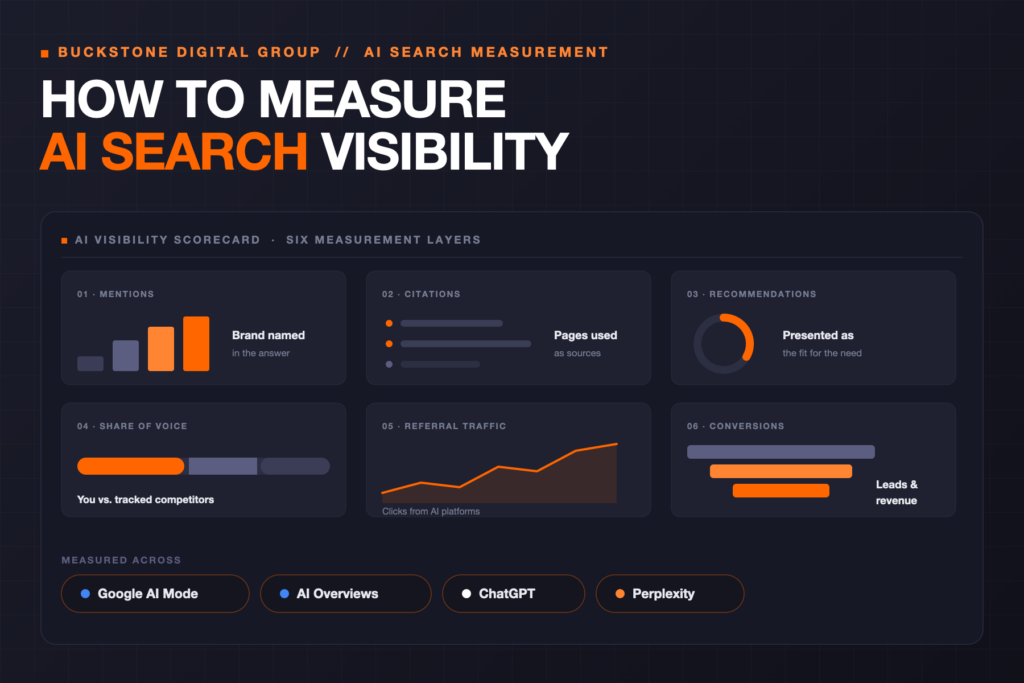
Companies are investing in AI search optimization, content, entity clarity, technical access, structured data, and authority building—and then discovering they cannot answer a simpler question: is any of it working?
Most teams cannot confidently say whether:
- ChatGPT is mentioning them
- Google is citing their pages in AI Overviews or AI Mode
- Perplexity uses their content
- They are being recommended or merely referenced
- Which competitors appear more often
- AI platforms are describing them accurately
- Any of this is generating qualified traffic or leads
Traditional SEO reporting is not sufficient by itself, which is the bigger story behind whether SEO is dead. Rankings, clicks, impressions, and conversions still matter—but AI-generated answers introduce visibility stages that do not always produce a click. A business can be summarized, cited, compared, and recommended inside an answer the user never leaves. That means AI visibility cannot be described by one number. It needs a layered scorecard.
AI Search Visibility should be measured as a progression from technical eligibility to market presence and business impact—not reduced to one ranking, one citation, or one referral-traffic number.
This is the sixth article in our AI Search Visibility series, and it answers the question the first five set up: now that you understand what AI Search Visibility is and how to improve it, how do you know the work is producing results?
Key takeaways
Measuring AI visibility, in one panel
- AI Search Visibility is not one metric.
- Mentions, citations, comparisons, and recommendations represent different levels of visibility.
- A prompt-tracking program needs a stable, commercially relevant prompt set.
- Manual testing is useful for diagnosis but unreliable as the entire reporting system.
- Search Console now provides dedicated reporting for Google’s generative AI search experiences — currently impressions, not clicks.
- ChatGPT referral visits can be identified through its referral UTM parameter,
utm_source=chatgpt.com. - Analytics only captures visits; it does not capture every unclicked mention or citation.
- Third-party monitoring platforms measure the prompts they test, not all AI activity.
- Segment visibility by platform, prompt category, customer journey, geography, and user context where possible.
- Competitor share of voice is often more meaningful than a raw mention count.
- Accuracy and sentiment matter alongside appearance frequency.
- Business outcomes remain the ultimate measurement layer.
- BuckStone reports AI visibility through Access, Understanding, Evidence, Corroboration, and Outcomes.
What does AI Search Visibility measurement mean?
In business-friendly language:
AI Search Visibility measurement is the process of evaluating how frequently, accurately, prominently, and persuasively a company appears across AI-generated search and recommendation experiences—and whether that visibility contributes to business outcomes.
A complete measurement program should answer five questions in order:
- Access — Can the platform retrieve our information?
- Understanding — Does the platform describe our business accurately?
- Presence — Does our brand or website appear for relevant questions?
- Competition — How does our presence compare with competitors?
- Outcomes — Does that presence contribute to meaningful customer behavior?
These map directly onto BuckStone’s five-part framework—Access, Understanding, Evidence, Corroboration, and Measurement. Measurement exists to show whether the first four layers are improving, and whether that improvement produces business results.
Why traditional SEO metrics are not enough
Traditional metrics still matter—organic impressions, organic clicks, rankings, click-through rate, landing-page engagement, leads, and revenue remain core. But AI answers can create visibility without a traditional blue-link click. A single answer can let a user:
- See a company cited as a source
- Read a summary built from its content
- See the company included in a comparison
- Receive it as one of several recommendations
- Search the brand later, or arrive through a different channel
- Contact the company without ever clicking the original citation
- Never click at all because the answer resolved the question
So referral traffic alone undercounts AI influence. That is not, however, a license to claim unmeasurable success. The discipline is triangulation—combining first-party data, analytics, prompt monitoring, and CRM evidence—not inventing attribution you cannot support. Traditional search performance and AI visibility are related but not interchangeable, and neither substitutes for the other. Strong technical SEO still underpins both.
The AI visibility progression
Visibility is not binary. A business moves through stages, and each stage requires a different metric. A company can clear the first three and still never be named; it can be named and never recommended; it can be recommended and never visited.
From eligibility to outcome
The nine-stage AI visibility progression
Accessible
The relevant crawler or platform can retrieve the website.
Retrievable
The content can enter the search or retrieval environment the platform uses.
Understood
The platform describes the company, people, products, services, and locations accurately. See how AI systems understand your business.
Cited
A page from the website appears as a source supporting an answer.
Mentioned
The company or product appears in the generated response. A company can be cited without being named, or mentioned without a direct citation.
Compared
The company appears alongside alternatives or competitors.
Recommended
The platform presents the company as a suitable option for the user’s stated need.
Visited
The user clicks through to the website.
Converted
The user completes a meaningful action — a form, call, purchase, demo, consultation, signup, store visit, application, or quote request.
Reporting that only measures the last stage (traffic or conversions) misses everything upstream that determines whether those outcomes are even possible.
Establish a baseline
Do you know where your business actually appears in AI search?
BuckStone can establish a measurable baseline across ChatGPT, Google’s generative AI experiences, Perplexity, competitor prompts, referral traffic, and business outcomes. For the Perplexity-specific playbook, see how to get cited by Perplexity.
The difference between a mention, citation, and recommendation
These three are constantly conflated, and conflating them is how agencies inflate results. They are different levels of visibility and should be tracked separately.
Mention
You are named
The response names the company, product, service, or expert — positively, neutrally, negatively, or even incorrectly.
Example
- “BuckStone Digital Group provides SEO and AI Search Visibility services.”
Citation
You are a source
The response links to or attributes information to one of your webpages. A citation is not automatically an endorsement.
Example
- An answer cites BuckStone’s article while explaining entity SEO.
Recommendation
You are the answer
The platform actively presents you as an option that matches the user’s need. It may occur with or without a direct citation.
Example
- “For an established manufacturer seeking technical SEO and AI visibility support, BuckStone Digital Group may be worth considering.”
Three rules follow from this: a citation is not automatically a recommendation; a recommendation can appear without a citation to your site; and a mention can be positive, neutral, negative, incorrect, or irrelevant. A report that merges them into one “appearances” figure hides the distinctions that actually matter.
The core AI Search Visibility metrics
No single one of these describes success. Together they form a scorecard.
1. Prompt coverage
The percentage of monitored prompts for which the company appears in a defined way.
Brand mention coverage  = brand prompts ÷ total monitored prompts × 100
Citation coverage       = domain-citing prompts ÷ total monitored prompts × 100
Recommendation coverage = recommending prompts ÷ total monitored prompts × 100
Every coverage number is meaningless without its conditions. The report must define what counts as an appearance, which prompts were included, which platform and model or search mode was tested, which country or location was used, which date the test ran, whether responses were repeated, and whether personalized or logged-in conditions applied. Never report “AI visibility increased 40%” without stating what was measured and against what denominator.
2. AI share of voice
The company’s visibility relative to a defined competitor set across monitored prompts.
Share of voice = company appearances ÷ total appearances among tracked competitors × 100Calculate it separately for mentions, citations, recommendations, top-three inclusion, prompt categories, and platforms—and always state the denominator. Appearing in 20 prompts sounds strong until you learn the leading competitor appears in 85.
3. Citation frequency
Track the number of monitored responses citing your domain, the number of unique URLs cited, citation rate across prompts, citation rate by platform and by topic, repeat citations, and newly gained or lost citations. URL-level reporting matters: a company may have one article cited repeatedly while its service pages and case studies stay invisible—a very different situation from broad citation across the site.
4. Brand mention frequency
Track brand, product, executive or expert, location, and service mentions, including unlinked mentions and—critically—correct versus incorrect ones. Do not treat every appearance as positive.
5. Recommendation rate
How often the company is included in a recommendation list, included among the top recommendations, described as a best fit, presented for a particular industry, location, budget, or use case—or excluded while competitors appear. This must be based on clearly defined monitored prompts, not memorable one-offs.
6. Response prominence
AI answers do not have one stable, universal ranking position, so do not pretend they do. Instead record practical prominence indicators: whether the company is the first mentioned, included in the initial visible answer, appears only after expanding the response, sits in a short list, appears only in supporting citations, is named in the conclusion, described in detail, or mentioned only briefly. We call this response prominence, not a ranking.
7. Answer accuracy
Score whether the platform correctly identifies your company name, services, products, locations, industries served, leadership, publicly stated pricing, hours, credentials, business status, differentiators, availability, contact information, and brand relationships. A simple scale works: Accurate · Partially accurate · Outdated · Incorrect · Missing · Unsupported. Frequent visibility paired with incorrect information can damage the brand more than invisibility.
8. Message alignment
Measure whether AI systems repeat the positioning you want to establish. For BuckStone, that means association with SEO, AI Search Visibility, technical SEO, website optimization, local SEO, Google Ads, established businesses, manufacturers, technology companies, and financial-services firms. Compare intended positioning against what platforms actually say.
9. Source diversity
Track which domains AI systems draw on when discussing your company or topics—your website, LinkedIn, Google Business Profile, review sites, industry directories, news coverage, association profiles, partner sites, customer case studies, forums, and marketplace listings. Diversity can reveal whether your identity is corroborated across the web. More domains is not automatically better; relevance and credibility matter more than count.
10. Competitor inclusion and exclusion
Track which competitors appear most often, which prompts trigger each, which attributes and sources support them, whether they are cited, mentioned, compared, or recommended, and—most usefully—where you are absent while a competitor appears. This is where measurement turns into an opportunity list.
11. AI referral traffic
In GA4, measure sessions and users arriving from AI platforms using session source, source/medium, referral traffic, landing pages, UTM parameters, engaged sessions, key events, conversions, revenue where available, assisted journeys, and new versus returning users. OpenAI documents that publishers allowing OAI-SearchBot can track ChatGPT referral traffic in analytics, and ChatGPT referral URLs carry utm_source=chatgpt.com—in GA4 it surfaces as chatgpt.com under the Referral channel (Reports → Acquisition → Traffic acquisition). Do not assume all AI traffic is always labeled perfectly: referrals can appear under variations, or fall into direct traffic, depending on browser, app, privacy, redirect, and implementation conditions. Maintain a reviewed AI-referral source grouping rather than hard-coding a universal list. A GA4 exploration or Looker Studio report grouping AI sources by sessions, engagement, and key events is useful—but it captures visits, never unclicked visibility.
12. Google generative AI performance
In June 2026, Google launched dedicated Generative AI performance reporting in Search Console We cover how to act on that report in how to appear in Google AI Overviews., giving a distinct view of how your URLs appear in generative AI features—AI Overviews, AI Mode, and generative AI features in Discover. Two facts shape how you should use it:
- It currently reports impressions — how often your URLs appeared in those features — broken down by page, country, device, and date (with hourly granularity), and by Search versus Discover. As of launch it does not include click data, click-through rate, or query-level data, and it does not expose every individual citation or exact prompt. Google has said it plans to add more metrics over time.
- Generative AI performance is also reflected in your overall Search Console performance data, so the dedicated report isolates the generative-AI slice rather than describing traffic that lives somewhere else.
Use it to compare current versus previous period, month over month, quarter over quarter, before and after major optimizations, generative-AI impressions versus overall organic visibility, and performance at the page and topic-cluster level. Do not borrow dimensions from the regular Performance report that the generative-AI report does not currently offer, and remember: Search Console covers Google’s surfaces only—never ChatGPT or Perplexity.
13. Branded search demand
Improved AI exposure may contribute to later brand searches, but correlation does not prove causation—keep the language cautious. Track branded impressions and clicks, brand-plus-service, brand-plus-review, and brand-plus-location searches, direct traffic, returning users, and branded conversions, and treat rises as supporting evidence rather than proof.
14. Assisted conversions and business outcomes
The ultimate layer: leads, qualified leads, calls, demo requests, sales, revenue, ecommerce transactions, applications, bookings, subscriptions, and pipeline influence. Last-click attribution can miss earlier AI influence—but you still must not assign AI credit without evidence. Supporting evidence can include referral sessions, landing-page paths, CRM source information, “how did you hear about us?” responses, call tracking, sales notes, self-reported attribution, branded-search increases, and controlled pre/post analysis. When channel attribution and reporting overlap with paid media, we align it with Google Ads measurement so the picture stays consistent.
Building a prompt-monitoring set
A monitoring program is only as good as its prompts. The set must reflect real customer decisions, not vague high-volume phrases—and it should be grouped by where the customer is in their journey.
The prompt journey
Six prompt types, one example each
Discovery
“Which SEO agencies work with manufacturers?”
Education
“What is entity SEO, and how does it differ from traditional SEO?”
Comparison
“Which agencies offer both SEO and AI visibility services?”
Recommendation
“Recommend an SEO agency for a mid-sized manufacturer.”
Validation
“Is [brand] reputable, and what services does it provide?”
Transaction
“Hire an SEO agency for a technology company.”
Within those types, prompts should be customized for your industry, services, products, customer type, geography, use case, pain point, buying stage, competitors, and brand-validation needs. A local restaurant tracks “best restaurants for private dining near Park Ridge”; a supplier tracks “what companies provide biodegradable industrial lubricants”; a financial-services firm tracks “how can a financial-services firm improve non-branded organic visibility.” Validation and transactional prompts should include your real brand and location names.
How many prompts should a business track?
There is no universal required number. As BuckStone planning guidelines—not platform rules—a practical starting range is:
- Small local business: ~25–50 carefully selected prompts
- Focused B2B company: ~50–100 prompts
- Multi-product, multi-location, or enterprise: larger, segmented sets
Quality beats volume. Fifty prompts that mirror real buying decisions are worth more than hundreds of synthetic variations with no commercial value.
Why one-off manual searches are unreliable
The same prompt can return different answers depending on platform, model, search mode, date, location, language, user context, personalization, conversation history, phrasing, follow-up questions, source freshness, probabilistic variation, and product updates. One manual query is a snapshot, not a measurement.
Manual testing is still valuable—for spot checks, diagnosis, accuracy reviews, source inspection, screenshots, and judging response quality. It simply should not be the entire reporting method. A screenshot proves a moment; a monitored prompt set proves a trend.
How to make prompt tracking more reliable
Methodology discipline
Turn prompt testing into a measurement, not an anecdote
- Use a documented prompt library, and keep core prompts stable over time
- Separate core prompts from experimental prompts
- Record platform, model, date, and location for every test
- Use consistent testing conditions and run recurring tests
- Preserve response evidence and track the sources cited
- Define scoring rules, then review results manually
- Record material platform changes that could affect results
- Don’t rebuild the prompt set every month — add new prompts without erasing historical baselines
- Segment prompts before calculating totals
AI visibility by business type
The right emphasis depends on the business model.
Local service businesses
Prioritize local recommendation prompts, service-plus-location prompts, correct business details, Google generative AI visibility, Google Business Profile consistency, reviews, calls, form submissions, and direction requests or bookings where available. Local SEO accuracy is the foundation here.
B2B and professional services
Prioritize problem and solution prompts, industry-specific recommendations, comparison prompts, expertise accuracy, executive and author visibility, case-study citations, demo requests, qualified leads, and pipeline influence.
Ecommerce and product companies
Prioritize product-category prompts, product comparisons, use-case recommendations, product citations, price and availability accuracy, merchant and product-data consistency, referral revenue, and assisted purchases. This connects directly to ecommerce and marketplace growth work.
Publishers and content-led brands
Prioritize citation frequency, unique URLs cited, topic-level visibility, referral traffic, newsletter conversions, content-reuse patterns, and new versus lost citation coverage.
Creating a monthly AI Search Visibility report
A useful report is structured so every finding leads to an action. Below is the reporting template BuckStone uses—shown as its structure, with no fabricated client figures.
01 · Executive summary
The one-page view
- Major gains and major losses
- Meaningful platform changes
- Business outcomes for the period
- Recommended priorities for next month
02 · Access & eligibility
Can platforms retrieve you?
- OAI-SearchBot & PerplexityBot status
- Google crawl & index status; robots.txt changes
- CDN or firewall issues; excluded pages
- Structured-data errors where relevant
03 · Visibility scorecard
Do you appear?
- Mention, citation & recommendation coverage
- AI share of voice; response prominence
- Accuracy rate
- Month-over-month change
04 · Platform breakdown
Where you appear
- Google generative AI features
- ChatGPT
- Perplexity
- Other monitored platforms — shown separately, not blended
05 · Prompt-category performance
Which journeys you win
- Discovery, educational, comparison
- Recommendation, validation, transactional
- Local where relevant
06 · Competitor comparison
How you stack up
- Share of voice; commonly appearing competitors
- Winning topics & losing topics
- New competitors; source patterns; content gaps
07 · Citation & source analysis
What’s being used
- Most-cited pages; newly cited; lost citations
- External sources supporting you vs. competitors
- Pages that need stronger evidence
08 · Accuracy & entity monitoring
Are you described correctly?
- Incorrect or outdated descriptions
- Missing services; incorrect locations
- Wrong leadership or confused brand relationships
09 · Traffic & conversions
Does it create value?
- AI referral users & sessions; landing pages
- Engagement; key events; conversions; revenue
- Assisted evidence & CRM information
10 · Actions for next month
Every finding becomes a task
- Fix crawler access · improve a service page · publish an answer-focused article
- Add a case study · strengthen author information · correct external profiles
- Improve structured data · earn third-party corroboration · update outdated content
- Improve internal linking · build a product comparison or location page · add original research
Notice what the structure refuses to do: it never blends all platforms into a single number, never reports a percentage without its denominator, and never ends a finding without an action.
Measurement + implementation
Reporting should identify what to do next.
BuckStone combines AI visibility monitoring with technical SEO, content strategy, entity optimization, structured data, authority building, and conversion measurement.
A practical AI Search Visibility scorecard
The whole program condenses into six measurement layers. Each answers a different question, and none replaces the others.
| Measurement layer | Example metrics | What it tells us |
|---|---|---|
| Access | Crawler access, indexation, blocked resources | Whether platforms can retrieve the information |
| Understanding | Accuracy, service association, entity consistency | Whether the business is interpreted correctly |
| Presence | Mentions, citations, recommendations, prompt coverage | Whether the company appears |
| Competition | Share of voice, competitor inclusion, prominence | How visibility compares with alternatives |
| Engagement | Referral sessions, landing pages, engaged sessions | Whether users visit |
| Outcomes | Leads, sales, bookings, pipeline, revenue | Whether visibility creates value |
Should businesses create one AI visibility score?
A composite score can help executives see directional movement at a glance. It can also conceal important differences. Citation coverage may improve while recommendation coverage declines; brand mentions may rise while accuracy gets worse; ChatGPT visibility may grow while Google visibility falls; traffic may climb without qualified conversions.
BuckStone can produce a summary index, but only if the underlying metrics stay visible beneath it. Use the scorecard first; treat a single composite number as an optional executive summary, never as the whole story—and never publish a percentage without explaining its denominator.
What should be benchmarked before optimization?
Before changing anything, record a baseline—and the exact methodology used to capture it—for prompt coverage, mentions, citations, recommendations, competitor share of voice, response prominence, accuracy, most-cited URLs, external sources, AI referral traffic, Google generative AI performance, branded search, leads and revenue, and technical accessibility. A baseline captured with an undocumented method cannot be compared to anything later.
How long does it take to measure improvement?
Avoid promising timelines. Movement depends on crawl and index timing, platform refresh cycles, website authority, competitive intensity, content publication, external corroboration, business category, prompt selection, platform changes, and implementation quality. As practical BuckStone guidance—not a platform rule—a workable cadence is:
- Technical accessibility: monitor continuously or during regular technical audits
- Prompt tracking: monthly is often appropriate for client reporting
- High-priority prompts: weekly monitoring can be useful
- Google Search Console: review monthly and after important releases
- Referral traffic & conversions: monitor continuously, report monthly
- Strategic trend evaluation: quarterly
Common AI measurement mistakes
- Reporting screenshots as a strategy
- Testing only branded prompts
- Changing prompts every month
- Combining mentions and recommendations into one figure
- Calling every citation a win
- Ignoring incorrect information
- Measuring only ChatGPT
- Ignoring Google’s generative AI reporting
- Measuring traffic but not visibility — or visibility but not conversions
- Treating third-party estimates as complete platform data
- Failing to record test conditions
- Using irrelevant high-volume prompts, or creating hundreds of synthetic prompts with no commercial value
- Ignoring location and language
- Reporting a percentage without explaining the denominator
- Comparing periods that used different prompt sets
- Letting platform-interface changes silently alter the methodology
- Claiming causal business impact from correlation alone
What AI Search Visibility tools are needed?
Organize tools by function, not brand. The methodology matters more than the number of tools.
First-party measurement
Google Search Console, Google Analytics 4, your CRM, call tracking, ecommerce analytics, and Google Business Profile performance where relevant. This is where the most trustworthy data lives.
Prompt-monitoring platforms
These systems can help track mentions, citations, recommendations, competitors, share of voice, prompt categories, source URLs, and historical change. BuckStone uses appropriate professional monitoring systems, potentially including Semrush—but no third-party platform sees every real user prompt, and each measures the prompts, locations, models, settings, and dates it tests, not the entirety of global AI usage.
Technical tools
Robots.txt testing, log-file analysis, crawl tools, indexation checks, schema validation, and CDN and firewall review.
Reporting tools
Looker Studio, spreadsheets, business-intelligence platforms, and client-reporting systems such as Notion. A clear method in a spreadsheet beats a beautiful dashboard built on an undefined denominator.
How BuckStone measures AI Search Visibility
We report against the same five-part framework we use to improve visibility, so measurement and implementation stay connected.
Access
We evaluate crawler permissions, indexability, server responses, CDN and firewall behavior, rendering, and the availability of important pages—the full technical SEO for AI search stack. See how to check whether your website is blocking AI crawlers.
Understanding
We evaluate brand accuracy, entity clarity, service association, product information, leadership and authorship, location accuracy, structured data, and internal relationships.
Evidence
We evaluate content depth, original information, case studies, reviews, expert authorship, supporting service and product pages, useful comparisons, and first-party data.
Corroboration
We evaluate third-party mentions, industry profiles, reviews, associations, partner pages, media coverage, and which external sources appear in AI responses.
Measurement and outcomes
We track prompt coverage, citations, mentions, comparisons, recommendations, share of voice, accuracy, referral traffic, branded demand, leads, sales, and pipeline impact—and pair every report with implementation. BuckStone does not merely show that a business is absent from AI answers. We identify why it is absent and what should change. If your business is missing entirely, start with why your business is not appearing in AI search results; to understand the platform mechanics behind these metrics, see how to get recommended by ChatGPT and how to show up in Google AI Mode.
Final answer: how should AI Search Visibility be measured?
Through a layered system that evaluates, in order: technical access, accurate understanding, mentions and citations, comparisons and recommendations, competitor share of voice, referral traffic, and conversions and business impact. No single platform or metric reveals the entire picture.
The strongest measurement program combines first-party search data, website analytics, a stable prompt-monitoring methodology, competitive analysis, manual quality review, and CRM and conversion data—reported clearly month over month, with an action attached to every important finding. Measurement should not merely prove activity. It should identify the next opportunity. When you are ready to build the system—or to work with a team that pairs it with implementation—that is the work we do.
Work with BuckStone
Turn AI search visibility into a measurable growth channel.
BuckStone can build the prompt set, competitive baseline, tracking system, monthly reporting, and optimization plan your business needs.
Frequently asked questions
What is AI Search Visibility?
AI Search Visibility is how frequently, accurately, and prominently a business appears across AI-generated search and recommendation experiences such as ChatGPT, Google AI Mode, AI Overviews, and Perplexity—and whether that presence contributes to business outcomes. It is measured as a progression, not a single ranking.
How do you measure whether a business appears in ChatGPT?
Use a stable set of monitored prompts tested on a recurring schedule to record mentions, citations, and recommendations, and use GA4 to track referral visits carrying utm_source=chatgpt.com. Analytics captures visits that were clicked; it does not capture every unclicked mention, so prompt monitoring and referral data are used together.
Can Google Search Console measure AI Overviews and AI Mode?
Yes. In June 2026 Google added dedicated Generative AI performance reporting in Search Console for AI Overviews, AI Mode, and generative AI features in Discover. At launch it reports impressions of your URLs, broken down by page, country, device, and date, and it does not yet include click data, click-through rate, or query-level detail. It covers Google’s surfaces only—not ChatGPT or Perplexity.
Can GA4 track traffic from ChatGPT?
Yes, when users click through. ChatGPT referral URLs include utm_source=chatgpt.com, and the visits appear in GA4 as chatgpt.com under the Referral channel (Reports → Acquisition → Traffic acquisition). Depending on browser, app, and privacy conditions, some AI referrals may fall into direct traffic, so a reviewed AI-source grouping is more reliable than a fixed list.
What is AI share of voice?
It is your visibility relative to a defined competitor set across monitored prompts—your appearances divided by the total appearances among tracked competitors, times 100. It can be calculated for mentions, citations, or recommendations, and it is only meaningful when the competitor set and denominator are stated.
What is prompt coverage?
The percentage of monitored prompts for which your business appears in a defined way—for example, prompts that mention your brand divided by total monitored prompts. Coverage is only interpretable alongside its conditions: which prompts, platform, model, location, and date were tested.
What is the difference between an AI mention and a citation?
A mention names your company, product, service, or expert in the response. A citation links to or attributes information to one of your webpages. You can be cited without being named prominently, or mentioned without any citation to your site.
Is an AI citation the same as a recommendation?
No. A citation means your page was used as a source. A recommendation means the platform actively presents your business as a suitable option for the user’s need. A citation is not automatically an endorsement, and a recommendation can appear without citing your site.
How many AI prompts should a business track?
There is no required number. As a BuckStone planning guideline, a small local business might start with roughly 25–50 carefully chosen prompts, a focused B2B company with roughly 50–100, and multi-product or enterprise businesses with larger segmented sets. Quality and commercial relevance matter more than volume.
How often should AI visibility be measured?
Monitor technical accessibility and referral traffic continuously; run prompt tracking monthly for reporting, with weekly checks on high-priority prompts; review Search Console monthly and after major releases; and evaluate strategic trends quarterly. These are practical guidelines, not platform rules.
Are manual ChatGPT searches reliable for reporting?
Not on their own. The same prompt can vary by platform, model, date, location, personalization, and phrasing, so a single query is a snapshot, not a trend. Manual testing is valuable for diagnosis, accuracy review, and screenshots, but reporting needs a stable, repeated prompt set.
Can AI visibility be measured without paid software?
Yes. Google Search Console, GA4, your CRM, call tracking, and a documented manual prompt library covering your key customer questions can establish a real baseline. Paid monitoring platforms add scale and competitor tracking, but a disciplined free-tool method is far better than screenshots.
Do AI monitoring tools track every real user prompt?
No. Third-party platforms test a defined prompt set on a schedule. Their measurements reflect the monitored prompts, locations, models, settings, and dates—not the entirety of global AI usage—and no tool has complete visibility into every real user prompt or proprietary system.
How should local businesses measure AI visibility?
Focus on local recommendation and service-plus-location prompts, the accuracy of business details, Google generative AI visibility, Google Business Profile consistency, reviews, and outcomes like calls, form submissions, and direction or booking requests.
How should ecommerce companies measure AI visibility?
Focus on product-category and comparison prompts, product citations, price and availability accuracy, merchant and product-data consistency, referral revenue, and assisted purchases—then tie visibility back to transactions rather than reporting appearances alone.
How does BuckStone report AI Search Visibility?
Through five layers—Access, Understanding, Evidence, Corroboration, and Measurement/Outcomes—covering prompt coverage, citations, mentions, comparisons, recommendations, share of voice, accuracy, referral traffic, branded demand, leads, and pipeline. Every report is paired with implementation, and every finding is tied to a specific next action.
Sources & methodology
Platform capabilities below are drawn from official primary documentation and were checked against current sources. We distinguish official platform reporting (Search Console, GA4) from third-party prompt monitoring and from BuckStone’s own measurement framework and planning recommendations. Where a platform does not publish a capability—for example, a complete first-party dashboard of every AI mention, citation, or prompt—we do not imply one exists. Formulas, prompt examples, scorecard layers, and cadence guidance are BuckStone methodology, not platform rules, and no client performance figures appear anywhere in this article.
- Google Search Central — Introducing Search Generative AI Performance Reports
- Google Search Central — Optimizing for Generative AI Features
- Google Search Central — AI Features and Your Website
- Google Search Central — Search Console and Google Analytics Data
- Google Search Console
- OpenAI — Publishers and Developers FAQ
- Perplexity — Perplexity Crawlers