Industries / SEO for Ecommerce Brands
SEO for Ecommerce Brands That Want More Profitable Revenue
BuckStone helps ecommerce and marketplace brands turn product and category pages into rankable, revenue-driving assets — and win visibility across Google, Google Shopping, and AI-driven product research.
That now includes Answer Engine Optimization (AEO) — getting your products surfaced and recommended when shoppers research through AI.
Explore our ecommerce & marketplace growth services.
Why Ecommerce Brands Struggle to Grow Organic Revenue
Sprawling catalogs, thin category pages, and duplicate variants keep stores invisible for the high-intent product searches that actually convert.
See how third-party sources influence AI recommendations and what makes a business recommendable.
Thin, templated category pages
Category and collection pages with little unique content, so they never rank for the terms shoppers actually use.
Product pages that don’t rank
PDPs missing structured specs, unique copy, and schema, so they lose to marketplaces and competitors.
Duplicate & variant chaos
Color, size, and filter variations spawning duplicate URLs that split authority and bloat the crawl.
Losing the sale to marketplaces
Amazon, Walmart, and big-box retailers outranking your own store for your own products.
Weak technical & site speed
Slow, hard-to-crawl storefronts with faceted-navigation and indexing issues that cap rankings.
Invisible in Shopping & AI
Missing from Google Shopping, "best" lists, and AI shopping answers where buyers now compare products.
How Shoppers Search for Products Now
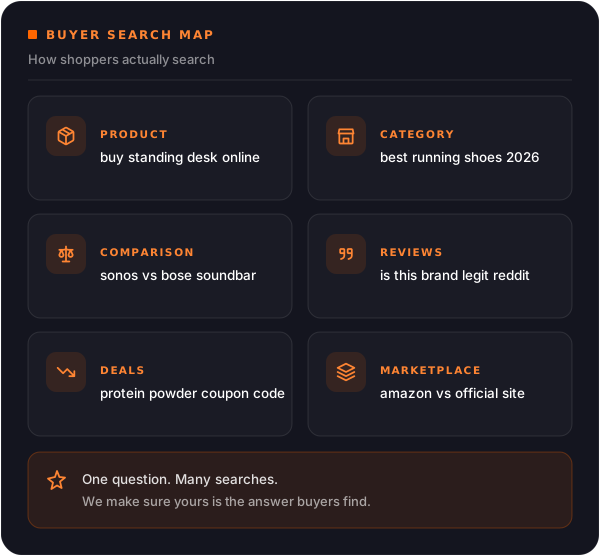
Shoppers rarely start on your homepage. They search by product, category, brand, and comparison across Google and Shopping — and increasingly ask AI to compare and recommend products before they buy.
When shoppers ask for the best option in a category, AI tools now compare specs, reviews, and price and surface a shortlist. your store shows up when your product data is clean, structured, and trusted.
Shoppers ask AI to compare and recommend products before visiting a store. If your product data isn’t structured and reviewed, you’re left off the shortlist.
Answer Engine Optimization for Ecommerce
How Shoppers Discover Your Products Through AI
Shoppers now ask ChatGPT and Perplexity to “find the best [product] under $X”, “compare [product A] vs [product B]”, or “recommend a [category] for [use case]” — and AI answers with specific products and brands. Answer Engine Optimization (AEO) makes your products, specs, and reviews structured and trusted enough for AI to surface and recommend them.
Product data AI can read
Structured product, variant, and spec data so answer engines match you to precise shopping queries.
Comparison-ready content
The attributes, use-cases, and comparisons AI needs to recommend you in “best / vs” answers.
Reviews & brand trust
Ratings, mentions, and brand signals that make AI confident enough to put your product forward.
What We Improve for Ecommerce SEO
The pages, product data, and technical foundations we optimize so shoppers find and buy from your store — and so Google and AI can understand and recommend your products.
Category & collection pages
Rankable category pages with unique content, internal links, and intent-matched structure.
Product page optimization
Unique descriptions, structured specs, and product schema that win high-intent PDP searches.
Variant & canonical strategy
Clean handling of variants, filters, and duplicates so authority consolidates instead of splitting.
Technical & site speed
Crawl, indexation, Core Web Vitals, and faceted-nav fixes that let every page rank.
Shopping & product feeds
Optimized feeds and structured data for Google Shopping and AI product surfaces.
Content & buying guides
Comparison guides and buyer content that capture research-stage demand and link to products.
Internal linking & schema
Site architecture and markup that help engines understand your catalog and rank collections.
Conversion & merchandising
Clear paths from search to cart that turn qualified traffic into orders, not bounces.
Why BuckStone for Ecommerce SEO
Large catalogs, marketplace competition, and messy variant data make ecommerce search fundamentally different from local or blog SEO. It takes technical depth and catalog strategy to win.
Catalog-scale strategy
We optimize templates and structure that scale across thousands of products, not one page at a time.
Technical ecommerce depth
Faceted navigation, canonicalization, and speed handled by people who know Shopify, Woo, and Magento.
Marketplace + owned search
One strategy to win on Google and defend against Amazon and big-box retailers for your own products.
Structured for Google + AI
Product data and schema built to earn visibility in Shopping and AI product recommendations.
Revenue, not just traffic
Every improvement ties to sessions that convert — orders and revenue, not vanity rankings.
Senior strategists, real relationships
You work directly with the people doing the thinking, with monthly calls and transparent reporting.
Ecommerce SEO FAQs
How is ecommerce SEO different from regular SEO?
Ecommerce SEO is built around product, category, and comparison searches at catalog scale. It requires unique category and product content, clean handling of variants and filters, product schema, and technical work like faceted-navigation control — all tied to revenue rather than raw traffic.
Can SEO help if we mostly sell on Amazon or Walmart?
Yes. We help you win owned-site rankings so you capture margin and customer data instead of renting them from marketplaces, while keeping a coordinated presence where high-intent shoppers already buy.
How do you handle huge catalogs and product variants?
We optimize at the template and category level and use canonical, indexing, and internal-linking strategies so thousands of products and their variants consolidate authority instead of creating duplicate content.
Should ecommerce brands invest in paid search and Shopping too?
Usually yes. Paid search and Shopping capture high-intent demand immediately and reveal which products and terms convert, while organic rankings and product visibility compound over time.
How long does ecommerce SEO take to work?
Technical and product-data fixes can lift performance within weeks, while competitive category and product rankings typically build over 4–8 months — with transparent monthly reporting throughout.
Ready to Turn Product Searches Into Profitable Revenue?
Let’s find where your shoppers are searching, where marketplaces are beating you, and how BuckStone can turn organic visibility into orders.
Digital Services for Ecommerce Brands
The services we most often combine for Ecommerce Brands to grow visibility, traffic, and qualified leads — connected into one strategy.
 BUCKSTONEDIGITAL GROUP
A strategic digital growth partner helping businesses stay visible wherever customers search, today and tomorrow.