
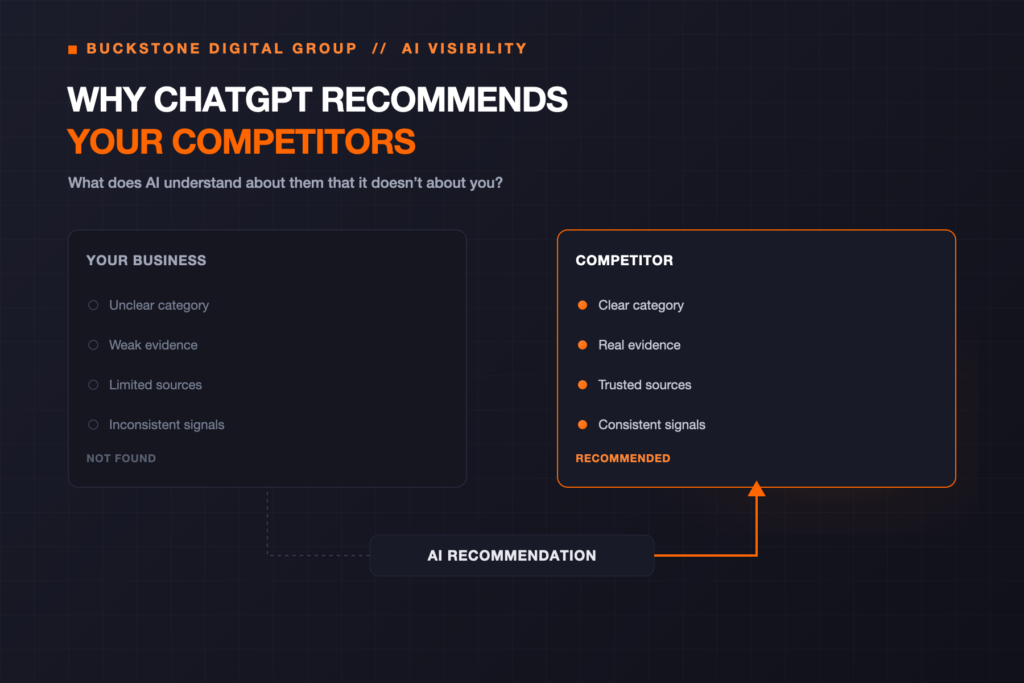
You open ChatGPT and ask, “What are the best [type of companies] in [your market]?” Your competitor appears — described accurately, services listed, maybe even a sentence on why someone should consider them. You don’t. You try another wording. Same result. It’s an unsettling thing to watch: the assistant confidently recommends the company across the street and can’t seem to find yours.
Here is the reassuring part: that does not necessarily mean ChatGPT has decided your competitor is the better business. More often, it means the digital information surrounding your competitor makes them easier to identify, understand, verify, and match to the question you asked. And that is diagnosable — there is no single “ChatGPT ranking factor,” but there is a system underneath these recommendations, and gaps in it can be found and closed.
ChatGPT does not need to believe your competitor is objectively the better company for your competitor to appear instead of you. Your competitor may have stronger digital evidence even if you have the stronger real-world business. So the better question isn’t “Why does ChatGPT like my competitor?” It’s: “What can the system find, understand, and verify about them that it cannot find or verify about us?”
- ChatGPT recommendations are contextual, not a universal ranking — different prompts produce different sets.
- A competitor can appear simply because its business is easier to understand online.
- Technical accessibility matters — systems can’t recommend what they can’t retrieve.
- Clear category, service, and product positioning matters more than polished slogans.
- Specific evidence beats generic claims.
- Independent third-party sources and honest reviews shape the information environment around a business.
- Structured data clarifies information but doesn’t guarantee a recommendation.
- Traditional SEO is still part of the retrieval foundation.
- One screenshot is not measurement — compare across repeatable prompt families.
- Competitor analysis should reveal which sources and signals separate the visible company from the invisible one.
- AI visibility improvement is usually a systems problem, not a single-page fix.
Does ChatGPT actually rank businesses?
No — there is no simple public “position 1–10” ChatGPT ranking comparable to a Google results page. A recommendation can change based on the prompt, wording, context, location, follow-up conversation, the sources available to be retrieved, freshness, and platform behavior. Ask two slightly different questions and you can get two different shortlists.
Because there’s no fixed ranking, the right thing to measure isn’t a position — it’s presence, prominence, context, accuracy, citations, recommendation, and stability across many related prompts. When the answer about you is simply wrong, that is a separate, fixable problem — see how to fix incorrect information about your business. That’s the whole argument of why AI rank tracking is more complicated than Google rank tracking.
The real question: what can AI understand about your competitor that it can’t about you?
Instead of asking why the assistant “prefers” a competitor, walk through what the information ecosystem can actually find and verify about each of you. The table below is an illustrative diagnostic framework — not a real client dataset — but it’s exactly the comparison worth running honestly against your own site.
| Can a system easily determine… | Your business | The competitor |
|---|---|---|
| What category the business is in? | ? | Clear |
| Which services/products it offers? | ? | Explicit |
| Who it serves, and where? | ? | Specific |
| Proof it can do the work? | ? | Evidenced |
| Whether outside sources agree? | ? | Corroborated |
| That the site is crawlable & indexable? | ? | Yes |
Every “?” is a place a competitor can pull ahead without being a better company. BuckStone groups those into five layers.
The five layers behind the gap
- 1Access
Can systems retrieve your information at all?
- 2Understanding
Can they identify your category, services, audience, and how you match the prompt?
- 3Evidence
Can they find proof of what you claim?
- 4Corroboration
Does the wider web independently reinforce your story?
- 5Measurement
Are you testing visibility in a way that’s actually meaningful?
Access: your competitor is easier to retrieve
Nothing else matters if systems can’t reliably reach your content. A competitor can win this layer simply by being more accessible — better crawlability and indexability, no accidental noindex or canonical errors, no important content trapped behind JavaScript or interactions, no server errors, no CDN or firewall rules quietly blocking crawlers, and clean internal linking instead of orphaned pages.
Start here: is your website blocking AI crawlers? and technical SEO for AI search. And note the overlap with classic SEO — a competitor’s stronger crawlability, architecture, and organic footprint often feed the same retrieval foundation, which is why AEO doesn’t replace SEO.
Understanding: your competitor is easier to identify and match
This is where most recommendation gaps actually live. Even with perfect access, a system has to work out what you are, who you serve, and whether you fit the specific question. Competitors win this layer in several compounding ways.
They’re easier to categorize
Vague copy — “innovative solutions for a changing world,” “your trusted partner for success” — tells a system almost nothing. Compare that to “commercial collection agency specializing in construction receivables” or “manufacturer of biodegradable industrial lubricants for environmentally sensitive applications.” AI systems can’t confidently recommend a company when its own website makes the category hard to determine. See how AI systems understand what your business does.
They match the prompt more specifically
“Best SEO agency” is a different request from “SEO agency specializing in manufacturers” or “agency that handles SEO and Amazon advertising for ecommerce brands.” General authority does not automatically equal contextual relevance — the business with explicit, matching service, industry, product, or use-case pages is easier to surface for the specific ask.
Their entity is clearer
Systems should be able to connect the organization to its brand, services, products, locations, leadership, experts, customers, and industries. Consistent naming, stable identifiers, a real About page, author pages, and sensible internal linking reduce ambiguity — the core of entity SEO.
Their information is better structured, and their content more specific
Clean structured data (Organization, LocalBusiness, Service, Product, Person, Article, FAQPage as appropriate) makes existing information easier to interpret — though it never creates authority the visible site doesn’t support (more on that here). And specific content beats generic: a system can already generate “What Is SEO?” on its own, so pages like “How Manufacturers Should Structure Product, Application, and Industry Pages for AI Search” — built on first-party expertise — are far more defensible. AI should accelerate expertise, not substitute for it (why generic content fails).
Evidence: your competitor is easier to believe
“We are experts” is a claim; evidence shows what the expertise looks like. A competitor with case studies, original research, real customer results, technical documentation, certifications, product specifications, portfolios, and expert-authored content gives the information ecosystem concrete reasons to consider them.
None of these is a confirmed “ChatGPT ranking signal” — but each makes a business easier to understand and verify, which is what recommendation depends on. This is the heart of what makes a business recommendable.
Corroboration: the rest of the web agrees
Your website tells the web what you say about yourself. Independent sources help establish whether the rest of the web tells a compatible story — and a competitor that shows up consistently across industry publications, partner and customer sites, review platforms, associations, credible directories, marketplaces, and legitimate news has a stronger, more verifiable footprint.
This is not “build more backlinks.” A mention on random-directory-4832.com is not equivalent to a relevant trade association, a major customer, or a trusted marketplace. Evaluate relevance, independence, specificity, credibility, and consistency — the mechanics are in how third-party sources influence AI recommendations.
Reviews are part of this layer too. Beyond a star rating, reviews can reinforce what a business is known for — a specific review (“they rebuilt our Shopify catalog, fixed our Merchant Center feed, and improved our Google Shopping setup”) creates far more descriptive context than “great company.” The right move is simple: ask for honest reviews, and never tell customers what keywords to include.
Measurement: you may be testing the wrong way
Sometimes the “gap” is partly a testing artifact. One prompt is not a measurement system. “Recommend the best agencies” and “which digital agencies specialize in SEO, AEO, and ecommerce marketplace growth for mid-sized manufacturers?” represent different needs and will surface different companies.
Measure repeatable prompt families: category, service, location, industry, problem, comparison, branded, and recommendation. Track presence and accuracy across each — the approach in how to measure AI Search Visibility.
Why does the same competitor keep appearing?
When one competitor shows up across many related prompts, it usually signals stronger category association, evidence, corroboration, search footprint, or reputation — but repetition is a signal to investigate, not proof of a specific ranking factor. The value is in the pattern: the more consistently a competitor appears across a prompt family, the more likely the information ecosystem finds them easier to retrieve and validate. That’s a lead to analyze, not a verdict to accept.
What actually drives AI recommendations? (the honest answers)
Several common questions deserve careful, non-hyped answers — because most confident claims about “ChatGPT ranking factors” aren’t documented.
Does Google ranking affect ChatGPT visibility?
Indirectly at most. Strong traditional search visibility often reflects underlying strengths — crawlability, content quality, authority, relevance, entity clarity, external references — that also help broader web retrieval. But a #1 Google ranking does not guarantee a ChatGPT recommendation, and a ChatGPT mention doesn’t require a #1 ranking (is SEO dead?).
Do backlinks help ChatGPT recommendations?
Not as a direct “more links = more mentions” lever. Links may contribute indirectly to discoverability, authority, and third-party corroboration — but the more useful question is which credible external sources reinforce the business and its expertise, which is corroboration, not link volume.
Do reviews affect ChatGPT recommendations?
Reviews can contribute to the public information environment and reinforce reputation, services, and recurring strengths — but there is no universal ChatGPT review-ranking formula, and manipulating reviews violates platform policies.
Does schema help ChatGPT visibility?
Structured data makes page information machine-readable and relationships explicit, which helps — but it must reflect visible content and use appropriate types. Schema is not a recommendation switch, and there is no special “AI schema.”
Can you pay ChatGPT to recommend your business?
You can pay for a clearly labeled placement, not an organic recommendation. In 2026 OpenAI introduced sponsored placements in ChatGPT — shown separately, at the bottom of responses, with clear “sponsored” labeling — and has stated that sponsored content does not influence the organic answers the assistant generates. In other words, the organic recommendation is still earned through the information ecosystem; ads are a distinct, labeled surface. (Platform advertising policies change — verify current OpenAI documentation before relying on specifics.)
Compare your business with the competitor, layer by layer
Run this side by side against the competitor that keeps appearing. Use qualitative states — Strong / Moderate / Weak / Unknown — rather than invented numeric scores; the goal is to locate the weakest layer, not to manufacture a metric.
| Layer | What to compare |
|---|---|
| Access | Indexation, crawler access, rendering, site architecture |
| Understanding | Category clarity, services, products, audiences, industries, locations, entity relationships |
| Evidence | Case studies, data, reviews, expertise, specifications, credentials |
| Corroboration | Publications, directories, associations, customers, partners, marketplaces, reviews |
| Recommendation visibility | Prompt presence, citations, recommendation language, accuracy, consistency |
How to fix the gap
Once you know the weakest layer, sequence the work — don’t start with whatever is easiest to publish.
- Verify technical access (crawlability, indexation, rendering)
- Clarify exactly what the company does — category, services, audiences
- Strengthen high-value service, product, and industry pages
- Improve entity relationships and internal linking
- Clean up structured data so it matches visible content
- Add specific evidence: case studies, data, credentials, examples
- Build meaningful external corroboration (relevant, credible sources)
- Improve review and reputation visibility appropriately
- Create original expert content around real buyer questions
- Measure repeatable prompt families over time
Publishing another blog article cannot repair a crawling problem, and adding schema cannot repair missing evidence. Diagnose the layer, then act.
What not to do
The pressure to “get into ChatGPT” produces a lot of bad advice. Avoid it.
Don’t spam the assistant, mass-produce thin AI articles, buy fake reviews or low-quality directory listings, invent author entities or awards, manufacture press, stuff “ChatGPT” into every page, add unsupported schema, spin up duplicate location pages, or treat llms.txt as a magic solution. And don’t assume crawler access alone creates recommendations, or judge success from a single prompt.
What is an AI visibility competitor audit?
A meaningful audit compares prompt families, the competitors appearing, recommendation frequency and context, the citations and source URLs behind them, and then the underlying signals — website structure, entity clarity, evidence, reviews, third-party footprint, technical access, and organic visibility — for you and for them.
You cannot improve a visibility gap until you know which layer is causing it. The objective is to understand why the information ecosystem finds a competitor easier to discover, understand, verify, and recommend — then fix that specific layer.
The Digital Visibility Brief
If you already know competitors are appearing where your business isn’t, the next step isn’t guessing at another optimization tactic — it’s identifying the visibility gap. That’s what BuckStone’s Private Visibility Brief is for: an executive, five-minute read that shows how your business appears across Google and AI-driven discovery, where competitors are capturing the non-branded demand you can’t see, and which priorities deserve attention first.
And a word on expectations: no responsible agency should guarantee a specific organic AI recommendation. BuckStone can strengthen accessibility, understanding, evidence, corroboration, and measurement — but platforms ultimately determine their outputs. The brief is a diagnosis, not a promise.
We don’t try to manipulate an assistant into saying a brand name. We connect traditional and technical SEO, AEO, entity SEO, structured data, content, evidence, third-party corroboration, reviews, competitor analysis, and measurement to make a business easier to discover, understand, verify, and recommend. Recommendation visibility is the output; the work happens underneath it.
Frequently asked questions
Why does ChatGPT recommend my competitors?
Usually because the information around your competitor makes them easier to identify, understand, verify, and match to the prompt — not because ChatGPT judged them the better company. AI recommendation gaps are usually information gaps.
Why isn’t my business showing up in ChatGPT?
Common causes: systems can’t reliably access your site, your category and services aren’t clear, you lack specific evidence, or few independent sources corroborate you. It usually traces to one of five layers — access, understanding, evidence, corroboration, or measurement.
How does ChatGPT decide which businesses to recommend?
There’s no single public formula. Recommendations depend on the prompt, context, retrievable sources, and platform behavior. In practice, businesses that are easy to access, understand, and verify — and consistently corroborated — are more likely to be surfaced.
Does ChatGPT rank businesses?
Not like a Google results page. There’s no fixed 1–10 ranking; recommendations vary by prompt and context. Measure presence, prominence, accuracy, citations, and stability across many related prompts instead of a single position.
How can I get my business recommended by ChatGPT?
Make it easy to access, understand, and verify: clear category and service pages, specific evidence, clean entities and structured data, and credible third-party corroboration. There’s a full tactical guide in how to get your business recommended by ChatGPT.
Can SEO improve ChatGPT visibility?
Yes, indirectly — the crawlability, content quality, relevance, and authority that support SEO also support broader web retrieval. AEO expands on that foundation; it doesn’t replace it.
Does Google ranking affect ChatGPT recommendations?
Only indirectly. Strong Google visibility reflects strengths that also help retrieval, but a #1 ranking doesn’t guarantee a ChatGPT recommendation, and a ChatGPT mention doesn’t require one.
Do backlinks help ChatGPT visibility?
Not as a direct lever. Links can contribute indirectly to discoverability and corroboration, but the useful question is which credible, relevant sources reinforce your business — corroboration quality, not link quantity.
Do reviews affect ChatGPT recommendations?
Reviews contribute to the public information environment and can reinforce reputation and services, but there’s no universal review-ranking formula. Ask for honest reviews; never script them or manipulate ratings.
Does schema help ChatGPT understand my business?
Clean structured data makes your information machine-readable and relationships explicit, which helps interpretation — but it must match visible content and isn’t a recommendation switch. There’s no special “AI schema.”
Does structured data help ChatGPT visibility?
It can, by clarifying meaning and entity relationships. Use appropriate types, stable identifiers, and no duplicate entities — but don’t expect schema alone to create authority the visible site doesn’t support.
Do third-party websites influence AI recommendations?
They shape the information environment around a business — reviews, directories, publications, associations, marketplaces, and customer sites. Relevance and credibility matter far more than raw mention count.
Why does the same competitor keep appearing in AI answers?
Consistent appearance across related prompts usually signals stronger category association, evidence, corroboration, or footprint. Treat repetition as a lead to investigate, not proof of a specific ranking factor.
How do I make AI understand what my business does?
State your category, services, audiences, and locations explicitly; keep naming and entities consistent; support claims with evidence; and use accurate structured data. Clarity beats clever slogans.
Can I see which sources ChatGPT uses?
ChatGPT’s search experiences can show citations/links for many answers, which reveal some of the sources behind a response. Reviewing those citations across prompts helps you see which sources reinforce competitors.
How do I compare my AI visibility with competitors?
Run repeatable prompt families, record who appears and how accurately, then compare the underlying layers — access, understanding, evidence, corroboration, and recommendation visibility — side by side.
What is AI share of voice?
It’s the proportion of a defined set of relevant prompts in which your business appears or is recommended, relative to competitors. It’s an observed presence measure for a test set, not a market-share figure.
How do I track ChatGPT recommendations?
Test consistent prompt families over time and log presence, recommendation language, accuracy, and cited sources — not one-off screenshots. See AI rank tracking vs. Google rank tracking.
How long does it take to improve AI Search Visibility?
There’s no universal timeframe. Some technical or clarity fixes can help quickly; broader recommendation visibility depends on content gaps, entity ambiguity, external footprint, competition, and platform retrieval behavior.
Can an agency guarantee ChatGPT recommendations?
No responsible agency should. A credible partner improves accessibility, understanding, evidence, corroboration, and measurement, and reports honestly — but platforms determine their outputs.
What is an AI visibility competitor audit?
A structured comparison of prompt families, appearing competitors, citations, and the underlying signals — technical access, entity clarity, evidence, reviews, third-party footprint, and organic visibility — to find why a competitor is easier to retrieve and validate.
What is a Digital Visibility Brief?
BuckStone’s Private Visibility Brief is a short executive diagnostic showing how your business appears across Google and AI-driven discovery, where competitors are capturing non-branded demand, and which gaps deserve attention first.
What should I fix first if competitors outrank me in AI search?
Fix the weakest layer first — usually access or understanding. Publishing more content can’t repair a crawling problem, and schema can’t repair missing evidence. Diagnose the layer, then sequence the work.
Sources & methodology
This article distinguishes documented platform behavior (how ChatGPT search, OpenAI’s crawlers — OAI-SearchBot for ChatGPT search, GPTBot for training, ChatGPT-User for user-triggered fetches — Google Search, AI Overviews and AI Mode, and Perplexity are publicly described to work, which changes over time and should be re-verified), BuckStone methodology (the five-layer diagnostic and audit approach), and reasonable strategic inference (clearly framed as such). It makes no claim that ChatGPT uses a specific ranking formula, or that reviews, backlinks, Google rankings, schema, crawler access, or llms.txt are direct or guaranteed recommendation factors. The 2026 introduction of clearly labeled sponsored placements in ChatGPT — described by OpenAI as separate from, and non-influential on, organic answers — reflects public documentation at the time of writing and may change; verify current OpenAI advertising and crawler policies before relying on specifics. No competitors, customer results, data, or AI outputs were fabricated; the comparison tables are explicitly illustrative diagnostic frameworks, not real datasets. Nothing here guarantees a specific AI recommendation. Primary references: OpenAI documentation (ChatGPT search, crawlers/user agents, advertising), Google Search Central and AI-features guidance, and Schema.org.