
Businesses are suddenly told they need SEO, AI SEO, AEO, GEO, ChatGPT optimization, and AI search optimization—as if everything they’ve invested in for years just stopped working. It didn’t. The confusion comes from treating a new label as a new discipline.
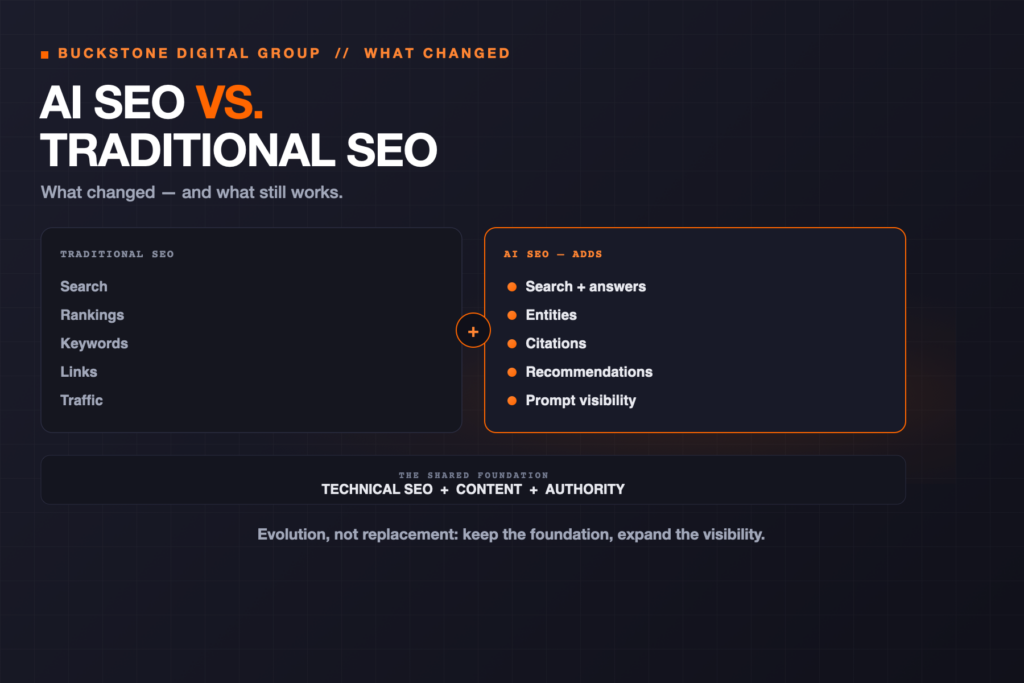
AI SEO does not replace traditional SEO. It expands it. The same technical and content foundations still matter—what changed is where visibility happens, how systems interpret a business, and how success is measured.
If you want the bigger-picture argument first, we made it in is SEO dead? This article answers the follow-up: what exactly changed between traditional SEO and AI-era SEO—and what still works exactly as it did.
Key takeaways
AI SEO vs. traditional SEO, in one panel
- Traditional SEO remains foundational.
- AI SEO adds new visibility surfaces rather than replacing Google Search.
- Crawlability, indexability, content, internal links, and authority still matter.
- Keywords still matter—but entity and topic relationships matter too.
- Backlinks still matter—but external corroboration now deserves explicit attention.
- Structured data clarifies information; it is not an AI ranking shortcut.
- Content needs more evidence and originality as generic information becomes trivial to produce.
- Rankings still matter but no longer capture the complete picture.
- AI SEO adds citations, mentions, recommendations, prompt coverage, accuracy, and share of voice.
- Visibility can influence a buyer before a website click.
- SEO and AEO should be coordinated, not siloed.
- BuckStone treats AI SEO as an expansion of search strategy, not a replacement for SEO fundamentals.
What is traditional SEO?
Traditional SEO is the practice of improving a website’s visibility across search engines through technical optimization, content, relevance, authority, user experience, and conversion. Done well, it has never been “keywords and links.” Strong modern SEO already spans crawlability, indexability, technical health, search intent, content quality, site architecture, internal linking, structured data, local search, conversion, and analytics.
Good SEO was never just keywords and links. The best version already optimized the whole system around a page.
What is AI SEO?
AI SEO is the extension of SEO into AI-driven search environments, where success can also mean being understood, retrieved, cited, mentioned, compared, or recommended inside a generated answer. It’s an informal industry term, not one official platform discipline—the same way “AI SEO agency” is a label, not a certification.
Traditional SEO asks: can the right page rank for the right search? AI SEO adds a second question: can the system understand the business, retrieve the right information, trust the supporting evidence, and surface it inside an answer? In practice that pulls in AI crawler access, entity clarity, structured data, author and publisher relationships, content depth, original evidence, corroboration, prompt monitoring, citation and recommendation tracking, AI referral traffic, and cross-platform visibility. BuckStone rolls all of it under one umbrella: AI Search Visibility.
Traditional SEO vs. AI SEO
These are differences in emphasis, not two separate disciplines. AI SEO is the left column plus a new layer—not a substitute for it.
| Traditional SEO | AI SEO |
|---|---|
| Search-engine rankings | Search + answer visibility |
| Keywords | Keywords + entities + topics |
| SERP placement | Citations, mentions, recommendations |
| Search queries | Queries + conversational prompts |
| Backlinks | Backlinks + broader corroboration |
| Organic traffic | Traffic + unclicked visibility |
| Domain/page relevance | Business/entity relevance |
| Search Console reporting | Search Console + prompt monitoring + AI referrals |
| Ranking competitors | Search + answer competitors |
| Page optimization | Page + entity + ecosystem optimization |
AI SEO audit
Is your SEO strategy built for the way search works now?
BuckStone can evaluate your traditional search foundation alongside AI visibility, crawler access, entity clarity, content, competitive citations, and measurement.
What has not changed
Before the new layer, it’s worth being clear about how much stayed exactly the same—because this is where most of the value still lives.
Technical SEO still matters. Crawlability, indexability, rendering, canonicals, redirects, sitemaps, internal linking, and site architecture are the foundation everything else depends on—covered in depth in technical SEO for AI search.
AI systems cannot reliably use information they cannot access.
Search intent still matters. You still have to understand what customers ask, what they need, and where they are in the buying journey. Content quality still matters—useful, specific, accurate content remains the point. Authority still matters—credibility still helps determine which sources deserve attention. And conversion still matters: visibility is worth little if the site can’t turn interest into leads, calls, bookings, or sales.
What changed
Six shifts account for most of the difference.
1. The interface changed. Users may meet AI Overviews, AI Mode, ChatGPT, Perplexity, conversational search, and generated comparisons before—or instead of—clicking a traditional result.
2. Visibility can happen without a click. A business can be cited, mentioned, compared, or recommended without receiving immediate traffic.
3. The business entity matters more explicitly. Systems increasingly need to resolve the organization, its leaders, authors, products, services, locations, industries, and relationships—the work of entity SEO and how AI systems understand your business.
4. External corroboration deserves more attention. Reviews, industry profiles, partner pages, client case studies, associations, publications, and independent mentions reinforce what a business claims about itself.
5. Content needs more differentiation. Generic summaries are easier than ever to produce, so value shifts to original research, case studies, first-party data, expert judgment, product specifics, and real experience. (We’ll go deeper on this in a companion piece on why generic SEO content fails in AI search.)
6. Measurement changed. Rankings, impressions, clicks, and sessions are joined by citations, mentions, recommendations, prompt coverage, accuracy, share of voice, AI referral traffic, and Google’s generative-AI Search Console reporting.
Do keywords still matter in AI SEO?
Yes. Keywords still represent language and demand—the words customers actually use. What’s new is that AI systems also connect topics, entities, relationships, context, and intent around those words.
AI search did not make keywords irrelevant. It made keyword-only thinking less complete.
Do backlinks still matter?
Yes. Links remain important across traditional search—they support discovery, authority, and relevance. AI-era visibility simply makes a broader set of external signals worth tracking alongside them: reviews, industry mentions, associations, partner pages, client evidence, and professional profiles.
Links still matter. They are no longer the only external signal worth understanding.
Does structured data matter more for AI SEO?
Structured data helps clarify entities and page relationships, and it’s useful for both SEO and AI-era clarity. But it isn’t a shortcut to citations: there is no universal “AI schema,” and visible content still carries the meaning. We cover the limits in can structured data help your business appear in AI search?
Entity SEO is the biggest practical shift. Before a system can usefully recommend a business, it often needs to know which company, service, location, expert, product, and industry it’s dealing with.
AI search raises the importance of making the business itself understandable—not merely optimizing individual pages.
The old SEO funnel vs. the AI search journey
The classic path was a straight line. The emerging one loops between traditional and AI search several times before a decision.
Picture a B2B buyer researching a manufacturer: they ask an assistant for options, see a few names cited, compare two on a review site, run a branded Google search on the shortlist, then land on a service page. Traditional and AI search both shaped that decision.
How AI SEO changes reporting
The reporting shift is the clearest signal of whether a program has actually adapted. AI-era reporting keeps everything traditional reporting had—and adds a visibility layer on top.
Traditional SEO report
- Organic visibility & rankings
- Impressions & clicks
- Organic traffic
- Leads & conversions
AI-era search report (adds)
- Prompt set & citation coverage
- Mention & recommendation coverage
- Competitor share of voice & accuracy
- Source analysis & AI referral traffic
- Generative AI search performance
- Conversion influence
If your reporting is still only the left column, the strategy behind it probably hasn’t changed either. The fuller model is in how to measure AI Search Visibility.
What a modern SEO program should include
Put together, a current program isn’t “SEO plus a ChatGPT report.” It’s a coordinated system across foundation, signals, and proof.
Foundation
- Technical SEO & crawler access
- Search demand & intent
- Internal linking & architecture
- Conversion
Signals
- Entity clarity & structured data
- Content & evidence
- External authority & corroboration
- Platform-specific AI visibility
Proof
- Competitive monitoring across search and answer engines
- Measurement from rankings through citations to leads and revenue
Modern SEO is not traditional SEO plus a ChatGPT report. It is a broader system for earning visibility across the entire search ecosystem.
How to know if your SEO agency is adapting
Bring these questions to your current partner. A modern search strategy should have concrete answers to each.
Visibility & competitors
- Are we monitoring AI visibility?
- Which prompts matter for our business?
- Are we tracking citations and recommendations?
- Are we monitoring competitors across AI platforms?
Foundation & entities
- Have you reviewed AI crawler access?
- How are our Organization and Person entities structured?
- Are case studies connected to relevant services and industries?
- What content can competitors not easily reproduce?
Measurement & delivery
- Are we tracking Google’s generative-AI performance and grouping AI referral traffic?
- How does our external corroboration compare with competitors?
- What AEO work is being implemented—not just monitored?
Evolve before it’s late
Your search strategy should evolve before your reporting tells you it’s too late.
BuckStone combines technical SEO, AEO, structured data, entity optimization, content, AI visibility monitoring, website implementation, and conversion measurement.
Should you hire an AI SEO agency or a traditional SEO agency?
Don’t chase a trendy specialist by default. Choose the agency with the deepest search capability and the clearest plan for adapting it to AI-driven discovery. A strong partner should understand traditional SEO, technical SEO, AEO, entity SEO, structured data, content, authority, AI visibility, analytics, conversion, and implementation. If you’re actively comparing firms, our guide to how to choose an AEO agency is the full checklist.
The label matters less than whether the agency can do the work.
How BuckStone approaches AI SEO
We didn’t discard traditional SEO—we expanded it. Our work already included technical SEO, crawlability, indexation, structured data, entity relationships, internal linking, site architecture, content strategy, local SEO, analytics, and conversion. As AI-driven discovery grew, we added AI crawler audits, prompt monitoring, citation and recommendation tracking, competitive AI visibility, AI referral analysis, generative-AI search reporting, and accuracy monitoring. That search work sits inside a broader growth system—website development, paid media, and ecommerce and marketplace growth—so visibility connects to revenue, not just reports.
The foundation stayed. The visibility model expanded. BuckStone optimizes for search as it exists now, not for a frozen version of Google from five years ago.
Whatever the interface, the work maps to five layers—the framework behind our SEO and answer-engine visibility work alike.
The framework
One system, five layers
Access
Can search and AI systems retrieve the information—the domain of technical SEO and crawler access?
Understanding
Can they identify the business, its people, services, and relationships—entities and structured data?
Evidence
Does the site support its claims with specific, original content?
Corroboration
Does the wider web—reviews, profiles, press—reinforce them?
Measurement
Is visibility improving across rankings, citations, mentions, recommendations, traffic, leads, and revenue?
Final answer: AI SEO or traditional SEO?
Businesses don’t need to choose. Traditional SEO remains foundational; AI SEO expands the strategy so the business can compete across Google Search, AI Overviews, AI Mode, ChatGPT, Perplexity, and whatever answer surface comes next. If your business is missing from those answers today, start with why your business isn’t appearing in AI search results.
The future of SEO is not less SEO. It is a broader definition of what search visibility means.
Keep what works
Keep what works. Expand for what changed.
BuckStone helps established businesses compete across traditional Google Search and the growing ecosystem of AI-driven search and answer experiences.
Frequently asked questions
What is traditional SEO?
Traditional SEO improves a website’s visibility across search engines through technical optimization, content, relevance, authority, user experience, and conversion. Done well, it has always included far more than keywords and links.
What is AI SEO?
AI SEO extends SEO into AI-driven search, where success can also mean being understood, retrieved, cited, mentioned, compared, or recommended inside a generated answer. It’s an informal industry term, not one official platform discipline.
What is the difference between AI SEO and traditional SEO?
Traditional SEO optimizes for search-engine visibility; AI SEO expands that toward business understanding, retrieval, citation, comparison, and recommendation across answer engines. The foundations are shared—AI SEO adds a new visibility and measurement layer.
Does AI SEO replace SEO?
No. AI SEO is traditional SEO expanded for AI-driven search. Crawlability, content, and authority still matter—answer engines rely on them.
Do keywords still matter for AI SEO?
Yes. Keywords still represent language and demand. AI systems also connect topics, entities, relationships, and intent—so keyword-only thinking is less complete, not irrelevant.
Do backlinks still matter for AI search?
Yes. Links support discovery, authority, and relevance in traditional search. AI-era visibility adds a broader set of external signals—reviews, mentions, associations, profiles—worth tracking alongside links.
Does technical SEO still matter?
More than ever. Access and rendering come before answers—AI systems can’t reliably use pages they can’t crawl, render, or index.
Does structured data help AI SEO?
It helps clarify entities and relationships and keep information consistent, but it isn’t a shortcut to citations. There’s no universal AI schema, and visible content still carries the meaning.
What is entity SEO?
Entity SEO makes the business itself—organization, people, services, products, locations, and relationships—clear and consistent so systems can confidently identify and describe it, which matters more in answer-driven search.
What is AEO?
Answer Engine Optimization is the practice of improving how a business and its information are understood, retrieved, cited, compared, and recommended across answer-driven search experiences like AI Overviews, ChatGPT, and Perplexity.
What is the difference between AEO and AI SEO?
AI SEO is the broader practical evolution of SEO; AEO describes the answer-engine visibility component within that evolution. In practice they overlap heavily.
What is GEO?
Generative Engine Optimization (GEO) is another evolving industry term for improving visibility in AI-generated answers. Like AEO and “AI SEO,” it describes work within the same shift rather than a separate discipline.
Is GEO the same as AI SEO?
They’re largely overlapping terms. BuckStone uses AI Search Visibility as the umbrella because the business objective—being found, understood, and recommended—matters more than the acronym.
Do I need AI SEO if I already have SEO?
If customers are starting to research you through AI answers, yes—but as an extension of your SEO, not a separate program. The foundation you already have is what AI visibility builds on.
What should an AI SEO strategy include?
Technical foundation and crawler access, search demand and intent, entity clarity and structured data, content and evidence, external corroboration, platform-specific AI visibility, competitive monitoring, conversion, and measurement.
How do you measure AI SEO?
Keep rankings, impressions, clicks, and conversions—then add citations, mentions, recommendations, prompt coverage, accuracy, competitor share of voice, AI referral traffic, and generative-AI Search Console data.
Are rankings still important?
Yes—they still signal relevance and competitiveness. They just no longer capture AI citations, recommendations, or answer-engine presence, so they’re part of the picture, not the whole report.
How do you track ChatGPT visibility?
By testing a defined set of commercially important prompts and recording whether your business is mentioned, cited, or recommended, how accurately it’s described, and monitoring ChatGPT referral traffic where it appears.
How do you track Google AI Overview visibility?
Through a mix of prompt/query testing and Google’s generative-AI Search Console reporting, which currently shows impressions for AI features—combined with monitoring which of your pages are cited.
How do you track Perplexity visibility?
By testing relevant prompts and recording citations and links to your site, checking accuracy, and monitoring Perplexity referral traffic. PerplexityBot surfaces and links sites; controls differ from Google’s.
Should my current SEO agency offer AEO?
Ideally the same partner handles both, because the disciplines share infrastructure. What matters is whether the agency demonstrates real AI-search capability—not whether it has added “AEO” to a menu.
How do I know whether my SEO agency is adapting to AI?
Ask whether it monitors AI visibility and competitors, tracks citations and recommendations, has reviewed crawler access, structures your entities, and implements AEO work—not just reports rankings. Vague answers are the tell.
Should I hire an AI SEO agency?
Hire the partner with the deepest search capability and the clearest plan for adapting it to AI-driven discovery. The label matters less than whether they can do the work across strategy and implementation.
How much does AI SEO cost?
There’s no universal price. It depends on site size, competition, technical condition, content and entity needs, monitoring scope, and how much implementation is included—from scoped audits to ongoing SEO + AEO retainers.
How long does AI SEO take?
Timelines vary and can’t be guaranteed. Technical corrections can begin immediately; measurable visibility changes take longer and differ by platform, depending on authority, competition, and content depth.
Can AI SEO guarantee citations or recommendations?
No. Any agency guaranteeing AI citations, rankings, or recommendations is a red flag. A credible partner improves the conditions for visibility and measures progress—without claiming to control platform behavior it can’t control.
Sources & methodology
This piece distinguishes documented platform behavior from BuckStone’s strategy, industry terminology, and professional judgment. Platform-specific statements—that Google’s AI Overviews and AI Mode draw on Google Search systems and cite sources; that Google states structured data isn’t required for AI features and that Search doesn’t use llms.txt; that Google’s generative-AI Search Console reporting currently shows impressions; and the roles of Googlebot, OAI-SearchBot/GPTBot, and PerplexityBot/Perplexity-User—were checked against current official Google Search Central, OpenAI, and Perplexity documentation and Schema.org. AI SEO, AEO, and GEO are evolving industry terms with no single official definition. We avoid quantitative claims about AI adoption, traffic decline, CTR reduction, ranking correlations, or citation rates, because those figures shift quickly and are easy to misrepresent. No fabricated statistics, metrics, or client results appear in this article.