
You ask ChatGPT to recommend a company that provides your service. Your competitors appear. Your company does not.
You try a similar question in Google AI Mode or Perplexity. The result is the same.
Perhaps the platform names companies that seem less experienced, less specialized, or less qualified than yours. Maybe it describes your business inaccurately. It might cite one of your articles without mentioning your company as a provider—or ignore you completely.
That can be frustrating, especially when your business has:
- Years of real experience
- Strong client relationships
- A professionally designed website
- Good Google rankings
- Positive reviews
- Established subject-matter expertise
- Services that clearly match the question
The natural reaction is to ask:
Why is AI recommending our competitors instead of us?
There is rarely one universal answer.
Your website may be inaccessible to a relevant crawler. Your pages may not be indexed. Your company may be described too vaguely. Your service coverage may be too shallow. Other websites may provide little independent support for your claims.
Or your business may already have some AI visibility—but the way you are testing it fails to capture that visibility accurately.
AI Search Visibility is not controlled by one tag, one schema property, one directory, or one “ranking factor.”
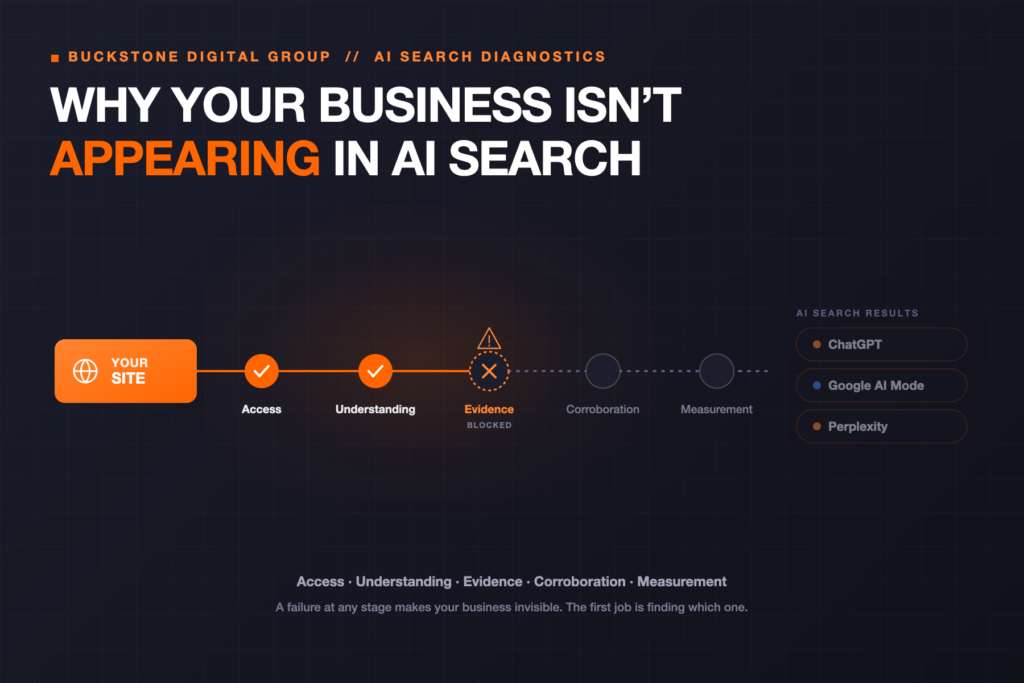
A company must move through several stages before it can become part of an AI-generated recommendation:
- The information must be accessible.
- The business must be understood.
- Relevant evidence must exist.
- Credible sources must support it.
- The business must genuinely fit the user’s question.
- The system must select it for that particular response.
- The company must measure the result correctly.
A failure at any stage can make the business appear invisible. This guide explains how to diagnose the problem—and what to improve. It is the diagnostic companion to our broader pillar on what AI Search Visibility means.
First, define what “not appearing” actually means
Businesses often describe themselves as completely absent from AI search when the reality is more complicated.
Your company may be:
- Absent from a recommendation list
- Mentioned but not linked
- Cited as a source without being named as a provider
- Visible for branded questions but not non-branded discovery
- Visible for one service but not another
- Visible nationally but not locally
- Visible in Google AI Mode but not ChatGPT
- Visible in one prompt variation but not another
- Described inaccurately
- Appearing behind competitors
- Receiving AI referral traffic that is not being recognized
- Influencing an answer indirectly through another source
These outcomes require different solutions.
Absence
The business does not appear in the answer or citations.
Inaccurate representation
The company appears, but its services, locations, leadership, or specialty are described incorrectly. That is a presence-with-wrong-information problem with its own correction process.
Weak association
The brand is known, but not connected to the service or industry relevant to the prompt.
Citation without recommendation
The website supplies useful information, but the company is not presented as the provider the user should consider.
Inconsistent visibility
The company appears in some platforms, prompts, or locations but not others.
Measurement failure
Visibility exists, but analytics, prompt testing, or reporting does not detect it.
Before changing the website, determine which problem you are actually trying to solve.
AI visibility is a sequence—not one ranking
The phrase “AI ranking” oversimplifies how visibility can occur. A page or company may pass through several distinct stages.
The AI visibility sequence
Nine stages — a failure at any one makes you invisible
Accessible
The relevant platform or search engine can reach the content.
Indexed or retrievable
The information is available within an index, retrieval system, cache, or searchable source environment.
Understood
The system can identify the company, services, products, people, locations, and subject relationships.
Considered relevant
The information appears useful for the user’s specific question.
Used as evidence
Information from the page helps support the response.
Cited
The response links to or visibly attributes the source.
Mentioned
The company or brand is named.
Compared
The business is evaluated alongside alternatives.
Recommended
The company is presented as a potentially suitable choice for the particular need.
A company can succeed at an early stage and fail at a later one. For example:
OAI-SearchBotmay access the website, but ChatGPT may never select its content.- Google may index the page, but AI Mode may find another source more useful.
- Perplexity may cite an article, but not recommend the company that published it.
- An AI response may mention the brand but misunderstand its current services.
- The company may be recommended for traditional SEO but not AI Search Visibility.
This is why there is no one-step fix.
Not sure where your visibility is breaking down?
Find the exact stage where your business goes invisible
BuckStone can evaluate whether the problem begins with crawler access, indexation, entity clarity, content evidence, third-party authority, or measurement.
BuckStone’s diagnostic framework
BuckStone evaluates AI Search Visibility through five connected areas. Most AI visibility failures can be traced to one or more of them.
BuckStone’s AI Search Visibility Framework
Five areas — and how each one fails
Can search and AI systems retrieve the information? Failure looks like: a firewall or CDN blocks a crawler that robots.txt appears to allow. Our guide to whether your website is blocking AI crawlers covers exactly this.
Can they clearly identify the business and its relevance? Failure looks like: a homepage that never states the company’s category, services, or market.
Has the company published useful information supporting its expertise? Failure looks like: generic blog posts that add nothing worth retrieving or citing.
Do credible outside sources reinforce the company’s claims? Failure looks like: a strong real-world reputation that barely exists beyond the company’s own site.
Is visibility being tested and attributed correctly? Failure looks like: judging visibility from one prompt, or missing AI referral traffic in analytics.
Access problems
1. A relevant crawler cannot access your website
A website can appear perfectly normal to a human visitor while blocking search or AI crawlers. Possible barriers include:
- Robots.txt rules
- Meta robots directives
X-Robots-Tagheaders- CDN bot protection
- Firewall restrictions
- Security plugins
- Rate limiting
- IP blocking
- Server errors
- Authentication requirements
- Staging-site settings
- JavaScript rendering problems
- Consent systems
- Incorrect HTTP responses
- Pages accessible only after submitting a form
Different platforms use different crawlers and systems. Examples include:
- Googlebot for Google Search
OAI-SearchBotfor ChatGPT Search eligibilityPerplexityBotfor Perplexity search visibility- Bingbot for Bing and Microsoft search environments
Allowing Googlebot does not automatically mean OpenAI or Perplexity can access the website.
Robots.txt may not be the only barrier
A robots.txt file can explicitly allow a crawler while a firewall or CDN blocks its requests. That creates a misleading situation:
- The published rule says access is allowed.
- The server never successfully delivers the page.
A proper audit should examine robots.txt, response codes, server logs, CDN events, security tools, published crawler IP ranges, rendering, and fetch behavior. Do not assume that an apparently permissive robots.txt file proves successful access.
Access is eligibility—not visibility
Fixing crawler access removes a barrier. It does not guarantee that the page will be selected, cited, or that the company will be recommended.
2. Important pages are not indexed or retrievable
Google’s generative search features rely on content available through Google Search. A page generally needs to be indexed and eligible to appear in Search with a snippet before Google can use it as supporting content within AI Mode or AI Overviews. For the Google-specific diagnostic, see why your business isn’t showing up in Google AI Overviews. Common indexation problems include:
- Accidental
noindex - Incorrect canonical tags
- Duplicate pages
- Weak or missing internal links
- Orphaned pages
- Redirect chains
- Soft 404s
- Server errors
- Low-value or substantially duplicate content
- Sitemap conflicts
- Pages created but never linked
- JavaScript rendering failures
- Staging URLs selected as canonical
- Parameter or faceted-navigation duplication
Use Google Search Console to inspect the pages that represent core services, products, industries, locations, case studies, expertise, leadership, and high-value informational topics. A company cannot expect to become visible for a service when the primary page explaining that service is not reliably indexed.
3. Your website architecture hides important information
A page may technically exist but remain difficult to discover or interpret. Common architecture problems include:
- Core services buried several clicks deep
- Articles that never link to commercial pages
- No relationship between services and industries
- Case studies disconnected from relevant capabilities
- Author pages disconnected from their articles
- Location pages isolated from Local SEO signals
- Important pages absent from navigation and internal links
- Duplicate pages competing for the same topic
- Generic anchors such as “learn more” everywhere
- No clear topical hierarchy
Good internal architecture helps search systems understand which pages are important, how subjects relate, which content supports a service, which person wrote or reviewed the material, which case studies provide evidence, which industries a service applies to, and which pages should be retrieved for different questions. The solution is not to link every page to every other page. It is to create clear, purposeful relationships—a core part of sound website architecture.
Understanding problems
4. Your website never clearly explains what your company does
Many business websites prioritize branding language over information. They say:
- Building tomorrow
- Solutions that move business forward
- Your partner for innovation
- Strategy without limits
- Transforming possibilities into progress
These statements sound polished but do not clearly establish the company’s category, services, products, customers, industries, geographic market, specialty, or differentiators.
An AI system should not have to infer that:
- You are an SEO agency because one page mentions search rankings.
- You serve manufacturers because several factory logos appear in a carousel.
- You provide nationwide service because your customers happen to operate in multiple states.
- You specialize in construction debt because one case study mentions a contractor.
- You provide AI Search Visibility because a blog category includes the phrase.
Important facts should be stated explicitly. A clear company description might identify official name, business type, primary services, primary audience, industries served, geographic reach, core expertise, and differentiation. Clarity is not keyword stuffing. It is accurate communication.
5. The relevant service is barely represented
A company may offer a service in practice but provide almost no public information about it. For example, it may claim to provide AI Search Visibility but have:
- One sentence on the homepage
- No dedicated service page
- No methodology
- No supporting articles
- No case studies
- No author expertise
- No description of deliverables
- No measurement framework
- No explanation of how it differs from ordinary SEO
That gives search systems little reason to associate the business strongly with the service. Meaningful service coverage may require a substantial service page, supporting educational articles, a clearly described methodology, relevant leadership or author expertise, case studies or examples, FAQs, related industry applications, measurement information, appropriate internal links, and independent corroboration. The goal is not to manufacture dozens of pages. It is to provide enough real information to support the association.
6. Your entity information is inconsistent
A business entity becomes harder to resolve when public information conflicts. Common inconsistencies include:
- Different company names
- Former addresses
- Multiple phone numbers
- Conflicting descriptions
- Old leadership profiles
- Incorrect founding dates
- Abandoned social accounts
- Duplicate directory listings
- Conflicting business categories
- Old domains
- Former services still presented as current
- Different geographic markets across profiles
- Leadership names not connected to the company
- Schema that contradicts visible content
Review your website, Google Business Profile, Bing Places, LinkedIn, industry directories, review platforms, association pages, social profiles, partner sites, press coverage, old domains, Organization schema, and Person schema. Minor wording variations are normal. Material contradictions create confusion.
7. Your structured data is incomplete, inaccurate, or disconnected
Structured data can help clarify organizations, people, articles, products, locations, and page relationships. Problems arise when:
- Every page creates a new Organization entity
- Author Person nodes are duplicated
sameAspoints to outdated or unrelated profiles- Leadership roles are unsupported by visible content
- LocalBusiness data conflicts with the website
- Product data does not match the visible offer
- Schema references staging domains
- Article authors are represented as the Organization
- FAQ schema does not match visible questions
- The site uses unsupported invented “AI schema”
Structured data should reinforce a coherent entity system. It cannot compensate for weak content or authority. Our guide to entity SEO explains how to build that coherent system. Google also states that no special schema type is required for its generative search features. Use structured data to describe reality—not create a fictional version of the business.
Evidence problems
8. Your content is generic
Generic content may be technically optimized and still provide little useful evidence. Examples include:
- Five benefits of SEO
- Why digital marketing matters
- Ten trends to watch
- What makes a great company
- The ultimate guide to business growth
- Reasons to hire an expert
These topics are not inherently useless. The problem is that many versions contribute no original analysis, first-party experience, data, examples, methodology, case studies, comparison criteria, technical detail, defensible point of view, or new information. AI search systems can summarize common knowledge without relying on another interchangeable article.
Content becomes more useful when it contains something worth retrieving. That may include original research, first-party data, detailed case studies, technical documentation, practical frameworks, product specifications, cost guidance, industry benchmarks, diagnostic steps, tested methods, expert analysis, specific examples, clearly explained tradeoffs, and useful visual assets. The objective is not simply to publish more. It is to publish stronger evidence.
9. Your content does not answer the questions customers actually ask
Traditional keyword research can miss the complexity of real buying decisions. A company may target:
Keywordindustrial SEO
But a potential customer may ask:
“Which SEO agencies understand long industrial sales cycles, technical product catalogs, distributor relationships, and non-branded demand generation?”
The second question includes several criteria. A company hoping to appear must provide enough information to support those associations. Review whether your content answers:
- Who is the service for?
- What problems does it solve?
- What makes the process different?
- What experience supports the claim?
- What does the engagement include?
- How is success measured?
- What limitations exist?
- Which industries and use cases apply?
- How does the company compare with alternatives?
- What should a buyer evaluate?
Do not create one page for every possible prompt. Build complete subject coverage around genuine customer decisions.
10. Your website makes claims without proof
Businesses frequently use language such as leading provider, industry expert, best-in-class, proven results, trusted partner, award-winning, or unmatched service. Those claims become more meaningful when supported by:
- Case studies
- Performance data
- Customer reviews
- Named methodologies
- Technical expertise
- Relevant experience
- Certifications where real
- Client examples
- Product documentation
- Expert authorship
- Independent coverage
A site containing only promotional claims gives people and machines little basis for evaluation. Show how the expertise is applied—which is exactly what a set of real case studies is for.
11. Your authors and experts are invisible
Strong content may be published without clearly identifying who created or reviewed it. Common problems include:
- No author byline
- Generic “admin” author
- No author profile
- Thin biography
- No relationship to the company
- No relevant expertise described
- No professional profiles
- Multiple disconnected Person entities
- An author archive that does not work
- Articles attributed to the wrong person
A useful author system can include a real name, current role, relevant biography, areas of expertise, profile image, article archive, professional profile links, stable Person schema, relationship to the Organization, and visible authorship on articles. Do not invent credentials. Make real expertise easier to identify and verify.
Corroboration problems
12. The wider web provides little evidence about your business
A company’s website is not the only source that may influence how it is understood. Third-party corroboration can come from customer reviews, client websites, industry publications, professional associations, local media, trade organizations, partner profiles, podcasts, conferences, product databases, vendor directories, independent comparisons, relevant community sources, and expert citations.
These sources can reinforce the connection between the business and its services, products, industries, locations, leadership, expertise, customers, and reputation. A business can be excellent in the real world but digitally invisible beyond its own site. That creates an authority gap.
13. Your reviews are weak, incomplete, or unrelated to the relevant service
Reviews can help establish customer experience, service quality, location, product use, business category, specialization, and reputation. But the value of review information depends on context. Possible problems include:
- Very few reviews
- Reviews on irrelevant platforms
- Reviews that mention only generic satisfaction
- Conflicting business profiles
- An outdated location
- Reviews tied to a former brand
- No responses to inaccurate information
- Strong reviews for one service but none for the service being evaluated
Do not manufacture reviews or incentivize dishonest feedback. Build a consistent process for earning legitimate feedback from actual customers. For location-based businesses, that process is inseparable from strong Local SEO.
14. Your competitors are easier to verify
A competitor may appear more frequently not because it is objectively better, but because more accessible evidence exists. Its website may offer:
- Clearer service descriptions
- Better industry pages
- More case studies
- More detailed authorship
- Stronger reviews
- Better product information
- More relevant third-party mentions
- More consistent entity data
- Better internal architecture
- More current content
- Stronger local signals
- More useful original resources
AI visibility is partly an information-availability problem. If the public evidence overwhelmingly describes one competitor and barely describes your company, the competitor may be easier to surface.
15. You pursued low-quality mentions instead of real authority
Responding to AI search by purchasing hundreds of directory placements is not a durable strategy. Low-quality tactics can include irrelevant directories, paid placement networks, fake forum discussions, repeated press-release syndication, manufactured reviews, copied profile descriptions, unrelated guest posts, and artificial brand mentions.
Google explicitly advises against seeking inauthentic mentions as a generative-search tactic. Prioritize sources that are relevant, credible, accurate, maintained, independent, useful to customers, and connected to real work.
Relevance problems
16. Your business is not the right match for the prompt
Not every absence is an optimization failure. A user might request a local freelancer, a company within a certain budget, a provider with a particular certification, a product available immediately, a specialist in a narrow industry, a firm located in a particular city, a company serving enterprise clients, or a provider with a specific integration.
Your company may not match those criteria. Do not evaluate success by whether the brand appears for every loosely related question. Prioritize prompts that reflect real services, real locations, real customers, real expertise, and real buying situations. The goal is relevant visibility—not maximum mention volume.
17. The prompt is too broad
A prompt such as:
Too broadWhat is the best marketing agency?
provides almost no useful selection criteria. The response may vary significantly and favor widely known brands, publications, directories, or companies with broad recognition. More meaningful prompts include:
- Recommend an SEO agency for an industrial manufacturer.
- Which agencies provide technical SEO and AI Search Visibility?
- Who helps multi-location businesses improve Local SEO?
- Which digital marketing companies understand long B2B sales cycles?
- What firm can audit why my company is absent from ChatGPT and Google AI Mode?
Measure the questions your customers might genuinely ask.
18. The platform used different context than you expected
Responses can change based on user location, conversation history, prompt wording, search availability, date, current sources, product experience, requested criteria, model behavior, and whether the question is informational or commercial. One answer is not a permanent universal ranking. It is one response generated under one set of conditions.
Measurement problems
19. You tested one prompt once
This is the most common measurement mistake. Our guide to measuring AI search visibility shows how to test and attribute it properly. A business owner asks one question, does not see the brand, and concludes:
Faulty conclusionWe do not rank in ChatGPT.
A meaningful test requires a controlled prompt set. Prompts should be segmented by service, product, industry, location, customer problem, comparison, buying stage, brand awareness, and informational versus commercial intent. Record whether the business appears, where it appears, how it is described, whether it is cited, which page is cited, which competitors appear, which external sources influence the response, whether the description is accurate, whether the result changes by platform, and whether the result changes over time.
20. You are looking only for a recommendation
AI visibility can produce value before a direct recommendation occurs. Possible outcomes include your article being cited, your case study supporting an answer, your company being mentioned as an example, your service page receiving referral traffic, a user learning your brand name and later searching Google, an AI response influencing a later direct visit, your company being included in a comparison, or your content shaping the criteria used to evaluate providers.
Track mentions, citations, referral sessions, assisted conversions, branded search changes, landing pages, lead-source responses, and sales conversations. Recommendation visibility matters, but it is not the only valuable outcome.
21. Your analytics are not identifying AI referral traffic
AI referral sessions may be grouped incorrectly or overlooked. Review source and medium, referral domains, landing pages, custom channel groups, referral exclusions, UTM parameters, conversion paths, assisted conversions, and server logs.
OpenAI states that ChatGPT Search referral URLs include utm_source=chatgpt.com, which can support analytics tracking. Other platforms may appear through different referral patterns. Create a documented method rather than assuming every AI visit will appear inside one default channel.
22. You are not using Google’s generative AI reporting
Google Search Console now provides dedicated generative AI performance reporting covering visibility from features such as AI Mode, AI Overviews, and generative experiences in Discover. Use the reporting to evaluate impressions, clicks, landing pages, topics, trends, geographic differences, device differences, and the relationship to overall organic visibility.
Connect that information to analytics, conversions, lead quality, revenue, and traditional Search performance. Google’s reporting can reveal visibility that manual prompt testing alone would miss.
23. You have no baseline
A business cannot reliably determine improvement without recording the starting point. An AI visibility baseline should include priority platforms, priority prompt groups, current mentions, current citations, competitors appearing, description accuracy, AI referral traffic, Google generative-search performance, technical crawler access, indexed priority pages, current third-party authority, and conversion activity. Without a baseline, every change feels anecdotal.
Why traditional SEO success does not guarantee AI recommendations
Traditional organic visibility and AI recommendation visibility overlap, but they are not identical. A company may rank strongly because a particular page satisfies a traditional query, its domain has authority, it has strong local signals, it has relevant links, and its content matches search intent.
An AI-generated recommendation may require additional context:
- Does the company match the requested industry?
- Is it appropriate for the user’s size or location?
- Do independent sources support the claim?
- Are relevant services explained?
- Is there evidence of experience?
- Can the system confidently compare it with alternatives?
- Is current information available?
Strong technical SEO creates an important foundation. It does not guarantee inclusion in every generated response.
Why citation does not always lead to recommendation
An article may be useful as a source without proving that the publisher should be hired. For example, an SEO agency might publish an excellent definition of structured data. An AI system may cite the article when explaining schema while recommending other companies for implementation.
To bridge that gap, the wider site should clearly establish that the company provides the service, how the service is delivered, who performs the work, which clients or use cases it supports, what evidence demonstrates capability, how to contact the company, and why the company is relevant to the specific buyer. Informational authority and commercial relevance should support one another. Our companion guides on getting recommended by ChatGPT and showing up in Google AI Mode go deeper on each platform.
A practical AI visibility diagnostic
Use the following questions as an initial self-assessment. If several answers are “no” or “we do not know,” the company does not need another isolated tactic—it needs a coordinated audit.
Access
- Can Googlebot access important pages?
- Can
OAI-SearchBotaccess the site? - Can
PerplexityBotaccess the site? - Are CDN or firewall rules blocking published crawler IP ranges?
- Are priority pages indexed?
- Are canonical tags correct?
- Is important content server-rendered and accessible?
Understanding
- Does the homepage clearly explain what the company does?
- Does each core service have a substantial page?
- Are industries and locations stated explicitly?
- Are leadership and authors identified?
- Is company information consistent?
- Does structured data use stable Organization and Person entities?
- Do internal links clarify subject relationships?
Evidence
- Does the site contain original or uniquely useful information?
- Are case studies available?
- Are methods and processes explained?
- Is the relevant expertise demonstrated?
- Does content answer real buying questions?
- Are important claims supported?
Corroboration
- Do credible third parties mention the company?
- Are reviews current and relevant?
- Are association and directory profiles accurate?
- Do client, partner, or industry sources support the company’s claims?
- Is the brand associated with the desired service outside its own website?
Measurement
- Is there a controlled prompt library?
- Are multiple platforms tested?
- Are mentions and citations tracked separately?
- Is AI referral traffic identified?
- Is Google’s generative-search performance reviewed?
- Are conversions connected to AI discovery?
- Is there a documented baseline?
Your business may not need more content. It may need the right diagnosis.
Pinpoint the specific barrier—then fix the right thing first
An AI Search Visibility Audit identifies the specific technical, content, entity, authority, and measurement barriers preventing your company from being found, cited, and recommended.
What should you fix first?
Do not begin by publishing 50 new articles. Prioritize the barrier closest to the beginning of the visibility sequence.
Fix access before content expansion
If crawlers cannot access or index the site, more content will not solve the problem.
Fix understanding before chasing authority
If the company’s own website does not clearly explain its services, outside mentions may reinforce an incomplete identity.
Build evidence before making more claims
If the site contains generic promotional copy, create resources that demonstrate actual expertise.
Strengthen corroboration after the foundation is clear
Earn relevant reviews, mentions, partnerships, listings, and citations that support accurate claims.
Establish measurement before declaring success
Record the baseline and define what improvement means. The correct order may vary, but random execution wastes time and money.
What will not fix the problem by itself?
The following tactics are not complete AI visibility strategies:
- Adding
llms.txt - Installing an AI SEO plugin
- Adding unsupported “AI schema”
- Repeating ChatGPT throughout the website
- Publishing hundreds of AI-generated articles
- Buying low-quality directory listings
- Prompting the brand repeatedly
- Adding dozens of generic FAQs
- Copying competitor content
- Tracking one prompt
- Renaming ordinary SEO work “GEO”
- Guaranteeing recommendations
Some tactics may have legitimate uses in a wider strategy. None replaces access, understanding, evidence, corroboration, relevance, and measurement.
How BuckStone identifies what is blocking AI visibility
BuckStone does not begin with a predetermined tactic. We investigate where the business is failing within the visibility sequence.
Technical access and indexation
We evaluate crawler access, robots directives, CDN and firewall behavior, server responses, rendering, canonicals, indexation, site architecture, and internal links.
Entity and business understanding
We evaluate company identity, services and products, industries, locations, leadership, authors, structured data, external profiles, and consistency.
Content evidence
We evaluate service depth, topical coverage, case studies, originality, expertise, customer questions, commercial relevance, and citation potential.
Third-party corroboration
We evaluate reviews, links, brand mentions, publications, associations, client and partner sources, directories, and reputation.
Visibility and measurement
We evaluate prompt groups, platforms, competitors, mentions, citations, referral traffic, Search Console reporting, conversion paths, and description accuracy.
The result is not a generic AI score. It is a prioritized diagnosis showing what is blocking visibility, what should be fixed first, and which improvements BuckStone can implement.
BuckStone does more than deliver an audit
Many audits identify problems and leave the client responsible for finding someone else to fix them. BuckStone can execute the work. Depending on the diagnosis, that may include:
- Technical SEO remediation
- Crawler-access corrections
- Website architecture
- Service and industry pages
- Content strategy
- Topical clusters
- Case studies
- Structured data
- Entity optimization
- Internal linking
- Author and leadership systems
- Local SEO
- Google Business Profile
- Product data
- Analytics
- Conversion tracking
- Authority development
- Ongoing AI visibility measurement
AI Search Visibility touches the entire digital ecosystem. That is why the solution often requires a team capable of working across the entire website rather than one isolated specialty—the coordinated approach behind our AI Search Visibility work.
Final answer: Why is your business not appearing in AI search?
Your business may be absent because:
- Relevant systems cannot access the website.
- Important pages are not indexed.
- The site does not clearly explain what the company does.
- Service coverage is too shallow.
- Entity information is inconsistent.
- Structured data is disconnected or inaccurate.
- Content provides weak evidence.
- Authors and expertise are unclear.
- Third-party corroboration is limited.
- Competitors are easier to verify.
- The business does not match the prompt.
- The prompt test is too broad or inconsistent.
- Analytics and reporting are missing existing visibility.
The problem cannot be diagnosed from one prompt alone. For the understanding layer specifically, see how AI systems understand your business. It requires evaluating technical access, company understanding, content evidence, external authority, relevance, and measurement as one connected system. That is what an AI Search Visibility audit should reveal.
Your next step
Stop guessing why competitors appear instead of you.
BuckStone evaluates and improves the complete system behind AI Search Visibility—from crawler access and technical SEO to content, entity optimization, structured data, authority, analytics, and implementation.
Frequently Asked Questions
Why does ChatGPT recommend my competitors instead of my business?
Competitors may have clearer service information, stronger content, more relevant reviews, better entity consistency, deeper third-party corroboration, or a website that is easier for OpenAI’s search systems to access. The cause should be diagnosed rather than assumed.
Can ChatGPT access my website?
OpenAI uses OAI-SearchBot for ChatGPT Search visibility. Access can be affected by robots.txt, server rules, published IP ranges, firewalls, CDNs, and security systems. Allowing access makes content eligible for consideration but does not guarantee citation or recommendation.
Why am I not appearing in Google AI Mode?
Priority pages may not be indexed, the content may not be competitive, the site may not cover the relevant customer decision deeply enough, or Google may select other supporting sources. Google says AI Mode remains rooted in its existing Search index and core ranking and quality systems.
Why is Perplexity not citing my website?
Perplexity may be unable to access the site, may not consider the page sufficiently relevant, or may find other sources better suited to the question. Perplexity recommends allowing PerplexityBot, but crawler access does not guarantee citation.
Can I rank well on Google and still be absent from AI search?
Yes. Traditional rankings support visibility, but AI-generated answers may evaluate broader context, retrieve multiple sources, compare providers, or require evidence beyond one keyword-focused page.
Does schema markup guarantee AI visibility?
No. Structured data can clarify entities and page information, but it does not guarantee that Google, ChatGPT, Perplexity, or another platform will cite or recommend a business.
Do I need an llms.txt file?
Google states that llms.txt is not required and does not improve Google Search visibility. Other tools may choose to use the file, but it is not a universal AI visibility solution.
How can I tell whether an AI crawler is blocked?
Review robots.txt, server responses, CDN logs, firewall events, security tools, and server logs. A crawler may be allowed in robots.txt but blocked elsewhere in the delivery stack.
How do I measure whether my business appears in AI search?
Use a controlled prompt library, citation and mention tracking, referral analytics, crawler logs, competitor comparisons, Google Search Console’s generative AI reporting, conversion tracking, and lead-source information.
What is an AI Search Visibility audit?
It is a coordinated evaluation of technical access, indexation, entity clarity, content evidence, structured data, third-party authority, platform visibility, competitors, analytics, and conversion paths.
How long does it take to improve AI visibility?
There is no universal timeline. Technical barriers may be fixed quickly, while building content evidence, entity clarity, authority, and competitive visibility may require sustained work over several months.
Can BuckStone guarantee that my business will be recommended?
No ethical agency can guarantee a particular answer from a third-party AI platform. BuckStone can identify and improve the conditions affecting accessibility, understanding, evidence, authority, relevance, and measurement.
Sources and Methodology
This guide relies on official platform documentation for every factual claim about how AI-driven search systems access, rank, and surface web content. Where a platform does not disclose the exact weighting of its systems or how it selects sources, the article says so rather than presenting speculation as confirmed fact, and it distinguishes documented platform statements from BuckStone’s strategic interpretation and practical diagnostic recommendations.
- Google Search Central — AI Features and Your Website. developers.google.com/search/docs/appearance/ai-features
- Google Search Central — Optimizing for Generative AI Features. developers.google.com/search/docs/fundamentals/ai-optimization-guide
- Google Search Central — How Google Search Works. developers.google.com/search/docs/fundamentals/how-search-works
- Google Search Central — Generative AI Performance Reports. developers.google.com/search/blog/2026/06/gen-ai-performance-reports
- Google Search Central — Guidance on Generative AI Content. developers.google.com/search/docs/fundamentals/using-gen-ai-content
- Google Search Central — Creating Helpful, Reliable, People-First Content. developers.google.com/search/docs/fundamentals/creating-helpful-content
- OpenAI — Publishers and Developers FAQ. help.openai.com/en/articles/12627856-publishers-and-developers-faq
- OpenAI — Overview of OpenAI Crawlers (
OAI-SearchBot,GPTBot,ChatGPT-User). platform.openai.com/docs/bots - Perplexity — Official Crawler Documentation (
PerplexityBot). docs.perplexity.ai/docs/resources/perplexity-crawlers
Methodology. BuckStone’s five-part AI Search Visibility framework—access, understanding, evidence, corroboration, and measurement—is applied in client engagements and refined through technical audits, controlled prompt testing across services, industries, geographies, and buying stages, and analysis of Search Console and referral data. Statements attributed to Google, OpenAI, and Perplexity reflect their publicly available guidance as of July 2026 and may change as those platforms update their products and policies. BuckStone does not have access to any platform’s private ranking or source-selection algorithms; where exact weighting is undisclosed, this article identifies the practical, observable factors a business can control rather than implying a guaranteed ranking formula.