
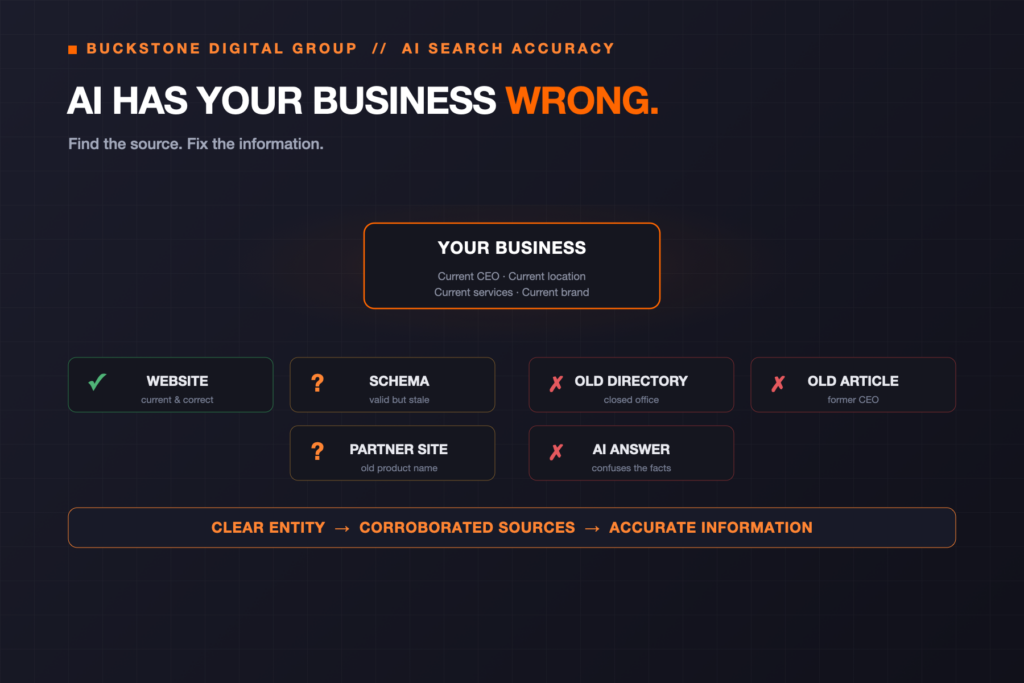
You ask ChatGPT, “What does [your company] do?” and it recognizes you — which is the good news. Then it gets the details wrong: it names a CEO who left two years ago, lists an office you closed, mentions a product you discontinued, puts you in the wrong industry, or blends you with a similarly named company. The instinct is immediate: “How do I tell ChatGPT this is wrong?”
That may not be the best first question. The better one is: where did the incorrect information come from, and why isn’t the correct information strong enough to replace it? AI business-information problems almost always originate upstream — in an inconsistent, outdated, or ambiguous information ecosystem — and the durable fix is to correct that ecosystem, not to argue with a single answer.
Incorrect AI answers are usually symptoms of a web that hasn’t caught up. If authoritative sources disagree about your business, AI systems have to decide which version to trust. The goal is not to correct one response — it’s to make the correct version of the business the easiest version to discover, understand, and verify across the web.
- There is no universal profile where a company edits its facts across every AI platform.
- Incorrect information can come from first-party or third-party sources — audit your own website first.
- Old pages, PDFs, schema, press releases, and bios can create conflicts.
- Rebrands, acquisitions, and similar company names are the biggest sources of entity confusion.
- Structured data must match visible content — it can be valid and still be factually wrong.
- Historically accurate information doesn’t need to be deleted; current reality needs to become unmistakable.
- Correcting one source doesn’t guarantee an immediate AI change, and different AI experiences use different information pathways.
- Each platform may need separate correction — a fix in one can stay wrong in another.
- Brand accuracy should be monitored systematically, not only when someone spots a bad screenshot.
- The durable fix is a clearer information ecosystem — consistency and evidence, not manipulation.
Why does ChatGPT have wrong information about my business?
ChatGPT may show incorrect or outdated business information when the public information surrounding a company is inconsistent, stale, ambiguous, or hard to verify. Depending on the specific ChatGPT experience, an answer may reflect current web retrieval, older model knowledge, the context of the conversation, or a combination — so a wrong answer isn’t necessarily proof that any single source is wrong; it can mean the web offers competing versions and the system picked one.
Where do AI systems get information about businesses?
The information ecosystem around a company can include its website, search indexes, news, directories, professional and social profiles, review platforms, marketplaces, customer and partner sites, associations, public documentation, structured data, and historical web content. Not every AI platform reads every source, and they don’t weight them the same way.
The strategic issue isn’t whether every AI system reads every website. It’s whether the web contains a clear, consistent, authoritative representation of the business — the premise behind how third-party sources influence AI recommendations.
10 common reasons AI has your business wrong
1. Your own website still contains outdated information
Sometimes the source of the “AI error” is sitting on the company’s own site — an old homepage or About line, a stale footer, team and product pages, old press releases, PDFs and media kits, or archived landing pages. Audit your own domain before blaming the model.
2. Structured data contradicts the visible website
The visible page says “Jane Smith, CEO” while the schema still names the previous CEO — or carries an old address, business name, or sameAs. Look for duplicate Organization or Person nodes and stale plugin/theme schema. Structured data can be technically valid and still be factually wrong (more on schema).
3. Third-party directories carry stale information
Google Business Profile, industry and professional directories, marketplaces, review platforms, and association listings may still show old facts. Prioritize the ones that matter rather than chasing every listing on the internet.
4. The business rebranded
A rebrand changes the company’s identity faster than it changes the web. The old name, domain, logos, social profiles, directory entries, press coverage, and customer mentions can linger for years. Where appropriate, state continuity explicitly (“formerly [Old Brand]”) — while planning to phase legacy wording out over time, not leave it forever.
5. The company merged or was acquired
Ownership, brand, products, executives, locations, and divisions all become ambiguous after a deal. Acquisitions create entity relationships that should be stated clearly instead of left for search systems to infer.
6. Another company has a similar name
Shared acronyms, product names, or founder names invite confusion. The less unique the name, the more explicit the disambiguation should be — full name, domain, geography, industry, leadership, and consistent descriptions across authoritative profiles.
7. Old products or services are still documented
A discontinued product, service, market, or division leaves references behind. Update the page, clearly label what’s discontinued, point to the replacement, or redirect when appropriate — without deleting genuinely useful history for no reason.
8. Leadership information is inconsistent
A former CEO, an old founder role, or a departed employee lingers across leadership pages, author bios, schema, professional profiles, press releases, and directories. The fix is to make the Person → Role → Organization relationship current and consistent everywhere it appears.
9. Geographic information is unclear
Headquarters, a physical office, a service area, and markets served are not interchangeable — but they’re often treated that way. An office that moved, a closed location, an expanded service area, or an outdated Google Business Profile can all produce a wrong “where.”
10. The AI may be relying on older knowledge
Here’s the nuance most guides skip: even if your current website is perfect, an answer may still reflect older information depending on the experience. Sometimes the web is correct and the AI answer is still stale. The response is the same — strengthen current authoritative information and use official feedback mechanisms where available — but don’t expect “update the site and ChatGPT changes tomorrow.”
The five layers of accuracy
The same framework behind AI Search Visibility applies directly to accuracy — accuracy improves when the entire digital information system increasingly agrees about what is true now.
- 1Access
Can systems retrieve the current information?
- 2Understanding
Is the company/entity unambiguous?
- 3Evidence
Does the website clearly establish what is true now?
- 4Corroboration
Do credible third parties reinforce the current information?
- 5Measurement
Are AI answers becoming more accurate over time?
The correction workflow: fix the source, not the screenshot
Before trying to correct the AI answer, find where the incorrect fact still exists on the web — then correct it at the source and make the current truth unmistakable.
- Trace the fact — search the wrong detail (e.g., “[old CEO]” “[company]”), including on your own domain, to find where it persists
- Audit your website — homepage, About, footer, team, products, services, locations, blog, press, PDFs, careers, legacy URLs
- Audit structured data — duplicate/stale
OrganizationandPersonnodes, wrong IDs, contradictory properties - Make the About page authoritative — who you are, what you do, who you serve, who leads, what brands you own, any rebrand or acquisition
- Fix high-value third-party sources first (relevance, credibility, prominence) — not every historical mention
- Preserve history, clarify the present — a 2019 article naming the old CEO can stay; the current CEO just needs to be unmistakable now
- Handle rebrands and acquisitions explicitly — “formerly [Old Brand]”; “[A] acquired [B] in 2025” — only when true
- Strengthen entity disambiguation — consistent name, domain, geography, leadership, and profiles
Entity SEO is partly the practice of reducing unnecessary ambiguity about who or what something is (entity SEO, and how AI systems understand your business). Make sure the current information is retrievable in the first place, too — crawlable and technically sound.
Can you directly edit what ChatGPT says about your company?
Not through a universal dashboard — there is no profile where a business edits its facts across AI platforms. OpenAI has publicly indicated it can’t simply edit a specific “fact” inside the model itself; it can filter or adjust outputs, not rewrite stored knowledge. ChatGPT does offer an in-product feedback control (the thumbs-down on a response) to flag and explain an error, which OpenAI reviews — but flagging doesn’t rewrite the answer on the spot or guarantee a change, and it doesn’t replace fixing the sources. So the reliable path is upstream: correct the information ChatGPT can retrieve and cite, strengthen the current authoritative version, and use official feedback where available. (These controls evolve — verify current OpenAI documentation.)
Does correcting ChatGPT in a conversation update it globally?
No. Correcting an answer inside a conversation may change the context of that conversation, but it doesn’t update the model’s knowledge, search results, or other users’ conversations. Correcting a conversation is not the same thing as correcting the information ecosystem.
What if ChatGPT cites the wrong source — or none at all?
Where a citation is visible, inspect it. If the cited source is wrong and you own it, correct it; if it’s a third party, request an appropriate factual correction where possible — then strengthen the current authoritative information so the better version is easier to find. Don’t expect instant re-citation or removal. Where there’s no citation, source-tracing is harder: compare the same question across multiple prompts, traditional Google search, Google’s AI experiences, and Perplexity, and look for the same wrong fact repeating. Repeated errors across multiple systems can be evidence that the ambiguity exists beyond one answer — a reasonable inference, not a certainty.
Fixing wrong information in Google AI and Perplexity
The principle is identical — correct the underlying web — but the mechanics differ, and each platform needs its own attention. For Google, that means fixing the underlying pages, ensuring they’re crawlable and indexable, using Search Console’s URL Inspection to request (re)indexing of updated pages, keeping structured data and Google Business Profile current, and using available feedback controls — there is no “edit the AI Overview” button. If the problem is absence rather than inaccuracy, see why your business isn’t showing up in Google AI Overviews. Google’s Search Console generative-AI performance reports (launched mid-2026) show impressions in AI Overviews and AI Mode but not clicks or prompts, so they help you monitor visibility, not edit answers. For Perplexity, where answers cite sources, inspect the citations, correct the ones you own, and pursue third-party updates where appropriate (how citations work in Perplexity). A fact corrected in one system can remain wrong in another for a while.
How long does it take — and why does wrong information come back?
There’s no universal timeframe. It depends on crawling and indexing, how many conflicting sources exist, whether the answer draws on live retrieval or older model knowledge, and how quickly third parties refresh. The website can change today; the entire information ecosystem may not synchronize today. And when errors return, it’s usually because old or conflicting sources remain, the entity is still ambiguous, or only one source was corrected — if the web still contains competing versions of the business, one fix may not resolve the underlying disagreement.
How to monitor whether AI has the correct information
Brand accuracy should be monitored systematically, not only when someone notices a bad screenshot. Test consistent prompt families — identity (“what is [company]?”), leadership (“who is CEO of [company]?”), products/services, geography (“where is [company] headquartered?”), brand relationships, and reputation — and record, for each, whether the answer is correct, partially correct, incorrect, outdated, or unsupported, along with the platform, prompt, date, and any cited source.
A simple matrix makes disagreements obvious. (Illustrative values below — not real data.)
| Fact | Website | ChatGPT | Google AI | Perplexity | Third parties | Status |
|---|---|---|---|---|---|---|
| Company name | Current | Current | Current | Old name | Mixed | Partial |
| CEO | Current | Former CEO | Current | Former CEO | Old bios | Incorrect |
| Headquarters | Current | Old address | Current | Unclear | Old listing | Outdated |
| Core services | Current | Current | Current | Current | Current | Correct |
| Parent/brand | Current | Unstated | Unstated | Unstated | Unstated | Unsupported |
The mechanics of repeatable measurement are in how to measure AI Search Visibility and AI rank tracking vs. Google rank tracking.
When the AI isn’t actually wrong
Sometimes an answer only looks incomplete. A company complains that AI associates it only with Service A — but its website is 90% Service A and barely mentions Service B. Or it says the company is “local” when the site documents only one market. Sometimes an AI answer looks incomplete because the business’s digital footprint is incomplete. That’s not a correction problem; it’s a visibility problem — and the fix is to build out the real, current representation of what the business does and where, the broader work of becoming recommendable.
Prioritizing corrections
Not every wording difference is a misinformation crisis. Fix the facts that materially affect how customers and search systems understand the business.
- Critical — wrong identity, ownership, address, services, products, or leadership
- High — commercially important ambiguity: service area, target market, product category, current capabilities
- Medium — outdated supporting context
- Low — minor wording differences that don’t materially change meaning
What not to do
Don’t create fake Wikipedia or Wikidata entries, fake profiles, press, awards, or reviews; don’t keyword-stuff directories or spin up hundreds of duplicate pages repeating the “correct” fact; don’t add fake schema, manipulate public knowledge sources, delete legitimate history, spam AI systems, or treat llms.txt as a correction mechanism. None of it fixes the underlying disagreement — and some of it creates new problems.
What an AI information-accuracy audit includes
Pulling it together, a focused accuracy audit reviews four source groups and turns the findings into a correction roadmap.
- First party — website, About, team, products, services, locations, PDFs, legacy URLs
- Technical — indexing, redirects, canonicals, crawlability, sitemap
- Structured data — Organization/Person/LocalBusiness/Product/Service, relationships, duplicates
- Third party — directories, reviews, partners, associations, marketplaces, press, customer references
- For each issue: the incorrect fact and the correct fact
- The conflicting source(s) producing it
- Priority, recommended action, and owner
- Status, monitored until AI answers agree
This is one focused slice of a broader AEO audit. And it’s how BuckStone approaches it: we don’t begin by trying to “correct ChatGPT” — we begin by identifying the source of the disagreement, then make the correct version of the business the easiest version to discover and verify. AI accuracy is an output; information consistency is the work underneath it. If you’ve already found one incorrect AI answer, the larger question is what else search and AI systems think they know about your business — which is exactly what the Digital Visibility Brief is built to surface.
Frequently asked questions
Why does ChatGPT have wrong information about my business?
Usually because the public information around your company is inconsistent, stale, or ambiguous, and the system surfaced one version. Depending on the experience, an answer may reflect current web retrieval, older model knowledge, or conversation context.
Where does ChatGPT get business information?
From the wider information ecosystem — your website and structured data, search indexes, news, directories, profiles, reviews, marketplaces, and partner/customer sites. Not every platform reads every source, so consistency across them is what matters.
Can I update my business information in ChatGPT?
Not through a universal profile or edit dashboard. The reliable path is to correct the underlying sources ChatGPT can retrieve and cite, strengthen your current authoritative information, and use in-product feedback where available.
Can I edit what ChatGPT says about my company?
Not directly. OpenAI has indicated it can filter or adjust outputs but not simply edit a specific stored “fact.” You influence answers by correcting the web sources behind them, not by editing the model.
How do I correct incorrect information in ChatGPT?
Trace where the wrong fact still lives, correct your own site and structured data, fix high-value third-party sources, make the current truth unmistakable, flag the error with in-product feedback, and monitor until answers update.
Why does ChatGPT show outdated information?
Because outdated information often still exists on the web — on old pages, PDFs, schema, or third-party listings — or because the answer reflects older model knowledge. The fix is to make current information stronger and more consistent than the old version.
Why is ChatGPT confusing my business with another company?
Usually a similar name, acronym, or founder name plus weak disambiguation. Make identity explicit — full name, domain, geography, industry, leadership, and consistent descriptions — across your site and authoritative profiles.
How do I update an old CEO in ChatGPT?
Make the current leader unmistakable: update leadership and author pages, Person schema, professional profiles, and key directories, and clarify the Person–Role–Organization relationship. Historical articles naming the former CEO can remain; the current one just needs to be clearly authoritative now.
How do I fix an old address in AI search?
Update the address on your site and PostalAddress schema, correct Google Business Profile and key directories, and distinguish headquarters, offices, and service area rather than treating them as interchangeable.
How do I update AI search after a rebrand?
Update the domain and redirects, homepage, About, logos, Organization schema, social profiles, Google Business Profile, and key directories and partners. State continuity where helpful (“formerly [Old Brand]”) — the old name lingers on the web longer than in your marketing.
How should an acquisition be represented online?
State the relationship explicitly and truthfully — “[A] acquired [B] in 2025,” or “[B] now operates as a division of [A]” — on the About pages and in Organization schema (parentOrganization/subOrganization), so systems don’t have to infer ownership.
Does schema help correct AI information?
It helps clarify meaning — but only if it matches the visible, current content. Stale or duplicate Organization/Person schema can itself be the source of a wrong answer, so schema should reinforce the current identity, not preserve an old one.
Does Organization schema help ChatGPT understand a company?
Accurate Organization (and Person) markup makes identity and relationships explicit and machine-readable, which supports understanding. It isn’t a correction switch and must match visible content.
Does correcting ChatGPT in one conversation update it globally?
No. It may change that conversation’s context, but it doesn’t update the model’s knowledge, search results, or other users’ conversations. Correcting a conversation isn’t the same as correcting the information ecosystem.
What if ChatGPT cites an outdated source?
Inspect the citation. If you own it, correct it; if it’s a third party, request a factual correction where possible. Then strengthen the current authoritative information — and don’t expect instant re-citation or removal.
What if ChatGPT does not show a citation?
Source-tracing is harder. Compare the same question across prompts, Google search and its AI experiences, and Perplexity, and look for the same wrong fact repeating — repetition suggests the ambiguity exists in the wider web, not just one answer.
How do I correct wrong information in Google AI?
Fix the underlying pages, keep them crawlable and indexable, use Search Console’s URL Inspection to request re-indexing of updated pages, keep structured data and Google Business Profile current, and use available feedback controls. There is no “edit the AI Overview” workflow.
How do I correct wrong information in Perplexity?
Where answers cite sources, inspect them, correct the ones you own, and pursue third-party updates where appropriate — then reinforce current authoritative information. Each platform needs its own correction.
How long does it take AI systems to update?
There’s no universal timeframe. It depends on crawling and indexing, how many conflicting sources exist, whether the answer uses live retrieval or model knowledge, and third-party refresh. The site can change today; the whole ecosystem may not synchronize today.
Why does incorrect information keep coming back?
Usually because old or conflicting sources remain, the entity is still ambiguous, or only one source was corrected. If the web still holds competing versions of the business, one fix may not resolve the disagreement.
How can I monitor AI information about my brand?
Test consistent prompt families (identity, leadership, products, geography, brand relationships, reputation) on a schedule, and log each answer as correct, partial, incorrect, outdated, or unsupported — with platform, date, and cited source — so you catch drift before customers do.
What is an AI brand accuracy audit?
A structured review of what your website, structured data, third-party sources, and AI answers each say about your identity, leadership, products, geography, and relationships — producing a prioritized correction roadmap. It’s a focused part of a broader AEO audit.
What is entity SEO?
Entity SEO is the practice of making who and what a business is unambiguous — consistent identity, relationships, and structured information — so systems don’t have to guess or reconcile conflicting versions. See what entity SEO is.
What is an AEO audit?
An AEO audit evaluates whether search and AI systems can access, understand, verify, and recommend a business — across access, understanding, evidence, corroboration, and measurement. Accuracy is one component. See what an AEO audit includes.
What is a Digital Visibility Brief?
BuckStone’s Digital Visibility Brief is an executive, five-minute diagnostic showing how your business appears across Google and AI-driven discovery, where competitors are capturing non-branded demand, and which priorities — including accuracy gaps — deserve attention first.
Can an agency guarantee that AI systems will update?
No responsible agency can guarantee a specific AI update or answer. What a credible partner can do is correct the underlying sources, strengthen the current authoritative information, and monitor until answers improve — platforms ultimately control their outputs.
Sources & methodology
This article distinguishes documented platform behavior (how ChatGPT search and OpenAI’s crawlers — OAI-SearchBot, GPTBot, ChatGPT-User — Google Search, AI Overviews and AI Mode, Google Business Profile, Search Console, and Perplexity are publicly described to work, which changes over time and should be re-verified), BuckStone methodology (the five-layer framework and correction workflow), and reasonable strategic inference (clearly framed as such). On correction specifically: there is no universal business-entity editing dashboard across AI platforms; OpenAI has publicly indicated it can filter or adjust outputs rather than edit specific stored facts, and offers in-product feedback that it reviews without guaranteeing changes; Google corrections work through updating and re-indexing the underlying pages (e.g., Search Console URL Inspection) and Google Business Profile, not an “edit the AI Overview” control; and each platform may require its own correction. These reflect public documentation at the time of writing and may change — verify current OpenAI, Google, and Perplexity documentation before relying on specifics. The brand-accuracy matrix uses clearly labeled illustrative values, not real client data; no companies, executives, facts, correction workflows, or results were fabricated, and nothing here guarantees that an AI system will update. Primary references: OpenAI documentation (ChatGPT search, crawlers, feedback), Google Search Central, Search Console, and Business Profile documentation, Schema.org, and Perplexity documentation.