
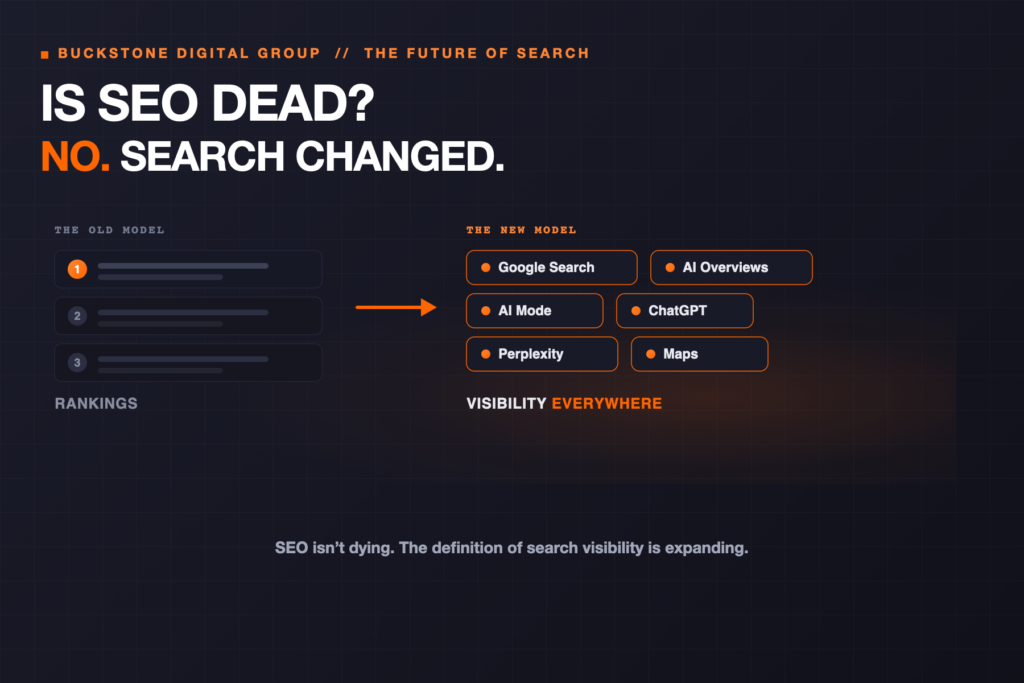
SEO gets a funeral every few years. Algorithm updates, social media, paid search, featured snippets, voice search, zero-click results—each was supposed to be the end. Now it’s AI. And yet businesses still depend on being found when someone searches. So the useful question isn’t whether SEO is dead. It’s what SEO has to become.
SEO is not dead. Search has outgrown the old definition of SEO—the model of rank a keyword, earn a click, get a customer.
Search is fragmenting. Customers now discover businesses across traditional Google results, AI Overviews, AI Mode, ChatGPT, Perplexity, Google Maps, local packs, marketplaces, product search, and review platforms. The businesses most at risk aren’t the ones investing in SEO. They’re the ones still defining SEO as a single line from keyword to click.
Key takeaways
Is SEO dead? The short version
- SEO is not dead—search behavior is changing.
- Google Search still matters, but it is no longer the only meaningful discovery surface.
- AI answers expand how a business can be cited, mentioned, compared, and recommended.
- Organic visibility can now create value before, or without, a click.
- Rankings and traffic still matter—but they no longer measure the full picture.
- Technical SEO remains foundational.
- AEO builds on SEO rather than replacing it.
- Entity clarity, evidence, and corroboration matter more in answer-driven environments.
- Businesses should optimize across both search engines and answer engines.
- Agencies must adapt their strategy, measurement, and implementation.
- BuckStone treats SEO and AEO as one evolving search ecosystem, not rival services.
SEO has been declared dead for years
Every major shift in search creates the same headline. Panda and Penguin were going to kill it. Social was going to replace it. Paid search was going to crowd it out. Featured snippets, voice search, and zero-click results were each supposed to end the click. The pattern is worth noticing, because the businesses that panicked and quit each time missed the growth the businesses that adapted captured.
AI is a bigger shift than most—but it follows the same rule. The interface is changing faster than the fundamentals. People still have questions, still compare options, and still decide who to trust and buy from. What’s changing is where that happens, and how you measure it. The honest reframing: SEO isn’t disappearing; the definition of visibility is expanding.
Why people think SEO is dead
The concern is not irrational. There are real, legitimate reasons the “SEO is dead” feeling is spreading right now.
AI answers resolve some questions without a click
AI Overviews, AI Mode, ChatGPT, and Perplexity increasingly answer certain questions on the spot. For informational queries in particular, a user may get what they need without visiting any website. That is a genuine change in behavior for some query types—though notably, these features still draw on the web and often cite sources.
The results page keeps getting more crowded
A modern query can return ads, a map pack, shopping units, video, featured results, People Also Ask, and an AI-generated answer—before a single traditional blue link. “Ranking #1” means less when the top of the page is full of everything else.
Rankings no longer tell the whole story
A business can rank organically and be absent from AI answers. Or it can be cited by an AI system without holding the traditional #1 position. Rank tracking simply doesn’t see the surfaces where a growing share of discovery now happens.
Content became a commodity
Generative tools made it trivial to produce competent, average information at scale. When everyone can publish a passable overview of a topic, the passable overview stops being an advantage.
AI did not make information scarce. It made undifferentiated information abundant—which raises the value of original experience, evidence, and expertise.
What actually died: the old definition of SEO
The version of SEO people are mourning is the reductive one: find a keyword, publish a page, add the keyword, build some links, rank, collect the click. That model was already incomplete years ago. Serious search work always included more.
Modern search strategy spans technical accessibility, entities, search intent, brand signals, structured data, content ecosystems, local results, products, reviews, authority, conversion, and now AI visibility. None of that is new-for-the-sake-of-AI—it’s what “doing SEO properly” already meant.
SEO did not die. The simplistic version of SEO became insufficient.
What SEO still does exceptionally well
It would be a mistake to swing from “SEO is everything” to “SEO is over.” The discipline still does several things nothing else does as well.
It captures active demand. People still search directly for products, services, locations, pricing, comparisons, reviews, and solutions—often at the moment they’re ready to act. That intent is enormously valuable and isn’t going anywhere.
It builds discoverable infrastructure. Crawlability, indexation, site architecture, internal links, page relevance, and technical quality are the foundation everything else—including AI visibility—depends on. This is the domain of technical SEO for AI search.
It builds the pages that convert. AI answers don’t remove the need for strong product, service, location, ecommerce, contact, and case-study pages. Those are where consideration turns into revenue.
It supports the data AI systems retrieve. Public web content remains central to many search and answer experiences. A site that is well-structured and accessible is easier for both search engines and answer engines to use.
What AI search changes
This is the real story. AI doesn’t end SEO—it adds new surfaces, new signals, and a new measurement model on top of it.
Visibility can happen before the click. A prospect might see a citation, a brand mention, a comparison, a recommendation, a product, or a local listing—and form an impression—before they ever reach your site.
The business itself becomes part of optimization. Increasingly, the work is clarifying the organization, its people, services, products, locations, industries, expertise, and relationships—so systems can identify and describe it correctly. That’s the discipline of entity SEO and how AI systems understand your business.
Evidence matters more. “We’re the leading provider” is a weak signal. Case studies, reviews, original research, named experts, product detail, demonstrated outcomes, and external corroboration are strong ones.
Pages compete as sources, not just rankings. A page is increasingly evaluated for whether it’s a good thing to cite—not only where it sits in a list.
Measurement expands. Traditional SEO metrics don’t disappear; new answer-engine metrics sit alongside them.
| Traditional SEO metrics | Expanded AI-visibility metrics |
|---|---|
| Keyword rankings | AI citations in answers |
| Impressions | Brand mentions & recommendations |
| Clicks & sessions | Prompt coverage & share of voice |
| Organic traffic | AI referral traffic |
| Conversions from search | Accuracy of how AI describes you |
Search visibility audit
Is your SEO strategy measuring where customers actually search now?
BuckStone can evaluate your traditional search performance alongside AI citations, recommendations, competitor visibility, technical readiness, and emerging search behavior.
SEO is becoming a visibility discipline
The clearest way to see the shift is in what “the job” is:
The trajectory
- Old SEO: rank the page.
- Modern SEO: help the right page win the search result.
- Emerging strategy: make the business visible and credible across the whole decision environment.
Where discovery now happens
- Google Search, AI Overviews & AI Mode
- ChatGPT & Perplexity
- Maps & local results
- Marketplaces & product search
- Review ecosystems
The unit of optimization is shifting from the page alone toward the page, the entity, the evidence, and the ecosystem surrounding the business.
Does AEO replace SEO?
No. Answer Engine Optimization (AEO) is the practice of improving how a business and its information are understood, retrieved, cited, compared, and recommended across answer-driven search experiences. It builds on SEO; it doesn’t replace it—we break down exactly what changed between AI SEO and traditional SEO. AI Search Visibility is BuckStone’s umbrella for the whole picture: making a business understandable, credible, retrievable, and recommendable across traditional search engines and AI-driven answer platforms.
SEO provides the technical foundation, indexability, relevance, content, search visibility, and authority. AEO adds emphasis on retrieval, citation, entity understanding, recommendation, prompt visibility, and monitoring how AI systems actually describe you.
AEO without SEO is a strategy built without infrastructure. SEO without AEO risks measuring yesterday’s search behavior while customers adopt tomorrow’s.
What happens to SEO if users click less?
Clicks still matter—many searches, especially commercial ones, still end on a website. But organic influence can also show up as brand recognition, a later branded search, direct traffic, an assisted conversion, a recommendation, a store visit, a phone call, or simple product consideration. None of that requires being the first click on an informational query.
Fewer clicks on some query types doesn’t mean less search influence. It means attribution gets harder—which is a measurement problem, not a death sentence.
Rankings still matter — but they aren’t enough
Rankings remain a useful signal of relevance, competitiveness, and organic discoverability. What they don’t reveal is AI citations, AI recommendations, answer-engine presence, how accurately your brand is described, prompt coverage, or AI share of voice.
Ranking reports are still useful. They are no longer a complete search-visibility report.
That’s why the right response isn’t to abandon rank tracking—it’s to add the measurement layer described in how to measure AI Search Visibility.
Content isn’t dead either — generic content is in trouble
AI lowered the cost of producing basic informational content to near zero. That doesn’t kill content; it changes what earns attention. Advantage now comes from experience, research, case studies, data, expertise, opinion, specificity, and customer evidence—the things a model can’t synthesize from everyone else’s summaries.
The web does not need another 1,500-word summary of a topic everyone has already summarized.
We’ll go deeper on this in a companion piece on why generic SEO content fails in AI search.
What businesses should do now
A practical plan, in order of leverage:
Foundation
- Keep investing in technical SEO—crawlability, indexability, rendering, canonicals, architecture, internal links
- Confirm AI/search crawlers can actually access your site
- Strengthen entity clarity—organization, leadership, authors, services, products, locations
Signals
- Publish evidence, not commodity content—case studies, research, expert detail
- Strengthen corroboration—reviews, profiles, associations, partner mentions
- Optimize for multiple environments—Google, AI Overviews, AI Mode, ChatGPT, Perplexity, local, product
Proof
- Expand measurement beyond rankings—citations, mentions, recommendations, competitor share of voice, AI referral traffic
- Connect visibility to business outcomes—leads, calls, sales, revenue, pipeline, qualified traffic
How to know whether your SEO strategy is outdated
None of these is fatal on its own. A cluster of them means your strategy is optimizing for the search of a few years ago.
Warning signs
- Reporting is almost entirely keyword rankings
- No one tracks AI visibility, ChatGPT, or Perplexity
- AI Overviews are ignored
- Structured data is treated as optional decoration
- Authors and leadership are poorly defined
- Case studies are disconnected from service pages
- Content is driven mostly by volume
- Your agency can’t explain entity SEO
- No one evaluates external corroboration
- AI referral traffic isn’t measured
- Technical fixes are perpetually delayed
- AI is discussed mainly as a threat
What good looks like
- Rankings tracked alongside AI citations and mentions
- ChatGPT, Perplexity, and AI Overviews monitored
- Structured data and entities treated as strategy
- Evidence-led content tied to services and case studies
- Corroboration actively built across the web
- Visibility connected to leads and revenue
Search changed
Search changed. Your reporting and strategy should too.
BuckStone combines SEO, AEO, technical implementation, entity optimization, content, structured data, AI visibility measurement, and conversion strategy into one coordinated system.
What should a modern SEO agency actually do?
The bar has moved. A capable search partner should handle technical SEO, search strategy, AEO, AI Search Visibility, entity SEO, structured data, content strategy, internal linking, local search, competitive monitoring, Search Console, AI performance reporting, GA4, conversion, and website implementation—not just produce a rankings report. If you’re evaluating partners, our guide to how to choose an AEO agency lays out the full checklist.
The job is not to preserve traditional SEO. It is to evolve search strategy as search evolves.
Why BuckStone is optimistic about SEO
We are not worried that AI is going to kill SEO. Every major shift in search creates resistance—that’s normal; teams get comfortable with the systems they understand. But search strategy can’t be built around preserving yesterday’s workflow. Our position is simple: SEO isn’t becoming irrelevant. It’s becoming broader.
The reason for the optimism is that the fundamentals we’ve focused on for years—technical accessibility, clear architecture, structured data, entity clarity, useful content, evidence, authority, and measurement—are exactly what answer-driven search rewards.
The interfaces are changing. The need for a business to be accessible, understandable, credible, and discoverable is not.
We were implementing structured data, entity relationships, and advanced technical SEO while many businesses still viewed SEO primarily as keywords and blog posts. AI search makes that systems approach more important, not less.
How BuckStone is expanding SEO for AI search
Whatever the interface, the work maps to five layers—the same framework we apply to SEO and answer-engine visibility alike.
The framework
One system, five layers
Access
Can search and AI systems retrieve the business’s information at all?
Understanding
Can they correctly identify what the business is and does?
Evidence
Does the website support the business’s claims with specifics?
Corroboration
Does the wider web reinforce them?
Measurement
Is visibility improving across rankings, AI citations, mentions, recommendations, traffic, leads, and revenue?
We are not replacing SEO with AEO. We are expanding SEO into a broader visibility system.
If your business is missing across platforms, the diagnostic in why your business isn’t appearing in AI search results is a good place to start—and it connects to the rest of our ecommerce and paid-media work where relevant.
Final answer: is SEO dead?
No. SEO is changing because search is changing. Businesses that adapt should keep benefiting from organic discovery, commercial search demand, AI visibility, brand authority, customer trust, and qualified traffic. The bigger risk isn’t investing in SEO—it’s continuing to invest in an SEO strategy that hasn’t changed while search behavior has.
SEO is not dead. Static SEO is. The future belongs to businesses that treat search as an evolving ecosystem—and build visibility wherever customers look for answers.
Evolve, don’t abandon
Don’t abandon SEO. Evolve it.
BuckStone helps established businesses build visibility across Google, AI Overviews, AI Mode, ChatGPT, Perplexity, and the next generation of search.
Frequently asked questions
Is SEO dead?
No. Search behavior is changing and visibility is expanding across new surfaces, but businesses still depend on being found when customers search. The reductive “keyword → click” version of SEO is what’s obsolete—not SEO itself.
Is SEO dead in 2026?
No. If anything, AI-driven search raises the value of the fundamentals SEO provides—technical accessibility, entity clarity, evidence, and authority. What’s changing is how visibility is earned and measured, not whether it matters.
Is SEO still worth it?
Yes, for most businesses. SEO captures active commercial demand and builds the discoverable infrastructure that both search engines and answer engines rely on. The key is a strategy that also accounts for AI visibility.
Is AI replacing SEO?
No—it’s expanding it. AI answers add new places to be cited, mentioned, and recommended, and a new measurement model on top of traditional search, but they still draw on the web that SEO makes accessible.
Will ChatGPT replace Google Search?
Both are becoming important discovery surfaces, and customers now use several. The safer assumption is a fragmented landscape—Google plus AI assistants—rather than one tool fully replacing another.
Will Google AI Overviews kill SEO?
No. AI Overviews draw on Google’s Search systems and often cite sources, so the work of being crawlable, indexable, useful, and clearly identified still applies. It changes eligibility and measurement, not the fundamentals.
Does AEO replace SEO?
No. AEO builds on SEO. SEO provides the technical foundation and content; AEO adds emphasis on retrieval, citation, entity understanding, and recommendation in answer engines. You need both.
What is AEO?
Answer Engine Optimization is the practice of improving how a business and its information are understood, retrieved, cited, compared, and recommended across answer-driven search experiences like AI Overviews, ChatGPT, and Perplexity.
What is AI SEO?
“AI SEO” is an informal label for optimizing toward AI-driven search. The term matters less than the capability behind it—technical SEO, entity work, evidence, measurement, and implementation across both search and answer engines.
What is AI Search Visibility?
It’s BuckStone’s umbrella term: making a business understandable, credible, retrievable, and recommendable across traditional search engines and AI-driven answer platforms—the combination of SEO and AEO working as one system.
Is traditional SEO obsolete?
The simplistic version is. Crawlability, indexation, relevance, content, and authority are more relevant than ever—they’re the foundation AI visibility builds on.
Do businesses still need SEO?
Yes. People still search directly for products, services, locations, and comparisons at the moment they’re ready to act, and SEO builds the pages that convert that demand.
Are keyword rankings still important?
They’re still a useful signal of relevance and competitiveness, but they no longer capture AI citations, recommendations, or answer-engine presence. Rankings are part of the picture, not the whole report.
Is organic traffic still important?
Yes—especially for commercial queries that still end on a website. But organic influence can also appear as brand recognition, branded search, recommendations, and assisted conversions that traffic alone doesn’t capture.
What happens to SEO if users stop clicking?
Clicks still matter, but fewer clicks on some query types doesn’t mean less influence—it means attribution gets harder. Visibility before the click still shapes recognition, trust, and later conversions.
How does AI change SEO?
It adds new surfaces (AI answers), new signals (entities, evidence, corroboration), and new metrics (citations, mentions, recommendations, share of voice) on top of traditional rankings and traffic.
What should businesses do about AI search?
Keep the technical foundation strong, clarify the business entity, publish evidence rather than commodity content, build corroboration, optimize across multiple search environments, and measure visibility all the way through to leads and revenue.
Do I need AEO if I already have SEO?
If customers are starting to research you through AI answers, yes—but as an extension of SEO, not a separate program. Answer engines still rely on the crawlability and structure SEO provides.
How should SEO be measured now?
Keep rankings, impressions, clicks, and conversions—then add AI citations, mentions, recommendations, prompt coverage, competitor share of voice, AI referral traffic, and business outcomes like leads and revenue.
What should a modern SEO agency be doing about AI?
Monitoring AI platforms, auditing crawler access, handling structured data and entity SEO, building corroboration, measuring citations and recommendations, and implementing technical and website changes—not just reporting keyword rankings.
How do I know if my SEO strategy is outdated?
If reporting is almost entirely rankings, no one tracks AI visibility, structured data is an afterthought, and AI is discussed mainly as a threat, your strategy is optimizing for the search of a few years ago.
Is content marketing still valuable in AI search?
Yes—but generic content is in trouble. Advantage now comes from experience, research, case studies, data, and expertise that a model can’t synthesize from everyone else’s summaries.
Does technical SEO still matter?
More than ever. Access and rendering come before answers—if search and AI systems can’t retrieve or interpret your pages, nothing downstream works.
What does BuckStone mean by AI Search Visibility?
The discipline of making a business accessible, understandable, credible, retrievable, and recommendable across Google and AI-driven answer platforms—SEO and AEO run as a single, measured system rather than competing services.
Sources & methodology
This is a thought-leadership piece, so it distinguishes documented platform behavior from BuckStone’s strategy, industry observation, and professional opinion. Platform-specific statements—that Google’s AI Overviews and AI Mode draw on Google Search systems and cite sources; that Google states structured data is not required for AI features and that Search does not use llms.txt; that Google’s generative-AI Search Console reporting currently shows impressions; and the roles of OAI-SearchBot/GPTBot and PerplexityBot/Perplexity-User—were checked against current official Google Search Central, OpenAI, and Perplexity documentation and Schema.org. We deliberately avoid quantitative claims about traffic decline, AI adoption, click reduction, or market share, because those figures shift quickly and are easy to misrepresent; where behavior is changing we describe the direction, not invented numbers. No fabricated statistics, metrics, or client results appear in this article.