
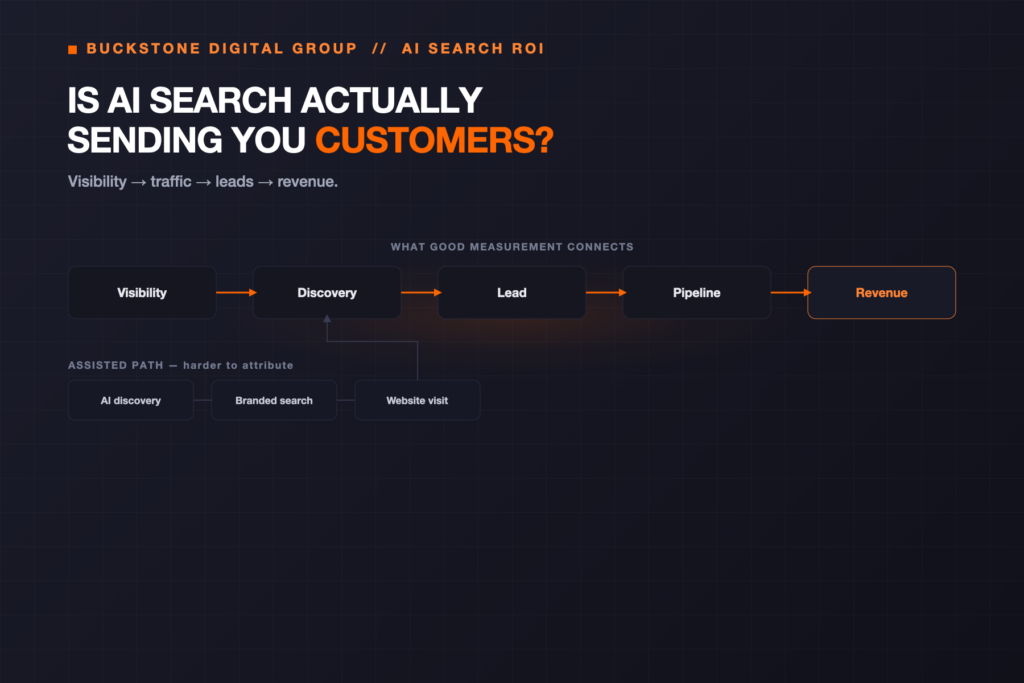
At some point, every conversation about AI search reaches the same question from the person paying for it: “We keep talking about ChatGPT visibility, AI Overviews, AI Mode, and Perplexity — but is any of this actually sending us customers?”
Here’s the honest answer, up front: some AI-driven visits can be measured directly, some AI-assisted discovery can only be inferred, and some influence may never appear cleanly inside analytics at all. That’s not a cop-out — it’s the actual shape of the problem, and a business needs both a way to count what’s countable and a disciplined way to reason about what isn’t.
A referral click from ChatGPT is measurable. A buyer who discovers your company in an AI answer and returns three days later through a Google search of your brand name may not be. AI search attribution should be treated as a spectrum of evidence, not a perfectly closed accounting system. The goal isn’t to prove that every AI mention produced revenue — it’s to build enough measurement to understand whether AI-driven discovery is contributing to qualified demand.
- AI visibility and AI referral traffic are not the same thing — appearing in an answer is not a visit.
- AI referral traffic is measurable when a user clicks through from a trackable source; much of it is not.
- AI systems can influence buyers without generating a direct click — awareness, later branded search, word of mouth.
- Don’t group all AI platforms as one source; ChatGPT, Google AI, and Perplexity behave differently in analytics.
- GA4 captures AI referrals only when referrer/source data survives — in-app AI browsers often strip it, so visits hide in Direct.
- CRM data is required for lead, pipeline, and revenue attribution; analytics alone stops at the website.
- Branded-search lift can be a supporting signal of AI awareness — but correlation is not attribution.
- Separate AI-sourced from AI-influenced — sourced revenue can be defended far more confidently.
- Conversion quality beats raw visit volume; ten qualified visits can outweigh a thousand informational ones.
- Visibility metrics are leading indicators; customers and revenue are the outcomes.
- State your assumptions — a precise-looking ROI built on weak attribution is not precise.
What can you actually measure?
Start by separating three kinds of evidence, because they have very different reliability:
- Directly measurable — a session that arrives with an identifiable AI source (for example, a ChatGPT link carrying
utm_source=chatgpt.com, or aperplexity.aireferrer). You can count these and follow them to conversions. - Inferable — signals that suggest AI influence without proving it: a rise in branded search, a jump in direct traffic after an AI feature started citing you, prospects mentioning AI in sales calls.
- Effectively invisible — influence that leaves no clean trail at all, because the referrer was stripped, the answer resolved without a click, or the discovery happened on someone else’s screen.
A serious measurement program doesn’t pretend the second and third categories are the first. It counts what’s countable, treats the rest as supporting evidence, and is honest about the line between them.
Visibility vs. traffic vs. revenue
Most confusion in this area comes from collapsing distinct things into one number. Keep them separate:
Every stage loses some of the previous one, and every stage is harder to attribute than the one before it. A report that jumps straight from “we appear in ChatGPT” to “AI drove revenue” has skipped the three steps where the real measurement work lives.
What AI traffic can you actually track today?
Trackability differs by platform, and platform behavior changes — so verify current behavior in your own analytics rather than trusting last year’s conventions.
ChatGPT
Links surfaced in ChatGPT search have generally arrived carrying utm_source=chatgpt.com, which lets GA4 identify them. In practice the picture is messier: some ChatGPT visits are labeled (not set) or land in Unassigned, and traffic from the ChatGPT mobile app or an in-app browser frequently arrives with no referrer at all — so it registers as Direct. You can track a meaningful share of ChatGPT referrals; you cannot assume every ChatGPT-originated visit is identifiable. (For the visibility side — being named in the first place — see how to get recommended by ChatGPT.)
Google AI experiences
This one needs care, because two systems report two different things. Search Console now includes a generative-AI performance report covering impressions in AI Overviews, AI Mode, and Discover’s AI features — but, as of this writing, it does not report clicks, and its data is separate from your website analytics. GA4, meanwhile, reports website sessions and conversions but does not hand you a clean, dedicated “AI Overviews” channel — a click from a Google results page that happened to contain an AI Overview usually still looks like ordinary Google organic. Don’t imply Google AI traffic arrives with its own GA4 label unless your property actually shows one. (For the visibility side of Google AI, see how to appear in AI Overviews and why you might not be.)
Perplexity
Perplexity referrals typically show up as perplexity.ai / referral in GA4 — but only when the platform sends a referrer header, and its in-app browsing can strip that just as ChatGPT’s does. Treat Perplexity as trackable-in-part, and validate whether it lands under Referral or gets swept into Direct in your own data.
Setting up GA4 to see AI referrals
GA4 will capture AI referral traffic, but it won’t organize it for you. The practical setup:
- Reports → Acquisition → Traffic acquisition, primary dimension Session source / medium
- Filter the table for
chatgpt, thenperplexity, then other platforms one at a time - Compare engagement and key events, not just sessions
- Build a custom channel group with a rule matching verified AI domains (chatgpt.com, perplexity.ai, and others you confirm)
- Order it above Referral so AI visits aren’t swept into generic referral
- Validate every domain before adding it — don’t pad the list with dead patterns
Two cautions. First, GA4’s interface and any emerging native AI grouping are still shifting — confirm the current UI rather than following a stale click-path, and note that a native grouping may not cover every platform (Perplexity, for instance, has been excluded). Second, and most important:
Ordinary Google organic traffic is not “AI traffic” just because an AI Overview may have been on the page. Direct traffic is not “AI traffic” just because some AI visits hide there. Count what carries a verifiable AI source; everything else is inference, and should be labeled as such.
Track conversions, then connect the CRM
Sessions are the least interesting number here. For each AI source, measure the actions that matter to your business — form submissions, tracked calls, demo requests, trials, account creations, purchases — and weigh conversion quality over volume. Ten qualified visits can be worth more than a thousand informational ones, so a low-volume AI source with strong conversion can matter more than a high-volume one that never converts.
But GA4 stops at the website. To know whether an AI-sourced conversion became revenue, you need the CRM. Capture original source, landing page, and campaign data on the lead record, then follow it through to MQL/SQL, opportunity, and closed revenue.
Analytics answers what happened on the website. The CRM answers what happened to the lead afterward. AI search ROI lives in the join between them — which is exactly why most “AI ROI” claims that rely on analytics alone stop one step short of the number that matters.
Why AI influence exceeds AI referrals
The single most important idea in AI attribution is that a first-touch or last-touch model will systematically undercount AI, because AI often does its work in the middle of a journey. Three scenarios show why:
- Scenario A — clean. ChatGPT → click to your site → demo request. The referral is tagged, the conversion is tracked, attribution is straightforward.
- Scenario B — laundered. ChatGPT names your company → the user searches your brand on Google → visits → converts. GA4 credits Google / organic. AI created the demand; the last click took the credit.
- Scenario C — invisible. An AI answer recommends you → the user mentions it to a colleague → the colleague visits directly. No system can confidently connect that to AI at all.
The takeaway isn’t “attribution is hopeless.” It’s that visible AI-referral traffic is a floor, not a ceiling — the measurable clicks are real, and there is almost certainly additional influence you can’t see. That’s the same reason AI rank tracking is harder than Google rank tracking: the thing you’re measuring doesn’t sit still in one place.
“Dark” AI discovery and branded-search lift
Some AI-driven discovery never produces a tagged referral. In-app AI browsers strip the referrer; answer engines resolve some questions without a click; recommendations travel by word of mouth. The discipline here cuts both ways:
Absence of an AI referral tag does not prove absence of AI influence. But equally, you shouldn’t claim invisible AI influence every time attribution is missing. The honest position is to hold both: acknowledge that measurable referrals understate reality, without inventing a number for the part you can’t see.
Branded search is the most useful of the inferable signals. If branded impressions, branded clicks, direct traffic, and product-name searches rise after AI features begin citing you, that’s consistent with growing awareness — but branded-search growth can be a supporting signal of increased awareness; it cannot automatically be attributed to AI search. Correlation earns a hypothesis, not a line item. Track it, annotate what else changed in the same window, and treat it as evidence, not proof.
AI-sourced vs. AI-influenced
If you take one distinction from this article, take this one. It keeps reporting honest and it keeps you out of arguments you can’t win.
- AI-sourced — an AI platform is identifiable as the originating acquisition source (a tagged referral that converts). You can defend this.
- AI-influenced — evidence suggests AI played a role in discovery or evaluation, but attribution isn’t direct (a branded-search lift, a prospect who mentions ChatGPT, a suspiciously timed direct-traffic bump).
Never blend them into one figure. Report sourced results as measured, report influenced results as directional and clearly labeled, and never let an influenced estimate borrow the credibility of a sourced number. The moment the two are combined, the whole report becomes contestable.
The AI search performance funnel
Put together, the path from an AI answer to revenue is a funnel — useful as a shared model for what you’re trying to measure, as long as it’s read as a framework and not a claim that every stage flows cleanly to the next.
How to calculate AI search ROI
For the portion you can attribute to a defined investment, the formula is ordinary — the rigor is in the inputs, not the arithmetic:
Use gross profit rather than revenue where margins matter, and state which you used. Count real costs — agency fees, internal labor, content, development, tools, outreach — but don’t charge your entire pre-existing SEO budget to AEO unless it’s legitimately attributable. And for pipeline businesses, keep sourced pipeline, influenced pipeline, and closed revenue in separate columns; blending them is the most common way these numbers become fiction.
A precise-looking ROI percentage built on weak attribution is not precise. If most of the “return” is influenced rather than sourced, say so, show the sourced figure on its own, and let the influenced number stand beside it as context. The visibility side of the ledger — mentions, citations, share of voice — belongs here too, but as a leading indicator; the full methodology for those metrics is in how to measure AI Search Visibility, and this article deliberately doesn’t repeat it.
Ask the customer directly
The cheapest attribution tool most businesses ignore is the question “How did you hear about us?” A short, optional field on high-value forms — with an explicit “ChatGPT / AI search” option alongside Google, referral, and social, plus a free-text box — regularly surfaces journeys analytics never caught. It’s imperfect and self-reported, but:
Pair it with sales-team discipline: when a prospect says “ChatGPT recommended you” or “your company came up in an AI answer,” capture it as a structured field in the CRM, not as a story that evaporates after the call. Anecdotes logged consistently become data.
The measurement stack
No single tool sees the whole journey, which is why AI ROI reporting is really an exercise in stitching four layers together:
Visibility monitoring shows what was happening before the click; Search Console shows discovery in Google Search; GA4 shows what happened on the site; the CRM shows what happened commercially. The reporting job is to connect them wherever the data allows — and to leave the gaps visible where it doesn’t.
What an AI search ROI report should include
A monthly or quarterly report should move from leading indicators to business outcomes, and end with the context that keeps the numbers honest.
| Layer | What it answers | Representative metrics |
|---|---|---|
| Visibility | Are we in the conversation? | Mentions, citations, recommendations, share of voice, competitor presence |
| Traffic | Is it producing visits? | Identifiable AI referrals, sessions, landing pages, engagement |
| Conversion | Are visits acting? | Leads, demos, trials, purchases — by AI source |
| Pipeline | Is it qualified? | Qualified leads, opportunities, sourced vs. influenced pipeline |
| Revenue | Is it business value? | Customers, sourced revenue, influenced revenue (kept separate) |
| Context | How much can we trust it? | Sample sizes, attribution limits, platform & implementation changes |
That last row is not optional. Good AI search reporting should reduce uncertainty, not hide it behind a dashboard.
AI search ROI by business type
What counts as a “return” depends on how the business makes money and how long its cycle runs — which also determines how much data you need before drawing conclusions.
| Business type | Primary AI-impact outcome | How ROI is framed |
|---|---|---|
| Ecommerce | Product discovery → purchase, repeat | Transaction revenue; higher volume, faster read |
| SaaS | Trials, demos, signups | Pipeline and ARR; sourced vs. influenced |
| Local services | Calls, forms, appointments | Closed jobs; smaller samples, watch call tracking |
| Professional services | Consultations, qualified opportunities | Revenue per engagement; long, few, high-value |
| Manufacturers / B2B | RFQs, opportunities | Sourced/influenced pipeline; very long cycles |
A B2B firm closing five deals a year needs a completely different analysis from an ecommerce store with thousands of monthly transactions. Small samples, long sales cycles, and seasonality all argue for patience — there is no universal threshold, and conclusions drawn from a handful of conversions are guesses wearing a percentage sign.
What not to do
- Label ordinary Google or Direct traffic “AI” without evidence
- Attribute all branded-search growth to AI
- Assign revenue to an AI mention just because it happened
- Present screenshots or share of voice as ROI
- Mix sourced and influenced pipeline into one figure
- Hide small sample sizes
- Promise perfect attribution
- Compare unlike attribution models side by side
How BuckStone measures AI search business impact
We don’t want to report that a brand appeared in ChatGPT and stop there. The business question is whether greater visibility is contributing to qualified demand — so we connect the layers that answer it: AI visibility and citation monitoring, Search Console, GA4, lead and call tracking, and CRM data through to conversions, pipeline, and revenue where the data allows. AI visibility is a marketing metric. Customers are a business metric. The reporting system should connect the two wherever the data allows — and stay honest about where it can’t. That’s the same philosophy behind an AEO audit and behind our AI Search Visibility work: measure more than mentions.
Frequently asked questions
Can you track traffic from ChatGPT?
Partly. ChatGPT search links have generally carried utm_source=chatgpt.com, which GA4 can identify. But visits from the ChatGPT app or in-app browser often arrive with no referrer and register as Direct, so you can track a meaningful share — not all of it.
Can you track AI search traffic in GA4?
Yes, for referrals that carry source or referrer data. GA4 has no reliable default AI channel, so the practical approach is a custom channel group matching verified AI domains, placed above Referral. Traffic without referrer data won’t be identifiable.
How do I track ChatGPT referrals?
In GA4, open Traffic acquisition, set the dimension to Session source / medium, and filter for chatgpt. Compare engagement and key events, not just sessions, and build a custom channel group so ChatGPT isn’t lumped into generic referral.
Does Google Analytics show AI traffic?
It shows AI referral traffic that arrives with identifiable source data (like ChatGPT or Perplexity referrals). It does not give Google’s own AI experiences a clean dedicated channel — a click from a results page containing an AI Overview usually still looks like ordinary Google organic.
Can Search Console show AI search traffic?
Search Console’s generative-AI report shows impressions in AI Overviews, AI Mode, and Discover’s AI features — but not clicks, in its current form. It measures Google-side visibility, which is different from the website sessions GA4 records.
Can I track traffic from Google AI Overviews?
Only indirectly. Search Console reports AI Overview impressions (not clicks), and a resulting click typically appears in GA4 as normal Google organic rather than a distinct AI Overview source. Don’t report a specific “AI Overviews traffic” number unless your data genuinely isolates it.
Can I track traffic from Google AI Mode?
AI Mode impressions are included in Search Console’s generative-AI reporting, but clicks aren’t separately reported there, and GA4 doesn’t hand you a dedicated AI Mode channel. Treat it as visibility you can see and traffic you largely can’t cleanly isolate.
Can I track Perplexity referrals?
Usually, when Perplexity sends a referrer — it appears in GA4 as perplexity.ai / referral. In-app browsing can strip the referrer and push visits into Direct, so validate whether it lands under Referral in your own property and add it to your AI channel group.
What is AI referral traffic?
Website sessions that arrive from an AI platform with identifiable source or referrer data — for example a click from ChatGPT or Perplexity. It’s a subset of AI influence: the part that produced a trackable click, not the full extent of AI’s effect on discovery.
What is AI search attribution?
The practice of connecting AI-driven discovery to business outcomes — visits, leads, pipeline, revenue — and being explicit about confidence. It’s best treated as a spectrum of evidence, from directly sourced to inferred to invisible, rather than a single closed number.
What is the difference between AI-sourced and AI-influenced revenue?
AI-sourced means an AI platform is identifiable as the originating source (a tagged referral that converted) — defensible. AI-influenced means evidence suggests AI played a role but attribution isn’t direct — directional. Report them separately and never blend them.
How do I measure AI-generated leads?
Tag conversions by session source so AI-sourced leads are identifiable, capture original source on the CRM lead record, and add a “how did you hear about us?” field for the journeys analytics misses. Then compare AI-sourced lead quality against your other channels.
How do I track AI leads in a CRM?
Pass original source, landing page, and campaign data from the website onto the lead record, then follow it through MQL/SQL, opportunity, and closed revenue. Add structured fields for self-reported and sales-noted AI mentions so anecdotes become reportable data.
Does AI Search Visibility increase website traffic?
Sometimes, but not always, and not proportionally. AI systems can answer without a click, so visibility can grow while informational clicks fall. The value often shows up as qualified discovery and awareness rather than raw session volume.
Does more AI visibility mean more revenue?
Not automatically. Visibility is a leading indicator; revenue is an outcome several steps away, each with attrition. More visibility improves the odds of discovery and consideration, but only measurement through to conversion and pipeline shows whether it produced business value.
How do I calculate AEO ROI?
ROI = (attributed value − AI search investment) / investment. Use gross profit where margins matter, count real costs, and separate sourced from influenced results. A precise-looking percentage built on weak attribution isn’t precise, so state your assumptions.
How do I calculate AI Search Visibility ROI?
The same way as AEO ROI: attribute value you can defend, subtract the investment, and divide. For pipeline businesses, keep sourced pipeline, influenced pipeline, and closed revenue in separate columns rather than combining them into one headline figure.
Should branded-search growth be attributed to AI?
Not automatically. A rise in branded search after AI features begin citing you is a supporting signal of awareness, but correlation isn’t attribution. Track it, annotate what else changed, and treat it as directional evidence rather than sourced revenue.
What is dark AI traffic?
AI-driven visits and influence that leave no clean referral trail — because an in-app browser stripped the referrer, an answer resolved without a click, or discovery spread by word of mouth. It means measurable AI referrals understate reality; it doesn’t license inventing a number for the invisible part.
Can ChatGPT influence a sale without sending a referral click?
Yes. A buyer can discover you in a ChatGPT answer, then reach your site later through a brand search, a direct visit, or a colleague’s recommendation. GA4 would credit that last step, not ChatGPT — which is why AI influence routinely exceeds visible AI referrals.
What should an AI search report include?
Six layers: visibility, identifiable AI traffic, conversions, qualified pipeline, revenue (sourced and influenced kept separate), and a context section covering sample sizes, attribution limits, and platform or implementation changes. The context is what keeps the rest trustworthy.
What metrics matter most for AI Search Visibility?
Leading indicators (mentions, citations, recommendations, share of voice) show whether you’re in the conversation; business metrics (qualified leads, pipeline, revenue) show whether it matters. Weight the business metrics, and use visibility as the early signal that they may follow.
What is AI share of voice?
Your visibility across a defined set of monitored prompts relative to competitors. It tells you whether you’re entering the conversation — not whether that conversation produced revenue. It’s a visibility metric, not ROI, and the two shouldn’t be conflated.
How long should I measure before evaluating ROI?
Long enough for your sales cycle and conversion volume to produce a real sample. Ecommerce can read results in weeks; a B2B firm closing a few deals a year may need many months. Seasonality and small samples argue for patience over early conclusions.
Can an agency accurately attribute all AI-driven revenue?
No — and be wary of any that claims to. A credible partner measures what’s sourced, estimates what’s influenced with clearly labeled assumptions, and is honest about the invisible remainder. Perfect AI attribution isn’t available; disciplined, transparent attribution is.
What is a Digital Visibility Brief?
BuckStone’s Digital Visibility Brief is an executive, five-minute diagnostic showing how your business appears across Google and AI-driven discovery, where competitors are capturing non-branded demand, and which priorities — including what can actually be measured — deserve attention first.
Sources & methodology
This article distinguishes documented platform behavior (how ChatGPT, Google’s AI experiences, Perplexity, GA4, and Search Console are publicly described to handle referrals and reporting as of writing — behavior that changes and should be re-verified) from BuckStone measurement methodology (the sourced-vs-influenced model, the four-layer stack, and the reporting framework) and reasonable inference (clearly framed as such). Verified points at the time of writing include: ChatGPT search links generally carrying utm_source=chatgpt.com while app/in-app-browser visits often lose the referrer and register as Direct; GA4 having no reliable default AI channel (a custom channel group is the practical fix, and any emerging native grouping is incomplete); Perplexity appearing as perplexity.ai / referral only when a referrer is sent; and Google Search Console’s generative-AI report showing impressions in AI Overviews, AI Mode, and Discover’s AI features — not clicks — separate from GA4 sessions. No benchmark percentages, traffic figures, client results, or attribution numbers were fabricated; ROI examples are illustrative, and nothing here promises perfect attribution or a specific return. Verify current OpenAI, Google, Google Analytics, and Perplexity documentation before relying on specifics. Primary references: OpenAI, Google Search Central, Google Analytics, and Perplexity documentation.