
You ask ChatGPT what your company does, and the answer is incomplete, outdated, or simply wrong.
The specifics vary, but the pattern is familiar. The company is confused with a similarly named business. Important services are missing. The wrong location appears. A former employee is listed as the founder. An old brand name is still in use. Competitors are recommended for work the business clearly does. Or the company is described as a general provider when it is, in fact, a specialist.
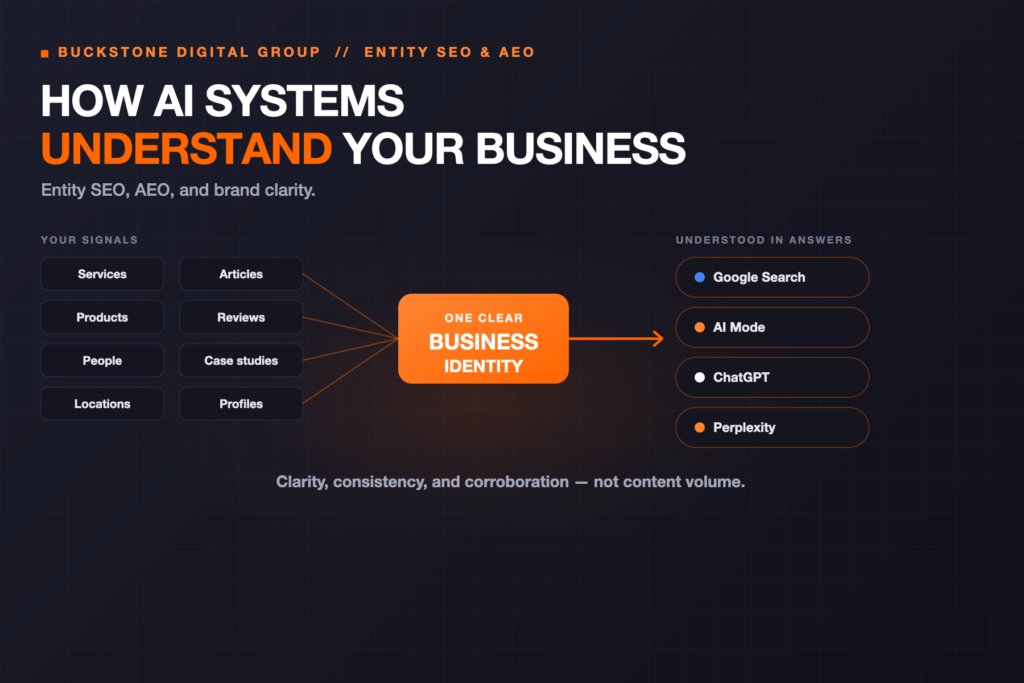
This is almost never caused by one missing keyword. AI systems build an understanding of a business from a network of available information: homepage copy, service and product pages, About information, leadership profiles, author pages, structured data, internal links, reviews, directories, Google Business Profile, LinkedIn, industry associations, partner pages, customer case studies, news coverage, marketplace listings, and other third-party sources.
AI systems understand a business by connecting repeated facts, entities, relationships, content, and external evidence. The clearer and more consistent those signals are, the easier the business is to identify and associate with relevant customer questions.
Which leads to the uncomfortable diagnosis behind most AI visibility problems:
Most businesses do not have a content-volume problem. They have a clarity, consistency, and corroboration problem.
Key takeaways
How AI understands a business, in one panel
- AI systems do not understand a company from one page or keyword.
- They assemble information from the company website and external sources.
- Clear company, service, product, leadership, location, and authorship information reduces ambiguity.
- AEO depends on SEO foundations such as crawlability, indexability, content, and authority.
- Structured data can clarify entities and relationships but cannot manufacture expertise.
- Internal links help connect services, industries, articles, authors, and case studies.
- About pages and leadership profiles help define the organization and its people.
- External mentions, reviews, directories, and partner pages can corroborate business claims.
- Conflicting names, addresses, services, profiles, and schema weaken clarity.
- AI visibility depends on relevance and evidence, not merely correct company information.
- Entity SEO strengthens the identifiable people, organizations, services, products, locations, and relationships surrounding a business.
- An AEO agency should audit the entire information environment—not merely add FAQ content or schema.
- BuckStone combines technical SEO, entity clarity, content, external corroboration, and measurement.
What does it mean for AI to “understand” a business?
“Understanding” here does not imply human comprehension. In practical terms, a search or AI system may need to associate a company with its preferred name, website, category, services, products, industries, locations, leaders, authors, customers, expertise, reputation, differentiators, external profiles, and supporting evidence.
Just as importantly, it may need to distinguish your company from similar names, competitors, former brands, subsidiaries, parent companies, local branches, unrelated people, old websites, and duplicate profiles.
Business understanding is the process of reducing ambiguity and strengthening meaningful relationships.
No platform publishes a complete entity-resolution or scoring formula, and different systems do not build understanding in identical ways. What we can work with is the information environment they draw from—and that is largely within your control.
How AI systems build a picture of your company
Think of the available information in four layers. No single layer automatically controls the final answer, and no single source is guaranteed to be treated as authoritative.
The information environment
Four layers AI systems can draw from
First-party website
Homepage, About, service and product pages, industry and location pages, leadership and author profiles, articles, case studies, FAQs, and contact information.
Technical & structured information
Structured data, titles, meta descriptions, canonicals, internal links, sitemaps, breadcrumbs, image information, and author/publisher relationships.
Business profiles & platforms
Google Business Profile, LinkedIn, Bing Places, industry directories, marketplace profiles, review platforms, and professional organizations.
Independent corroboration
News coverage, industry publications, partner pages, client websites, podcasts, interviews, research citations, reviews, association listings, and conference appearances. On one platform specifically, this is how you get cited by Perplexity.
First-party information
- You control it completely
- Can be corrected immediately
- Defines your intended positioning
- Treated as a claim, not proof
External information
- You influence it, rarely control it
- Updates on someone else’s timeline
- Can contradict your website
- Provides independent corroboration
Keywords, content, and entities are three different things
Effective SEO and AEO require all three working together. Entity work does not replace keyword research, and neither replaces substantial content.
Keywords
Describe language
The words customers actually use when they search or ask. They tell you how demand is expressed.
Examples
- industrial lubricant supplier
- SEO agency
- financial advisor
- private dining restaurant
Content
Explains the subject
The detail around services, products, customer needs, use cases, process, and expertise. This is where evidence lives.
Provides
- What you do and for whom
- How the work is done
- Proof it worked before
- Depth on the subject
Entities
Identify the things
The specific, identifiable people, organizations, and objects the language and content refer to.
Examples
- The company itself
- Founder & authors
- A named product or service
- A location or brand
What is entity SEO?
Entity SEO is the practice of making the identifiable people, organizations, services, products, locations, and subjects surrounding a business clearer, more consistent, and better connected.
In practice, business entity SEO can involve company naming conventions, About-page clarity, leadership profiles, author archives, service definitions, product information, location accuracy, structured data, internal linking, external profile cleanup, third-party corroboration, stable entity IDs, and ongoing monitoring of how AI systems describe the company. Our full guide to entity SEO covers the underlying concepts in more depth.
What is AEO, and how does entity SEO support it?
Answer Engine Optimization, or AEO, is the practice of improving how a business and its information are understood, retrieved, cited, compared, and recommended across answer-based search experiences.
AEO overlaps heavily with traditional SEO, technical SEO, entity SEO, structured data, content strategy, internal linking, local SEO, digital PR, reviews and reputation, and analytics and measurement. It is not a separate discipline that replaces search fundamentals.
The relationship
AEO builds on SEO
- A business cannot create a strong answer-engine presence while ignoring crawlability, indexability, content, authority, and technical quality.
- Entity SEO is how you make the business identifiable; AEO is how that identity gets retrieved, compared, and recommended.
- Anyone selling AEO as a replacement for SEO is selling half a strategy.
Consider a realistic prompt: “Recommend an SEO and AEO agency for a manufacturing company.” To include a company confidently, a system may need to connect that the company is an SEO agency, that it provides AEO services, that it works with manufacturing clients, that it has technical SEO experience, that relevant case studies exist, that identifiable leaders and authors stand behind the work, and that external sources support those associations.
Clear entity relationships help an answer system make those connections. They do not guarantee inclusion—relevance, evidence, and competition still decide the outcome.
The information AI systems need from your website
1. A clear homepage
Your homepage should make plain who the company is, what it provides, whom it serves, where it operates, what differentiates it, and what to do next. The common failures are vague mission statements, clever headlines with no category clarity, lists of unexplained services, internal jargon customers never use, and several conflicting descriptions of the same company.
2. A substantive About page
The About page should define the organization, its history, leadership, expertise, industries, business model, locations, official profiles, and relevant relationships. “We are passionate about excellence” does almost nothing to clarify an entity. Concrete facts do.
3. Complete service pages
Each major service needs its own substantial page explaining what the service is, who it is for, what problems it solves, what is included, how the process works, what evidence supports it, which industries it applies to, and what the next step is. If you want to help AI understand your services, a homepage list of service names is not enough.
4. Product information
Product businesses should keep name, brand, manufacturer, description, specifications, use cases, availability, price where applicable, product relationships, and supporting guides accurate—and consistent with marketplace listings and feeds.
5. Industry and customer context
A company can provide a service without ever showing which industries or customer types it serves. Industry pages, case studies, client examples, and specific language strengthen those associations. Do not create thin doorway pages to chase every permutation.
6. Leadership and author profiles
Real people make a business easier to verify. Useful profiles include full name, role, biography, expertise, employer relationship, authored content, professional profiles, an approved image, and a stable Person entity. Author pages do not create expertise—they make legitimate expertise easier to identify and confirm. At BuckStone, Jeff Palicki and Dalton West each maintain a real profile and a consistent identity across every article.
7. Location and service-area information
Distinguish clearly between a physical office, a storefront, a service area, a market served, a headquarters, and a branch. Never create fake locations or imply offices that do not exist—this is where local SEO accuracy and entity clarity meet.
8. Case studies and evidence
A case study connects the company, the service, the industry, the customer problem, the work performed, and the result. That combination is far stronger evidence than an unsupported marketing claim. Our case studies exist to make those relationships explicit.
9. Internal linking
Internal links express relationships: article to service, service to case study, case study to industry, industry to service, article to author, author to organization, product to supporting guide, and location to service.
Internal links do more than move users between pages. They help define how the website’s subjects and entities relate.
10. Structured data
Structured data can make visible relationships explicit—article author, organization publisher, person employer, product brand, LocalBusiness address, breadcrumb hierarchy, and stable IDs. We cover the limits in detail in can structured data help your business appear in AI search.
Structured data can clarify the website’s entity system, but it should never contradict or replace visible content.
Why external corroboration matters
Everything on your website is a first-party claim. External sources either support that claim or contradict it—reviews, LinkedIn, industry associations, partner websites, client case studies, news articles, interviews, directories, awards, certifications, marketplace profiles, and professional organizations.
Quality, relevance, accuracy, and independence matter far more than raw mention volume. Not every mention helps. Mass directory submission is not a corroboration strategy; a handful of credible, relevant, accurate sources that genuinely connect your company to its work is worth more than hundreds of thin listings.
How reviews affect AI understanding of a business
Reviews can help establish that a business is active, what customers actually experience, which services customers mention by name, whether the location is relevant, general reputation, recency, and recurring strengths or complaints.
Reviews do not directly cause AI recommendations, and no platform documents such a mechanism. What review content can do is reinforce—or quietly contradict—the positioning you are trying to establish. If your website says you specialize in one thing and every review describes something else, that inconsistency is part of your information environment too.
Why AI describes businesses incorrectly
When a description is wrong, the cause is usually somewhere in this list: vague homepage copy, conflicting company names, old descriptions still circulating, former addresses, inconsistent service information, multiple live websites, duplicate social profiles, a weak About page, missing leadership information, generic authorship, stale directory listings, incorrect structured data, staging URLs left in metadata, unclear parent and subsidiary relationships, similar competitor names, sparse external evidence, outdated third-party sources, AI-generated pages repeating old errors, a recent rebrand, new services with no corroboration yet, or plain location ambiguity.
Note how few of these are content-production problems. Most are clarity and consistency problems. For the broader diagnostic, see why your business is not appearing in AI search results.
Entity audit
Does AI understand what your company actually does?
BuckStone can evaluate how your business, services, products, people, locations, and expertise are represented across your website and the wider search ecosystem.
Why AI confuses your company with another business
Entity confusion has predictable causes: common business names, acronyms, similar domains, shared founder names, former brands still indexed, acquisitions, franchise structures, parent companies, subsidiaries, multiple locations, and inconsistent legal versus trade names.
The countermeasures are unglamorous but effective. Decide on a preferred name and use it consistently everywhere. Explain legal names, trade names, and former names openly on the About page. Keep one coherent Organization identity in structured data. Maintain stable, accurate external profiles. And make sure the details that distinguish you—location, industry focus, leadership—appear consistently across sources rather than only on your homepage.
How to correct inaccurate AI information about your business
There is no button that edits an AI system’s description of your company. What you can do is fix the underlying information environment and let systems re-retrieve it.
Correction process
Seven steps, in order
Document the incorrect claims
Record the platform, exact prompt, date, the precise incorrect statement, any sources cited, and the business impact.
Identify the likely source
Check your website, structured data, directories, social profiles, old domains, news coverage, review platforms, partner pages, knowledge panels, and cached pages.
Correct first-party information
Update the homepage, About page, service pages, leadership profiles, contact information, structured data, and internal links.
Correct important external profiles
Prioritise sources that are authoritative, visible, and relevant rather than trying to fix everything at once.
Create supporting evidence
Publish clear service information, case studies, leadership profiles, updated product details, original research, and useful expert content.
Use official correction tools where they exist
You can edit your own Google Business Profile, and Google lets a verified representative claim a knowledge panel and submit “Suggest edits” with supporting links. ChatGPT and Perplexity publish no equivalent business-correction tool.
Re-test and monitor
Updates do not appear immediately, and no one can promise a correction timeline. Re-test the same prompts on a schedule and track changes.
Be realistic about the ceiling here: a business can improve the public information systems draw from, but it cannot guarantee that every third-party or model-generated error will be corrected.
A practical business-understanding audit
Work through these groups on your own site before hiring anyone. Most companies find several issues in the first two.
Company identity
- Is the preferred business name consistent everywhere?
- Are legal and trade names explained?
- Is the company category clear?
- Is the main website obvious?
- Is the logo current and are official profiles connected?
Services and products
- Does each major offering have a substantial page?
- Are customer types and industries clear?
- Are product details current?
- Are discontinued offerings removed?
People and expertise
- Are leaders identified with accurate roles?
- Are author profiles complete?
- Is expertise supported by visible work?
- Are Person entities stable across articles?
Locations
- Are offices distinguished from service areas?
- Are addresses, hours, and phone numbers current?
- Do external profiles match the website?
Website relationships
- Do articles link to relevant services?
- Do services link to case studies?
- Do industries link to capabilities?
- Do authors connect to their content?
- Does the About page connect organization and leadership?
Structured data
- Is there one coherent Organization identity?
- Are Person IDs reused?
- Are author and publisher relationships correct?
- Are staging URLs removed?
- Does markup match visible content?
External corroboration
- Do major profiles describe the company accurately?
- Do reviews reinforce the intended services?
- Are important directories current?
- Do credible sources connect you to your expertise?
- Are obsolete profiles still visible?
AI-output monitoring
- Is the company described accurately?
- Are major services and locations included?
- Are leaders correct?
- Is it associated with the right industries?
- Which competitors appear instead, and which sources support the answer?
SEO + AEO together
Most AI visibility problems are bigger than one page or plugin.
BuckStone combines technical SEO, entity optimization, structured data, content strategy, external consistency, and AI visibility measurement to create a clearer and more defensible business identity.
How an AEO agency should improve business understanding
What a capable AEO agency does
- Audits how platforms currently describe the business
- Reviews crawler access and indexability
- Clarifies homepage and About-page positioning
- Improves service and product pages
- Builds leadership and author profiles
- Audits structured data and establishes stable entity IDs
- Improves internal linking
- Corrects important external profiles
- Identifies corroboration gaps and competitor associations
- Tracks mentions, citations, recommendations, and accuracy
- Connects visibility work to leads and business outcomes
What it should not merely do
- Add a batch of FAQs and call it AEO
- Install a schema plugin
- Generate hundreds of AI-written articles
- Promise ChatGPT rankings
- Submit the company to low-quality directories
- Create claims the website cannot support
- Treat AEO as separate from SEO
What to look for in an SEO and AEO agency
If you are choosing between an SEO agency and an AEO agency, the honest answer is that you need one team that does both. Use this as a buyer’s checklist, alongside our full guide to how to choose an AEO agency.
Technical capability
- Technical SEO and site architecture experience
- Structured-data implementation, not just auditing
- Development capability to ship fixes
- GA4 and Search Console fluency
Strategy & entity work
- Entity SEO knowledge
- Content strategy tied to services and industries
- Internal-linking expertise
- Local SEO where relevant
- Digital PR or authority strategy
Measurement & honesty
- AI visibility monitoring and competitor analysis
- Clear, plain-language reporting
- No guaranteed AI rankings, citations, or recommendations — any agency promising these is misrepresenting how these systems work
- Willingness to implement recommendations, not just deliver a PDF
How long does it take AI systems to understand a business?
No one can promise a timeline, and you should be sceptical of anyone who does. How quickly things change depends on crawl timing, indexing, platform refresh cycles, website authority, how fast external sources update, rebrand complexity, business-name ambiguity, number of locations, content publication, third-party corroboration, and platform changes.
As practical guidance rather than a platform guarantee: technical and first-party corrections can begin immediately; search and AI systems may take time to retrieve and incorporate them; external corrections often move at their own pace; and monitoring should continue monthly, with higher-priority issues checked more frequently. Our guide to measuring AI search visibility covers how to track that properly.
How business understanding fits BuckStone’s framework
We work through five layers. Access—can platforms retrieve the relevant information at all? (See is your website blocking AI crawlers.) Understanding—can they identify the organization, people, services, products, locations, and relationships accurately? Evidence—does the website provide real proof, expertise, case studies, and substantial content? Corroboration—do independent sources support the claims? Measurement—are descriptions accurate, and is the company being cited, mentioned, compared, recommended, visited, and converted?
A business becomes easier to recommend when it is first easy to identify, understand, and verify. On Google specifically, that plays out in how to appear in Google AI Overviews.
In practice that means we run an AI description audit documenting how major platforms currently describe the business; an entity and identity audit covering names, profiles, locations, people, services, products, and structured data; website architecture work connecting services, industries, authors, leadership, case studies, locations, products, and articles; and content clarity work on homepage positioning, About and service pages, product information, industry pages, and profiles—often alongside website development and core SEO.
We then establish coherent structured data for Organization, Person, Article, Product, and LocalBusiness entities where appropriate, identify external profiles needing correction, build a corroboration strategy around reviews, partnerships, industry profiles, case studies and publications, and set up AI visibility measurement tracking accuracy, mentions, citations, comparisons, recommendations, competitor share of voice, referral traffic, and business outcomes.
BuckStone does not treat AEO as a content trick or schema installation. We improve the complete information environment surrounding the business.
Final answer: how AI systems understand your business
AI systems build understanding by connecting information from your website, structured data, services and products, leaders and authors, locations, internal relationships, reviews and profiles, independent third-party sources, repeated and consistent facts, and evidence tied to relevant customer questions.
You improve that understanding by clarifying your identity, publishing complete service and product information, building strong About and leadership pages, connecting content through internal links, implementing accurate structured data, correcting external inconsistencies, earning credible corroboration, and monitoring how AI systems actually describe you. That combination is what AI Search Visibility means in practice—and it is how businesses get recommended by ChatGPT and show up in Google AI Mode.
AI visibility begins with clarity. A business that is difficult to identify, understand, or verify will also be difficult to recommend.
Work with BuckStone
Make your business easier to identify, understand, and recommend.
BuckStone can identify and fix the technical, content, entity, and authority problems weakening your visibility across Google, ChatGPT, Perplexity, and other search experiences.
Frequently asked questions
How do AI systems understand a business?
By connecting repeated facts and relationships across your website, structured data, business profiles, reviews, and independent third-party sources. Consistency across those sources reduces ambiguity and makes the business easier to identify and associate with relevant questions.
How does ChatGPT learn what my company does?
Primarily from publicly available information it can retrieve—your website, profiles, and third-party sources. OpenAI does not publish a formula describing exactly how it resolves or ranks businesses, so the practical lever is making the underlying public information clear and consistent.
What information does AI use to describe a company?
Homepage and About copy, service and product pages, leadership and author profiles, structured data, internal links, Google Business Profile, LinkedIn, directories, reviews, news coverage, partner pages, and case studies. No single source automatically controls the answer.
Why does ChatGPT describe my business incorrectly?
Usually because the underlying public information is vague, outdated, or contradictory—old descriptions, former addresses, conflicting names, a thin About page, generic authorship, stale directory listings, or a recent rebrand that external sources have not caught up with.
Why is my business not appearing in AI recommendations?
Accurate information alone is not enough—you also need relevance and evidence. Common gaps are missing service depth, no industry or customer context, no case studies, weak external corroboration, or competitors with stronger, clearer associations.
How can I help AI understand my services?
Give each major service its own substantial page explaining what it is, who it is for, what problems it solves, what is included, the process, and supporting evidence—then link it to relevant industries, case studies, and authors.
What is entity SEO?
Entity SEO is the practice of making the identifiable people, organizations, services, products, locations, and subjects surrounding a business clearer, more consistent, and better connected across the website and the wider web.
What is brand entity optimization?
It is entity SEO applied specifically to a brand—making the brand name, category, positioning, products, people, and official profiles consistent so systems can distinguish it from similar names and associate it with the right services and markets.
What is AEO?
Answer Engine Optimization is the practice of improving how a business and its information are understood, retrieved, cited, compared, and recommended across answer-based search experiences such as AI Overviews, AI Mode, ChatGPT, and Perplexity.
Is AEO different from SEO?
It overlaps heavily rather than replacing it. AEO builds on SEO—a business cannot create a strong answer-engine presence while ignoring crawlability, indexability, content quality, authority, and technical fundamentals.
Does structured data help AI understand a business?
It can make visible facts and relationships more explicit, which reduces ambiguity. It cannot manufacture expertise or authority, and Google states no special schema is required for its generative AI features.
Do About pages help with AI search visibility?
A substantive About page helps define the organization, its leadership, expertise, industries, locations, and official profiles. It will not fix every entity problem on its own, but a vague About page actively makes a company harder to identify.
Are author pages important for AEO?
They help connect real people to their work, roles, expertise, and organization, which makes legitimate expertise easier to identify and verify. Author pages do not create expertise by themselves.
Do reviews affect AI recommendations?
Reviews can establish that a business is active and describe customer experience, services, and reputation. No platform documents reviews as a direct cause of AI recommendations, but review content can reinforce or contradict your intended positioning.
How do internal links help entity SEO?
They express relationships—article to service, service to case study, case study to industry, article to author. Internal links do more than move users between pages; they help define how a site’s subjects and entities relate.
Why does AI confuse my company with another business?
Common names, acronyms, similar domains, shared founder names, former brands, acquisitions, franchises, or inconsistent legal and trade names. Consistent preferred naming, About-page clarification, one coherent Organization identity, and accurate external profiles reduce the confusion.
How do I correct outdated AI information about my company?
Document the error and its sources, fix your first-party information and structured data, correct important external profiles, publish supporting evidence, use official tools where they exist, then re-test. Updates are not immediate and corrections cannot be guaranteed.
How long does it take AI systems to recognize website changes?
There is no published timeline. It depends on crawl and indexing timing, platform refresh cycles, site authority, and how quickly external sources update. Treat monthly monitoring as a baseline, with priority issues checked more often.
What does an entity SEO agency do?
It audits and improves how a business is identified across the web—company naming, About and leadership pages, service and product definitions, location accuracy, structured data, internal linking, external profiles, and corroboration—then monitors how systems describe the company.
What should an AEO agency audit?
Current AI descriptions, crawler access and indexability, homepage and About positioning, service and product pages, leadership and author profiles, structured data and entity IDs, internal linking, external profiles, corroboration gaps, competitor associations, and measurement tied to business outcomes.
Should I hire an SEO agency or an AEO agency?
Realistically you need one team that does both. AEO depends on SEO foundations, so an agency without technical SEO, content, and implementation capability cannot deliver durable answer-engine visibility.
How much does an entity SEO audit cost?
There is no universal price. Cost depends on website size, number of services and products, locations, existing schema, brand complexity, the extent of external inconsistencies, how much implementation is required, and the scope of ongoing monitoring.
What is included in an AI Search Visibility audit?
Typically crawler access and indexability, entity and identity review, structured-data analysis, content and internal-linking assessment, external profile and corroboration review, AI description testing, competitor comparison, and a prioritised implementation plan.
Can BuckStone guarantee that AI systems will recommend my company?
No. No agency can guarantee inclusion, citation, or recommendation by independent platforms—those systems are controlled by third parties and do not publish their selection methods. What we can do is remove the barriers and build the clarity and evidence that make recommendation possible.
Sources & methodology
Platform claims here were checked against current official documentation. We distinguish official platform documentation, Schema.org vocabulary, and BuckStone’s own entity and AEO framework. Where platforms do not disclose their entity-resolution or source-selection systems—which is the case for Google’s AI features, ChatGPT, and Perplexity alike—we say so rather than inferring a formula. We verified that Google offers a documented knowledge-panel claim and verified “Suggest edits” process, and that OpenAI and Perplexity publish no equivalent business-correction tool. Audit steps, checklists, and timing guidance are BuckStone methodology, not platform rules, and no guarantee of inclusion, citation, or recommendation is expressed or implied.
- Google Search Central — AI Features and Your Website
- Google Search Central — Optimizing for Generative AI Features
- Google Search Central — Introduction to Structured Data
- Google Search Central — Organization Structured Data
- Google Search Central — ProfilePage Structured Data
- Google Search Central — Article Structured Data
- Google — Submit Feedback on Content About You (knowledge panel)
- Google — Get Verified on Google (claim a knowledge panel)
- Schema.org — Organization
- Schema.org — Person
- Schema.org — sameAs
- OpenAI — Publishers and Developers FAQ
- Perplexity — Perplexity Crawlers