
“Add schema markup and ChatGPT will start recommending your company.”
It is an attractive claim, because it makes AI visibility sound like a one-time technical installation—a plugin, a block of JSON-LD, a checkbox. It is also misleading.
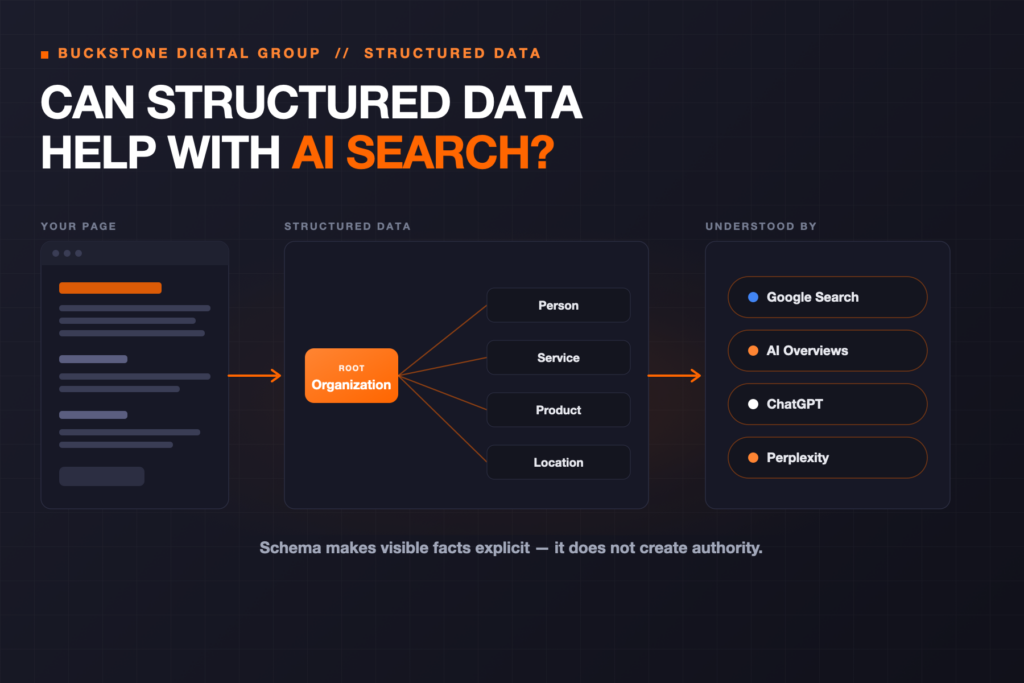
Structured data can genuinely clarify what an organization is, who authored an article, which company published it, what a product is, where a business is located, which services a page describes, and how those things relate to one another. What it cannot do is independently create expertise, trust, reputation, original evidence, reviews, industry experience, third-party validation, customer relevance, or recommendations.
Structured data can support AI Search Visibility by improving clarity and consistency, but it is not a direct or guaranteed route into AI-generated answers.
This article is the Understanding-layer companion to the rest of our series. If you have read whether your website is blocking AI crawlers (the Access layer), this is the next question: once systems can reach your pages, does schema help them understand you?
Key takeaways
Structured data and AI search, in one panel
- Structured data helps classify page content and clarify identifiable entities and relationships.
- Google uses structured data to understand content and support eligible search features.
- Google states structured data is not required for generative AI search and there is no special AI schema.
- OpenAI and Perplexity do not publicly guarantee that schema causes citations or recommendations.
- Schema must match visible content.
- Structured data cannot manufacture authority, reviews, expertise, or business relationships.
- Organization, Person, Article, Product, LocalBusiness, and other types are useful when they accurately represent the page.
- Not every Schema.org type is supported as a Google rich-result feature — and FAQ rich results have been retired entirely.
sameAscan clarify identity but is not an authority-transfer mechanism.- Stable entity IDs help connect repeated references to the same organization or person.
- Duplicate or conflicting markup can weaken clarity even when individual nodes are technically valid.
- Validation tools test different things and should not be confused.
- Schema should support the broader content, entity, technical SEO, and authority strategy.
- BuckStone audits the complete schema graph rather than merely installing a plugin.
What is structured data?
Structured data is machine-readable markup that describes what a page and its major elements represent.
A human visitor looking at your page already recognizes a company name, an author, a product, a price, a location, a review, an article, or an event. Structured data states those things explicitly, in a standardized format, so software does not have to infer them from layout and phrasing.
Three terms get used interchangeably and should not be. Schema.org is the shared vocabulary—a large set of types and properties maintained collaboratively. JSON-LD, Microdata, and RDFa are formats for expressing that vocabulary in a page; JSON-LD is the format Google recommends and the one most WordPress systems output. Google-supported structured-data features are the much smaller subset of types and properties that can make a page eligible for a specific search appearance.
That last distinction matters more than almost anything else in this article: Schema.org defines a broad vocabulary, while Google supports selected types and properties for specific search experiences. A type can be perfectly valid Schema.org and still have no corresponding Google feature at all.
What structured data actually does
Used honestly, structured data can classify the primary page type; identify an organization, author, product and offer, local business, event, video, job posting, or dataset; connect an article to its author and publisher; define breadcrumbs; and connect repeated references through stable entity IDs.
Notice the verbs. Structured data helps clarify, can support understanding, may make a page eligible, and reduces ambiguity. It does not force any platform to interpret a page a particular way, and no amount of markup obliges a system to show, cite, or recommend you.
What structured data does not do
What schema can do
- Classify the page type and its main entity
- Identify the organization, author, and publisher
- Define products, offers, locations, and events
- Make relationships between entities explicit
- Connect repeated references via stable IDs
- Support eligibility for documented search features
- Reduce ambiguity about visible facts
What schema cannot do
- Guarantee rankings, rich results, citations, or recommendations
- Create expertise, reputation, or reviews
- Replace content, links, or entity consistency
- Repair a crawl block or weak site architecture
- Make false information true
- Make a thin page authoritative
- Force a knowledge panel to appear
Schema can clarify evidence. It cannot substitute for evidence.
Structured-data audit
Is your schema clarifying your business—or creating more confusion?
BuckStone can audit every structured-data source on your website, identify duplicate entities, correct author and publisher relationships, and align the graph with your visible content.
Is structured data required for Google AI Mode or AI Overviews?
No—and Google says so plainly. Its guidance on AI features states that “you don’t need to create new machine readable files, AI text files, or markup to appear in these features,” and that “there’s also no special schema.org structured data that you need to add.” Google adds that “the best practices for SEO remain relevant for AI features in Google Search” and that there are “no additional requirements to appear in AI Overviews or AI Mode.”
Two of Google’s stated best practices are directly relevant here: making sure important content is available in textual form, and making sure your structured data matches the visible text on the page. Pages still need to meet ordinary technical and search eligibility requirements—which is exactly what showing up in Google AI Mode actually depends on.
This distinction matters commercially, because it is where a lot of money gets wasted. A business should not add invented “AI-specific” schema, install unsupported markup because an agency called it “GEO schema,” generate hundreds of properties with no visible support, or expect schema installation alone to change AI visibility. None of those are supported by Google’s documentation.
Does structured data help ChatGPT?
OpenAI publishes guidance about crawler access and search referrals—which bots exist, what each is for, and how publishers can allow or block them. It does not publicly state that any particular Schema.org type guarantees inclusion, citation, or recommendation in ChatGPT search.
A well-structured website may still be easier for automated systems to interpret, because the company is described clearly, authors are identifiable, services have substantial pages, relationships are consistent, metadata and visible content agree, important pages are accessible, and official profiles support the same identity. Those are the same qualities that help a business get recommended by ChatGPT in the first place. But it would be dishonest to attribute a specific citation to a specific property.
Structured data may contribute to a clearer public information environment, but OpenAI does not provide a public formula connecting specific schema properties to ChatGPT recommendations.
Does structured data help Perplexity?
The same discipline applies. Perplexity documents how its crawler surfaces and links websites in its search results, and how its user-triggered fetcher retrieves a page to answer a question. It does not publicly confirm that it relies on a particular schema type when selecting citations.
Accessible, clear, well-supported information is genuinely useful to any retrieval system. Schema is part of how you express that clarity—but it is not a Perplexity citation switch, and it should never be sold as one.
Structured data and entity SEO
Structured data is the technical expression of something larger: your entity system. Entities include the Organization, the People connected to it, its Products, Services, Places and LocalBusiness locations, its Articles and Events, and its Brand. Markup lets you state the relationships between them explicitly rather than hoping they are inferred.
The rule that keeps this honest: the schema graph should reflect the visible website and the real-world business. It should never become an invented parallel version of the company that exists only in JSON-LD.
The most relevant schema types for businesses
Not every business needs all of these. Use a type when it accurately describes something visible and important on the page.
| Type | What it can clarify | Watch out for |
|---|---|---|
| Organization | Name, URL, logo, description, contact, founders, official profiles | Duplicate or disconnected company nodes |
| LocalBusiness | Address, phone, hours, category, real locations | Service areas marked as physical offices |
| Person | Real authors, leaders, roles, employer, authored content | Invented expertise; several nodes per author |
| ProfilePage | That a page is a person’s profile | It does not prove expertise by itself |
| Article | Headline, author, publisher, dates, image | New author identity created per article |
| Product / Offer | Name, brand, SKU, price, currency, availability | Price/availability drifting from the page or feed |
| Service | What a service is, tied to the organization | Assuming it creates a rich result — it does not |
| BreadcrumbList | Page hierarchy and position | Markup that contradicts real navigation |
| VideoObject | Name, thumbnail, upload date, duration, publisher | Marking up video that isn’t actually present |
| Event | Genuine events with dates and locations | Promotions as “events”; expired data left live |
| FAQPage | Visible Q&A content on the page | Google retired the FAQ rich result — see below |
| Review / AggregateRating | Eligible ratings from real users | Strict self-serving-review restrictions |
Four of these carry enough nuance to deserve their own note.
Organization
Google documents that adding Organization markup can help it understand administrative details and disambiguate the organization. Use one coherent primary organization identity, reuse a stable @id, and do not create a disconnected new Organization node on every page. Your visible About page and company information should support whatever the markup claims.
Person and ProfilePage
Person markup clarifies real authors, founders, and experts—their role, profile page, employer relationship, and authored content. ProfilePage indicates that a page is that person’s profile. Neither proves expertise on its own. Avoid invented credentials, several disconnected Person nodes for one author, using a company logo as a person’s image, or publishing under “Admin.” At BuckStone, authors such as Jeff Palicki and Dalton West each have one real profile and one stable identity that every article references.
Product and Offer
Product businesses can define name, brand, SKU, price, currency, availability, offers, and eligible ratings. The hard part is consistency: product data should agree across the visible page, the structured data, feeds, Merchant Center, and marketplaces—a core part of ecommerce and marketplace growth. Never mark up unavailable products or reviews that do not exist.
FAQPage — and what actually happened to it
This one deserves a correction to a lot of agency advice. FAQPage markup identifies visible question-and-answer content on a page. In August 2023 Google limited FAQ rich results to well-known, authoritative government and health websites. Since then Google has gone further and retired the feature entirely: FAQ rich results stopped appearing in Search in May 2026, and Google removed the FAQ search appearance, its rich-result report, and Rich Results Test support in June 2026.
So: adding FAQPage markup today will not produce a visible FAQ rich result in Google Search. Google has also said sites do not need to rush to remove existing FAQ structured data, because unused structured data does not cause problems for Search. FAQ content remains genuinely useful to readers—just do not add FAQ schema because someone claims AI systems prefer it. No platform documents that.
Review and AggregateRating
Review markup carries strict eligibility rules. Google’s policy states that if the entity being reviewed controls the reviews about itself, its pages using LocalBusiness or any other Organization structured data are ineligible for the star review feature—including reviews placed on your own site directly or through an embedded third-party widget. Ratings must be sourced directly from users. In practice this means most businesses should not mark up their own testimonials, and should verify current requirements before implementing anything.
Stable entity IDs and the schema graph
Inside a JSON-LD graph, @id gives an entity a stable identifier that other nodes can point to. It looks like this:
// One reusable identifier for the same company
"@id": "https://example.com/#organization"
That single Organization ID can then be referenced by the WebSite node, by every Article’s publisher, by a Person’s employer, by the About page, by service pages, and by a LocalBusiness relationship where appropriate. Each real author likewise has one stable Person ID that every article they write points back to.
The purpose is coherent identity, not technical elegance. Ten nodes that all reference one Organization describe one company. Ten nodes with ten different Organization IDs describe, as far as a parser is concerned, ten companies.
What does sameAs do?
sameAs points to another URL that identifies the same entity—an official LinkedIn profile, an official company social profile, a recognized professional profile, Wikidata or Wikipedia where legitimately applicable, ORCID for researchers, or an official parent or association profile where it genuinely identifies the same entity.
Be precise
What sameAs does not do
- Transfer authority automatically
- Guarantee a knowledge panel, rankings, or AI recognition
- Turn every directory listing into an official identity source
- Replace external corroboration or visible biography and company information
Do not add every social, directory, and mention URL you can find. A short list of genuine identity references is more useful than a long list of weak ones.
Visible content and schema must agree
This is the single most common way structured data goes wrong, and Google’s guidance is explicit that markup should represent the visible page. Stale or contradictory schema can even be why AI shows incorrect information about your business. Contradictions we find regularly:
- Schema lists a service the page never mentions
- Schema gives one address while the footer shows another
- Article schema names Jeff as the author while the visible byline says Dalton
- Product schema shows one price while the page shows another
- Organization schema references a retired logo
- Person markup claims credentials absent from the biography
- Event markup includes an event that already happened
- LocalBusiness markup claims a location that is only a service area
- Review markup describes ratings the user cannot verify anywhere
- Schema identifies a staging-domain URL
Schema should describe the page. It should not create a hidden version of it.
Duplicate and conflicting schema
Multiple nodes are not automatically a problem. A single well-built page legitimately contains Organization, WebSite, WebPage, Article, Person, ImageObject, and BreadcrumbList nodes. Duplication only becomes harmful when separate systems produce disconnected or contradictory versions of the same entity.
The usual sources are stacked plugins and templates—an SEO plugin, theme-generated schema, page-builder widgets, a dedicated schema plugin, ecommerce and review and event plugins, manual JSON-LD, and tag-manager injections—each unaware of the others. The conflicts look like two Organization nodes with different IDs, several Person nodes for one author, different logos or names, contradictory author relationships, duplicate FAQPage nodes, lingering staging domains, or LocalBusiness and Organization nodes that never connect.
The fix is rarely “add more.” Choose one primary schema system and extend it carefully. On this site, Yoast is the primary graph source, and anything additional connects to it rather than competing with it.
Validation tools are not interchangeable
A great deal of confusion comes from treating “it passed” as one thing. These tools answer different questions.
| Tool | What it tests | What passing does not mean |
|---|---|---|
| Rich Results Test | Implementation & eligibility for Google-supported rich-result features | That the result will actually display |
| Schema.org Validator | Broader Schema.org syntax and vocabulary | That Google supports the type as a feature |
| Search Console | Detected issues & enhancement eligibility for supported features on real URLs | That the graph is strategically coherent |
| Raw source inspection | Which JSON-LD scripts actually render on the live page | That the values are accurate or useful |
| Complete graph review | Whether nodes connect coherently across templates | — this is the step most audits skip |
Valid syntax means the markup is well-formed. It does not mean the information is accurate, strategically useful, or eligible for anything.
Can structured data improve AI visibility?
Indirectly, yes—by reducing ambiguity, clarifying page type, connecting authors and publishers, identifying products and organizations and locations, improving consistency, supporting ordinary search features, and strengthening the technical expression of your entity system.
But actual visibility also depends on access, indexing or retrieval, relevance, content quality, original evidence, topical depth, entity clarity, external corroboration, competitive strength, prompt context, platform behavior, and what the user actually needs. Schema touches one of those.
Structured data can strengthen understanding, but understanding is only one requirement for visibility. For the Google-specific picture, see how to appear in Google AI Overviews.
If your business is absent from AI answers entirely, schema is rarely the first thing to fix—work through why your business is not appearing in AI search results first.
A practical structured-data audit
Nine steps, in order. Most sites fail somewhere in the first four.
- Identify the primary schema system. Determine whether markup comes from Yoast, Rank Math, the theme, a custom plugin, an ecommerce plugin, a page builder, tag manager, manual code, or several at once.
- Inventory the live schema graph. Read the actual rendered page source and record node types, IDs, authors, publishers, main entity, URLs, images, and page relationships.
- Check for duplicate identities. Compare Organization IDs, Person IDs, LocalBusiness IDs, product identities, and publisher and author references.
- Compare markup with visible content. Verify names, titles, addresses, services, products, prices, ratings, authors, dates, images, locations, and relationships.
- Check page-type appropriateness. Is this really an Article? A real Product? A physical location or a service area? Are those FAQs visible? Is the Event genuine? Is the Person profile substantive? Is the Organization node the same company used everywhere else?
- Validate syntax and Google eligibility using the correct tool for the correct question.
- Correct staging and migration leftovers — staging URLs, old domains, HTTP URLs, retired logos, former company names, removed authors, expired products, old addresses.
- Re-test the complete graph. Do not stop when one isolated node passes.
- Monitor after website changes — redesigns, migrations, plugin and theme updates, new locations, leadership changes, product launches, platform or SEO-plugin changes.
Organization
- One stable Organization identity
- Current name, correct URL, current logo
- Accurate official profiles
- Visible About information supports it
- No staging references
People and authors
- Real authors with accurate titles
- Public profile pages & stable Person IDs
- Correct author relationships
- Legitimate
sameAsprofiles - Approved author images
Pages and content
- Correct page type & accurate headline
- Correct dates and publisher
- Correct canonical
- Visible content matches markup
Products and services
- Accurate prices & current availability
- Correct brand and identifiers
- No unsupported ratings
- Substantial visible service content
Local information
- Real physical locations only
- Accurate hours, phone, address
- Service areas distinguished from offices
- Google Business Profile consistency
Technical quality
- Valid JSON-LD, no malformed scripts
- No duplicate or conflicting nodes
- No hidden active examples
- Accessible to crawlers; no stale cached markup
Beyond validation
Passing a validation test does not mean your schema system is coherent.
BuckStone evaluates the full graph across your website, templates, plugins, authors, services, products, locations, and external identity signals.
Common structured-data mistakes
- Installing several schema plugins that each emit their own graph
- Creating duplicate Organization nodes
- Adding schema not supported by visible content
- Marking every page as FAQPage
- Using LocalBusiness for locations that do not exist
- Creating a Person node with no real profile behind it
- Listing expertise the site does not demonstrate
- Adding every possible property “just in case”
- Treating warnings as fatal errors — or ignoring actual errors
- Confusing Schema.org validity with Google feature eligibility
- Assuming passing validation guarantees display
- Copying markup from another company
- Leaving placeholder values or staging URLs in production
- Failing to update prices and availability
- Adding self-serving review markup incorrectly
- Creating disconnected author nodes
- Using
sameAsas a directory dump - Injecting example JSON-LD as active schema
- Treating schema as the complete AI strategy
Should businesses add more schema for AI search?
Not automatically. Add or improve markup when it accurately represents important visible information, clarifies a real entity or relationship, corrects genuine ambiguity, supports a documented Google feature, improves consistency, integrates with the existing graph, and can realistically be maintained over time.
Do not add markup merely because a plugin offers it, a competitor has it, an AI tool generated it, a salesperson called it “GEO schema,” the type exists on Schema.org, or it increases the raw number of properties on the page.
How structured data fits BuckStone’s framework — and how we handle it
Across our five layers: Access means the page and its markup must be crawlable and retrievable in the first place. Understanding is where structured data does its real work, clarifying entities, page types, attributes, and relationships. Evidence means visible pages, case studies, products, reviews, and expert content have to support what the markup claims. Corroboration means external sources reinforce the same organization, people, services, and reputation. Measurement means tracking validation, search eligibility, AI descriptions, citations, accuracy, and business outcomes—covered in how to measure AI search visibility.
Structured data is most closely connected to Understanding, but it depends on every other layer.
In practice: we build a schema inventory of every source generating markup, then consolidate the graph, removing disconnected or contradictory nodes. We establish and reuse stable entity IDs for the Organization and each real Person, and wire up correct author and publisher relationships. We align Organization and LocalBusiness accuracy across company, location, contact, and profile information—work that overlaps with local SEO—and connect product and service markup to substantial visible pages, implemented as scalable templates through the appropriate WordPress, ecommerce, or development system rather than page by page.
Then we validate and QA: syntax, Google-supported features, graph relationships, visible-content alignment, logged-in and logged-out output, template consistency, duplicate nodes, and staging references—and maintain it after redesigns, migrations, plugin changes, and content expansion. This is technical SEO work, and it is considerably more than installing a plugin.
Final answer: can structured data help your business appear in AI search?
Yes—structured data can help a business appear in search and AI-driven discovery by making important facts and relationships easier to interpret. But it does not guarantee rankings, rich results, citations, mentions, recommendations, or knowledge panels, and no reputable partner will tell you otherwise.
The correct approach is to make important information visible and accurate; use appropriate schema types; reuse stable entity identities; connect authors, publishers, products, services, and locations correctly; remove duplicate and contradictory markup; validate with the correct tools; maintain the graph over time; and combine schema with access, evidence, corroboration, and measurement. That combination is what AI Search Visibility actually is.
Schema should clarify the truth about a business—not attempt to manufacture authority that the website and wider web do not support.
Work with BuckStone
Give search systems a clearer picture of your business.
BuckStone combines structured data, entity SEO, technical implementation, content strategy, and AI visibility measurement into one coordinated system.
Frequently asked questions
What is structured data?
Structured data is machine-readable markup that describes what a page and its major elements represent—the organization, author, product, price, location, or article on the page—in a standardized format so software does not have to infer them from the layout.
What is schema markup?
“Schema markup” is the common name for structured data written using the Schema.org vocabulary. It is usually implemented in JSON-LD, the format Google recommends, though Microdata and RDFa also exist.
Can schema markup help my business appear in ChatGPT?
It may contribute to a clearer public information environment, but OpenAI does not publicly state that any particular schema type causes inclusion, citation, or recommendation in ChatGPT. Access, clear visible content, consistent identity, and real evidence matter more.
Is structured data required for Google AI Mode?
No. Google states that you don’t need to create new machine-readable files, AI text files, or markup to appear in its AI features, and that there are no additional requirements to appear in AI Overviews or AI Mode beyond ordinary SEO best practices.
Is there special schema for AI search?
No. Google explicitly says there is no special Schema.org structured data you need to add for its generative AI features. Any product sold as “AI schema” or “GEO schema” is not based on published platform documentation.
Does structured data improve Google rankings?
Structured data can help Google understand a page and may make it eligible for supported rich-result features, but valid markup does not guarantee rankings or that any rich result will appear.
Which schema types are most useful for businesses?
Most commonly Organization, Person, Article, BreadcrumbList, and—where genuinely applicable—LocalBusiness, Product and Offer, Service, VideoObject, and Event. Use a type only when it accurately describes something visible and important on the page.
What is Organization schema?
Organization markup describes the company operating the site—name, URL, logo, description, contact details, founders, and official profiles. Google documents that it can help understand administrative details and disambiguate an organization. Use one coherent identity with a stable @id.
What is Person schema?
Person markup describes a real individual connected to the business—an author, founder, or subject-matter expert—including their role, profile page, employer relationship, and authored content. Each real person should have one stable Person identity, supported by a visible profile.
What does sameAs mean?
sameAs points to another URL that unambiguously identifies the same entity, such as an official LinkedIn profile or a recognized professional profile. It clarifies identity; it does not transfer authority, guarantee a knowledge panel, or improve rankings on its own.
What is a stable schema @id?
An @id is a stable identifier for an entity inside your JSON-LD graph, such as https://example.com/#organization. Reusing it lets every article, page, and Person node reference the same organization instead of creating a new one each time.
Can duplicate schema hurt a website?
Duplicate nodes are not automatically a penalty, and a page legitimately contains several node types. The problem is disconnected or contradictory versions of the same entity—two Organizations with different IDs, or several Person nodes for one author—which makes the graph harder to interpret.
Does FAQ schema improve AI visibility?
There is no published platform documentation supporting that claim. Google also retired the FAQ rich result: it stopped appearing in Search in May 2026, and the search appearance, report, and Rich Results Test support were removed in June 2026. Existing FAQ markup does not need to be removed, but it should not be added as an AI tactic.
What is the difference between the Schema.org Validator and Google’s Rich Results Test?
The Schema.org Validator checks broader Schema.org syntax and vocabulary. Google’s Rich Results Test checks implementation and eligibility for the specific structured-data features Google supports. Markup can be valid Schema.org while having no corresponding Google feature.
Does valid schema guarantee rich results?
No. Valid structured data may make a page eligible for a supported feature, but Google does not guarantee that any rich result will be shown. Eligibility and display are different things.
Should every service page use Service schema?
Not necessarily. Schema.org includes Service, but implementing it does not create a Google rich result. Use it when it accurately describes visible service information and fits your broader graph—and remember the substance of the service page matters far more than naming it in JSON-LD.
Can structured data replace visible content?
No. Google’s guidance is that structured data should match the visible content of the page. Markup that describes services, credentials, locations, or reviews a visitor cannot verify on the page is a policy problem, not a shortcut.
What is included in a structured-data audit?
Identifying every system generating markup, inventorying the live rendered graph, checking for duplicate Organization and Person identities, comparing markup against visible content, confirming page-type appropriateness, validating with the right tools, clearing staging and migration leftovers, re-testing the complete graph, and monitoring after site changes.
Sources & methodology
Platform claims here were checked against current official documentation. We distinguish Google-supported rich-result features from the broader Schema.org vocabulary, and we separate Google’s documentation, OpenAI’s and Perplexity’s documentation, and BuckStone’s implementation methodology. Where a platform does not publish a source-selection system—as with ChatGPT and Perplexity citation choices—we say so rather than inferring a formula. Notably, we verified that Google has retired the FAQ rich result rather than merely restricting it. All schema shown in this article is illustrative text only and is not emitted as active markup on this page.
- Google Search Central — Introduction to Structured Data
- Google Search Central — General Structured Data Guidelines
- Google Search Central — Structured Data Features Gallery
- Google Search Central — Organization Structured Data
- Google Search Central — LocalBusiness Structured Data
- Google Search Central — Article Structured Data
- Google Search Central — ProfilePage Structured Data
- Google Search Central — Product Structured Data
- Google Search Central — Review Snippet (self-serving review policy)
- Google Search Central — FAQ Structured Data (deprecation notice)
- Google Search Central Blog — Changes to HowTo and FAQ Rich Results
- Google Search Central — AI Features and Your Website
- Google Search Central — Optimizing for Generative AI Features
- Schema.org — Organization
- Schema.org — Person
- Schema.org — Service
- Schema.org — sameAs
- OpenAI — Publishers and Developers FAQ
- Perplexity — Perplexity Crawlers