
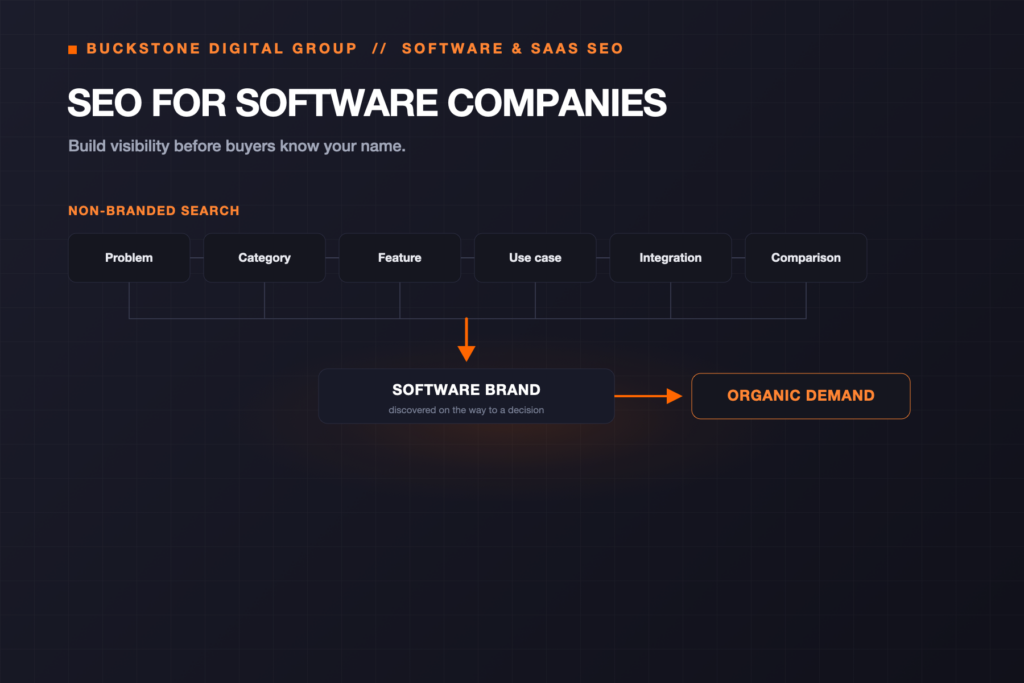
A software company can rank in the number-one position for [Brand Name], [Brand] login, and [Brand] pricing — and still be almost invisible to everyone who has never heard of it. The Search Console report fills with branded, navigational, and support queries. The rankings feel good. But they don’t create new demand.
Branded visibility proves people already know the company. Non-branded visibility determines whether new buyers can discover it. That single distinction is the difference between SEO as a brand-protection cost and SEO as an acquisition channel — and it’s where most software companies have the biggest, most under-worked opportunity.
SEO becomes an acquisition channel the moment a company starts appearing for the problems, categories, capabilities, use cases, integrations, and comparisons buyers search before they know the brand name. The goal is not to rank the homepage for “software.” It is to build a search architecture around the problems the product solves, the capabilities it provides, the environments it integrates with, and the buyers it serves.
- SaaS SEO should create non-branded discovery, not merely protect branded search.
- Software sites need architecture beyond homepage + pricing + blog — category, feature, use-case, industry, integration, and comparison pages.
- Category pages establish what the software is; feature pages explain capabilities; use-case pages connect capability to outcome.
- Integration pages capture high-intent compatibility searches — “will this fit our stack?”
- Comparison and alternative content serves evaluation-stage demand — done honestly, not as competitor spam.
- Documentation can support both discovery and validation for technical buyers.
- Case studies provide evidence; generic blog content rarely is enough.
- Programmatic SEO can work but creates real quality and indexation risk.
- Technical SEO matters, especially on JavaScript-heavy software sites.
- Branded and non-branded performance should be reported separately, and conversion measured alongside traffic.
- Strong traditional SEO increasingly supports AI-driven discovery too — but rankings don’t automatically produce AI recommendations.
What is SaaS SEO?
SaaS SEO is the process of making a software product discoverable through organic search across the entire buyer journey — from initial problem research and category discovery through feature evaluation, integrations, comparisons, alternatives, validation, and conversion. It is the practice of appearing for what buyers search on the way to a decision, not only for the company’s own name.
What it is not: publishing four blog posts a month and hoping. A keyword-driven blog with no commercial architecture behind it produces traffic that rarely converts and often never reaches the people evaluating software. SaaS SEO is an architecture problem first and a content problem second.
Why software SEO is different
Software is unusually dependent on the information surrounding the product, because the product itself cannot be inspected from a webpage the way a physical product can. A search engine can’t open the app, run a workflow, or test an integration. Its understanding depends entirely on positioning, language, documentation, information architecture, features, integrations, use cases, evidence, and external sources.
That has a direct consequence: if the website doesn’t clearly express what the product is, who it’s for, what problems it solves, and where it fits, search engines are left to guess — and a competitor with a clearer, better-organized answer will be easier to surface. The competing software company may not have the better product. It may simply be easier for search engines and buyers to understand where it fits.
The non-branded discovery problem
Most software companies already win their branded searches. The gap is everything else. Consider the two halves of a typical Search Console profile:
Both examples above are illustrative. The point is structural: a traffic graph can grow while actual market discovery stays flat if most of the growth comes from people already searching the brand. A software company wins organic discovery when it appears for problems, capabilities, categories, use cases, industries, integrations, alternatives, comparisons, and buying questions before the brand is already known.
This isn’t theoretical. For Pair Networks, a technology and web-hosting company, focused work on title-tag optimization grew non-branded visibility 48% — a direct example of shifting a profile away from brand-only rankings.
The SaaS buyer journey and search architecture
The most useful way to plan software SEO is to map searches to the stage of the buying process they belong to — then make sure a page exists to answer each one. The site architecture should follow the buying process, not the company’s internal org chart.
| Buyer stage | Search behavior | Best content type |
|---|---|---|
| Problem | “how do I solve X?” | Educational / problem content |
| Category | “software for X” | Category / product page |
| Capability | “software with X feature” | Feature page |
| Use case | “CRM for contractors” | Use-case / industry page |
| Compatibility | “X integrates with Y” | Integration page |
| Comparison | “A vs. B” | Comparison page |
| Alternatives | “alternatives to A” | Alternative page |
| Validation | “[brand] reviews” | Reviews / case studies |
| Decision | “[brand] pricing / demo” | Pricing / conversion page |
Most software sites have the top (problem/blog) and the bottom (pricing/demo) and almost nothing in the commercially decisive middle — the category, feature, use-case, integration, and comparison pages where evaluation actually happens.
The pages that create non-branded discovery
These are the page types that turn a brochure site into a discovery engine. Each answers a different search, and each should be built only where genuine demand and depth exist.
Category positioning
A product has to be understandable in the language buyers already use. Category creation and category capture are different jobs: a company can introduce distinctive positioning while still targeting the terminology buyers search. If a brand calls itself a “revenue intelligence workspace” but the market searches “sales analytics software,” both may need representation. A company can introduce a new category without becoming invisible for the language buyers already use.
Product pages
The core product page should establish, unambiguously: what it is, what it does, who it’s for, the primary problem it solves, key capabilities, differentiation, proof, and a clear next step. The most common failure is vague SaaS copy. When a software company says it “empowers teams to work smarter,” it may sound polished to humans while communicating almost nothing about what the product actually does — and nothing a search engine can match to a query.
Feature pages
A feature deserves its own URL when it has meaningful search demand, is a major buyer criterion, is strategically important, supports multiple use cases, and can be covered with real depth — not for every small UI function. Map each one feature → problem → outcome → evidence. Feature pages should explain customer value, not simply repeat the product navigation.
Use-case pages
These are the most underused pages in SaaS. Buyers frequently search for the outcome — “automate customer onboarding,” “reduce manual invoice processing,” “centralize client communications,” “monitor cloud infrastructure” — before they know which feature enables it. Use-case pages connect capability to the need the buyer actually feels.
Industry pages
Verticalization works when the page proves the product understands the industry’s workflow: the industry problem, its workflow and requirements, how the product applies, the terminology, relevant integrations, and evidence. An industry page should demonstrate that the product understands the industry’s workflow, not merely announce that the company serves the industry. Swapping only the industry name across a template is exactly the pattern that generic content that fails in search is made of.
Integration pages
Integration searches often answer a late-stage buying question: “Will this fit into our technology stack?” Searches like “[product] Salesforce integration” or “[product] QuickBooks integration” carry strong commercial intent. A good integration page explains what connects, what data moves, the use cases it enables, setup, benefits, honest limitations where relevant, and links to documentation. For products with a real ecosystem, these pages are one of the highest-ROI non-branded assets available.
Documentation, comparisons, and alternatives
Documentation as SEO
For technical products, documentation is not only a support asset — for developers and evaluators it can be part of product discovery and validation. API docs, knowledge bases, configuration and implementation guides, technical specifications, and security documentation all capture long-tail technical searches and reassure buyers who need to see how something works before they commit. Crawl and index decisions here should be strategic: not every support URL needs to rank, and a sprawling, thin help center can dilute more than it helps.
Comparison pages
“A vs. B” and “[brand] vs. [competitor]” searches are evaluation-stage gold, but they demand integrity. Avoid fake neutrality; be factual; compare meaningful factors — customer fit, capabilities, implementation, integrations, pricing where it’s current and public, support, and use cases. The goal of comparison content is to help the right buyer choose, not to pretend every buyer should choose you.
Alternative pages
“Alternatives to [competitor]” is high-intent, and it’s easy to do badly. A legitimate alternatives page identifies real scenarios, provides genuine options, compares honestly, and explains fit — it does not invent competitor claims or pricing, or spin up low-quality competitor-spam pages. Done well, it captures buyers actively in-market; done cheaply, it becomes exactly the kind of thin content search engines increasingly discount.
Product-led and programmatic SEO
Product-led SEO
Product-led SEO turns the product itself, or utilities adjacent to it, into discovery assets: free tools, templates, calculators, datasets, public profiles, generators, and searchable libraries that rank on their own and preview the product’s value. The discipline is relevance — a free tool should support product relevance, not exist only because SEO marketers like tools. The best of these are simultaneously linkable assets, lead-generation surfaces, and product previews.
Programmatic SEO
Programmatic SEO — generating pages at scale across dimensions like integrations, industries, templates, or use cases — can work when the combinations create genuinely distinct value. It fails when they don’t, producing thin pages, duplicate content, index bloat, and crawl waste.
Before scaling, ask whether each generated page answers a real, distinct search with real, distinct content. If a template can’t produce a genuinely useful page for a given combination, that combination shouldn’t be a page. Scale the ones that clear the bar; suppress the rest.
Content, evidence, and case studies
Blog and educational content
Blog content still matters — but as expertise, not keyword inventory. Skip the “what is CRM?” and “top 10 benefits” filler and the generic AI-written articles with no point of view. Prioritize implementation issues, technical decisions, benchmarks, original research and data, buyer comparisons, workflow advice, regulatory changes, and genuine expert analysis. A blog should expand the expertise surrounding the product, not become a warehouse for keywords.
Case studies and evidence
Case studies serve SEO and conversion at once: a strong one establishes customer type, problem, implementation, product use, outcome, and proof — and shouldn’t be buried in a gated PDF when an indexable HTML page would also earn search visibility. BuckStone’s technology work includes Pair Networks, where structural SEO drove a 50% increase in organic traffic and a 25% increase in ranking keywords, and the separate non-branded visibility gain of 48% noted earlier. (Pair Networks is a technology and web-hosting company; the figures are theirs, and shouldn’t be read as a generic guarantee.)
Third-party ecosystems and reviews
Software buyers rarely decide on your site alone. Review platforms and directories (G2, Capterra), marketplaces and integration directories, partner ecosystems, customer sites, and — for developer tools — ecosystems like GitHub all reinforce category, features, customers, reputation, and comparisons. You can’t manipulate or script this, but you can make sure the external picture is accurate and complete, because third-party sources shape how you’re understood. Reviews are best read as buyer validation and product intelligence — recurring themes, customer type, strengths, implementation, support — never as SEO copy to be scripted.
Technical SEO and internal linking
The best SaaS content strategy cannot compensate for pages Google cannot reliably crawl, index, or understand. Software sites carry a distinctive set of technical risks worth auditing directly:
- JavaScript rendering — is the marketing content in the rendered HTML, not only client-side?
- App vs. marketing boundary — is the logged-in app kept out of the index cleanly?
- Subdomains & docs — are docs/help/blog subdomains intentional and consistent?
- Canonicals & parameters — faceted URLs, query params, and duplicate product pages resolved?
- Staging & internationalization — staging noindexed; hreflang correct where used?
- Indexation — are the pages that should rank actually indexed, and the thin ones not?
- Orphan pages — are key commercial pages linked from somewhere real?
- Sitemaps — accurate, segmented, and free of noise?
- Migrations — redirects mapped and preserved through replatforms?
- Core Web Vitals — performance acceptable where it affects experience and crawl?
The same principles behind technical SEO for AI search apply here. And architecture is only as strong as its links: internal linking should connect the product’s capabilities to the problems, markets, and evidence surrounding them — homepage to product, product to feature, feature to use case, use case to industry, industry to integration, all of it to case studies and relevant blog analysis. Isolated content clusters that never link to the commercial architecture waste their own authority.
Keyword research and branded-vs-non-branded reporting
Software keyword research is a classification exercise, not a volume ranking. Group queries by intent — problem (“how to automate X”), category (“X software”), feature (“software with X”), use case (“X software for Y”), integration (“X + Y integration”), comparison (“A vs. B”), alternatives (“alternatives to A”), and branded — because the intent, not the volume, tells you what the page must do. A 100-search-per-month query near a purchase decision may be more valuable than a 10,000-search informational query with no product relevance (framed as a strategy for prioritization, not a universal rule). This is a different discipline from entity SEO, which makes the company itself unambiguous; both matter.
Then report branded and non-branded separately — always. It’s the only way to see whether SEO is actually creating market discovery or just re-counting existing awareness. Track demo requests, trials, product signups, qualified leads, pipeline, and revenue where attribution allows, not traffic alone. The objective is not simply more organic traffic. It is greater visibility at the moments when buyers are discovering, comparing, validating, and selecting software. Rankings are evidence of visibility; pipeline is evidence that visibility is creating business value.
PLG vs. sales-led, and pricing
Growth model shapes emphasis. Product-led companies often lean on free-product surfaces, templates, use cases, and activation-oriented resources; sales-led and enterprise companies lean on industry pages, security and implementation content, integrations, case studies, and complex buyer questions. Many are hybrids and need both. On pricing pages: pricing intent exists whether or not you publish numbers. If the business model genuinely prevents public pricing, don’t force it — but do answer the related concerns (what determines price, packages, the demo process, what to expect) rather than leaving a thin page that satisfies no one.
SEO and AI Search Visibility for software
Buyer discovery is expanding beyond traditional results into AI Overviews, Google’s AI Mode, ChatGPT, Perplexity, and other AI-assisted research. The good news for software companies: the foundations that make a product understandable to search — clear architecture, real answers in crawlable text, strong evidence, and external corroboration — are the same foundations that make it retrievable and citable in AI experiences. The caution: strong rankings do not automatically produce AI recommendations, and this is a traditional-SEO article, not an AEO guide.
Software companies should not build one website for Google and another information strategy for AI. The stronger approach is to create a product-information system that works across both. For the AI-specific deep dive — how software brands get found and recommended in ChatGPT and AI search — see AI Search Visibility for Technology & SaaS Companies. For the broader conceptual picture, AI SEO vs. traditional SEO.
Diagnosing a software company that only ranks for its brand
Branded visibility is not failure. It is an incomplete acquisition strategy. If a software company ranks well for its own name and little else, work down this list — each missing item is a place non-branded discovery is leaking away.
- Category, feature, and use-case pages that exist and rank?
- Industry pages that prove workflow understanding?
- Integration, comparison, and alternative pages for evaluation-stage demand?
- Documentation and expert content that support discovery and validation?
- HTML case studies providing indexable evidence?
- Internal links connecting capabilities to problems, markets, and proof?
- Clean technical indexation — the right pages in, the thin ones out?
- Accurate third-party presence (directories, reviews, ecosystems)?
- Backlinks and corroboration that reinforce category and reputation?
- Conversion tracking that separates branded from non-branded outcomes?
The same lens works on competitors. When a competitor consistently out-ranks you for non-branded terms, audit the difference across ranking categories, page architecture, features, use cases, industries, integrations, comparisons, content, evidence, backlinks, and third-party profiles. The competitor may not have better software. It may simply provide a better-organized answer to what buyers are searching for. A focused software SEO audit turns that comparison into a prioritized plan across technical health, branded/non-branded keyword mix, commercial architecture, content and evidence, off-site presence, and measurement — a narrower, SEO-specific cousin of the broader AEO audit.
Timelines, ROI, and choosing an agency
How long does SaaS SEO take? There’s no universal timeframe, and anyone promising one is guessing. It depends on existing authority, site health, competition, category maturity, content architecture, technical issues, and market demand. Expect leading indicators — non-branded impressions, ranking coverage, qualified landing-page traffic — to move before business outcomes like trials, demos, pipeline, and revenue.
How to measure ROI: separate leading indicators (non-branded impressions and clicks, ranking coverage, qualified traffic) from business outcomes (trials, demos, MQL/SQL where applicable, pipeline, customers, ARR where attribution allows). How to choose an agency: the right partner understands SaaS buyer journeys, works with product marketing, has real technical-SEO depth, separates branded from non-branded, builds commercial architecture rather than just publishing posts, understands integrations and documentation, can measure to pipeline, can actually execute, and understands how AI Search Visibility fits as search evolves. The full checklist for evaluating a partner is in how to choose an AEO agency.
How BuckStone approaches technology and software SEO
BuckStone connects the pieces most software companies run separately: technical SEO, information architecture, non-branded keyword strategy, product and service positioning, feature and use-case and industry pages, integrations, original content, case studies, entity SEO, AI Search Visibility, conversion, analytics, and paid search where it fits. We’re not trying to generate traffic for traffic’s sake. We’re building visibility around the problems, capabilities, comparisons, and decisions that can create qualified demand — the work behind our SEO service and SEO for technology companies. The goal, throughout, is to make the software easier to discover before the buyer knows its name.
Frequently asked questions
What is SaaS SEO?
SaaS SEO is the practice of making a software product discoverable through organic search across the whole buyer journey — problem research, category discovery, feature evaluation, integrations, comparisons, alternatives, validation, and conversion — not just ranking for the company’s own name.
How does SEO work for software companies?
It works by building pages that match how buyers search at each stage — category, feature, use-case, industry, integration, comparison, and alternative pages — supported by technical health, evidence, and internal linking, so the product appears before buyers know the brand.
Is SEO effective for SaaS businesses?
Yes, when it targets non-branded, high-intent demand rather than generic traffic. Effectiveness comes from commercial architecture and measurement to pipeline — not from publishing volume. Poorly targeted SaaS SEO produces traffic that never reaches buyers.
How is SaaS SEO different from traditional SEO?
The fundamentals are the same, but software is intangible, so understanding depends heavily on positioning, documentation, integrations, and evidence. SaaS SEO also leans harder on commercial page types — features, use cases, integrations, comparisons — and on separating branded from non-branded results.
Why does my software company only rank for branded searches?
Usually because the site has a homepage, pricing, and a blog but lacks the middle architecture — category, feature, use-case, integration, and comparison pages — that captures non-branded demand. Branded-only ranking is an incomplete acquisition strategy, not a failure.
How do SaaS companies build non-branded organic traffic?
By building pages around the problems, categories, capabilities, use cases, industries, integrations, and comparisons buyers search before they know the brand — then supporting them with technical health, evidence, internal links, and external corroboration.
What pages should a SaaS website have for SEO?
Beyond homepage, pricing, and blog: category/product pages, feature pages, use-case pages, industry pages, integration pages, comparison and alternative pages, documentation, and HTML case studies — each built only where genuine demand and depth exist.
Do feature pages help SaaS SEO?
Yes, when a feature has real search demand, is a major buyer criterion, and can be covered with depth. Map each feature to problem, outcome, and evidence — and don’t create a page for every minor UI function.
What are SaaS use-case pages?
Use-case pages target the outcome a buyer wants — “automate onboarding,” “reduce manual invoicing” — and connect it to the feature that delivers it. Buyers often search the outcome before they know which capability enables it, which makes these pages high-value and underused.
Do integration pages help software SEO?
Often significantly. Integration searches (“[product] Salesforce integration”) answer a late-stage question — will this fit our stack? — and carry strong commercial intent. Explain what connects, what data moves, setup, benefits, and honest limitations.
Should SaaS companies create competitor comparison pages?
Yes, if done with integrity: factual, non-neutral-in-name-only comparisons across meaningful factors that help the right buyer choose. Avoid fake neutrality and never invent competitor claims or pricing.
Should SaaS companies create “alternatives to” pages?
They can capture high-intent, in-market buyers — but only when legitimate: real scenarios, genuine options, honest comparison, and clear fit. Low-quality competitor-spam alternative pages are thin content that search engines increasingly discount.
What is product-led SEO?
Product-led SEO uses the product or adjacent utilities — free tools, templates, calculators, datasets, generators, public libraries — as discovery assets that rank on their own and preview the product’s value. The test is genuine product relevance, not novelty.
Does programmatic SEO work for SaaS?
It can, when generated combinations create genuinely distinct value — across integrations, industries, or use cases. It fails when they don’t, creating thin pages, duplication, and index bloat. The ability to generate 50,000 URLs doesn’t mean search engines need them.
Does documentation help software SEO?
For technical products, yes — docs capture long-tail technical searches and help evaluators validate the product. Make indexing decisions strategically; not every support URL needs to rank, and a thin, sprawling help center can dilute more than it helps.
Should SaaS companies publish blog content?
Yes, but as expertise, not keyword inventory. Prioritize implementation issues, benchmarks, original research, buyer comparisons, and expert analysis over “what is X” filler. A blog should expand the expertise around the product.
How important are case studies for SaaS SEO?
Very — for both SEO and conversion. A strong case study establishes customer type, problem, implementation, use, and outcome, and earns search visibility when published as indexable HTML rather than buried in a gated PDF.
Does technical SEO matter for software companies?
Critically. JavaScript rendering, app-vs-marketing boundaries, subdomains, canonicals, parameters, indexation, and migrations are common failure points. The best content strategy can’t compensate for pages Google can’t reliably crawl, index, or understand.
How should SaaS companies do keyword research?
Classify queries by intent — problem, category, feature, use case, integration, comparison, alternative, branded — not just by volume. A low-volume query near a purchase decision can be worth more than a high-volume informational one with no product relevance.
What is the difference between branded and non-branded SaaS traffic?
Branded traffic comes from people already searching your company or product name; non-branded comes from problems, categories, capabilities, and comparisons. Branded proves awareness; non-branded creates new discovery. Report them separately or growth can look real while market discovery stays flat.
How do you measure SaaS SEO ROI?
Separate leading indicators (non-branded impressions and clicks, ranking coverage, qualified traffic) from business outcomes (trials, demos, MQL/SQL, pipeline, customers, ARR where attribution allows). Rankings show visibility; pipeline shows business value.
How long does SaaS SEO take?
There’s no universal timeframe. It depends on existing authority, site health, competition, category maturity, architecture, technical issues, and demand. Leading indicators typically move before pipeline and revenue — be wary of anyone promising a fixed timeline.
How is SaaS SEO different from ecommerce SEO?
Ecommerce optimizes catalogs of inspectable products with transactional intent; SaaS optimizes an intangible product whose understanding depends on positioning, documentation, integrations, and evidence, across a longer evaluation journey of features, use cases, and comparisons.
Does SEO help software companies appear in AI search?
Strong SEO foundations — crawlable answers, clear architecture, evidence, and corroboration — also help AI systems retrieve and cite a product. But rankings don’t automatically produce AI recommendations; AI visibility is a related, separate discipline.
How is AI Search Visibility changing SaaS SEO?
Discovery is spreading across AI Overviews, AI Mode, ChatGPT, and Perplexity, so the goal shifts from ranking a page to being an understandable, well-evidenced answer. The right move is one product-information system that works for both search and AI — not two strategies.
What should a SaaS SEO audit include?
Technical health (crawl, render, canonicals, indexation), branded/non-branded keyword mix, commercial architecture (category, feature, use-case, industry, integration), content and evidence, off-site presence, and measurement to pipeline — turned into a prioritized plan.
How do I choose an SEO agency for a software company?
Look for real SaaS buyer-journey understanding, technical-SEO depth, branded/non-branded separation, commercial-architecture building, integration and documentation fluency, measurement to pipeline, execution ability, and an understanding of AI Search Visibility as search evolves.
What is a Digital Visibility Brief?
BuckStone’s Digital Visibility Brief is an executive, five-minute diagnostic showing how your business appears across Google and AI-driven discovery, where competitors are capturing non-branded demand, and which priorities deserve attention first.
Sources & methodology
This article reflects established, current SEO practice for software companies and BuckStone’s methodology; it distinguishes documented search behavior (Google’s crawling, rendering, indexing, and snippet fundamentals, and how AI features such as AI Overviews and AI Mode draw on the same index — verify current Google Search Central documentation before relying on specifics) from BuckStone methodology and strategic judgment (clearly framed as such). Product, category, feature, integration, comparison, and keyword examples are illustrative and not descriptions of specific clients. Case-study figures — Pair Networks’ 50% organic-traffic and 25% ranking-keyword gains, and the separate 48% non-branded visibility gain — are drawn directly from the linked BuckStone case studies; Pair Networks is a technology and web-hosting company, and those results are specific to that engagement, not guarantees. No companies, metrics, results, or AI outputs were fabricated, and nothing here promises a specific ranking, timeline, or AI recommendation. Primary references: Google Search Central documentation (crawling, indexing, snippets, AI features) and the linked BuckStone case studies.