
Home / Case Studies / Ecommerce
Ecommerce · AI Search Visibility
How Packer’s Pine Beat Bigger Brands in AI Search
A focused SEO a
d AI visibility strategy helped Packer’s Pi
e ea
top recomme
datio
s from ChatGPT a
d Google, i
crease its AI me
tio
s by approximately 230%, a
d reach a
estimated AI audie
ce
early 10 times larger tha
a direct competitor.
AI mention, sentiment, share-of-voice and audience figures come from AI visibility tracking between November 2025 and April 2026. “AI audience” is an estimated potential audience, not website visits or customers.
Client Overview
Packer’s Pine has been making pine tar soap since 1869 — more than 150 years in a category most brands entered in the last five.
It sells direct through its own store and through major retailers, with a loyal customer base built on a formulation people have trusted for generations. Like a lot of ecommerce brands with real heritage, its reputation was well established with customers — and far less obvious to the systems now answering product questions on their behalf.
The Challenge
Packer’s Pine has genuine authority. It has been making pine tar soap since 1869, it has decades of product experience behind it, and it sits on shelves next to brands a fraction of its age.
But longevity doesn’t guarantee visibility. Packer’s Pine competes with brands like Dr. Squatch — companies with far bigger advertising budgets, more aggressive content programs and mainstream awareness bought through heavy paid media.
The job wasn’t to invent authority. It was to translate the authority Packer’s Pine already had — its history, its formulation expertise, its product range — into the clear, structured signals Google, ChatGPT and other AI systems use when they decide which brands to cite and recommend.
AI engines can’t recommend authority they can’t clearly understand.
The Strategy
We ran this as an SEO program, not an “AI SEO” experiment. Everything below is what made Packer’s Pine legible to AI systems: better product data, better content, clearer structure and consistent measurement.
1. Strengthened product-level authority
We improved core product pages, product information, metadata and structured product data so search engines and AI systems could clearly understand what Packer’s Pine sells, what makes it different and which customer needs its products address.
2. Refreshed existing informational content
Rather than publishing new articles for the sake of volume, we used performance data to find content Google already understood but that had lost traction or needed more depth. We rewrote headers and copy, tightened metadata, fixed internal links and restructured pages — making the information easier for people and AI systems to extract, understand and cite.
3. Answered the questions customers actually ask
We targeted high-intent and problem-aware questions across pine tar soap, sensitive skin, dry skin, antibacterial soap, natural soap, body wash and scalp irritation. Each page got concise direct answers, stronger supporting explanation and FAQ sections built to win traditional search features while making the content easier for AI to reuse.
4. Added structured FAQ data
We implemented FAQ schema where it fit, making the relationship between each question and answer explicitly machine-readable. That supports traditional SERP visibility and AI citation eligibility at the same time.
5. Built comparison content
We created clear, crawlable comparisons between Packer’s Pine and competing products, organizing ingredients, price, history, benefits and value in a format search engines and AI systems can evaluate. That put Packer’s Pine inside the exact comparisons buyers were already asking ChatGPT and Google to make.
6. Improved internal linking and topical relationships
We connected informational articles, product pages, comparison content and related customer questions. This gave search engines a clearer picture of the brand’s topical depth and moved readers naturally from research to the relevant product.
7. Reinforced trust and entity signals
We consistently reinforced the brand’s history, category relevance, retailer presence, product experience and long-standing reputation — making it unmistakable that Packer’s Pine isn’t another generic soap company, but a legitimate authority in the pine tar category.
8. Monitored AI visibility and followed the data
We tracked brand mentions, estimated audience, share of voice, sentiment, cited pages, competitor visibility and the specific topics generating AI recommendations — then used those findings to close gaps, prioritize the next round of work and reinforce the signals already producing results.
There was no secret AI hack. We applied strong SEO fundamentals, structured the information properly, followed the data and kept improving the content. That is what made Packer’s Pine easier for AI systems to understand, trust and recommend.
The Results
The important part isn’t that Packer’s Pine started showing up for its own name. It’s that the brand began appearing for non-branded, commercially valuable questions — the ones people ask when they are actively deciding which pine tar soap to buy.
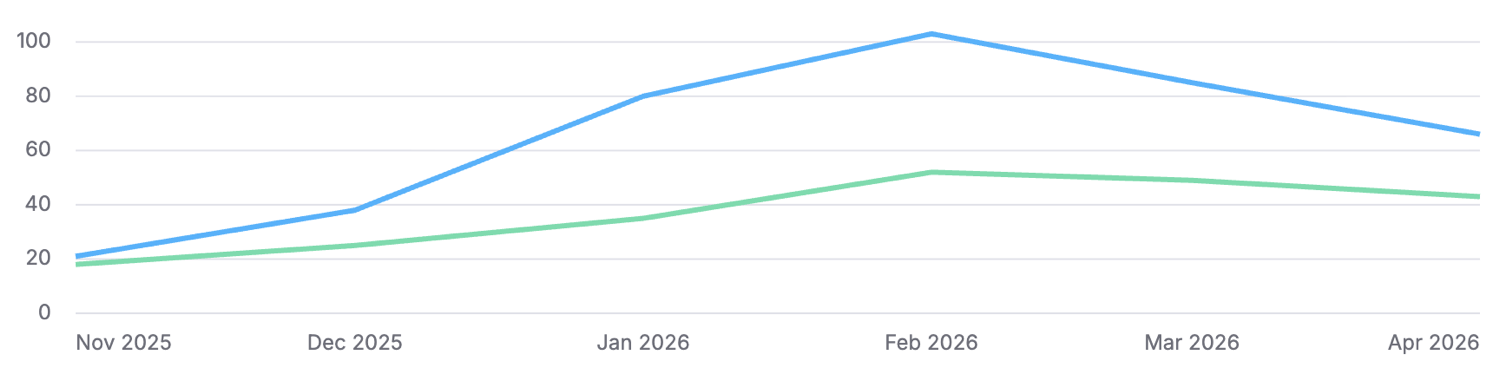
Tracked AI mentions increased from roughly 20 in November 2025 to 66 in April 2026 — 230% above the starting point — even after peaking at about 103 in February 2026.
Over the same window, Packer’s Pine reached an estimated AI audience of about 1.9 million, against 190,900 for Nostalgic Skincare — nearly 10 times the estimated AI audience. That figure is an estimated potential audience, not website visits.
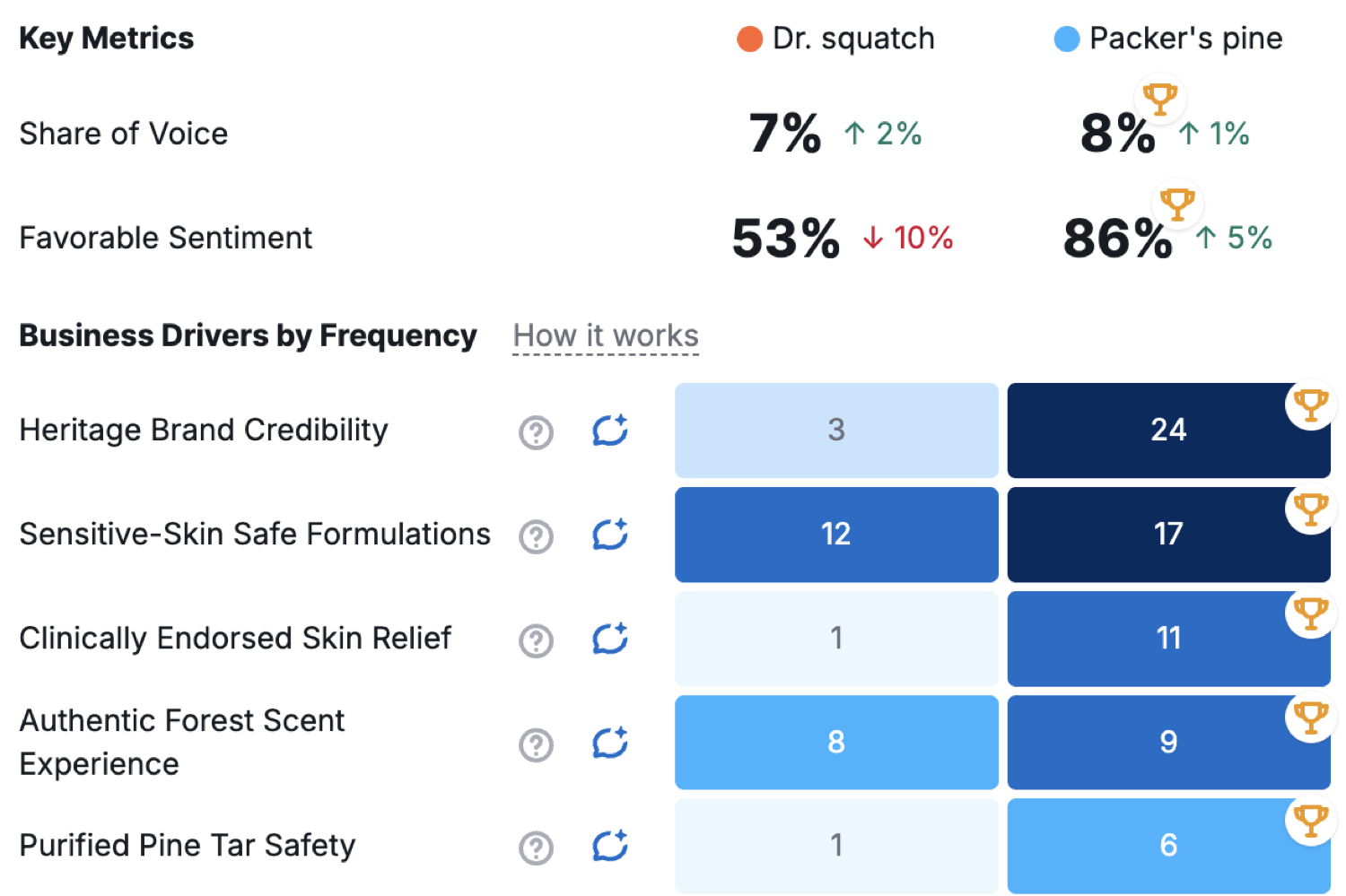
Against Dr. Squatch — a brand with far more marketing muscle — Packer’s Pine held 86% favorable AI sentiment to Dr. Squatch’s 53%, and an 8% AI share of voice against 7%. It also came out ahead across all five tracked AI buying drivers:
- Heritage brand credibility
- Sensitive-skin-safe formulations
- Clinically endorsed skin relief
- Authentic forest scent experience
- Purified pine tar safety
Against Nostalgic Skincare, Packer’s Pine recorded 66 AI mentions to 43 — roughly 54% more.
And when buyers asked directly, the recommendations followed:
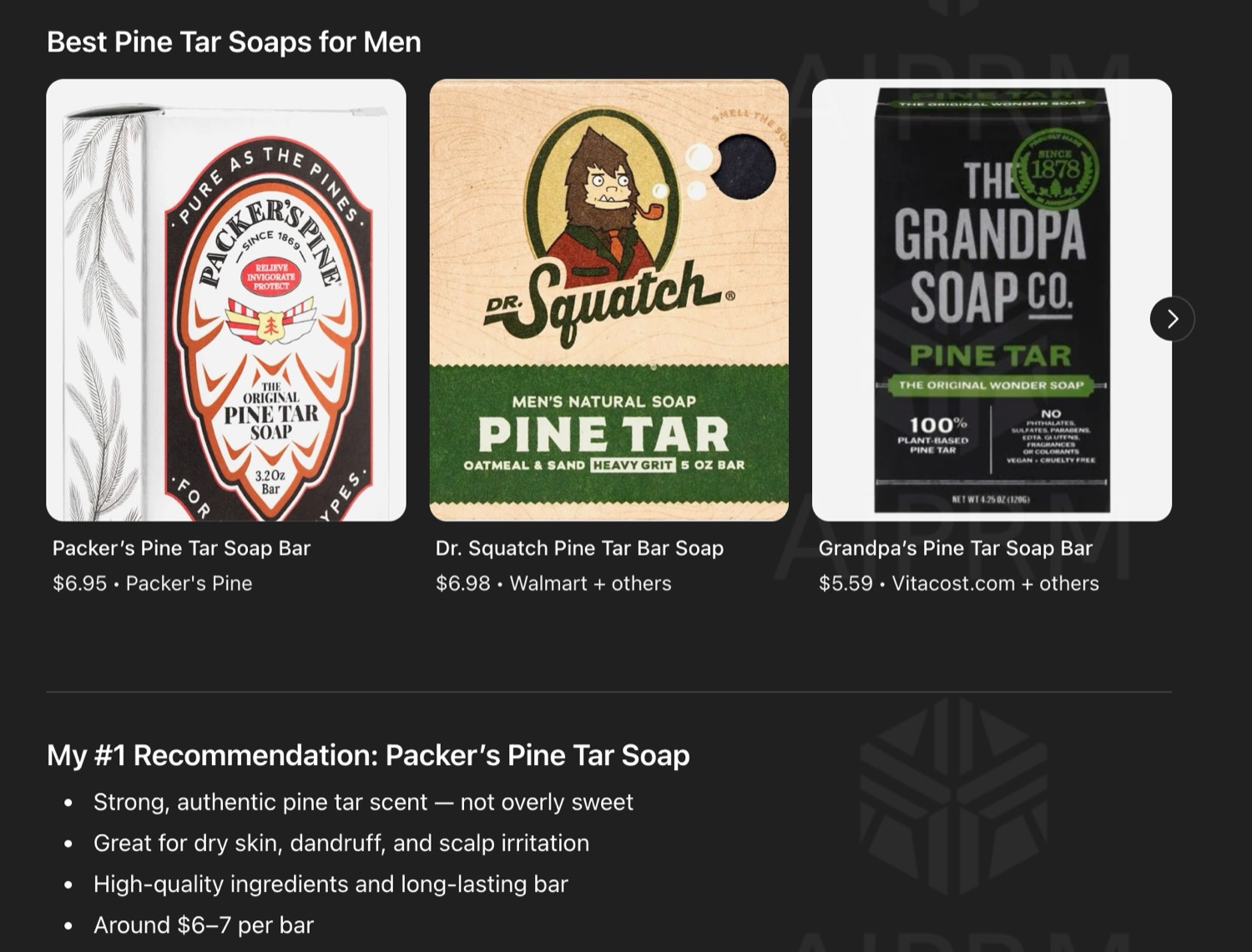
- Asked “I’m looking to buy pine tar soap for men,” ChatGPT put Packer’s Pine first.
- ChatGPT named it “Best Overall” pine tar soap, ahead of Dr. Squatch and Grandpa Soap.
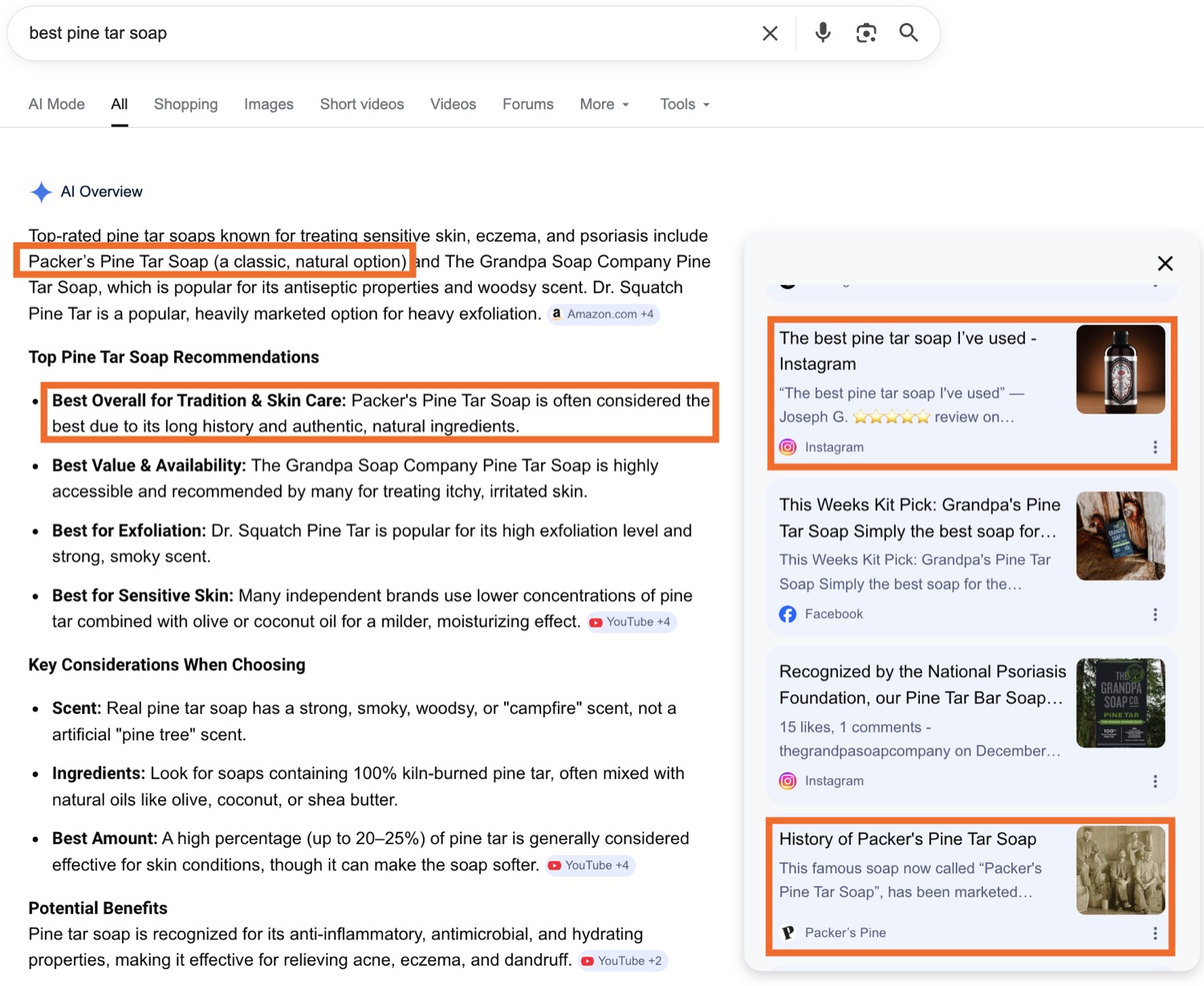
- Google’s AI Overview for “best pine tar soap” called it “Best Overall for Tradition & Skin Care.”
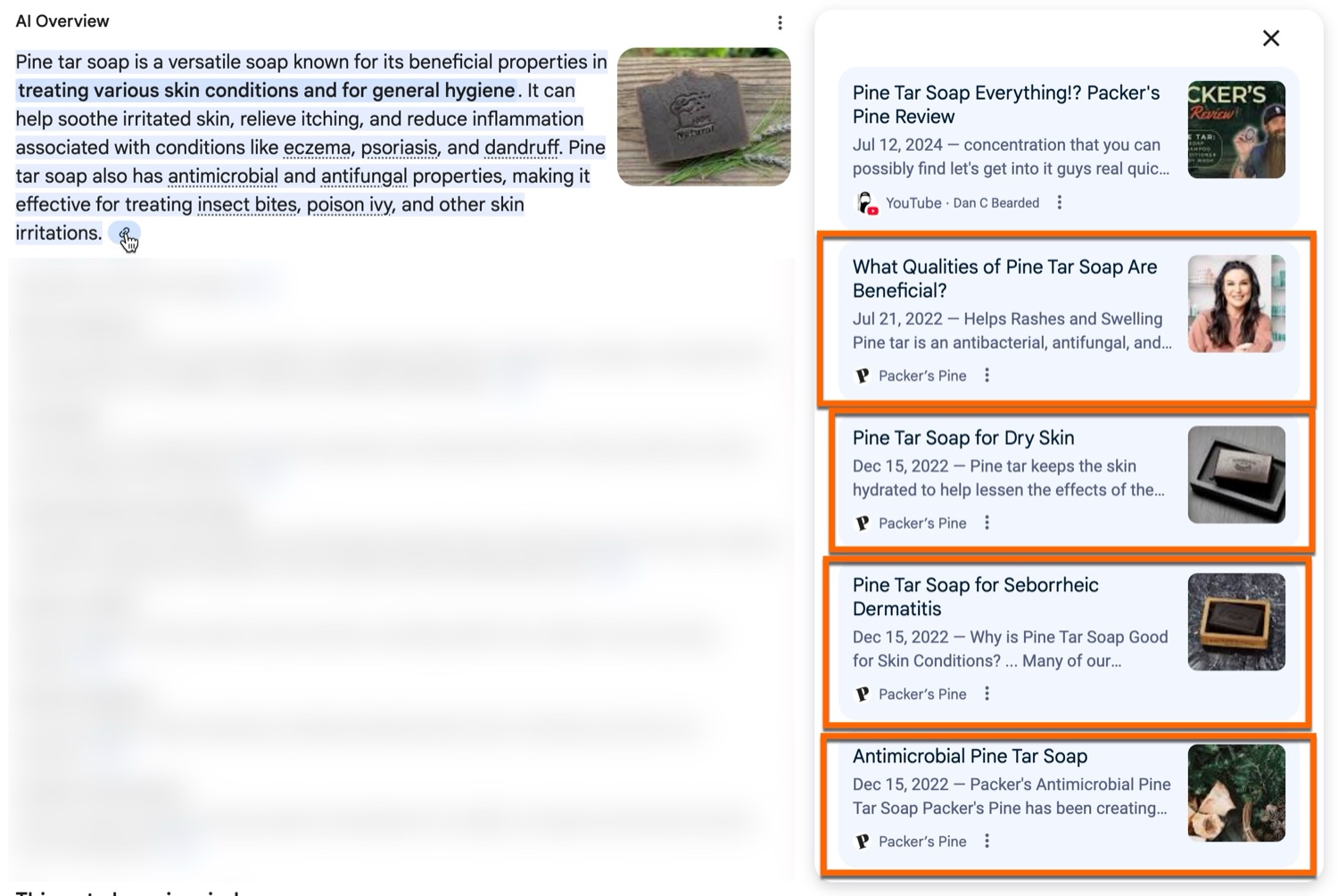
- In another Google AI Overview for “pine tar soap,” four of the five citations came from Packer’s Pine content — citing both the website and supporting social content.
Visual Proof
These are pulled straight from AI visibility tracking and live AI results — the evidence behind the numbers above.

Why It Worked
Four things made the difference.
- We made the brand legible. AI systems recommend what they can parse. Structured product data, FAQ schema and cleaner page structure turned real expertise into signals machines can actually read.
- We competed on substance, not spend. Packer’s Pine can’t outspend Dr. Squatch. It didn’t need to — it out-explained it, inside the exact comparisons buyers ask AI to make.
- We used what already existed. Refreshing content Google already trusted moved faster than starting from scratch.
- We measured what mattered. Tracking mentions, sentiment, share of voice and cited pages showed which topics were producing recommendations — so we could do more of what worked.
None of it required a trick. It required doing SEO properly and making the brand’s authority impossible to miss. If you want the mechanics, we cover them in our guides to getting recommended by ChatGPT and showing up in Google AI Mode.
The takeaway isn’t that Packer’s Pine got more visible. It’s that a 150-year-old brand, with a fraction of its competitors’ marketing budget, became the answer AI gives when someone asks which pine tar soap to buy. That is what a focused, consistent AI search visibility strategy buys you at the exact moment a customer is deciding.
Is AI Recommending Your Brand—or Your Competitors?
BuckStone helps businesses earn visibility across ChatGPT, Google AI Overviews and whatever search becomes next. If you don’t know how AI describes your brand today, that’s the place to start.
Check My AI Visibility