
Home / Case Studies / Commercial Credit & Collections
Commercial Credit & Collections · SEO & Content Strategy
How CCFG Expanded Its Organic Search Footprint 18x Through the Rise of AI Search
A nearly four-year SEO strategy grew CCFG from 33 ranking keywords to 603 — even as AI-generated answers and zero-click searches changed how businesses earn visibility online.
Figures are point-in-time comparisons from the SEMrush US organic database: September 15, 2022 vs June 15, 2026. They reflect keyword rankings only — not traffic, leads, applications, conversions or revenue, which are outside this dataset. Rankings fluctuate over time.
Client Overview
In 2022, Construction Credit & Finance Group (CCFG) had almost no non-branded search presence. If you weren’t already searching for the company by name, you probably weren’t finding it.
BuckStone built and managed a long-term SEO strategy for CCFG — one aimed at durable visibility across the commercial-credit and construction-credit searches its future clients actually use, rather than short-lived traffic spikes. Over nearly four years, that work expanded CCFG’s overall rankings, its first-page presence, and its standing on high-value commercial searches.
That growth didn’t stall when search got harder. As Google began answering more questions directly and AI-generated answers changed how people find and vet companies, CCFG’s search footprint kept expanding — because the strategy was built on authority and genuinely useful coverage.
The Challenge
When BuckStone started, CCFG’s organic footprint was tiny. In the SEMrush US database on September 15, 2022, the site ranked for:
- 33 ranking organic keywords
- 4 first-page (top-10) rankings
- 2 top-three rankings
That’s a small footprint for a firm whose potential clients search in dozens of different ways — by service, by problem, and by state. Commercial collections, construction credit, payment risk, and the geographically specific versions of each add up to far more than a handful of terms.
Branded searches alone were never going to be enough. The objective was to build an organic acquisition footprint around valuable, non-branded searches — the terms that signal someone actively looking for the help CCFG provides.
The Strategy
There was no single trick. CCFG’s growth came from five areas of work, sustained and refined over years.
Website & technical foundation
A site search engines can crawl, understand and trust. We improved architecture, crawlability and indexation, page speed, page structure, internal linking and schema — plus ongoing technical health. It’s the plumbing that lets good content rank.
High-intent commercial content
Pages built around the services businesses actually search for — commercial collections, construction credit, payment risk — instead of chasing high-volume traffic that never turns into real inquiries.
State & geographic targeting
Deliberate state- and location-focused content, so CCFG could show up for the geographically specific searches commercial clients use when they need help in a particular market.
Topical authority
Supporting content that demonstrates real depth across commercial collections, construction credit, payment risk and related subjects — the kind of coverage that makes a site a credible answer, not just one more result.
Continuous optimization
Improving existing pages, tracking competitors, responding to ranking movement, and building on what the search data showed was working.
The Results
Between September 2022 and June 2026, every measure of CCFG’s organic footprint grew — not by a few percent, but by multiples.
The actual trajectory
The endpoints tell the headline, but the shape between them matters too. This is CCFG’s real visibility curve from SEMrush — not a smoothed illustration. It climbs, dips, and climbs again, which is exactly how durable SEO growth looks up close. (On a narrow screen, swipe the chart sideways.)
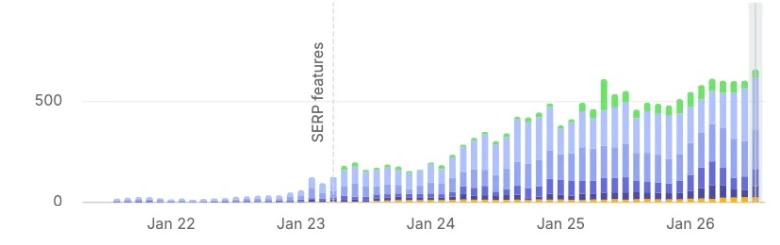
The important result isn’t one unusually strong month. It’s the sustained expansion of CCFG’s search presence across nearly four years.
The Search Landscape Changed. The Growth Didn’t Stop.
Search stopped being just a list of ten blue links. Google now answers many questions directly on the results page, and AI Overviews and tools like ChatGPT have changed how people discover and vet companies before they ever click through.
In that environment, ranking is necessary but no longer sufficient. Getting found means broad authority, strong commercial content, clearly structured information, and presence across both traditional results and AI-driven answers.
CCFG’s footprint kept expanding straight through this shift — because the strategy was built for exactly this. Depth and useful coverage, not tricks, are what both Google’s ranking systems and AI answer engines reward.
CCFG entered the AI-search era with 33 ranking keywords. By June 2026, it ranked for 603.
What the Results Prove
- Sustainable SEO compounds. The footprint didn’t spike and fade — it grew and held across nearly four years.
- Broader visibility means more ways to be found. More ranking keywords means more entry points across the buyer journey.
- Technical strength and content strategy work together. Neither carries a site on its own; the gains came from both.
- Commercial and geographic intent beats generic traffic. Targeting the right searches expands reach without chasing volume that never converts.
- Long-term strategy beats reacting to monthly noise. The trajectory matters more than any single month’s movement.
What comes next. Everything above is already achieved. Here is where the strategy goes from here:
- Keep strengthening high-value commercial rankings.
- Expand state and geographic coverage where the search opportunity supports it.
- Improve visibility inside AI-generated answers and recommendations.
- Strengthen entity signals, structured data, and topical relationships.
- Connect future visibility more directly to lead and revenue data, now that better conversion tracking is in place.
These are goals for the next phase — not results being claimed today.
Want search visibility that compounds instead of disappearing with the next algorithm change?
BuckStone builds long-term SEO and AI-search strategies around real business opportunities — not temporary ranking tricks. If you want a search footprint that keeps growing, let’s talk.
Build My Growth Strategy